Legal ExplainerMotorcycle AccidentsInformational

California Lane-Splitting Crashes: Fault and Evidence

California law defines lane splitting, and the CHP says it is legal when done in a safe and prudent manner. A rider is not automatically at fault merely because a crash occurred during lane splitting. Fault depends on actual conduct and causation, including traffic movement, lane changes, signals, visibility, video, witnesses, and physical damage.

Published

July 14, 2026

Updated

July 14, 2026

Reading time

11 min read

Jurisdiction

California

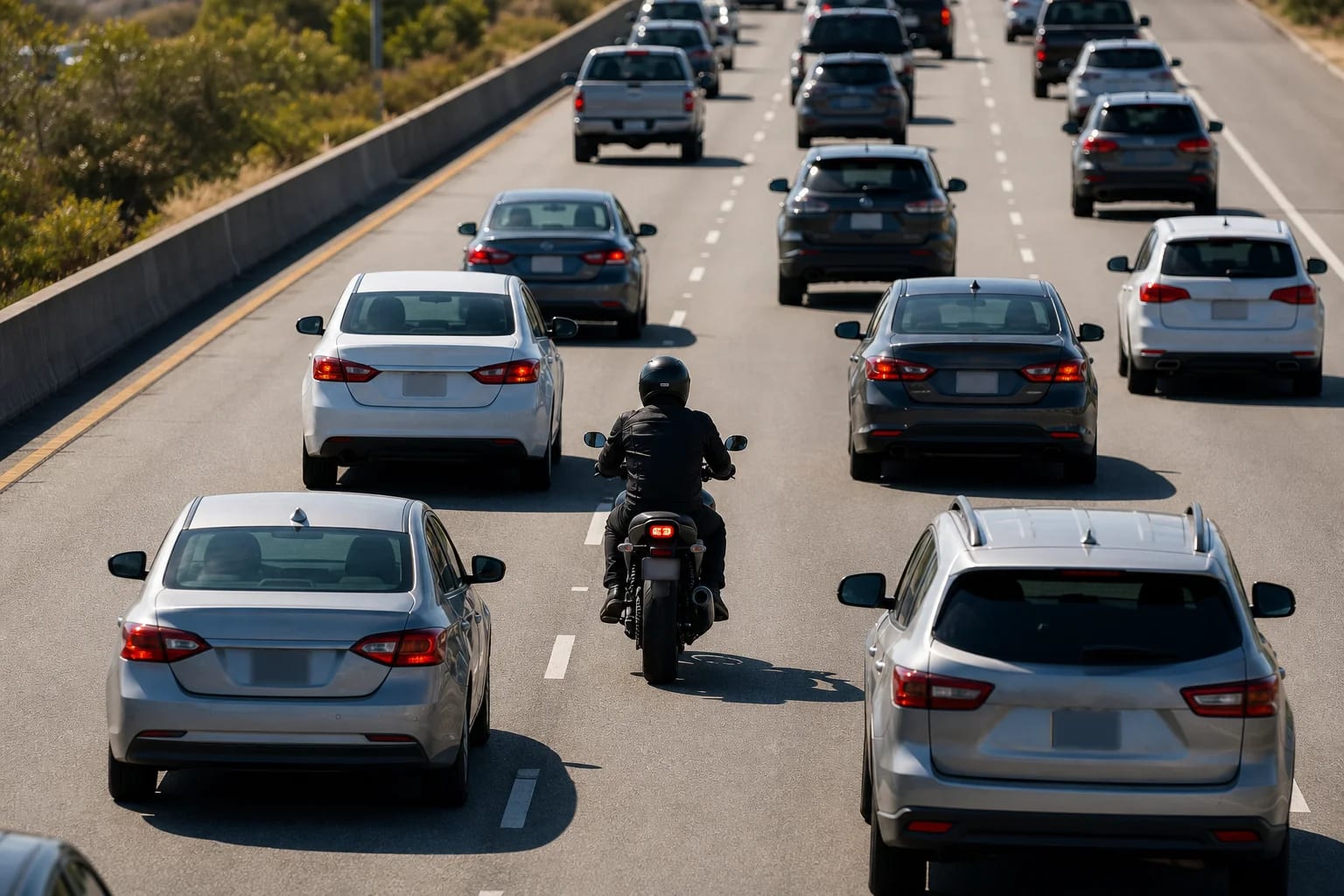
Helmeted motorcyclist riding between slow-moving traffic lanes on a California freeway.
Lane-splitting fault questions depend on traffic, vehicle movements, and evidence—not the maneuver’s label alone.

Quick answer

Learn how California defines lane splitting, how comparative fault works, and what evidence can clarify a disputed motorcycle crash.

Key takeaways

  • California Vehicle Code section 21658.1 defines lane splitting, but it does not declare a rider automatically at fault—or fault-free—after a crash.
  • Section 21658.1 contains no numerical lane-splitting speed threshold; safety guidance should not be restated as a statutory number.
  • Useful fault evidence usually connects each vehicle’s movement, surrounding traffic, visibility, signals, video, witnesses, and damage pattern.
  • Identify and preserve original evidence promptly, but do not assume a person or business must retain a record for a particular period.
Hurt Advice Editorial Team

Prepared by

Hurt Advice Editorial Team

Editorial Research and Publishing Team

Source-checked editorial publishing

Why trust this article

Prepared by the Hurt Advice Editorial Team using exact California statutes, current CHP guidance, CHP collision-report instructions, and the 2026 California comparative-fault jury instruction. No attorney is identified as author or reviewer because no direct attorney participation is documented for this version.

Recent update: Initial source-supported publication prepared July 14, 2026.

At a glance

What this guide helps you decide

Start with the question that brought you here, identify the records that can verify the facts, and use the related guidance only where it helps. This article addresses motorcycle accidents questions in California.

Main question

Decide how this topic may apply to your situation

Use "California Lane-Splitting Crashes: Fault and Evidence" to sort the facts you know, the questions still open, and whether a motorcycle accidents resource or consultation may be useful in California.

Guide map

Start with the sections most relevant to you: Who this California lane-splitting guide helps, Why does lane-splitting fault need a fact-specific review?, What does California law say about lane splitting?

Move through the article by issue, not by guesswork, so liability, medical proof, insurance pressure, deadlines, and next steps stay connected.

Records to gather

Connect these subjects to your records: lane-splitting crashes, motorcycle fault evidence, comparative fault, lane-change evidence

Compare the topic with records, photos, medical visits, police reports, insurer letters, and local claim details before relying on a general answer.

Trust check

Use the source trail before acting

This page includes 6 source references plus internal next-step paths so readers can verify where the guidance comes from.

Before you rely on this guide

This article is written for people dealing with injury-law questions in California. It is meant to help you understand the issue, not replace legal advice about your specific case.

What to do after this article

Start with the quick answer, skim the table of contents, and then use the links below to move into the practice area, author archive, or resource page that turns general guidance into a clearer next step for your situation.

Who this California lane-splitting guide helps

This guide is for a California motorcyclist, passenger, driver, or family member trying to understand a collision that happened while a motorcycle was traveling between rows of vehicles. It is especially useful when the accounts differ about traffic movement, signaling, visibility, or who changed direction. It does not decide fault and does not assume that every crash between lanes happened for the same reason.

Start with the California motorcycle accident hub if you need broader information about injuries, insurance, or claim pathways. The motorcycle injury referral service page explains how Hurt Advice routes eligible requests. This article stays narrower: it explains how the lane-splitting label relates to fault evidence without pretending that one fact decides an entire case.

Hurt Advice is a lawyer referral and legal information service, not a law firm. This guide provides general educational information, not legal or medical advice. A visitor should use it to organize questions and records, not as a substitute for advice about a particular collision.

  • California Vehicle Code section 21658.1 defines lane splitting, but it does not declare a rider automatically at fault—or fault-free—after a crash.
  • Section 21658.1 contains no numerical lane-splitting speed threshold; safety guidance should not be restated as a statutory number.
  • Useful fault evidence usually connects each vehicle’s movement, surrounding traffic, visibility, signals, video, witnesses, and damage pattern.
  • Identify and preserve original evidence promptly, but do not assume a person or business must retain a record for a particular period.

Why does lane-splitting fault need a fact-specific review?

Lane splitting describes a movement. It does not, by itself, establish negligence or identify the cause of a collision. A rider may have been traveling between rows while another driver moved laterally without checking or signaling. In another crash, the rider’s speed, following distance, visibility, or response may become disputed. Other events involve road debris, a vehicle door, abrupt braking, several vehicles, or an incomplete view of the sequence.

The useful question is therefore not simply, “Was the motorcycle lane splitting?” It is: what did each person do, what could each person reasonably perceive, and which conduct was a substantial factor in causing the crash and harm? That answer should be built from evidence rather than stereotypes about riders or assumptions about drivers.

Fault analysis can also separate a legally permitted maneuver from the way it was performed. A permitted movement can still be unsafe in a particular setting, while the presence of that movement does not automatically prove negligence. The same distinction applies to a driver’s lane change: the label alone is not enough; the movement, signal, visibility, and causal sequence matter.

What does California law say about lane splitting?

California Vehicle Code section 21658.1(a) defines lane splitting as driving a motorcycle with two wheels in contact with the ground between rows of stopped or moving vehicles in the same lane, including on divided and undivided streets, roads, or highways. Subsections (b) and (c) authorize the California Highway Patrol to develop educational guidelines with input from specified road-safety stakeholders.

The statute defines the maneuver. It does not state that lane splitting automatically establishes fault, and it does not contain a specific numerical speed or speed-differential threshold. The CHP’s current motorcycle guidance says lane splitting is legal when performed in a safe and prudent manner. That is safety guidance, not a substitute for the statutory text or a case-specific fault decision.

Other California movement rules may matter depending on the crash. Vehicle Code section 21658(a) applies on a roadway divided into two or more clearly marked lanes for traffic in one direction. It requires a vehicle to remain as nearly as practical within one lane and not move from that lane until the movement can be made with reasonable safety. Vehicle Code section 22107 requires a person moving a vehicle right or left from a direct course to do so with reasonable safety and to signal when another vehicle may be affected. Those triggers must be matched to the roadway and proven movement; neither section supplies a universal conclusion about who violated the law.

California’s 2026 comparative-fault instruction, CACI No. 405, says a defendant asserting that a plaintiff’s negligence contributed to the harm must prove negligence and that the negligence was a substantial factor in causing the harm. If proven, damages are reduced by the assigned percentage of responsibility. The directions say the instruction should not be given without substantial evidence of plaintiff negligence. Read the exact CACI No. 405 at PDF page 317 / printed page 243.

What facts can clarify fault?

Use a fact-to-proof map instead of starting with a conclusion. For each disputed question, identify the records that could confirm, contradict, or narrow the competing accounts. The goal is not to collect the largest file; it is to connect the movement sequence to reliable sources.

The CHP Collision Investigation Manual, Chapter 4, PDF page 25 instructs officers to mark the lane-splitting movement code when a motorcycle was traveling between rows of stopped or moving vehicles as defined by section 21658.1(a). That is a report-classification instruction. The code identifies a movement; it does not itself allocate civil fault. This distinction is an inference from what the manual says the box records, read alongside the separate comparative-fault instruction.

  • Definition question — vehicle positions, lane markings, video, witness descriptions, and the collision report can show whether “lane splitting” accurately describes the pre-crash movement.
  • Traffic question — timestamps, witness accounts, available camera views, and vehicle data may clarify congestion, stopping, and relative movement without relying on a guessed speed.
  • Lateral-movement question — signal footage, dashcam video, damage location, lane markings, and witness accounts may show a lane change, drift, turn, or door opening.
  • Visibility question — lighting, weather, mirrors, sight lines, obstructions, vehicle size, rider clothing, and lights can test what each person could perceive.
  • Contact question — damage, debris, scrape marks, photographs, and careful measurements may show impact location and whether an account fits the physical evidence.
  • Other-cause question — pavement condition, debris, additional vehicles, mechanical inspection, and emergency records may reveal that the sequence involved more than rider-versus-driver conduct.

What steps should you take after a lane-splitting crash?

1. Address immediate safety and care. Move out of active traffic if it is safe and lawful to do so. Request emergency assistance when needed. Do not remain in a dangerous location merely to collect evidence, and do not delay necessary evaluation to finish a checklist.

2. Identify every vehicle and person involved. Record names, contact information, license plates, insurance information, witness details, and the responding agency. Note whether another vehicle left, stopped farther away, or may have triggered the sequence without physical contact. Separate what you personally saw from what another person reported.

3. Record the roadway before details change. If it is safe, photograph the motorcycle and every involved vehicle; lane lines and the space between rows; final resting positions; debris, scrape marks, and damaged parts; traffic controls; lighting, weather, congestion, and obstructions; and nearby businesses, buses, buildings, or vehicles that may have cameras. The broader accident evidence checklist can organize scene, witness, medical, property, and insurance records.

4. Preserve original rider-held material. Keep original photographs, video, helmet-camera files, route information, repair estimates, towing records, and communications. Export working copies without editing the originals, and record where each file came from. The digital-evidence preservation guide explains originals, metadata, and context. Avoid filters, cropped-only versions, captions written into the file, or repeated forwarding that obscures provenance.

5. Identify evidence held by others. Possible sources include another vehicle’s camera, a nearby business, a transit vehicle, a residential camera, an agency recording, or vehicle systems. Ask whether records exist; do not state that they necessarily exist or that the holder must keep them for a fixed period. The motorcycle accident evidence guide offers broader preparation context but does not replace advice about a particular request.

6. Build one neutral chronology. Separate direct observation, a witness’s account, what a photograph or video depicts, what a collision report records, and what remains disputed. Do not improve uncertainty. “Traffic appeared slow, but I did not measure its speed” is more reliable than an unsupported number.

What belongs on the evidence checklist?

Organize the file by source and keep an index that says what each item is, who supplied it, when it was obtained, and whether it is an original or working copy. A clean source trail helps prevent a later disagreement about what changed.

Photograph the motorcycle, helmet, clothing, and damaged gear before repair or disposal when doing so is safe. Do not keep a leaking fuel system, damaged battery, sharp component, or other dangerous item in an unsafe condition merely for evidentiary reasons. Safety actions should be documented, not obstructed.

  • Rider-held evidence — original camera and phone files, motorcycle and gear photographs, route information, towing or storage records, and a factual chronology.
  • Other-party evidence — vehicle and insurance identification, photographs of each damage area, statements actually made at the scene, and known camera or vehicle-data sources without assuming availability.
  • Independent evidence — witness names and unedited statements, collision-report identifiers, nearby camera locations, roadway photographs, and weather, lighting, and traffic context.
  • Injury and loss evidence — care records and provider instructions, bills and out-of-pocket costs, work restrictions and wage records, and a dated record of functional changes.
  • Custody details — present location, custodian, transfers, repairs, inspections, and any safety-required handling of physical items.

When should you handle each part of the process?

Use event-based timing rather than an invented universal deadline. At the scene, if safe, identify people, vehicles, witnesses, lane positions, and possible cameras. Before physical condition changes, document the motorcycle, vehicles, helmet, clothing, roadway evidence, and known damage. When an outside source is identified, make a narrow request promptly without promising that the material exists or claiming an unsupported retention duty.

Before providing a detailed insurer narrative, compare memory with original photographs, video, and the known chronology. Do not guess about a speed, distance, signal, or viewing angle. If legal timing is uncertain, review the California deadline guide and seek advice tied to the actual parties and claim. This article intentionally states no filing deadline because different defendants and circumstances can trigger different analyses.

Evidence work and legal analysis can proceed on separate tracks. A record may disappear before anyone resolves fault, while a legal deadline may depend on facts that are not apparent at the scene. Prompt organization is practical, but this article does not create or calculate a legal duty, retention period, or filing date.

What can a focused preservation request say?

A useful request is specific, calm, and factual. Send it to a verified address for the person or organization that may control the identified record. Keep proof of sending and any response. Do not accuse the recipient of destroying evidence, claim that a particular retention period applies without support, or demand material unrelated to the event.

Sample request: “I am requesting preservation of records, if they exist, concerning the motorcycle collision near [location] on [date and approximate time], involving [vehicle descriptions]. Relevant material may include exterior or onboard video, photographs, incident records, and data that identifies vehicle movement around the event. Please confirm receipt and whether additional identifying information is needed.”

Tailor the list to what the recipient may actually possess. A business may have exterior video; a transit operator may have vehicle cameras and incident records; another driver may have dashcam footage. The sample is an organization tool, not a litigation-hold template or legal opinion. Sending it does not itself prove that a preservation duty exists, define the legally proper scope, or guarantee that records are available.

How should you read the collision report?

Start with identifiers and observations: date, location, vehicle and party information, witness names, roadway description, diagrams, statements attributed to specific people, cited photographs, and the officer’s recorded movement codes. Check whether the report distinguishes direct observation from a statement made after the event.

A report may be an important organizing record, but it may not contain every camera, witness, damage photograph, or later-developed fact. A lane-splitting movement code means the officer recorded that movement under the CHP manual’s definition. It does not, standing alone, apply the civil comparative-fault instruction or prove that the coded movement caused the collision.

If a factual detail appears wrong, preserve the original report and supporting material. Avoid rewriting a source document. A California attorney can advise whether and how to present a correction or additional evidence in the relevant process.

Which mistakes and red flags should you avoid?

The most common errors replace evidence with an assumption. “Lane splitting is legal” does not mean the rider is fault-free, and “the motorcycle was between lanes” does not mean the rider is automatically negligent. The exact movement, surrounding traffic, safety, and causation still require proof.

Be cautious with anyone who promises a result, declares fault from one photograph, invents a universal camera-retention period, or says that contacting a referral service creates representation. Hurt Advice’s attorney-advertising and California referral disclosure explains the service’s role and limits.

  • Turning a safety recommendation or internet shorthand into a numerical statute that section 21658.1 does not contain.
  • Treating the CHP lane-splitting movement code as a civil verdict.
  • Editing the only copy of video or photographs instead of keeping originals and separate working copies.
  • Discarding or repairing damaged items before documenting them, unless safety requires immediate handling.
  • Sending an unlimited demand for “everything” instead of identifying the event and likely evidence categories.
  • Guessing about speed, distance, sight lines, signals, or record availability.
  • Relying on one report, photograph, or witness statement without comparing it with the complete sequence.

What are careful next steps?

Make one neutral chronology and one evidence-owner list. Identify unresolved questions about vehicle movement, visibility, signals, video, witnesses, damage consistency, and other possible causes. Preserve originals, keep a custody log for physical items, and use safe handling for damaged property.

Readers who want to compare a source-backed attorney profile can review Raffi Naljian’s public Hurt Advice profile. That link is provided for attorney-fit research only; it does not mean he wrote or reviewed this article, is available, or will accept a matter.

The Hurt Advice editorial standards explain how autonomous Editorial Team articles are sourced and labeled. After reviewing the disclosures, the case-routing contact path can collect intake information for possible referral. Submitting information does not create an attorney-client relationship, and representation can begin only through a separate written agreement with an independent attorney or law firm. Hurt Advice does not guarantee participation, free legal services, or any outcome.

Frequently Asked Questions

Is lane splitting legal in California?
The CHP currently says lane splitting is legal when done in a safe and prudent manner. Vehicle Code section 21658.1 defines the maneuver and authorizes CHP educational guidelines. The statute does not create a numerical lane-splitting speed threshold, and other traffic rules can still apply to the actual conduct.
Does lane splitting automatically make the motorcyclist at fault?
No automatic-fault rule appears in Vehicle Code section 21658.1. A comparative-fault claim requires evidence that the rider was negligent and that the negligence substantially contributed to the harm. Surrounding traffic, rider conduct, driver movement, visibility, and physical evidence all matter.
What if the other vehicle changed lanes into the motorcycle?
Vehicle Code sections 21658(a) and 22107 may be relevant to a disputed lane movement, depending on the roadway and facts. Evidence may include signaling, lateral movement, lane markings, sight lines, video, witnesses, and damage location. The statutes should be applied to proven facts, not assumed from the collision alone.
What is the strongest evidence after a lane-splitting crash?
No single item is always strongest. Original video, independent witnesses, physical damage, roadway photographs, and a reliable chronology can reinforce or contradict one another. Preserve original files and identify where every item came from.
How quickly should I ask for nearby video?
Identify and contact a possible video holder promptly because availability and business practices vary. Do not claim a universal retention period or assume footage exists. A narrow request should identify the event, approximate time, location, vehicles, and requested material.

Sources and references

Exact lane-splitting definition and authority for CHP educational guidelines; the section contains no automatic-fault rule or numerical speed threshold.

Exact reasonable-safety and signaling rule for turning or moving right or left from a direct course when another vehicle may be affected.

Need help after an accident?

Hurt Advice intake team can review your situation, explain your options, and help you move forward with a plan that fits your case.