
Legal ExplainerBicycle AccidentsChecklist / Process

What to Do After a Defective E-Bike Crash in California

If an e-bike defect may have contributed to a California crash, protect people from fire or electrical danger first, then preserve the bicycle, battery, charger, failed components, packaging, app data, and purchase or repair trail without testing or altering them. Identify the exact product and seller chain, check official recalls, and get prompt advice before evidence or deadlines are lost.

Published

July 14, 2026

Updated

July 14, 2026

Reading time

12 min read

Jurisdiction

California

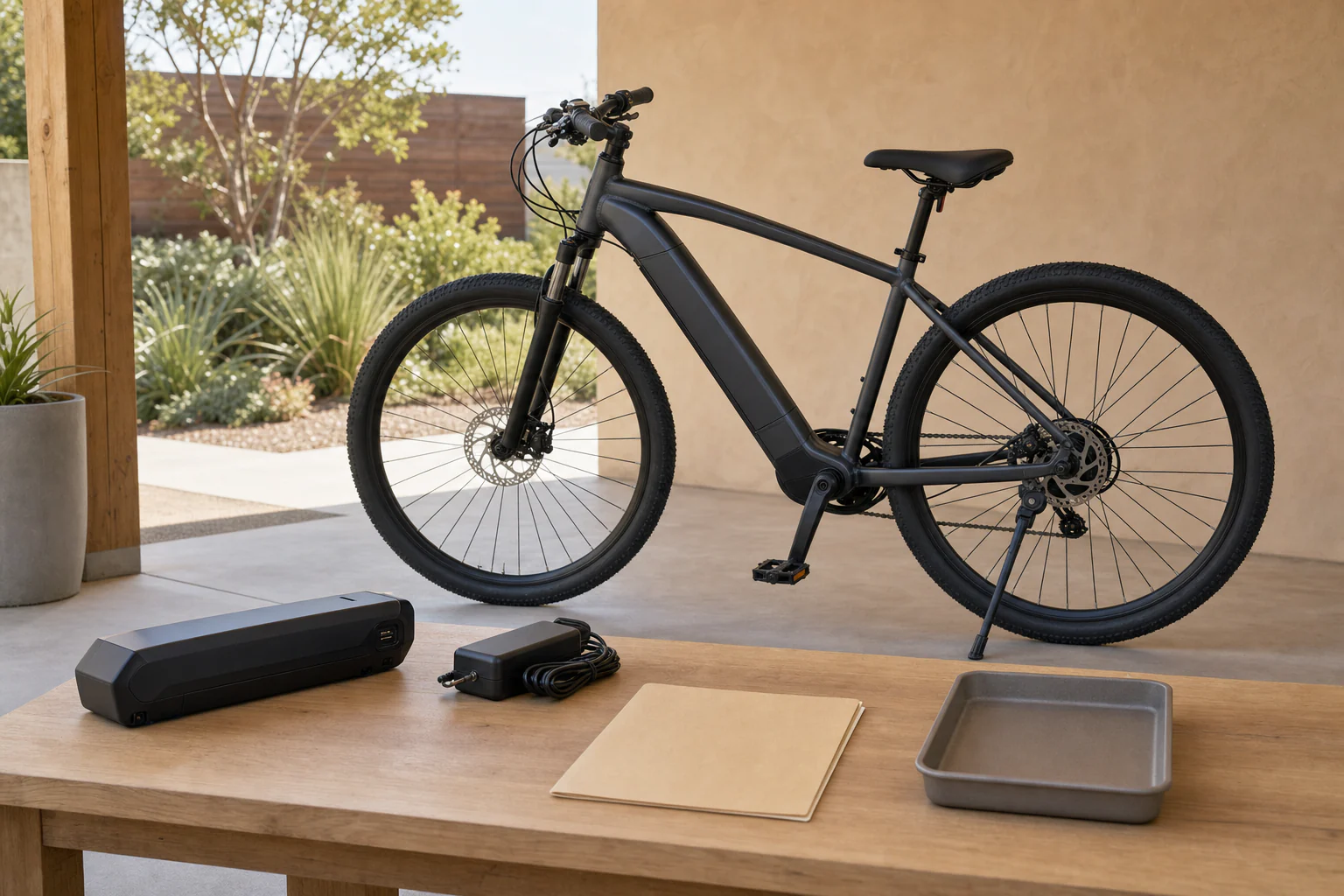
Unbranded electric bicycle with a separate battery and unplugged charger arranged for careful documentation
Original AI-generated editorial image of an unbranded e-bike, separate battery, and unplugged charger in a calm documentation setting; no real crash, victim, lawyer, brand, or document is depicted.

Quick answer

Preserve the e-bike, battery, charger, app data, and purchase trail after a suspected defect while keeping battery safety, California law, and CPSC reporting distinct.

Key takeaways

  • Treat a hot, smoking, swollen, hissing, leaking, or fire-damaged battery as a safety problem before treating it as evidence.
  • Identify the frame, battery, charger, controller, seller, rental operator, repair history, and software version as separate evidence sources.
  • A recall, a CPSC report, and a California civil claim answer different questions; one does not automatically prove another.
  • Do not test, repair, charge, discard, or transfer a stable product casually when an independent inspection may matter.
Hurt Advice Editorial Team

Prepared by

Hurt Advice Editorial Team

Editorial Research and Publishing Team

Source-checked editorial publishing

Why trust this article

Prepared by the Hurt Advice Editorial Team from current California statutes, 2026 Judicial Council civil jury instructions, U.S. Code text, and CPSC safety and reporting sources. No attorney is identified as author or reviewer because no direct attorney participation is documented for this version.

Recent update: Initial source-supported publication prepared July 13, 2026.

At a glance

What this guide helps you decide

Start with the question that brought you here, identify the records that can verify the facts, and use the related guidance only where it helps. This article addresses bicycle accidents questions in California.

Main question

Decide how this topic may apply to your situation

Use "What to Do After a Defective E-Bike Crash in California" to sort the facts you know, the questions still open, and whether a bicycle accidents resource or consultation may be useful in California.

Guide map

Start with the sections most relevant to you: Who this defective e-bike guide helps, What should you do first after a suspected e-bike failure?, Does California law treat the product as an e-bike?

Move through the article by issue, not by guesswork, so liability, medical proof, insurance pressure, deadlines, and next steps stay connected.

Records to gather

Connect these subjects to your records: defective e-bike crash, e-bike evidence preservation, product liability, lithium-ion battery safety

Compare the topic with records, photos, medical visits, police reports, insurer letters, and local claim details before relying on a general answer.

Trust check

Use the source trail before acting

This page includes 8 source references plus internal next-step paths so readers can verify where the guidance comes from.

Before you rely on this guide

This article is written for people dealing with injury-law questions in California. It is meant to help you understand the issue, not replace legal advice about your specific case.

What to do after this article

Start with the quick answer, skim the table of contents, and then use the links below to move into the practice area, author archive, or resource page that turns general guidance into a clearer next step for your situation.

Who this defective e-bike guide helps

This guide is for a California rider, parent, owner, renter, or family member who has a concrete reason to suspect that an e-bike, battery, charger, brake, throttle, frame, controller, or software system contributed to a crash or fire event. It is not a diagnosis of the product and it does not assume that every loss of control is a defect. Road design, maintenance, rider input, another road user, later modification, and component failure can overlap.

The useful first question is not “Who should I blame?” It is “How can I protect people, keep the product identifiable, and preserve the facts before anything changes?” The broader defective e-bike injury service page explains the claim lane, while the bicycle accident hub covers general collision issues. This article supplies the narrower product-custody, reporting, and evidence workflow.

  • Treat a hot, smoking, swollen, hissing, leaking, or fire-damaged battery as a safety problem before treating it as evidence.
  • Identify the frame, battery, charger, controller, seller, rental operator, repair history, and software version as separate evidence sources.
  • A recall, a CPSC report, and a California civil claim answer different questions; one does not automatically prove another.
  • Do not test, repair, charge, discard, or transfer a stable product casually when an independent inspection may matter.

What should you do first after a suspected e-bike failure?

Protect life and health first. Call emergency services when the crash, fire, or symptoms require it. Move away from traffic and from heat, smoke, fumes, or a damaged energy-storage device. Do not reconnect a battery, restart the bike, reproduce the failure, or ask a friend to “see if it still works.” A successful restart can overwrite app data or change a component; an unsuccessful one can create another hazard.

Once the scene is safe, take wide and close photographs without moving dangerous items: the bike's resting position, roadway or room, frame, wheels, brakes, controls, battery bay, battery, charger, visible damage, labels, packaging, and nearby objects. Record the date, time, weather, lighting, people present, and who took custody. Preserve original files and export app or ride data without editing it; the digital evidence preservation guide explains originals, metadata, and working copies.

Do not promise a manufacturer, seller, insurer, shop, or rental company that it may take or destroy the product. If a safety authority requires removal or disposal of a hazardous battery, document its condition and identifying information before the transfer when that can be done safely, and record who received it, when, where, and under what instructions. Safety takes priority over perfect physical preservation.

Does California law treat the product as an e-bike?

Classification matters because the product label and operating limits can help identify what was sold and whether it was later changed. California Vehicle Code section 312.5 defines an electric bicycle as a bicycle with fully operable pedals and a motor that does not exceed 750 watts. Class 1 and class 2 assistance must stop at 20 miles per hour; class 3 pedal assistance must stop at 28 miles per hour and the bike must have a speedometer. The statute also requires a permanent label showing classification, top assisted speed, and motor wattage. Read the exact, current Vehicle Code section 312.5 beside those numbers.

Those limits apply only to a product that fits the statutory definition. Section 312.5 excludes certain vehicles intended to be modifiable above 20 miles per hour on motor power alone or above 750 watts, vehicles actually modified past those thresholds, and vehicles whose operable pedals were removed. That does not decide whether an injury claim exists; it changes the classification and makes the original configuration, current configuration, controller settings, replacement parts, and seller descriptions important.

Current Vehicle Code section 24016 adds product-specific checkpoints. An e-bike covered by section 312.5 must comply with CPSC bicycle equipment and manufacturing requirements, and its motor must disengage or stop when the brakes are applied or through a release or activation mechanism described by the statute. Manufacturers must certify compliance. The section also restricts speed modifications that take the product outside the e-bike definition. These rules have precise triggers and should be read in the current text of Vehicle Code section 24016, effective January 1, 2026, rather than generalized to every powered bicycle.

What exactly should you preserve?

Think in systems, not just “the bike.” A suspected brake failure may involve a lever, cable or hydraulic line, caliper, rotor, wheel, tire, controller, motor cutoff, installation, adjustment, or later repair. A power event may involve the battery cells, housing, battery-management system, connector, charger, outlet, adapter, firmware, app, or a replacement component. Preserve the relationships among those parts.

Keep the whole bicycle when it is safe to do so. Also keep detached parts, the original battery and charger, keys, adapters, tools supplied with the product, packaging, manuals, warnings, assembly materials, sales listing, receipt, financing record, warranty registration, shipping label, recall notice, service invoices, messages, photographs, video, app exports, and account records. Use the site's accident evidence checklist for general scene, witness, insurance, and loss records that sit beside the product file.

How do you build a product identity and custody map?

Create one row or folder for each item rather than assuming every component came from the same company. For the frame, battery, charger, controller, motor, brakes, and any failed part, record the brand shown, model, serial number, other code, seller, purchase date, installer, repairer, and present location. Photograph a label in context and then close enough to read it. Do not detach a label to improve the picture.

Next, build the commercial chain: marketplace or storefront, seller named on the receipt, distributor or importer on packaging, manufacturer named on the product, rental or sharing operator, assembly service, repair shop, and anyone who supplied a replacement battery or charger. Names in advertisements are leads, not conclusions about which legal entity designed, made, imported, distributed, sold, serviced, or controlled the product.

  • Component — frame, battery, charger, controller, motor, brake part, or accessory.
  • Identity — model, serial, batch or date code, label photograph, and packaging match.
  • Source — seller, marketplace listing, importer, manufacturer, assembler, repairer, or rental operator.
  • History — purchase, delivery, assembly, charging, service, software, prior symptom, and incident.
  • Custody — who has the item now, what changed hands, and what conditions were imposed.

Which California product-defect question fits the evidence?

California's current civil jury instructions separate several product questions. CACI No. 1201 addresses the elements of a manufacturing-defect claim, while No. 1202 describes a product that differed from the manufacturer's intended result or from apparently identical units in the same product line. CACI Nos. 1203 and 1204 address two design-defect approaches, and No. 1205 addresses a failure-to-warn theory. The exact elements, burdens, foreseeable-use questions, causation, and defenses matter; read the 2026 California Civil Jury Instructions, CACI Nos. 1201–1205 rather than treating “defect” as one universal claim.

A manufacturing question asks whether this unit departed from the intended result or comparable units. A design question examines the product's design under the applicable test. A warning question asks about a risk that was known or knowable in light of generally recognized scientific and technical knowledge, whether it presented a substantial danger in intended or reasonably foreseeable use or misuse, whether an ordinary consumer would have recognized it, and whether warnings were adequate.

Evidence may support more than one investigation and still prove none. A broken part after a crash may have caused the crash, broken because of the crash, or been changed later. A recall can identify a known product problem but may cover a different model, date range, component, or remedy. An expert inspection may be needed, but the expert should receive an unaltered product, identity record, and custody history—not only selected photographs or a repaired bike.

What steps create a reliable evidence file?

First, write a factual incident timeline while memory is fresh. Describe what the bike did, what the rider did, what appeared or sounded unusual, and what happened next. Separate what you personally observed from what another person said. Avoid diagnosing the component in the timeline. “The display went dark and the rear wheel stopped turning” is more useful than “the controller was defective” unless a qualified inspection supports that conclusion.

Second, collect independent records: emergency dispatch, fire response, collision or incident report, photographs, video, witness contact details, purchase records, product listing, assembly instructions, account history, service tickets, recall communications, insurer messages, and medical and wage records tied to claimed harm. Ask nearby businesses or property managers about video promptly, without representing that they must keep it for a particular number of days.

  • A neutral event timeline with observations separated from conclusions.
  • Scene, product, label, damage, and custody photographs in original form.
  • Purchase, marketplace, shipping, warranty, assembly, repair, and replacement-part records.
  • App, firmware, ride, rental, charging, telematics, and communication exports when available.
  • Emergency, witness, medical, wage, property-loss, and insurance records relevant to the claimed harm.

How should battery safety change preservation?

A damaged lithium-ion battery is not an ordinary evidence box. The U.S. Consumer Product Safety Commission advises micromobility users to inspect products for damage, use only the manufacturer's supplied charger, avoid modified or reworked battery packs, and not place lithium batteries in household trash. Its Micromobility Information Center also directs users to follow recall disposal instructions and report safety incidents.

If a battery is hot, swollen, hissing, smoking, leaking, punctured, fire-damaged, or otherwise unstable, do not charge it, power the bike, open the housing, carry it through occupied space, put it in a vehicle, or store it inside a home merely to preserve a claim. Contact emergency responders when conditions warrant and follow the manufacturer, recall, fire authority, or qualified local hazardous-materials program. Tell the responder that identification and documentation matter, but do not obstruct a safety-required action.

What do recalls and CPSC reports prove?

Search the exact model, serial or date code, component, and manufacturer in the official CPSC recall database. Read the affected-product description and remedy, not only the headline. A recall for one battery date range does not automatically cover a different pack. A matching recall may guide safe handling and identify an investigation lead; it does not by itself establish causation, damages, or the elements of a California claim. The absence of a listed recall likewise does not prove that a product is safe or that no defect occurred.

Consumers can submit a safety report through SaferProducts.gov incident reporting. The official SaferProducts.gov report FAQ explains that a publishable consumer report needs a product description, the manufacturer or private labeler, a description of harm or risk, and the incident date. A report is a regulatory safety communication. It is not a lawsuit, a recall, an admission, or a substitute for preserving the product and claim evidence. Keep a copy of what was submitted and any confirmation number.

Businesses have a different federal reporting rule. Under 15 U.S.C. section 2064(b), a manufacturer, distributor, or retailer that obtains information reasonably supporting specified noncompliance, a defect that could create a substantial product hazard, or an unreasonable risk of serious injury or death must immediately inform the CPSC unless the Commission has been adequately informed. Read the exact 15 U.S.C. § 2064(b). That company duty is not a deadline for an injured consumer and does not prove that a particular report was required or that a civil claim succeeds.

What timing and process issues matter?

California Code of Civil Procedure section 335.1 states a two-year period for an action for injury to, or death of, an individual caused by another's wrongful act or neglect. The controlling text of section 335.1 is the source for that number. It generally frames personal-injury claims against private product-side parties; it is not a universal deadline for every theory, every plaintiff, or every defendant.

Accrual and delayed-discovery questions, a claimant's age or legal incapacity, a public entity, wrongful death, warranty, contract, property damage, workers' compensation, bankruptcy, federal law, defendant identity, and other facts can create different rules or analyses. Do not calculate the last filing day from this article. A product can also disappear long before a filing period ends, so evidence work and deadline analysis should begin on separate tracks.

A careful process often moves through immediate safety and treatment, product control, identity and custody mapping, record requests, qualified inspection planning, party and insurance research, legal deadline review, and then a decision about a claim or lawsuit. A verified California attorney profile with product-liability experience, such as Armen Akaragian's Hurt Advice profile, can provide background for choosing whom to ask; the link is not a statement that he authored or reviewed this article, is available, or will accept a matter.

What should a preservation request say?

A useful request is specific, calm, and factual. Send it to a verified address for the business or person who actually controls the item or record. Keep proof of sending and any response. Do not accuse the recipient of destroying evidence, claim that a particular retention period applies without support, or demand unsafe storage.

Sample: “I am requesting that you not repair, alter, test, disassemble, dispose of, overwrite, or transfer the e-bike and related materials from the incident on [date] while inspection and safe-storage arrangements are evaluated. The request includes the bicycle, battery, charger, detached parts, photographs, video, account and ride data, service and rental records, prior complaints tied to this unit, and custody records. Please identify the current location and custodian, advise immediately of any safety concern or required disposition, and contact me before any change.”

Tailor the list to what the recipient may actually possess. A rental operator may have telematics and service records; a repair shop may have the bike and work order; a marketplace may have the listing and transaction record. The request is evidence of notice and scope. Whether a preservation duty exists, when it arose, what it covers, and what remedy may follow are legal questions that depend on facts and law.

Which mistakes weaken a suspected-defect investigation?

The most serious mistake is creating a second hazard: charging a damaged battery, attempting a demonstration, storing an unstable pack in occupied space, or transporting it without qualified direction. Other common errors are authorizing repair before inspection, discarding a charger or packaging, cleaning residue, accepting store credit that requires surrender, resetting the app, updating firmware, posting a confident defect theory online, or letting several people handle the product without a log.

Be cautious with anyone who promises a result, quotes a settlement from a photograph, says a recall automatically wins a case, or treats a CPSC report as legal representation. Hurt Advice is a lawyer referral and legal information service, not a law firm. Its legal and referral disclaimer explains that submitting information does not create an attorney-client relationship and that outcomes and participation are never guaranteed.

  • Testing, charging, repairing, cleaning, updating, or discarding before the evidence plan is set.
  • Failing to identify separate frame, battery, charger, controller, seller, and service records.
  • Letting a hazardous battery remain in an unsafe place solely for litigation purposes.
  • Treating a recall, report, broken part, or online opinion as conclusive proof.
  • Signing a release or transfer document without understanding what product, parties, and claims it covers.

What are careful next steps?

Make one inventory, one custody log, and one timeline today. Secure stable items without altering them, and use qualified emergency or hazardous-materials help for an unstable battery. Save the product identity trail, purchase and repair trail, app and account exports, photographs, witness information, and communications. Check the exact product against official recalls and keep a copy of any consumer safety report.

Then ask a California lawyer to evaluate classification, possible parties, inspection protocol, insurance, and deadlines before an item is repaired, surrendered, or destroyed. Hurt Advice's case-review form can collect intake information for possible referral; it does not guarantee representation, a participating attorney, free legal services, or any outcome. Review the editorial standards, the Editorial Team author archive, and the Bicycle article archive for related sourcing and attribution.

Frequently Asked Questions

Should I keep a damaged e-bike battery after a crash?
Keep it only if doing so is safe and consistent with qualified emergency, manufacturer, recall, or hazardous-materials instructions. Do not charge, open, test, transport, or store an unstable battery in occupied space merely to preserve evidence. When physical retention is unsafe, document condition and identifiers when possible, record the transfer or disposal instructions, and preserve the charger, packaging, receipts, label photographs, app data, and custody record.
Does an e-bike recall prove a California product-defect claim?
No. A matching recall may identify a safety problem and remedy, but the affected model, serial or date range, component, configuration, incident mechanism, causation, harm, and legal elements still matter. A recall does not automatically establish liability or damages, and a recall for a different product range may not apply.
What if the CPSC database shows no recall for my e-bike?
The absence of a listed recall does not establish that the product was safe or that no defect occurred. Preserve the product and records, verify model and component identities, review later modifications and repairs, consider a SaferProducts.gov report, and obtain qualified inspection and legal guidance based on the actual evidence.
Should a repair shop take the e-bike apart to find the problem?
Not casually. Disassembly or destructive testing can change or consume evidence. Ask the shop to stop repair, alteration, testing, disposal, and transfer while an inspection plan is considered. A proper plan may identify participants, protocol, photographs, measurements, retained samples, safety controls, and custody records.
What evidence matters for a rental or shared e-bike?
Preserve the account and trip identifiers, reservation and payment record, unit number, app screens and exports, start and end times, route data, photographs, witness information, operator communications, and the exact bike location. Promptly request preservation of the bike, battery, maintenance, charging, telematics, prior complaint, and custody records without inventing a retention deadline.
How long do I have to file a California e-bike injury claim?
California Code of Civil Procedure section 335.1 states a two-year period for an action for injury or death caused by another’s wrongful act or neglect, generally relevant to personal-injury claims against private parties. Accrual, discovery, age, incapacity, public entities, contracts, property or warranty theories, defendant identity, and other facts can change the analysis. Ask a California lawyer to calculate the actual deadline; do not use this FAQ as a filing-date calculator.

Sources and references

Exact e-bike definition, 750-watt maximum, class 1 and 2 20-mph limits, class 3 28-mph limit, label requirement, and statutory exclusions.

Current equipment, manufacturing, motor-disengagement, certification, and speed-modification rules for e-bikes covered by section 312.5.

Controlling two-year text for an action for injury or death caused by another’s wrongful act or neglect, with applicability limits explained in the article.

Primary CPSC safety guidance on damaged products, manufacturer-supplied chargers, modified packs, recalls, reporting, and lithium-battery disposal.

Federal safety agencyCPSC Recalls

Official recall search used for product, component, affected-range, hazard, and remedy verification.

Federal statute15 U.S.C. § 2064(b)

Exact business reporting duty and triggers, kept distinct from the consumer report and civil claim.

Need help after an accident?

Hurt Advice intake team can review your situation, explain your options, and help you move forward with a plan that fits your case.