
Legal ExplainerPersonal InjuryChecklist / Process

What Proof Do You Need for a California Injury Claim?

For an ordinary California negligence claim, CACI No. 400 focuses on negligence, harm, and substantial-factor causation. A report, medical record, photograph, or witness rarely proves all three. The useful task is to map each disputed fact to reliable, source-traceable proof—and state clearly what remains uncertain.

Published

July 14, 2026

Updated

July 14, 2026

Reading time

11 min read

Jurisdiction

California

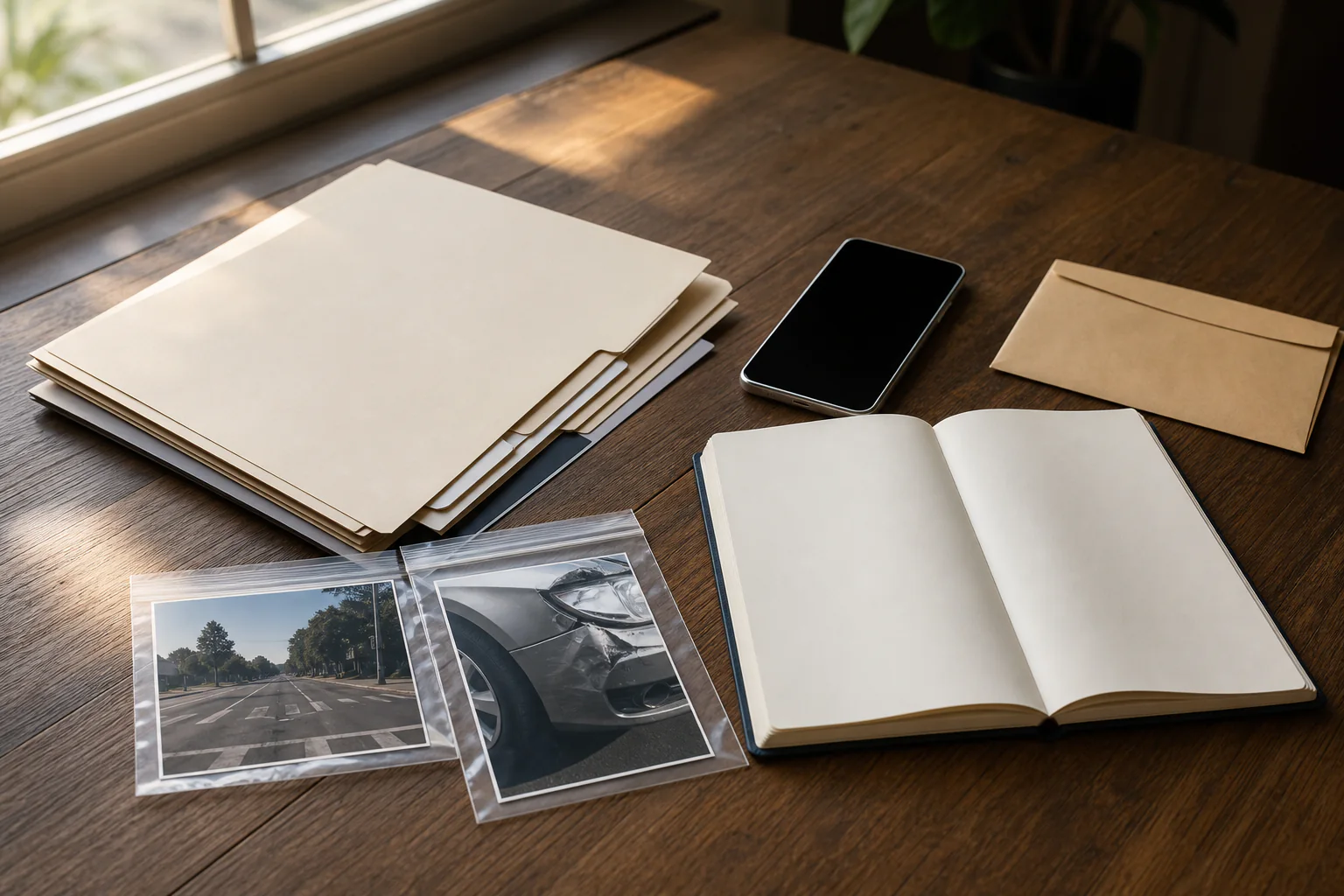
Organized blank folders, original crash photographs, a phone, and a notebook arranged for an injury evidence review.
A useful proof file connects each disputed fact to a source, its context, and what it cannot establish alone.

Quick answer

For an ordinary California negligence claim, useful proof connects negligence, harm, and causation to reliable records, witnesses, and source context. No single report, photo, or medical record necessarily proves the whole case. Build an element-to-proof map, preserve originals you control, explain each item’s limits, and flag unresolved gaps for fact-specific legal review.

Key takeaways

  • Start with the facts that must be proved, then ask which source supports or contradicts each fact.
  • A report, photograph, medical record, or witness usually proves only part of the story; no label makes one item conclusive.
  • Separate firsthand, official, medical, business, digital, and derivative material so its source and limits remain clear.
  • Use a proof-gap audit and claim-packet index to show what is known, what is disputed, and what still needs follow-up.
Hurt Advice Editorial Team

Prepared by

Hurt Advice Editorial Team

Editorial Research and Publishing Team

Source-checked editorial publishing

Why trust this article

Prepared by the Hurt Advice Editorial Team using the current 2026 California civil jury instructions and exact California Evidence Code sections on relevance, writings, personal knowledge, and authentication. No attorney is identified as author or reviewer because no direct attorney participation is documented for this version.

Recent update: Initial source-supported publication prepared July 14, 2026.

At a glance

What this guide helps you decide

Start with the question that brought you here, identify the records that can verify the facts, and use the related guidance only where it helps. This article addresses personal injury questions in California.

Main question

Decide how this topic may apply to your situation

Use "What Proof Do You Need for a California Injury Claim?" to sort the facts you know, the questions still open, and whether a personal injury resource or consultation may be useful in California.

Guide map

Start with the sections most relevant to you: Who this California injury-claim proof guide helps, What must a California negligence claimant prove?, What makes evidence relevant and usable?

Move through the article by issue, not by guesswork, so liability, medical proof, insurance pressure, deadlines, and next steps stay connected.

Records to gather

Connect these subjects to your records: personal injury claim proof, negligence elements, evidence mapping, proof-gap audit

Compare the topic with records, photos, medical visits, police reports, insurer letters, and local claim details before relying on a general answer.

Trust check

Use the source trail before acting

This page includes 6 source references plus internal next-step paths so readers can verify where the guidance comes from.

Before you rely on this guide

This article is written for people dealing with injury-law questions in California. It is meant to help you understand the issue, not replace legal advice about your specific case.

What to do after this article

Start with the quick answer, skim the table of contents, and then use the links below to move into the practice area, author archive, or resource page that turns general guidance into a clearer next step for your situation.

Who this California injury-claim proof guide helps

This guide is for an injured Californian who has photographs, reports, medical records, messages, bills, or witness names but does not know what each item actually proves. It is most useful in an ordinary negligence matter where fault, harm, or causation is disputed. Product-liability, medical-malpractice, intentional-tort, government, workplace, and other claims can use different legal elements and procedures.

The California personal injury hub explains the broader intake and attorney-review path. This article is narrower: it maps disputed facts to evidence and identifies proof gaps. It is not another collection checklist. For a scene-and-record inventory, use the accident evidence checklist.

Hurt Advice is a lawyer referral and legal information service, not a law firm. This article offers general educational information, not legal or medical advice. Submitting information does not create an attorney-client relationship, and only a separate written agreement with an independent attorney or law firm can begin representation.

  • Start with the facts that must be proved, then ask which source supports or contradicts each fact.
  • A report, photograph, medical record, or witness usually proves only part of the story; no label makes one item conclusive.
  • Separate firsthand, official, medical, business, digital, and derivative material so its source and limits remain clear.
  • Use a proof-gap audit and claim-packet index to show what is known, what is disputed, and what still needs follow-up.

What must a California negligence claimant prove?

The exact claim theory controls the proof. For an ordinary negligence claim, California's 2026 CACI No. 400 at PDF page 306 / printed page 232 instructs that the claimant must establish negligence, harm, and that the defendant's negligence was a substantial factor in causing that harm. The instruction applies to negligence; its directions say professional or medical negligence wording should be modified, and other claim types may have different elements.

In a civil trial, the ordinary burden is not the criminal beyond-a-reasonable-doubt standard. CACI No. 200 at PDF page 116 / printed page 42 explains that a party must persuade the factfinder that a required fact is more likely true than not true. It also says the factfinder considers all evidence, regardless of which party produced it.

That framework changes the evidence question. The goal is not to assemble the largest folder or repeat a conclusion. The goal is to connect each required proposition to evidence whose source, context, and limits can be explained, while identifying contrary material instead of hiding it.

What makes evidence relevant and usable?

Relevance begins with a disputed fact. California Evidence Code section 210 defines relevant evidence as material that has any tendency in reason to prove or disprove a disputed fact that matters to the action, including credibility. A photograph of vehicle damage may be relevant to impact location, for example, but it may not establish who had the right of way or whether a particular symptom came from the event.

Source knowledge matters too. Evidence Code section 702, subject to its expert-testimony reference in section 801, requires a witness who testifies about a matter to have personal knowledge of it. Record what a witness personally saw or heard; keep later assumptions and secondhand retellings separate.

California's definition of a writing is broad. Evidence Code section 250 includes photographs, email, sounds, symbols, and other recorded communications or representations, regardless of storage method. But being a writing does not automatically make an item admissible. Evidence Code section 1401 requires authentication before a writing, or secondary evidence of its content, may be received in evidence. Other rules, objections, privileges, and exceptions may still apply.

Which proof can support each negligence element?

Use the CACI No. 400 elements as columns in your thinking, even if you keep the working file as a list. Each item below names examples that may support a proposition and then states what the item does not establish by itself. The actual weight depends on source, completeness, consistency, context, and the claim theory.

  • Negligence: scene photographs, video, witness observations, incident or collision records, maintenance history, policies, measurements, and qualified analysis may clarify conduct and circumstances. A citation, report conclusion, or damaged object does not automatically prove civil negligence or resolve competing accounts.
  • Harm: contemporaneous care records, diagnostic material, provider findings, bills, photographs, work restrictions, wage records, receipts, and a factual account of functional change may document injury and loss. A bill proves a charge was made; it does not by itself prove necessity, causation, reasonableness, or payment.
  • Substantial-factor causation: event timing, prior baseline records, symptom onset, consistent histories, mechanism evidence, treating-provider analysis, and qualified expert opinions may connect conduct to harm. Timing alone is not always enough, and a diagnosis alone may not identify which event caused or aggravated it.
  • Coverage and recovery path: policies, declarations, reservation letters, ownership records, employment records, and contract relationships may identify possible payment sources or responsible entities. Coverage is a practical claim question, not one of CACI No. 400's three negligence elements.

How do you run a proof-gap audit?

A proof-gap audit starts with neutral questions, not a preferred conclusion. Write each disputed fact in one sentence. Then list the supporting source, contrary source, missing source, custodian, and next step. Mark uncertainty plainly. A blank cell is useful because it shows where memory or assumption is doing work that evidence has not yet done.

Sort sources by origin. Firsthand material includes a participant's original photographs and a witness's own observations. Official material includes agency identifiers, diagrams, and records, but the source's scope still matters. Medical and business material should be tied to the provider or custodian and its date range. Digital material should retain the original file and context. Derivative material—summaries, screenshots, transcriptions, timelines, or edited copies—should point back to the source from which it was made.

Run a contradiction check before writing any demand or detailed narrative. Compare names, dates, time zones, locations, direction of travel, quoted statements, medical history, work dates, damage descriptions, and file timestamps. A contradiction does not necessarily end a claim. It may reflect a typo, different vantage point, incomplete record, or genuine dispute. Preserve both versions and describe the difference instead of silently correcting the source.

  • Fact: the single proposition that matters.
  • Support: the source that tends to prove it.
  • Limit: what that source does not establish.
  • Contrary material: evidence that conflicts or creates another reasonable explanation.
  • Owner: the person, agency, provider, business, device, or account that may control the source.
  • Follow-up: a specific request or question, without assuming the material exists.

What belongs in a claim-packet index?

A claim-packet index is a map, not an argument. Give each item a short identifier, then record its source, date, original location, the fact it may support, its limits, and any follow-up. Keep originals in their native location or a protected archive and use working copies for annotation. The digital-evidence preservation guide explains originals, metadata, and context in more detail.

A useful index entry might read: “Photo A-03; supplied by passenger; original phone file retained; created on event date; depicts final vehicle position from the northwest corner; may support resting-position and visibility questions; does not show the pre-impact movement; full-resolution original available; photographer contact confirmed.” That description is more useful than “best crash photo” because it separates observation from conclusion.

For injury and damages documentation, link rather than duplicate. The injury-documentation resource covers photos, records, bills, work limits, and daily impact. The symptom-journal guide explains factual entries and privacy or discovery cautions. In the proof index, state which disputed fact each item addresses and what it cannot prove alone.

  • Item ID and plain-language description.
  • Source or custodian and how the item was obtained.
  • Date or date range, plus original storage location.
  • Disputed fact the item may support or contradict.
  • What the item does not show or establish.
  • Authentication or context question and follow-up status.

What steps should you take to build the proof map?

1. Put safety and appropriate care first. Do not remain in danger or delay needed care to complete an evidence task. Record what you can safely and lawfully, and distinguish what you personally observed from what someone later told you.

2. Define the disputed facts. Ask what happened, who controlled the relevant condition or conduct, what harm occurred, what connects the conduct to the harm, and what loss is actually documented. Avoid starting with “What proves my case?” because that invites confirmation bias.

3. Build an evidence-owner list. Identify participants, witnesses, agencies, providers, employers, insurers, property owners, businesses, vehicles, devices, accounts, and other possible custodians. Do not say a source exists until it is confirmed.

4. Preserve claimant-held originals. Keep original files, communications, physical-item photographs, and source information. Use separate working copies. This is practical evidence hygiene, not a claim that any person has a legally defined preservation duty.

5. Request specific material. Identify the event, approximate time, location, people or vehicles, and the narrow record category. Keep proof of the request and response. Do not invent a universal retention period or promise that a request will secure a record.

6. Write a source-limited summary. Attribute each important statement to personal observation, a named witness, a record, a photograph, qualified analysis, or an unresolved question. Re-run the contradiction check before sharing it.

When should you handle each part of the process?

Use event-based timing. At the scene, address safety, identify people and possible witnesses, and record conditions if it is safe. As care and expenses develop, keep records connected to dates and providers. Before property is repaired, transferred, or discarded, photograph its condition and obtain appropriate safety advice. When an outside source is identified, make a narrow request promptly without asserting an unsupported retention rule.

Before giving a detailed recorded or written account, compare memory with original material and separate known facts from estimates. Before signing a release, understand what it covers and which facts remain unresolved. These are process cautions, not a filing-deadline calculation.

Legal deadlines depend on the claim, parties, accrual rules, and possible exceptions. Public-entity, medical, workplace, minor, delayed-discovery, and other circumstances can require different analysis. This article intentionally states no filing deadline. Use the California deadline guide as an issue-spotting resource and seek advice tied to the actual facts rather than relying on a generic date.

What can a neutral evidence request say?

Send a request to a verified contact for the person or organization that may control the identified material. Keep it calm, narrow, and factual. Do not accuse the recipient of destroying evidence, state that a fixed retention period applies without exact authority, or request unrelated records.

Record request example: “I am asking whether records exist concerning the incident near [location] on [date and approximate time], involving [people, vehicles, or property descriptions]. If available, please preserve and explain the process for requesting [specific video, incident record, photograph, or data category]. Please confirm receipt and let me know whether additional identifying information is needed.”

Witness follow-up example: “Thank you for speaking with me. Please describe only what you personally saw or heard, where you were, and anything that affected your view. If you are uncertain about a time, distance, speed, or sequence, please say so. I will not ask you to adopt my account.”

These examples are organization tools, not subpoenas, litigation holds, legal demands, or guarantees that material exists. A California attorney can advise whether a different formal process is appropriate after reviewing the parties and procedural posture.

Which mistakes and red flags should you avoid?

The most common proof error is treating a category as a conclusion: “the report proves fault,” “the MRI proves the crash caused it,” or “the video proves everything.” Each source has a viewpoint, scope, date range, and purpose. Explain those limits.

Be cautious with anyone who promises an outcome, asks you to alter a source, supplies a universal evidence-retention deadline without exact authority, treats an intake as representation, or claims that an attorney reviewed this article when the byline does not say so. Hurt Advice's attorney-advertising and California referral notice explains the platform's role and limits.

  • Collecting volume without tying items to disputed facts.
  • Keeping screenshots or summaries while losing the original source and context.
  • Coaching a witness, filling uncertainty with estimates, or combining several accounts into one voice.
  • Ignoring prior records, contrary photographs, inconsistent dates, or another plausible cause.
  • Assuming an official report is a civil verdict or that a provider record decides legal causation.
  • Sharing a detailed chronology before checking it against the source file.
  • Claiming a business, agency, or person must keep a record for a period that has not been verified for that exact custodian and trigger.

What are careful next steps?

Finish one fact-to-proof map, one evidence-owner list, and one packet index. Mark the three most important unresolved questions. Preserve originals, record how each item was obtained, and state contradictions plainly. Do not delay needed care or guess about legal deadlines while organizing the file.

Readers who want to compare a verified public profile can review Armen Akaragian's Hurt Advice profile. That link is for attorney-fit research only; it does not mean he wrote or reviewed this article, is available, or will accept a matter.

The Hurt Advice editorial standards explain how autonomous Editorial Team articles are sourced and labeled. After reviewing the disclosures, the case-routing contact path can collect intake information for possible referral. Hurt Advice does not guarantee participation, representation, free legal services, or any result. An attorney-client relationship begins only through a separate written agreement with an independent attorney or law firm.

Frequently Asked Questions

What proof do I need for a California personal injury claim?
In an ordinary negligence claim, proof should address negligence, harm, and whether the negligence was a substantial factor in causing the harm. Useful sources may include photographs, video, witnesses, reports, medical records, provider analysis, wage records, bills, receipts, and qualified expert work. Each item has limits, and other claim theories may require different elements.
Does a police or incident report prove fault?
Not automatically. A report can organize identities, observations, statements, diagrams, citations, and an investigator’s conclusions, but its scope and basis matter. Compare it with original photographs, video, witnesses, physical evidence, and later-developed records rather than treating it as a civil verdict.
Are photos, texts, and phone records automatically admissible?
No. Evidence Code section 250 treats many recorded communications and images as writings, and section 1401 requires authentication before a writing or secondary evidence of its content may be received. Relevance, hearsay, privilege, completeness, and other rules may also matter. Keep originals and source context for legal review.
Do medical records prove that an accident caused an injury?
Medical records can document history, findings, diagnosis, care, restrictions, and timing, but no single record necessarily proves legal causation. The analysis may also consider prior baseline, symptom onset, event mechanics, consistent histories, alternative causes, treating-provider analysis, and qualified expert opinions.
What if important evidence is held by another driver, business, provider, or agency?
Identify the likely custodian, describe the event and record category narrowly, ask whether the material exists, and keep proof of the request and response. Do not assume a universal retention period or claim that the holder has a particular preservation duty without exact authority for that source, trigger, and circumstance.
How much evidence is enough for an injury claim?
There is no universal item count. CACI No. 200 frames the ordinary civil burden as whether the required fact is more likely true than not true. Source quality, relevance, consistency, context, and how the evidence addresses contrary explanations matter more than the number of files or witnesses.

Sources and references

Exact definition of relevant evidence, including material bearing on a disputed consequential fact or credibility.

Exact broad definition of writing, including photographs, email, sounds, symbols, and recorded communications regardless of storage method.

Exact personal-knowledge requirement for witness testimony, subject to the section’s reference to expert testimony under section 801.

Exact authentication requirement for a writing and for secondary evidence of its content before receipt in evidence.

Need help after an accident?

Hurt Advice intake team can review your situation, explain your options, and help you move forward with a plan that fits your case.