
Who this guide is for and what it does
This guide is for a nursing-home resident, an authorized resident representative, or a family member helping the authorized person organize records after a fall. It is not a medical diagnosis, a discovery demand, or a conclusion about liability. If the resident has an urgent change in consciousness, severe pain, breathing difficulty, new weakness, or another emergency concern, follow the treating clinician’s instructions or call emergency services instead of waiting for records.
For broader neglect and reporting context, read the California nursing-home abuse and neglect guide. For the service cluster connected to unsafe supervision and mobility assistance, see nursing-home fall-prevention failures.
Start with three record layers
The cleanest file separates documents by who created them and why. Mixing everything into one folder makes it harder to see whether two entries genuinely conflict.
Layer one: the resident’s clinical record. This may include admission and quarterly assessments, fall-risk tools, the Minimum Data Set (MDS), the baseline and comprehensive care plans, physician orders, nursing notes, certified nursing assistant flow sheets, medication administration records, therapy notes, vital signs, neurological checks, post-fall assessments, notifications, transfer forms, and discharge summaries. The exact chart varies by facility and resident.
Federal rules require a certified nursing facility to conduct an initially and periodically comprehensive assessment of each resident’s functional capacity. They also require a new comprehensive assessment when the facility determines, or should determine, that a significant change has occurred. Completed assessments from the previous 15 months must remain in the active record and be used to develop, review, and revise the care plan. See 42 C.F.R. section 483.20.
Layer two: separate facility and preservation requests. A facility may have video, door-alarm data, call-light logs, staffing assignments, lift or walker maintenance records, employee schedules, training materials, internal incident reports, or quality-assurance materials. Ask that relevant items be preserved and identify them specifically, but do not state that every item is automatically part of the resident-access record. If a category is unavailable or withheld, request a written response identifying the category and the reason rather than arguing about the conclusion in the first request.
Layer three: outside and public records. Ambulance, emergency-department, imaging, specialist, and rehabilitation records can supply independent timestamps and findings. The existing emergency-department triage and discharge records guide explains that hospital layer. Public CDPH materials may show a facility’s inspection and complaint history, but they are facility-level context, not a substitute for the resident’s chart.
Request the pre-fall assessment and care plan
Start the date range early enough to capture what the facility knew before the event. A useful range may begin at admission or several weeks before the fall, depending on the length of the stay and whether there were earlier falls or changes in mobility. Ask for versions, not just the latest copy. A care plan updated after the fall can otherwise hide which instructions were actually in place beforehand.
Federal care-planning rules require a baseline care plan within 48 hours of admission and a comprehensive person-centered care plan with measurable objectives and timeframes tied to assessed needs. The interdisciplinary team must review and revise the comprehensive plan after assessments. See 42 C.F.R. section 483.21.
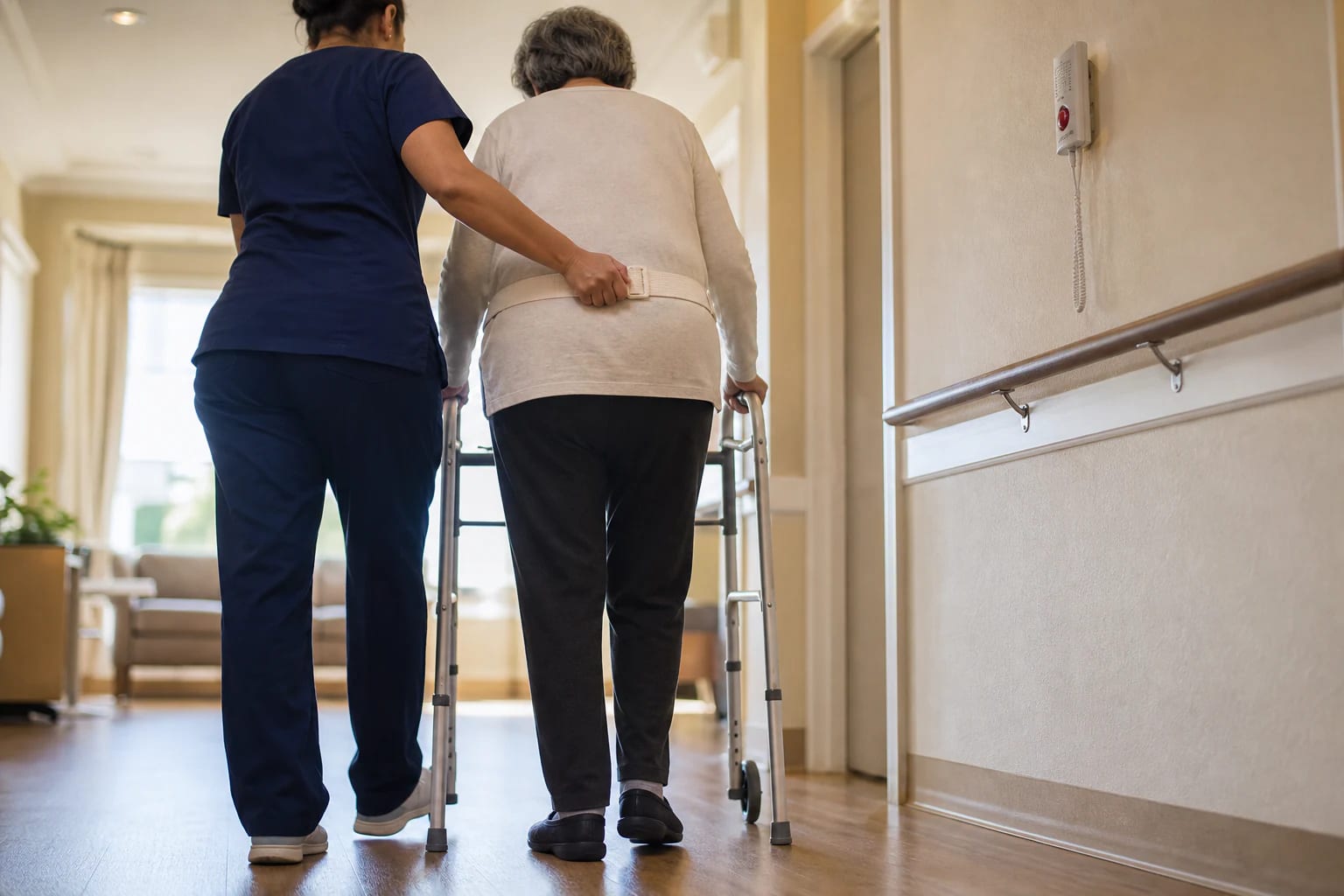
Look for concrete mobility instructions: one-person or two-person assistance, gait-belt use, transfer method, walker type, footwear, toileting schedule, bed position, alarm use, therapy recommendations, and when the resident should use the call light. Compare those instructions with the underlying assessment. The current CMS MDS 3.0 RAI Manual page identifies the operative manual and notes that Section J addresses falls and major injuries. The MDS is standardized assessment data; it should be read alongside, not instead of, daily notes and the individualized care plan.
A fall does not by itself establish a regulatory violation. The federal quality-of-care rule says the resident environment must remain as free of accident hazards as possible and each resident must receive adequate supervision and assistance devices to prevent accidents. What those requirements mean for one event depends on the resident’s assessed needs and the actual facts. See 42 C.F.R. section 483.25(d).
Build the event and response timeline
Use exact timestamps where the records provide them. If an entry gives only a shift or approximate time, preserve that wording instead of inventing a minute. This comparison table keeps observations separate from interpretations.
| Timeline point | Records to compare | Neutral question to ask |
|---|---|---|
| Before the fall | Fall-risk assessment, MDS, care plan, orders, therapy notes, medication record | What assistance or device was documented before the event? |
| Last routine contact | CNA flow sheet, rounding record, assignment sheet, call-light data | When was the resident last observed and what help was planned? |
| Discovery or witnessed event | Nursing note, resident statement, witness note, incident entry if available | Who observed what, and which facts are firsthand? |
| Immediate assessment | Vital signs, pain and skin assessment, neuro checks, physician notification | What changes were recorded and when? |
| Family or representative notice | Nursing note, communication log, message record | When, how, and to whom was notice documented? |
| Transfer and treatment | 911 or ambulance record, transfer form, hospital arrival, imaging | Do dispatch, departure, and arrival times align? |
| After return | New orders, significant-change assessment, therapy reassessment, revised care plan | What changed after the event, and when did the change take effect? |
For a larger incident file, the accident evidence checklist can hold photographs, communications, treatment records, and expenses outside the nursing-home chart. Keep a clean original of every file and work from copies.
Use a focused written request
Federal resident-rights rules say the resident has a right to access personal and medical records. A certified facility must provide access within 24 hours of an oral or written request, excluding weekends and holidays, and allow copies on two working days’ advance notice. The rule also allows a reasonable cost-based copying fee. Those rights belong to the resident; another person should identify the authority that permits access. See 42 C.F.R. section 483.10(g)(2).
Use these steps:
- Identify the resident, facility, requested date range, and requester’s authority. Do not include unnecessary medical details in an ordinary email subject line.
- Ask for the resident record in the native electronic format if readily producible, including version history or audit information that is part of the record.
- List the core categories: assessments, MDS, all care-plan versions, orders, nursing and CNA entries, medication administration, therapy, post-fall checks, notices, transfers, and discharge material.
- In a separate paragraph, ask the facility to preserve potentially relevant video, call-light data, schedules, assignments, device records, and electronically stored audit information.
- Ask for a written response identifying any unavailable or withheld category. Keep proof of delivery and the response.
Practical request script
I am requesting access to and copies of the personal and medical records for [resident name] for [date range]. I am the [resident/authorized representative], and I have included documentation of authority if needed. Please include assessment and MDS records, every care-plan version effective during the range, orders, nursing and CNA documentation, medication administration, therapy, post-fall assessments, notifications, transfer records, and discharge records. Please provide electronic records in their readily producible native format. Separately, please preserve any relevant video, call-light data, staff assignments, device-maintenance records, and electronic audit information. If a requested category is unavailable or withheld, please identify that category and the stated reason in writing.
This is a record request, not an accusation. Avoid asking staff to rewrite notes, speculate, or agree with a legal theory.
Compare the records without overreading them
Make a working copy of the timeline with columns for source, author, recorded time, event time, and exact wording. A late-entered note is not necessarily false; electronic systems often distinguish the time of entry from the time of care. Preserve both. Likewise, a medication administration record may show that a dose was charted, but interpretation of medication effects requires a qualified clinician.
Focus on three comparisons. First, compare the assessed risk with the intervention in the care plan. Second, compare the intervention with the staff assignment or contemporaneous note. Third, compare the facility’s response timeline with ambulance and hospital records. The medical-care documentation hub can help organize outside providers, imaging, therapy, and follow-up.
A mismatch should become a precise question: Was this plan version effective at the time? Does the entry show event time or entry time? Was a significant-change assessment completed after the fall? Which record documents the family notice? Precise questions are more useful than labels such as “cover-up,” “obvious neglect,” or “malpractice” before the evidence is reviewed.
Check public California facility materials
California’s CDPH complaint process covers skilled nursing and other licensed health facilities. CDPH explains that a surveyor may use observations, interviews, and medical-record review, and that a Statement of Deficiencies, commonly called Form 2567, is a public record of a complaint investigation. See the CDPH Complaint Investigation Process.
Search the individual facility in Cal Health Find for inspections, complaints, deficiencies, and plans of correction. The CDPH Cal Health Find Consumer Guide explains the database and public documents. Similar prior findings may help frame questions, but they do not prove what happened to this resident. A complaint is also separate from a medical-record request and from any civil claim.
Avoid common mistakes and watch for red flags
Common mistakes include requesting only the incident report, accepting only the newest care plan, omitting the pre-fall period, mixing originals with annotated copies, and assuming an outside hospital has the nursing-home chart. Another mistake is treating every family member as automatically authorized; confirm the resident’s consent or the requester’s legal authority.
Questions worth prompt follow-up include a missing care-plan version, a large unexplained gap around the event, inconsistent transfer times, a plan revision with no effective date, missing post-fall assessment, or a response that does not identify what was searched. These are record-quality concerns, not automatic legal conclusions. Ask for clarification in writing and preserve the answer.
Do not post a resident’s medical information publicly to obtain help. Use secure channels and share only what is necessary.
Take careful next steps
After assembling the file, create a one-page chronology and a separate missing-items list. Ask the treating team medical questions and direct facility-record questions to the records contact or administrator. If you are considering a regulatory complaint, use the CDPH process and keep the submission. If legal deadlines, authorization, evidence preservation, or a disputed injury cause require individual analysis, a California attorney can evaluate the facts and the applicable law.
Hurt Advice’s editorial standards explain how this guide was sourced. Hurt Advice is a lawyer referral and legal information service, not a law firm. It does not provide legal advice or promise representation or a result. Read the California referral and attorney-advertising notice. If you want to submit a private case-routing request, use the contact page; submitting information does not create an attorney-client relationship.
Frequently asked questions
Can any family member request a nursing-home resident’s records?
No. The resident may request the records, and an authorized representative may be able to act for the resident. The facility can ask for documentation of authority. A family relationship by itself does not always establish access, so confirm the resident’s consent, health-care power, conservatorship, or other applicable authority.
How quickly must a certified nursing facility provide access or copies?
Under 42 C.F.R. section 483.10(g)(2), access must be provided within 24 hours of an oral or written request, excluding weekends and holidays. The facility must allow copies on two working days’ advance notice and may charge a reasonable cost-based fee. Different rules may apply outside a federally certified nursing facility.
Is the internal incident report always part of the resident’s medical record?
Not necessarily. Ask for resident-chart documentation of the event and separately identify any incident report or other operational material you want preserved or requested. Do not assume every internal risk-management or quality-assurance file is included in the resident-access record. Ask for a written response identifying withheld or unavailable categories.
What care-plan version should I request after a fall?
Request every version effective during the chosen date range, including the version in effect before the fall and any revision afterward. Also request the assessment or significant-change documentation used to revise the plan. A later printout alone may not show which assistance instructions applied when the event occurred.
Do missing or conflicting records prove nursing-home negligence?
No. A gap or inconsistency can justify a focused follow-up question, but it does not by itself prove breach of a duty, causation, damages, concealment, or any other legal element. Review the exact timestamps, version history, outside treatment records, and explanations before drawing a conclusion.
Sources
- 42 C.F.R. section 483.10 — Resident rights
- 42 C.F.R. section 483.20 — Resident assessment
- 42 C.F.R. section 483.21 — Comprehensive person-centered care planning
- 42 C.F.R. section 483.25 — Quality of care
- CMS Minimum Data Set 3.0 Resident Assessment Instrument Manual
- CDPH Complaint Investigation Process
- CDPH Cal Health Find Consumer Guide