
Legal ExplainerBlogInformational

Who Pays After a Food Delivery Driver Crash in California?

After a California crash involving an app-based food delivery driver, coverage can depend on whether the driver had accepted a delivery, whose vehicle was used, and which policies apply. California requires specified liability coverage during “engaged time,” but no payment is automatic. Preserve the app timeline, vehicle identifiers, and written insurance positions before drawing conclusions.

Published

July 13, 2026

Updated

July 13, 2026

Reading time

11 min read

Jurisdiction

California

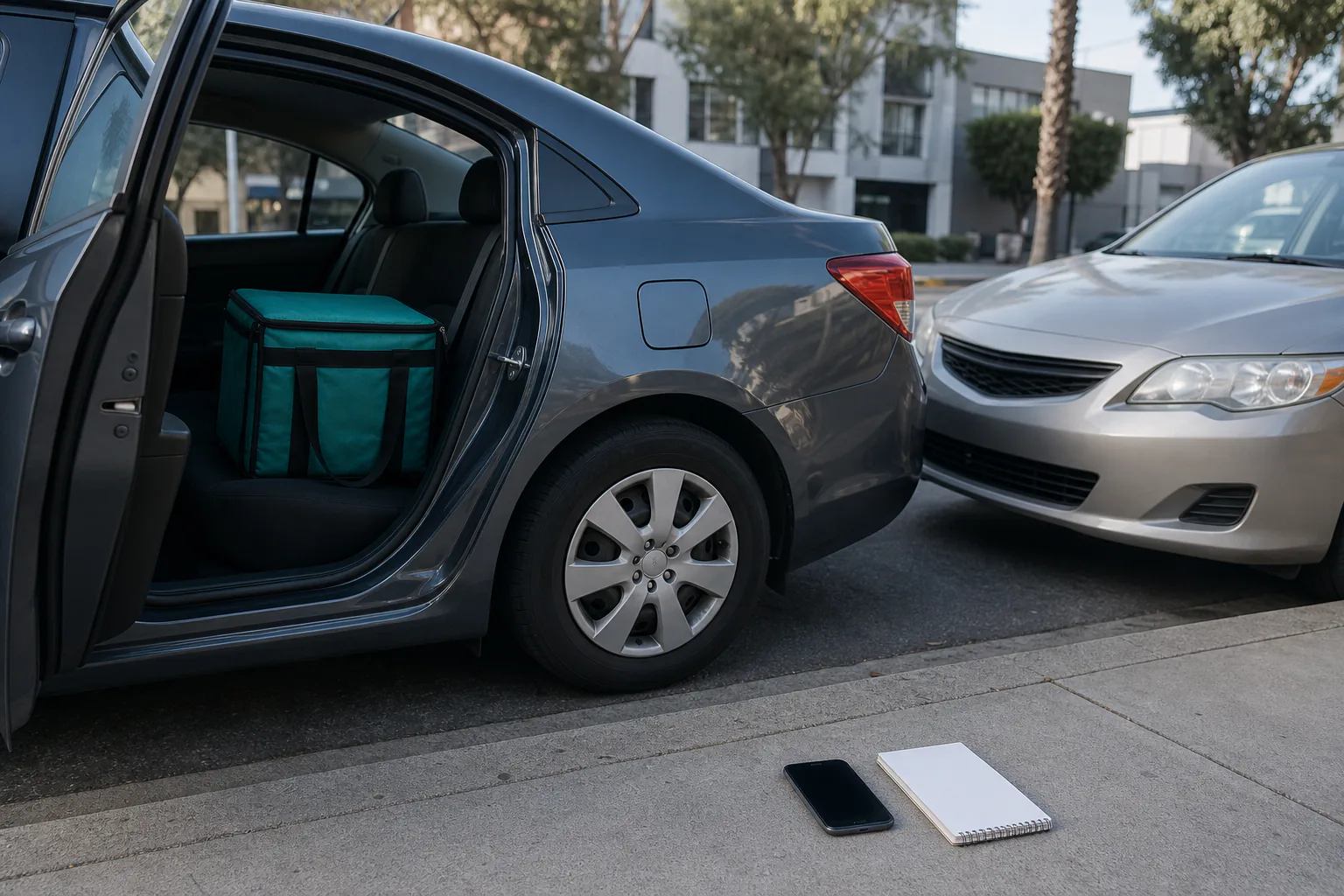
Unbranded food delivery bag in a car beside another vehicle after a minor curbside crash
Editorial illustration of the vehicle, delivery-status, and record questions that can matter after an app-based food delivery crash.

Quick answer

Use the delivery timeline, vehicle ownership, and policy records to identify possible coverage after a California app-based food delivery crash.

Key takeaways

  • California defines “engaged time” by the accepted delivery request and completion timeline, so the order record may be central evidence.
  • A delivery network company must maintain at least $1 million in liability coverage for third-party injuries during engaged time when the vehicle is not otherwise covered by a compliant policy.
  • The driver, vehicle owner, personal carrier, network company, and data vendors may hold different records; do not treat them as one evidence source.
  • Preserve the app timeline and vehicle identifiers without assuming that a platform, insurer, or vehicle owner is automatically responsible.
Hurt Advice Editorial Team

Prepared by

Hurt Advice Editorial Team

Editorial Research and Publishing Team

Source-checked editorial publishing

Why trust this article

Prepared by the Hurt Advice Editorial Team using current California statutes, California DMV guidance, and a California Supreme Court source. This version has not been reviewed by an attorney and is general legal information from a lawyer referral service, not legal advice.

Recent update: Original publication with a California app-status evidence map, coverage distinctions, preservation script, and official-source citations.

At a glance

What this guide helps you decide

Start with the question that brought you here, identify the records that can verify the facts, and use the related guidance only where it helps. This article addresses blog questions in California.

Main question

Decide how this topic may apply to your situation

Use "Who Pays After a Food Delivery Driver Crash in California?" to sort the facts you know, the questions still open, and whether a blog resource or consultation may be useful in California.

Guide map

Start with the sections most relevant to you: Who this guide helps and what to remember, Why does the driver’s app status matter?, What does California’s delivery-network insurance rule say?

Move through the article by issue, not by guesswork, so liability, medical proof, insurance pressure, deadlines, and next steps stay connected.

Records to gather

Connect these subjects to your records: food delivery driver crashes, delivery network company insurance, engaged time, app evidence

Compare the topic with records, photos, medical visits, police reports, insurer letters, and local claim details before relying on a general answer.

Trust check

Use the source trail before acting

This page includes 6 source references plus internal next-step paths so readers can verify where the guidance comes from.

Before you rely on this guide

This article is written for people dealing with injury-law questions in California. It is meant to help you understand the issue, not replace legal advice about your specific case.

What to do after this article

Start with the quick answer, skim the table of contents, and then use the links below to move into the practice area, author archive, or resource page that turns general guidance into a clearer next step for your situation.

Who this guide helps and what to remember

This guide is for someone hurt in a California collision involving a driver making an app-based food delivery, a vehicle owner whose car was being used for a delivery, or a family member trying to identify which records and insurers may matter. It focuses on the status-and-coverage questions that arise before anyone can responsibly say who may pay.

The central question is usually not just, “Which app was on the phone?” It is what the driver was doing at the exact time of the collision, whose vehicle was involved, what the app record shows, and which policies apply to those verified facts. Start with the broader food-delivery driver accident service guide if you need a general claim overview rather than this evidence-and-coverage map.

  • California defines “engaged time” by the accepted delivery request and completion timeline, so the order record may be central evidence.
  • A delivery network company must maintain at least $1 million in liability coverage for third-party injuries during engaged time when the vehicle is not otherwise covered by a compliant policy.
  • The driver, vehicle owner, personal carrier, network company, and data vendors may hold different records; do not treat them as one evidence source.
  • Preserve the app timeline and vehicle identifiers without assuming that a platform, insurer, or vehicle owner is automatically responsible.

Why does the driver’s app status matter?

California Business and Professions Code section 7463 defines a delivery network company as a business that facilitates delivery services through an online-enabled application or platform. The same statute defines “engaged time” as beginning when an app-based driver accepts a delivery request and ending when the request is completed. The statute also excludes specified periods, including some canceled or abandoned requests. Read the current text in the official California Legislature source for section 7463.

That definition makes the order timeline more useful than a vague statement that the driver was “working” or “off duty.” Acceptance, pickup, delivery, cancellation, and completion timestamps can help place the collision inside or outside engaged time. Location history, customer messages, photographs, receipts, and witness accounts may help test that timeline, but each source has limits and should be preserved in its original form.

Do not edit screenshots to remove surrounding details or rely on a cropped image as the only copy. The digital evidence preservation guide explains how to keep original files, exports, and context without claiming that a screenshot alone proves the driver’s status.

What does California’s delivery-network insurance rule say?

California Business and Professions Code section 7455 requires a delivery network company to maintain at least $1 million in automobile liability coverage per occurrence for bodily injury and property damage to third parties during engaged time if the driver’s vehicle is not otherwise covered by a compliant policy. The current statutory text appears on the California Legislature’s section 7455 page.

That requirement is important, but it is not a promise that a particular claim will be accepted or paid. The parties may dispute whether engaged time had begun or ended, whether the vehicle and driver match the order record, what caused the collision, whether the injuries are connected, and how different policies coordinate. Policy language, statutory conditions, and verified facts still matter.

Section 7455 also describes occupational accident coverage for an app-based driver’s own covered injuries while online. That benefit is distinct from the public liability coverage discussed above. Do not use a driver-benefit document as proof that an injured passenger, pedestrian, cyclist, or other motorist has third-party liability coverage under the same terms.

Use this coverage-and-record map

The map below is a working tool, not a coverage opinion. Fill it with verified facts and keep unknowns marked as unknown. A lawyer or licensed insurance professional can then compare the record with the policies and California law.

Keep a second column for the date requested, the person or company contacted, and the response. This turns a collection of screenshots into an evidence-owner map. For the broader insurance process, see the California insurance claims resource.

  • Accepted delivery? Check order history, an app export, a dispatch record, or the customer receipt. This helps identify whether engaged time may have started.
  • Completed, canceled, or abandoned? Check the completion timestamp, cancellation notice, delivery photograph, and messages. This helps test whether engaged time may have ended or been excluded.
  • Vehicle owner and insurer? Check registration, the insurance card, and carrier correspondence. This identifies possible policy and permissive-use questions.
  • Vehicle and driver tied to the order? Compare the plate, VIN, driver profile, police report, and scene photographs. This connects the digital trip to the physical collision.
  • Crash facts and resulting harm? Use scene evidence, witnesses, medical records, and repair estimates. Coverage alone does not establish fault, causation, or damages.

Step 1: identify the vehicle, driver, and delivery

Begin with what can be verified at the scene or from reliable records: the driver’s name, license plate, vehicle make and model, registered owner, insurance information, collision location, time, and any delivery bag or app screen you personally observed. Photograph the full scene only when it is safe and lawful. Do not reach into a vehicle, handle another person’s phone, or log in to an account that is not yours.

If police respond, record the agency and report or incident number. A police report can help identify people and vehicles, but it does not replace the driver’s separate California DMV reporting duty. The California DMV accident-reporting page says a driver must file an SR-1 within 10 days when anyone is injured or killed or property damage exceeds $1,000, and that this report is required in addition to reports made to police or an insurer.

If you were a passenger or bystander rather than a driver, you may not be the person required to file the SR-1. Still preserve the report number and vehicle information for your own records. The California car accident guide provides a broader immediate-steps checklist.

Step 2: reconstruct the app timeline without guessing

Create a minute-by-minute timeline around the collision. Include the accepted order time, pickup location and time, estimated delivery route, collision time, any customer or dispatcher message, cancellation event, delivery photograph, and completion time. Mark the source beside each entry. If two sources conflict, keep both and describe the conflict instead of choosing the version you prefer.

Useful identifiers can include an order number, trip or delivery ID, driver profile name, customer receipt, restaurant receipt, delivery address, app version, and the email or phone number associated with your own account. Share private customer details only with an appropriate recipient and only as needed. Publicly posting an address, phone number, medical image, or full account screenshot can create unnecessary privacy and authenticity problems.

A driver’s statement that the app was off, or an injured person’s belief that a delivery was active, may be relevant but should not end the inquiry. Ask what record supports the statement. App data may be held by the driver, the network company, a restaurant, the customer, or a contracted platform, and no single person may have the complete timeline.

Step 3: map possible policies without assuming coverage

List each possible policy separately: the driver’s personal automobile policy, a vehicle owner’s policy if someone else owned the car, the delivery network company’s statutory coverage, and any commercial or umbrella coverage actually identified. Record the claim number, named insured, carrier, adjuster contact, reservation-of-rights or denial language, and the status period the carrier says applies.

Do not describe the statutory $1 million requirement as “the app’s automatic settlement fund.” It is a liability coverage requirement tied to statutory conditions, not a guaranteed payment. Likewise, a personal carrier’s delivery-use exclusion does not by itself prove that no other coverage exists. Obtain the written position and keep the envelope, email headers, attachments, and policy references.

California’s current Proposition 22 framework also affects how app-based work is classified. The California Supreme Court’s official year-in-review reports that its unanimous Castellanos decision upheld Proposition 22’s contractor provision against the constitutional challenge before the court. Classification does not, by itself, answer negligence, vehicle ownership, engaged-time, or insurance questions in a specific crash.

Can the vehicle owner be a separate part of the analysis?

Sometimes. California Vehicle Code section 17150 states that a vehicle owner is liable for injury, death, or property damage caused by the negligent or wrongful act of a person using the vehicle with the owner’s express or implied permission. The current statute is available from the California Legislature’s section 17150 page.

That text creates a question to investigate, not a conclusion that an owner owes every claimed amount. Permission, ownership, causation, statutory limits, insurance, and other defenses can matter. The car may also be rented, leased, borrowed, or owned by a household member, and those relationships should be verified rather than inferred from who was driving.

Photograph the plate and registration only when you have lawful access. Do not contact a vehicle owner with accusations or publish their personal information. A focused request for insurance and preservation information is more useful than a public allegation.

What evidence belongs on the checklist?

The checklist should connect each disputed fact to a record and a likely custodian. Keep originals, make working copies, and use consistent filenames with the capture or receipt date. If you photograph an app screen, also record whose device it was, who took the photograph, and whether the screen was scrolled or filtered.

  • Collision identity: date, time, location, report number, driver, plate, VIN, registered owner, witnesses, and scene photographs.
  • Delivery status: order or trip ID, acceptance, pickup, cancellation, completion, customer messages, restaurant receipt, and delivery photograph.
  • Policy map: personal carrier, vehicle-owner carrier, network-company claim channel, policy or claim numbers, and written coverage positions.
  • Injury and loss: medical discharge papers, treatment records, work-loss documentation, repair estimates, and a careful symptom record. The injury documentation guide explains how to organize these without exaggeration.
  • Authenticity: original file, account or device, export method, date received, file metadata when available, and a log of who received a copy.

What can you say in a focused preservation request?

A useful request identifies the collision, the people and vehicle, a reasonable time window, and the record families tied to the disputed status. It does not need accusations or a claim that litigation has already been filed. Adjust this plain-language example to facts you can verify:

“Please preserve records in your possession, custody, or control concerning the collision on [date] at approximately [time] near [location], involving driver [name if known] and vehicle [plate/VIN if known]. The requested preservation includes the delivery request and status timeline, acceptance, pickup, cancellation or completion records, related messages, route or location records reasonably connected to the delivery, driver and vehicle identifiers, photographs, and insurance or claim records for the time period surrounding the collision. Please confirm the correct contact for this request.”

A preservation request is not a subpoena, court order, proof that a record exists, or automatic access to private systems. Do not impersonate an attorney, demand passwords, or say a person must communicate directly with you if they are represented. Keep the sent version, delivery confirmation, and any response.

What timing and process should you track?

Handle immediate safety and medical needs first. Then preserve scene records, report the collision to the appropriate insurers, complete any required DMV report, and build the app-status timeline. Ask for written claim identifiers and coverage positions. Do not surrender the only copy of a phone, photograph, receipt, or medical record.

California Code of Civil Procedure section 335.1 generally provides two years to start an action for injury or death caused by another’s wrongful act or neglect. Read the current language on the California Legislature’s section 335.1 page. This general rule is not a deadline calculation for a particular matter. Government entities, minors, delayed discovery, different legal theories, and other circumstances can change the analysis, sometimes with earlier notice steps.

The DMV reporting period, an insurer’s requested response date, a preservation concern, and a lawsuit filing deadline are different clocks. Do not wait for one before investigating the others. The California limitations resource gives general orientation, but individualized advice is needed for an actual deadline.

Which mistakes and red flags can weaken the process?

The first mistake is treating a delivery bag, decal, or app notification as conclusive proof of engaged time. The second is accepting a verbal “no coverage” statement without asking for the written basis. A third is combining personal, owner, and network-company coverage into one line on the evidence map.

Other red flags include a request for passwords, a broad authorization unrelated to the collision, pressure to sign before you understand a release, a demand to hand over the only device copy, or a promise that a referral service guarantees a lawyer or result. Do not delete unfavorable messages, alter timestamps, stage a photograph, or contact a customer through information that was not lawfully provided to you.

Coverage and fault are different. Even if an engaged-time policy applies, evidence is still needed about how the crash happened and what injuries or losses were caused. Conversely, a coverage dispute does not erase a potentially valid liability claim; it means the policy and party analysis requires more care.

What are careful next steps?

Write the verified collision identifiers at the top of one page, add the order-status timeline, and list each possible policy and record custodian. Preserve originals and keep a dated request log. If you want counsel to evaluate the map, you may compare the issue with a verified profile such as Raffi Naljian’s Hurt Advice profile; that link does not mean he authored or reviewed this article, is available, or will accept a matter.

Hurt Advice is a California lawyer referral and legal information service, not a law firm. Reading this page or submitting information does not create an attorney-client relationship, promise representation, identify a particular lawyer, guarantee an outcome, or promise free legal services. The editorial standards, source policy, and referral and legal-information disclosure explain the site’s role.

If you want to share the basic facts for an intake review, use the case-review form. Keep the first submission focused, do not send irreplaceable originals, and avoid including customer or medical details that are not needed for the initial review.

Frequently Asked Questions

Does a delivery app automatically pay after its driver causes a crash?
No. California requires specified delivery-network liability coverage during engaged time under statutory conditions, but payment still depends on verified status, applicable policies, fault, causation, damages, and the claim process. Ask for written coverage positions rather than assuming the app or the personal carrier is the only possible source.
What is “engaged time” for a California food-delivery driver?
Business and Professions Code section 7463 generally describes engaged time as the period beginning when an app-based driver accepts a delivery request and ending when the request is completed, subject to statutory exclusions. The order timeline and related records can be important evidence.
Is $1 million in coverage always available for a delivery crash?
Do not assume it is automatically available. Section 7455 requires a delivery network company to maintain at least $1 million in third-party automobile liability coverage during engaged time if the vehicle is not otherwise covered by a compliant policy. Whether that rule applies to a specific crash can be disputed.
What if the driver says the app was off?
Preserve the statement, but also identify the record behind it. Order history, acceptance and completion timestamps, messages, receipts, delivery photographs, location records, and network-company data may help reconstruct status. Conflicting sources should be preserved rather than edited into one preferred account.
Do I need to file a California DMV SR-1?
The California DMV says a driver must file an SR-1 within 10 days if anyone was injured or killed or property damage exceeded $1,000, and the filing is separate from police and insurance reports. A passenger or bystander may not be the filing driver; check the current DMV instructions for your role.
Is Hurt Advice a law firm, and does contacting it create representation?
No. Hurt Advice is a lawyer referral and legal information service, not a law firm. Reading the article or submitting information does not create an attorney-client relationship, promise that a lawyer will accept the matter, guarantee an outcome, or promise free legal services.

Sources and references

Need help after an accident?

Hurt Advice intake team can review your situation, explain your options, and help you move forward with a plan that fits your case.