
Editorial date: October 16, 2026. First published online: October 17, 2026.
On this page
- Why seeing and noticing are different
- What drivers can change
- Walking choices without blame
- Why crossing lighting matters
- A practical decision aid
- California’s crosswalk guidance
- Report a visibility concern clearly
- If a crash has already happened
Why seeing and noticing are different
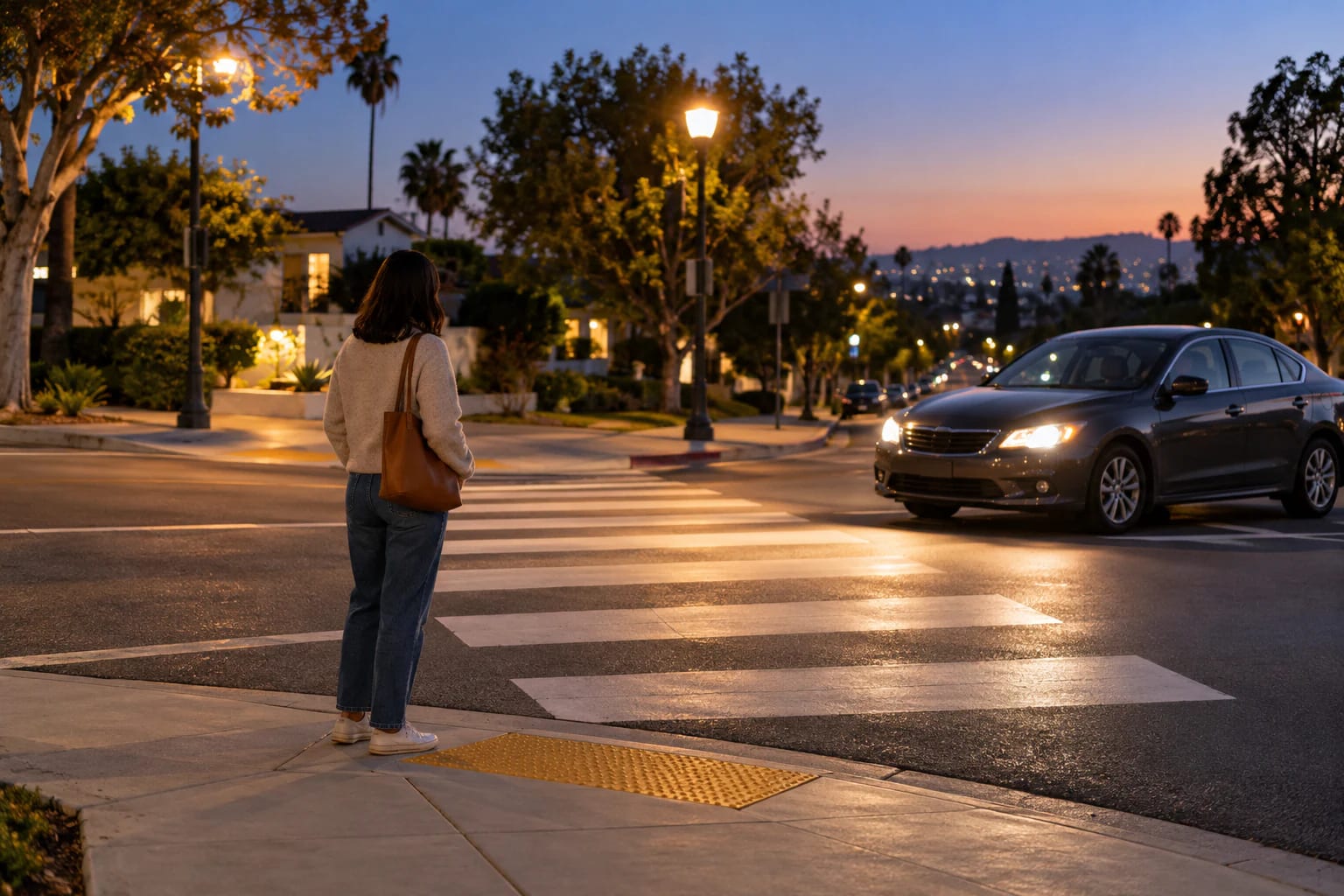
Visibility is not a single yes-or-no condition. A driver may detect something without immediately recognizing a person. NHTSA’s conspicuity research summary distinguishes standing out visually from being expected and understood. It also identifies twilight changes and headlamp glare as challenges. A person’s view of an approaching vehicle is not proof of the driver’s view of that person.
Think of the useful questions in order: What was visible? What was recognized? What action followed? Those questions should remain separate when discussing a close call. “There were streetlights” describes one part of the setting. “The driver stopped before the crossing” describes an action. Neither statement should silently become “everyone could see everything.”
The headline’s “plain sight” describes that everyday mismatch, not a finding that a particular driver had an unobstructed view. You do not need to decide who is a good or bad observer to take the problem seriously. You need to identify which part of the encounter was uncertain and which safer choice is available next.
This is also why a visibility explanation is different from an excuse. It describes a condition to address. It does not settle whether someone acted reasonably, which traffic rules applied or who caused an injury.
What drivers can change before reaching the crossing
Start before the person is directly in front of the vehicle. The California DMV’s night-driving guidance says to be able to stop within the distance illuminated by the headlights. It warns that pedestrians are harder to see after dark and advises driving slowly while adjusting after leaving a bright place. High beams have appropriate uses and restrictions; they should not be used to blind approaching drivers. More light is not automatically the right response to glare.
FHWA’s lighting guidance makes the speed connection clear: at higher speeds, a hazard can become visible in the headlights too late for the vehicle to stop. There is no universal safe detection distance in this article. The practical point is to leave room for the uncertainty instead of treating the first moment of recognition as the moment to begin planning.
For a crossing approach, use a short mental sequence: look for the crossing, look for people approaching or occupying it, and be ready to stop. NHTSA specifically advises extra nighttime caution, slowing before turning across a crosswalk and never passing a vehicle stopped at a crossing. Another vehicle can hide the person it has stopped for.
A familiar route deserves that same attention. Knowing where a crosswalk is does not tell you who will use it tonight. Put the attention on the actual crossing rather than a remembered expectation that the road will be empty.
Walking choices without turning safety advice into blame
A person on foot should not have to solve every problem with a street, vehicle or driver. Optional precautions can still be useful when the available route is imperfect. NHTSA’s walking guidance recommends sidewalks where available, crossing at intersections or crosswalks, watching traffic throughout the crossing and waiting for a clear stop rather than assuming a driver will yield.
Make the decision about the encounter in front of you. A hand gesture from one driver does not answer what a second lane is doing. An illuminated crossing does not make an obscured approach visible. If a situation feels unclear, looking for another available crossing or waiting for a clearer opportunity can be a practical choice. That is a planning option, not a judgment about someone who has already been hurt.
For those who choose an extra visibility aid, NHTSA’s research summary explains that retroreflective material returns light toward its source. The cited research reports improved detection, especially with material on moving limbs, but does not establish a corresponding crash reduction. It also warns that enhanced conspicuity is unlikely to overcome driver distraction.
Keep that limit attached to the recommendation. An aid can be useful without being a promise. This article does not turn a clothing choice, flashlight or reflective accessory into a legal condition for using a crosswalk, or into an explanation of why an individual crash occurred.
A bright roadway is not always a well-lit crossing
Look at what the illumination is meant to accomplish. A roadway can have lights while a person’s position within the crossing still needs attention. FHWA’s nighttime pedestrian-crossing guidance addresses the placement of lighting so people are illuminated from the sides, with attention to shadows and glare. It also discusses complementary treatments such as conspicuous crossing markings and activated beacons.
Those are design considerations for the responsible transportation professionals. A photograph of a lamp does not establish that a crossing meets a technical standard, and a dark-looking image does not establish a violation. The useful public question is narrower: does this location need a pedestrian-visibility assessment?
FHWA’s lighting countermeasure page treats lighting as an option for roadway segments and particular locations, including crossings. The broader NHTSA Safe System framework includes safer roads, speeds, vehicles and people. That is a reason to discuss the street environment alongside personal choices, rather than putting the entire burden on the person walking.
A resident can report what they observed without designing the fix. “The person waiting at the west curb was in shadow” is a specific observation. “Install this kind of fixture at this height” is an engineering proposal. Keeping the two separate makes a concern easier to assess honestly.
A practical decision aid for the next nighttime trip
The following is an editorial planning aid, not a test that certifies a crossing as safe. Use the guidance matching your role. If you cannot answer a question, leave it unresolved rather than filling it with an assumption.
Driving toward a crossing you know well
Ask yourself: Am I watching this crossing now, or relying on what usually happens here?
A useful next action: Refocus on the current approach, people and stopped vehicles before proceeding.
Turning across a pedestrian path
Ask yourself: Have I accounted for people as well as vehicle traffic?
A useful next action: Recheck the crossing as part of the turn and be prepared to stop.
Walking where another vehicle blocks part of the view
Ask yourself: What can I actually see about the remaining traffic?
A useful next action: Avoid treating one driver’s stop or gesture as confirmation about every lane.
Choosing an evening walking route
Ask yourself: Which available crossing offers a clearer view and a manageable route?
A useful next action: Make that choice before reaching a difficult crossing when practical.
Helping a child, older adult or person using a mobility aid
Ask yourself: What pace, communication and assistance does this person want?
A useful next action: Plan together; do not assume that everyone can move or respond at your pace.
Reporting a recurring concern
Ask yourself: Can I describe the exact approach and observed condition without guessing its cause?
A useful next action: Use the reporting steps below and ask the responsible office for assessment.
You can use this aid before a trip, not only after something frightening happens. It is also a conversation starter for a household: the person who drives and the person who walks may be describing the same intersection from very different positions.
California’s crosswalk guidance does not disappear at sunset
The California Driver’s Handbook explains that not all crosswalks have painted markings. It directs drivers to use caution, slow or stop to let a pedestrian finish crossing, and not to pass a vehicle stopped at a crosswalk. It also recognizes that some people need additional time to cross.
Those points are a practical baseline for drivers. They are not a complete statement of every rule governing every crossing, signal or roadway. This article does not assign fault, interpret a particular signal sequence or decide a claim. If the question concerns a real event, the actual positions, traffic controls, sequence and other evidence matter.
For the broader subject, the Hurt Advice pedestrian information hub provides related guidance. If the unresolved issue is how the signals operated, use the separate crosswalk signal-timing records article rather than assuming a nighttime visibility explanation answers the signal question.
Report a visibility concern clearly, without inventing a conclusion
For a non-emergency concern, first find the official road, streetlight or transportation reporting channel for the location. If you are unsure which office is responsible, ask for the correct channel. Do not place yourself in traffic or recreate a hazardous crossing to gather a report.
Prepare a short description with the following distinctions:
- Location: identify the crossing and which approach you mean. A nearby landmark can help locate it, but should not replace the actual location.
- Observation: describe what you saw from a safe position. Distinguish an apparently unlit lamp from a person standing in shadow under functioning lights.
- Timing: record when you observed it. If a photograph was taken on another evening, label that separately.
- Question: ask whether the responsible team can assess pedestrian visibility or direct you to the appropriate office.
Here is a first-contact message you can use without claiming a technical defect:
I would like to report a nighttime pedestrian-visibility concern. Please tell me the correct reporting channel and the location details your team needs. I want to distinguish what I observed from any conclusion about lighting design. I can describe the crossing, approach, observation time and conditions from a safe position. Can the responsible team assess the concern or direct me to the office that can?
Keep the confirmation and any response. A report asks for an assessment; it does not establish which design change is appropriate or that a defect exists. If there is an immediate danger, use the appropriate emergency channel instead of relying on an ordinary maintenance message.
If a crash has already happened, preserve the questions as well as the records
Safety and appropriate care come first. Later, when you can organize the information safely, keep the original records that already exist. Separate an observation from a conclusion: the location of a streetlight, the driver’s reported account, a witness’s position and the lighting conditions may be different parts of the story.
A simple file can have three headings: what I personally observed, what another source says, and what is still unknown. Record the source and date beside an item. A later photograph remains a later photograph; do not present it as a complete reconstruction of the earlier scene. Avoid returning to traffic to prove that someone “should have seen” someone else.
The accident evidence checklist can help organize available material. Family members can use the guide to helping an injured relative to support that work while respecting permission and privacy. Neither a record checklist nor an explanation of darkness can determine the result of a case.
Population figures answer another question again. The existing pedestrian crash-data guide explains how to keep time, place and source context attached to a statistic. A general nighttime pattern cannot establish what an individual driver could see.
If you want help preparing an initial inquiry, start with what to organize before contacting Hurt Advice. An optional contact request can describe the event and the question you need help with; it does not promise acceptance or representation.
Related attorney: Abraham Chuljyan. His firm publishes pedestrian-injury services; confirm experience and availability directly. This related profile does not imply authorship or review.
Editorial and source note
This article explains general safety information and preparation options. No attorney reviewed this version. It does not diagnose an injury, decide responsibility or promise an outcome. Source pages were checked on October 17, 2026; an access check is different from attorney review. See the editorial standards and advertising and referral notice. Hurt Advice publishes information and case-routing intake; it is not a law firm. Any attorney-client relationship requires a separate agreement with an independent attorney or firm.
For related reading, browse the pedestrian article collection and the Editorial Team archive.