
Legal ExplainerPedestrian AccidentsChecklist / Process

California Crosswalk Signal Timing Records: What to Request

A crosswalk-signal records file should start with custody and provenance, not a conclusion. Identify the exact intersection, crossing direction, movement, and time range; determine which agency owned, operated, programmed, and maintained the equipment; then keep planned settings, available operational data, maintenance records, original media, and witness observations in separate lanes.

Published

July 24, 2026

Updated

July 24, 2026

Reading time

10 min read

Jurisdiction

California

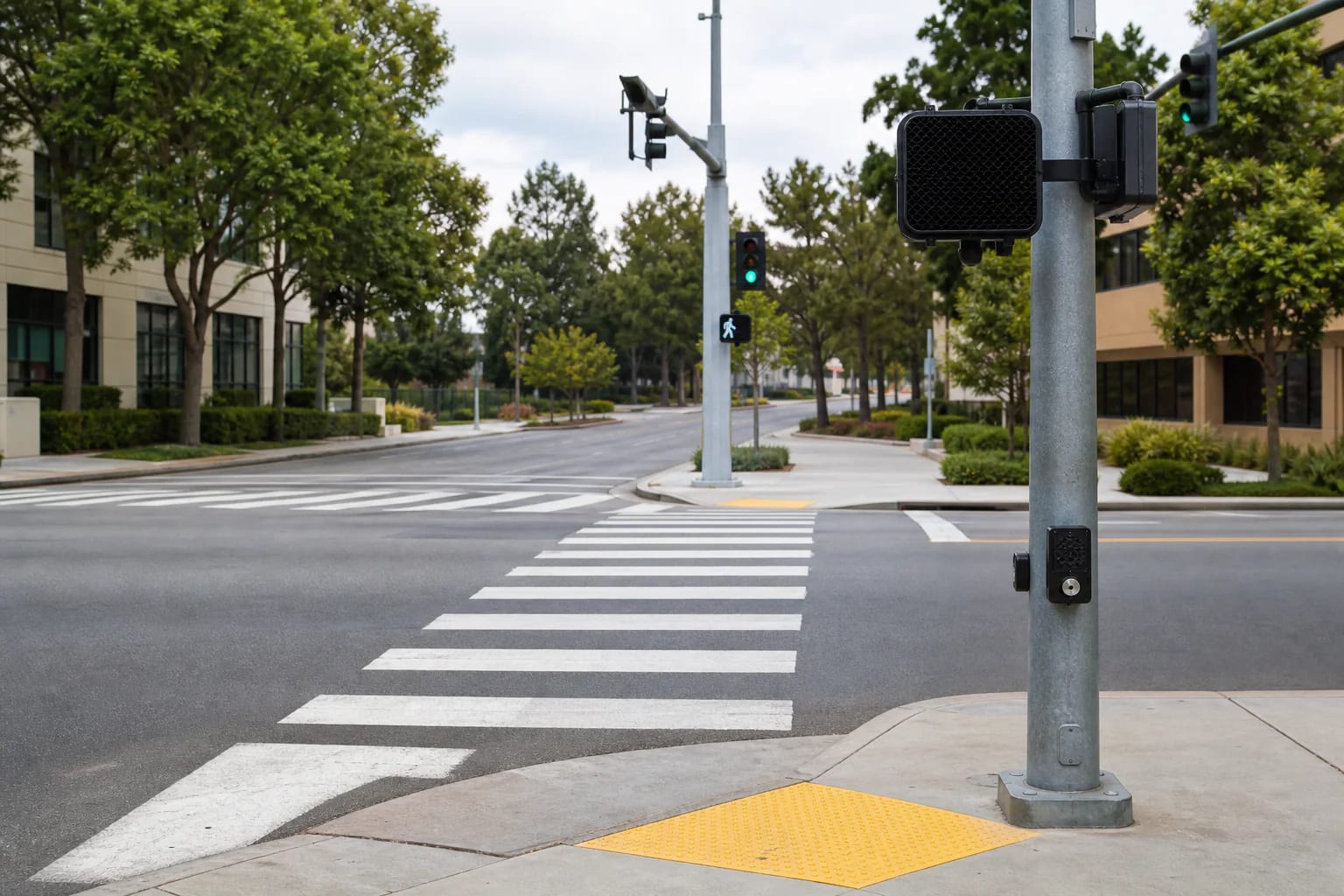
Empty California crosswalk with pedestrian signal head, push button, curb ramp, and traffic signal hardware in daylight
A reliable crosswalk-signal file separates the governing plan, operational records, maintenance history, scene observations, and later changes by source and time.

Quick answer

After a California crosswalk incident, first identify who owned, operated, programmed, and maintained the signal. Then request the governing timing plan, pedestrian intervals, approved changes, detector and maintenance records, and any available controller data. Keep planned settings, field records, witness observations, and later changes separate; none alone proves a malfunction or fault.

Key takeaways

  • Identify who actually owns and operates the signal before sending a request; the road name, nearby route number, and intersection jurisdiction can point to different agencies.
  • Request a source-labeled packet: the governing timing plan, phase and interval settings, approved changes, pedestrian detector or push-button records, maintenance and complaint history, and any available controller or event data for a narrow period.
  • Keep four things separate: what a person observed, what the approved plan specified, what an agency record shows happened, and what changed after the event.
  • Do not infer a signal malfunction, legal violation, or fault from a countdown display, video clip, timing sheet, work order, or missing record alone.
Hurt Advice Editorial Team

Prepared by

Hurt Advice Editorial Team

Editorial Research and Publishing Team

Source-checked editorial publishing

Why trust this article

Prepared by the Hurt Advice Editorial Team from the current California MUTCD 2026, official Caltrans records guidance, and current California statutes governing pedestrian signals, crosswalk duties, public-record requests, and public-entity claim timing. No attorney reviewed this displayed version.

Recent update: Original publication with a signal-custodian map, six-part timing and maintenance record packet, neutral public-records request script, interval explanation, design-versus-operation reconciliation tool, timing cautions, evidence checklist, and next-step sequence.

At a glance

What this guide helps you decide

Start with the question that brought you here, identify the records that can verify the facts, and use the related guidance only where it helps. This article addresses pedestrian accidents questions in California.

Main question

Decide how this topic may apply to your situation

Use "California Crosswalk Signal Timing Records: What to Request" to sort the facts you know, the questions still open, and whether a pedestrian accidents resource or consultation may be useful in California.

Guide map

Start with the sections most relevant to you: Quick takeaways, Who this guide is for—and the narrow task it solves, Start with the exact intersection, crosswalk, and movement

Move through the article by issue, not by guesswork, so liability, medical proof, insurance pressure, deadlines, and next steps stay connected.

Records to gather

Connect these subjects to your records: California Crosswalk Signal, Pedestrian Signal Timing, Traffic Signal Records, Signal Custodian

Compare the topic with records, photos, medical visits, police reports, insurer letters, and local claim details before relying on a general answer.

Trust check

Use the source trail before acting

This page includes 6 source references plus internal next-step paths so readers can verify where the guidance comes from.

Before you rely on this guide

This article is written for people dealing with injury-law questions in California. It is meant to help you understand the issue, not replace legal advice about your specific case.

What to do after this article

Start with the quick answer, skim the table of contents, and then use the links below to move into the practice area, author archive, or resource page that turns general guidance into a clearer next step for your situation.

Quick takeaways

  • Identify who actually owns and operates the signal before sending a request; the road name, nearby route number, and intersection jurisdiction can point to different agencies.
  • Request a source-labeled packet: the governing timing plan, phase and interval settings, approved changes, pedestrian detector or push-button records, maintenance and complaint history, and any available controller or event data for a narrow period.
  • Keep four things separate: what a person observed, what the approved plan specified, what an agency record shows happened, and what changed after the event.
  • Do not infer a signal malfunction, legal violation, or fault from a countdown display, video clip, timing sheet, work order, or missing record alone.

Who this guide is for—and the narrow task it solves

This guide is for a California pedestrian, driver, passenger, family member, or authorized helper organizing records after an incident at a signalized crosswalk. It solves one narrow task: identify the signal custodian and build a reliable timing-and-maintenance file for the exact intersection, direction of travel, crosswalk, signal phase, and time period.

The pedestrian-accident service guide covers the broader legal lane. The pedestrian first-steps resource covers immediate safety and reporting. The intersection-accident topic guide addresses broader scene decisions. This article does not decide right of way, signal compliance, road design, causation, public-entity liability, or fault.

Get urgent medical help when needed. Do not enter traffic, block a crosswalk, touch a signal cabinet, open equipment, stage a crossing, or delay care to collect evidence. Record only what can be observed safely and lawfully.

Start with the exact intersection, crosswalk, and movement

A request that says only “the signal at Main Street” can miss the relevant records. Write the full names of both roads, city, county, nearest address, state-route or highway number if shown, and GPS coordinates if available. Identify the crossing direction—for example, north curb to south curb—and the vehicle movement involved, such as eastbound through or southbound right turn.

Record the event date and best-supported time range, the source of that time, which corner held the push button, whether a pedestrian signal head or countdown was visible, and which signal face each person could actually see. Preserve uncertainty. “Phone photo metadata shows 8:14:32 p.m.” is different from “witness estimates around 8:15 p.m.”

Save original photographs and videos with metadata. Make working copies for labels or arrows. The digital-evidence preservation guide explains why an untouched source file and a clearly labeled working copy serve different purposes.

Identify the signal custodian before requesting records

The visible city name does not always identify the operator. A signal may be controlled by a city, county, Caltrans district, another public agency, or an arrangement involving more than one entity. Start with the local transportation or public-works department and ask who owned, operated, maintained, and programmed the signal on the event date. If a state route is involved, check the relevant Caltrans district.

Caltrans District 4’s official records-request page is a useful concrete example: it tells requesters to describe records by time, date, and location and lists “Signal Light Timing” among frequently requested records. That page proves this record category exists in that district; it does not prove every agency uses the same name, keeps the same data, or will disclose every requested item.

Preserve each referral. If a city says Caltrans holds timing plans but a contractor handles maintenance, record the speaker, agency, date, contact channel, exact answer, and any ticket number. A custody map can include multiple sources without assuming any source is responsible for the incident.

Build a six-part signal-record packet

  1. Governing plan: the timing sheet, signal timing plan, phase diagram, coordination plan, or equivalent record that applied at the exact date and time.
  2. Change history: approved revisions, implementation dates, temporary timing, construction or special-event plans, and records showing when a change became active.
  3. Pedestrian features: WALK, pedestrian-change, countdown, buffer, leading-pedestrian-interval, recall, detection, accessible signal, and push-button configuration records when they exist.
  4. Maintenance lane: complaints, service tickets, inspections, technician notes, cabinet or detector work, outage reports, replacements, and closure status for a narrow relevant period.
  5. Operational data: any available controller logs, event records, alarms, detector data, conflict-monitor records, communications-system history, or other retained data tied to the exact controller and time range.
  6. Geometry and custody: as-built or striping plans, crosswalk and curb-ramp changes, controller or cabinet identifier, equipment inventory, and the agency or contractor responsible for each record type.

Ask for existing records and their native identifiers. Do not demand that an agency create a new analysis, reconstruct data it never stored, or certify that a missing record proves an event did not happen. Record types, system capabilities, retention, exemptions, and availability differ.

Use a narrow public-records request script

A focused request is easier to route and less likely to mix unrelated intersections. Adapt this neutral script:

“Please identify the agency unit that owned, operated, programmed, and maintained the traffic and pedestrian signals at [full intersection, city, crosswalk direction, and route number if applicable] on [date] from [start time] through [end time]. For that location and period, please provide available existing records showing the governing signal timing or phase plan; pedestrian WALK, change, countdown, buffer, leading interval, recall, and detection settings; approved timing changes and effective dates; complaints, inspections, maintenance tickets, technician notes, outages, and repairs; controller, detector, alarm, or event data retained for the period; and as-built or crosswalk plans that identify the relevant equipment. Please identify any other custodian if your agency does not hold a requested category. This request does not ask the agency to create a new analysis or state a legal conclusion.”

Use a narrow time window for event data and a separately stated period for maintenance or change history. Keep proof of delivery, the exact text sent, tracking number, agency responses, clarification requests, estimated production date, rolling productions, and any stated exemption or no-record result.

Understand what the pedestrian intervals mean

California Vehicle Code section 21456 describes the legal meaning of pedestrian signal indications. It says a WALK indication permits a pedestrian facing it to proceed subject to vehicles lawfully in the intersection; it also distinguishes a flashing upraised hand with a countdown from a steady upraised hand and addresses when a pedestrian may start or complete a crossing.

The current Caltrans California MUTCD 2026, Chapter 4I separately defines pedestrian signal features and engineering standards. Section 4I.06 distinguishes the walk interval, pedestrian change interval, and buffer interval. It provides that the buffer is displayed before conflicting vehicular movement is released and explains how clearance time is evaluated. It also discusses countdown displays, pedestrian detectors, leading pedestrian intervals, and different walking-speed considerations.

Those sources are not a substitute for the actual intersection record. A witness may describe the display seen from one position. A video may begin after the cycle started. A timing sheet may show approved settings rather than prove what the controller displayed at a particular second. Reconcile the sources; do not collapse them into “the signal was too short” or “the signal failed” without qualified, case-specific analysis.

Separate design settings, field operation, and observation

Create one row for every relevant item with these fields: timestamp or effective date; source; custodian; crosswalk and movement; record type; setting or observation; whether it is planned, configured, observed, logged, reported, or changed; file name or identifier; and unresolved questions.

For example, one row might state: “Agency timing sheet, revision 7, effective May 1; north-south pedestrian phase; 7-second WALK listed.” A separate row might state: “Original phone video created May 14 at 8:14:32 p.m.; shows flashing hand and countdown 6 through 0; recording begins before 6 is visible.” Neither row establishes what occurred before recording began or whether the plan was active in the field.

A maintenance ticket is also a status record. Opened, assigned, inspected, reset, part ordered, repaired, tested, and closed are different events. Preserve attachments and revision history when provided. Do not rewrite “could not reproduce” as “nothing was wrong,” or “reset controller” as an admission of malfunction.

Know what the Public Records Act clock does—and does not do

California Government Code section 7922.535 states that an agency receiving a request for copies must determine within 10 days whether the request seeks disclosable records in its possession and promptly notify the requester. In unusual circumstances, written notice can extend that determination period by no more than 14 days.

That is a determination clock, not a promise that all records will be produced within 10 days. The statute also describes unusual circumstances such as records at field facilities, voluminous records, consultation, and the need to compile or extract data. Preserve the agency’s estimated availability date and follow its clarification or rolling-production process.

Public access can involve exemptions, privacy, security, privilege, system limitations, or records that another custodian holds. A denial, redaction, no-record response, or request for clarification should be preserved exactly. Get specific legal advice before disputing a response or demanding access to sensitive signal-system information.

Keep traffic rules separate from the records task

California Vehicle Code section 21950 states that a driver must yield to a pedestrian crossing within a marked crosswalk or an unmarked crosswalk at an intersection, subject to the rest of that chapter. It also states that pedestrians must use due care and that drivers retain duties of care toward pedestrians.

Section 21456 addresses pedestrian control signals, but neither statute makes a timing sheet, countdown photo, witness statement, or maintenance record an automatic liability conclusion. The meaning of the signals, movements, visibility, timing, conduct, injury, causation, public-entity rules, and other evidence must be evaluated together.

Use the California injury-claim proof guide to connect source lanes without overstating any item. If a transit vehicle or transit-controlled facility is involved, the public-transit claim guide explains why agency identity and claim procedures may add another lane.

Treat preservation, public-record, and claim deadlines as different clocks

Signal settings, controller data, video, detector data, alarms, maintenance systems, and staff memory may have different retention or change schedules. Send a focused preservation and records request promptly, but do not publish or rely on a universal retention period unless the actual custodian or governing rule confirms it.

When a public entity may be involved, California Government Code section 911.2 states that a claim relating to injury to a person or personal property must generally be presented no later than six months after accrual. Agency identity, accrual, claim content, service, exceptions, late-claim procedures, and other rules require case-specific review.

A public-record request is not a government claim, and sending one does not necessarily preserve a claim deadline. A preservation letter, police report, insurance notice, and civil filing also serve different functions. Seek prompt California legal advice rather than waiting for the records production to finish.

Use a source-and-status evidence checklist

  • Location: both road names, city, county, route number, coordinates, crossing direction, corners, lanes, and signal faces.
  • Time: event date, supported time range, time source, time-zone or device setting if relevant, and uncertainty.
  • Original media: untouched files, metadata, creator, device, export history, and labeled working copies.
  • Custody: owner, operator, programmer, maintenance unit, contractor, controller or cabinet identifier, and referral trail.
  • Timing: governing plan, phase diagram, pedestrian intervals, detector settings, coordination, temporary plans, revisions, and effective dates.
  • Operations: available controller, event, detector, alarm, or communications records for the narrow time range.
  • Maintenance: complaints, tickets, inspection, work, parts, testing, attachments, status changes, and closure.
  • Responses: request text, delivery, tracking, determination, clarification, estimate, production, redaction, exemption, and no-record statement.

Common mistakes and red flags

  • Requesting only “camera footage”: the signal timing, change, detector, maintenance, geometry, and custody records answer different questions.
  • Sending the request only to the city: verify whether a state route, county, contractor, or another agency held the relevant records.
  • Using a broad multi-year request: identify the exact intersection, crosswalk, movement, event window, and separately justified history period.
  • Treating planned timing as field proof: approved settings and event-specific operation are different evidence lanes.
  • Using a phone stopwatch as an engineering conclusion: recording start, position, cycle, preemption, detection, geometry, and actual configuration can matter.
  • Calling any ticket an admission: preserve the ticket’s exact wording, status, attachments, and later action.
  • Waiting for production before checking deadlines: public-record and government-claim processes run on different clocks.
  • Touching signal equipment: never open, alter, test, obstruct, or attach anything to public traffic-control hardware.

Next steps: a seven-part action sequence

  1. Address urgent care and safety; do not enter traffic or handle signal equipment.
  2. Identify the exact intersection, crosswalk direction, vehicle movement, signal faces, and best-supported time range.
  3. Preserve original scene media, metadata, witness contact details, reports, and care timing.
  4. Ask the city, county, or Caltrans district who owned, operated, programmed, and maintained the signal on that date.
  5. Send a narrow preservation and records request covering the six-part packet and keep proof of delivery.
  6. Build separate planned, configured, observed, logged, reported, maintained, and changed lanes.
  7. Seek case-specific California advice before a government-claim deadline, disputed records response, destructive inspection, or technical conclusion.

Hurt Advice is a lawyer-referral and legal-information service, not a law firm. This article provides general educational information, not legal, engineering, traffic-signal, investigation, safety, or medical advice. No attorney reviewed this displayed version. A licensed California attorney can evaluate the actual intersection, signal custody, records, conduct, injuries, public-entity issues, and deadlines. You can use the Hurt Advice contact page to request a referral.

Frequently Asked Questions

Who keeps traffic-signal timing records for a California crosswalk?
The custodian may be a city, county, Caltrans district, another public agency, or more than one entity under an operating or maintenance arrangement. Ask who owned, operated, programmed, and maintained the exact signal on the event date, and preserve every referral rather than assuming the visible city name identifies the only custodian.
What signal records should I request after a pedestrian collision?
Request the governing timing or phase plan, pedestrian interval and detector settings, approved changes and effective dates, complaints and maintenance tickets, inspection and technician notes, available controller or event data for a narrow time range, as-built or crosswalk plans, equipment identifiers, and the agency or contractor responsible for each category.
Does a countdown video prove the pedestrian signal was timed incorrectly?
No. A video shows only what its camera captured during its recording window. It may not show when the cycle began, the applicable phase, preemption, detection, geometry, approved plan, actual controller configuration, or the full crossing. Preserve the original file and compare it with agency records without declaring a malfunction.
How long does a California agency have to answer a public-records request?
Government Code section 7922.535 generally gives the agency 10 days to determine whether the request seeks disclosable records in its possession. Written notice may extend that determination by no more than 14 days in unusual circumstances. This is not a guarantee that all records will be produced within 10 days.
How long are traffic-controller logs and signal data kept?
There is no safe universal retention period. Agencies use different controllers, software, communications systems, vendors, policies, and record categories, and some data may never be created or retained. Ask promptly for preservation and for the custodian to identify what existing data and retention rules apply to that intersection.
Does a public-records request protect a California government-claim deadline?
Not necessarily. A records request and a government claim are different processes. Government Code section 911.2 generally requires a claim relating to personal injury or personal-property injury to be presented within six months after accrual, subject to definitions, exceptions, and procedures. Seek case-specific advice promptly.

Sources and references

Official meaning of WALK, flashing upraised-hand with countdown, and steady upraised-hand pedestrian signal indications.

Need help after an accident?

Hurt Advice intake team can review your situation, explain your options, and help you move forward with a plan that fits your case.