
Legal ExplainerCar AccidentsChecklist / Process

Rental-Car Return and Damage Records After a California Crash

A useful rental-car file keeps the agreement and exact vehicle tied to separate pickup, crash, recovery, return, and post-return states. Preserve original condition records, map each custodian, document the handoff, and reconcile later damage lines to estimates, repairs, payments, and source limits without treating one photograph, waiver, or invoice as proof of fault, coverage, or causation.

Published

August 2, 2026

Updated

August 2, 2026

Reading time

12 min read

Jurisdiction

California

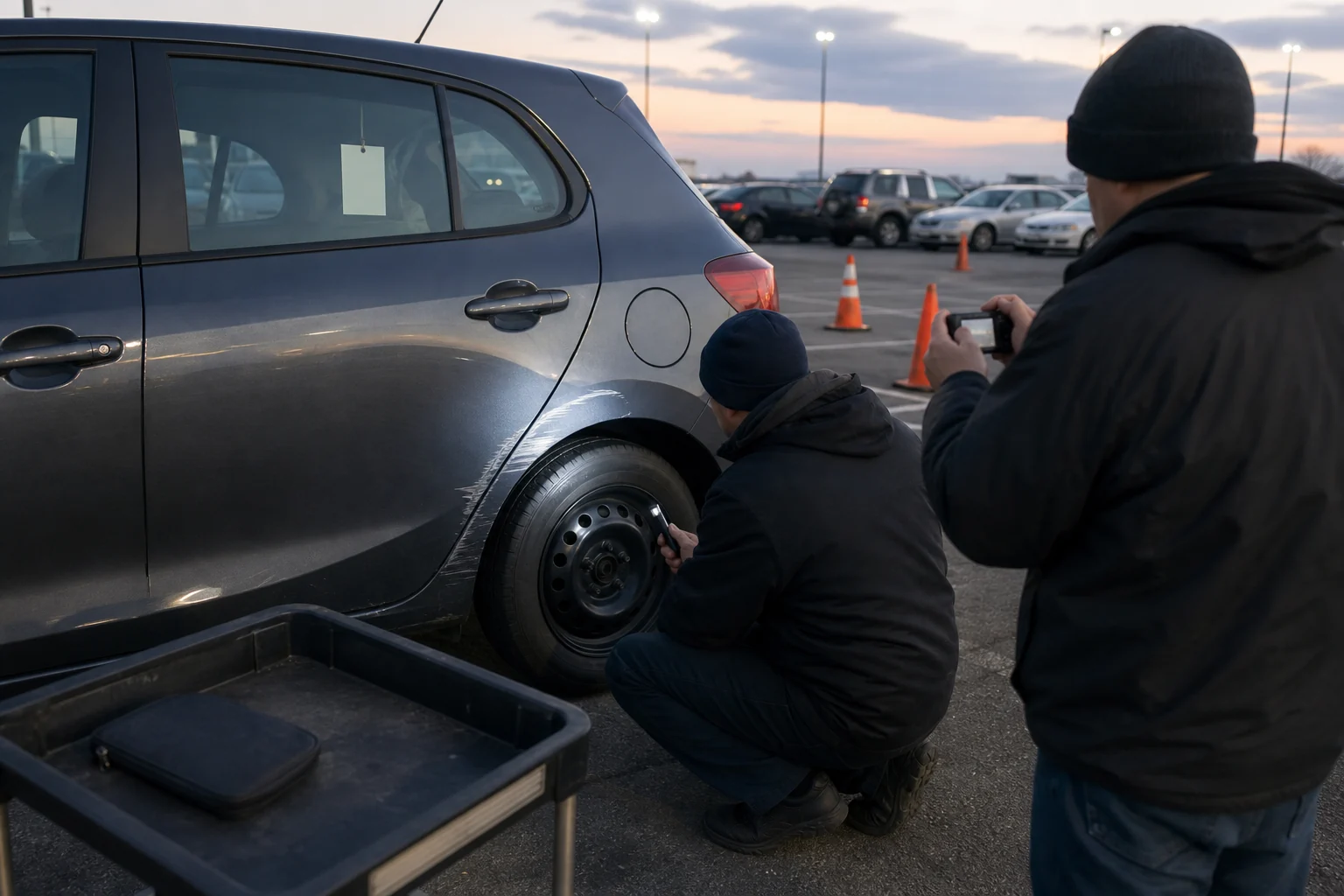
Rental-lot inspectors photograph a scraped rear wheel arch on an unbranded rental car during a return-lane condition check
Keep pickup, crash, recovery, return, inspection, repair, payment, and custody records in separate source-labeled condition states.

Quick answer

After a California rental-car crash, preserve the complete agreement and vehicle identity, then separate pickup, crash, recovery, return, and post-return condition records. Map each rental-company, insurer, tow, repair, agency, and renter-held source; document the handoff; and reconcile later damage claims without assuming that one photograph, estimate, waiver, or invoice proves fault or coverage.

Key takeaways

  • Preserve the complete rental agreement, vehicle identity, authorized-driver information, pickup condition, and any damage-waiver or coverage election before portals or links change.
  • Build separate pickup, crash, recovery, return, and post-return states; never describe a later inspection as if it showed the vehicle at pickup or at impact.
  • Photograph the whole vehicle and questioned area safely before a voluntary return, repair, wash, part replacement, or transfer when circumstances allow.
  • Map rental-company, insurer, credit-card, tow, repair, police, and renter-held sources separately because no single custodian necessarily has the complete record.
Hurt Advice Editorial Team

Prepared by

Hurt Advice Editorial Team

Editorial Research and Publishing Team

Source-checked editorial publishing

Why trust this article

Prepared by the Hurt Advice Editorial Team from current California Legislature, Department of Motor Vehicles, and Department of Insurance sources. No attorney reviewed this displayed version.

Recent update: Original publication with a rental transaction and vehicle identity sheet, five-state condition timeline, coverage-lane map, return handoff workflow, custodian map, damage-claim reconciliation ledger, neutral request scripts, checklist, mistakes, and FAQs.

At a glance

What this guide helps you decide

Start with the question that brought you here, identify the records that can verify the facts, and use the related guidance only where it helps. This article addresses car accidents questions in California.

Main question

Decide how this topic may apply to your situation

Use "Rental-Car Return and Damage Records After a California Crash" to sort the facts you know, the questions still open, and whether a car accidents resource or consultation may be useful in California.

Guide map

Start with the sections most relevant to you: Who this guide is for—and the exact task it solves, Quick takeaways, Contents: the eight record lanes

Move through the article by issue, not by guesswork, so liability, medical proof, insurance pressure, deadlines, and next steps stay connected.

Records to gather

Connect these subjects to your records: California Rental Car Records, Rental Car Return Inspection, Rental Vehicle Damage Claim, Pickup Condition Records

Compare the topic with records, photos, medical visits, police reports, insurer letters, and local claim details before relying on a general answer.

Trust check

Use the source trail before acting

This page includes 6 source references plus internal next-step paths so readers can verify where the guidance comes from.

Before you rely on this guide

This article is written for people dealing with injury-law questions in California. It is meant to help you understand the issue, not replace legal advice about your specific case.

What to do after this article

Start with the quick answer, skim the table of contents, and then use the links below to move into the practice area, author archive, or resource page that turns general guidance into a clearer next step for your situation.

Who this guide is for—and the exact task it solves

This guide is for a California renter, authorized driver, passenger, family member, or records organizer after a crash involving a traditional rental car.

The task is not to decide fault, whether a scrape is new, which contract term controls, or who must pay. It is to preserve the agreement and vehicle identity, separate pickup, crash, and return condition, map custodians, and reconcile later damage claims. The broad rental-car accident guide explains the claim lane. The borrowed-car liability article addresses owner and driver responsibility. This checklist owns the narrower return, condition-version, damage-claim, and record-custody job.

Hurt Advice is a lawyer referral and legal information service, not a law firm. This is general information, not legal, insurance, mechanical, or claims-handling advice. It does not establish coverage, breach, fault, causation, damages, admissibility, or responsibility. No attorney reviewed this displayed version.

Quick takeaways

  • Preserve the complete rental agreement, vehicle identity, authorized-driver information, pickup condition, and any damage-waiver or coverage election before portals or links change.
  • Build separate pickup, crash, recovery, return, and post-return states; never describe a later inspection as if it showed the vehicle at pickup or at impact.
  • Photograph the whole vehicle and questioned area safely before a voluntary return, repair, wash, part replacement, or transfer when circumstances allow.
  • Map rental-company, insurer, credit-card, tow, repair, police, and renter-held sources separately because no single custodian necessarily has the complete record.
  • Treat a damage invoice, photograph, estimate, waiver, or claim letter as one source—not automatic proof of when damage occurred, who caused it, or which coverage applies.

Contents: the eight record lanes

Use eight lanes: (1) rental transaction and vehicle identity, (2) pickup condition, (3) authorized drivers and coverage elections, (4) crash and immediate reporting, (5) tow, storage, and recovery, (6) return inspection and handoff, (7) post-return damage, repair, and claim records, and (8) deadlines, preservation, and next steps.

Create one vehicle identity sheet, one five-state condition timeline, one custodian map, one return handoff receipt, and one damage-claim reconciliation ledger. Keep general scene, witness, medical, and insurance material in the car-accident checklist so the rental-return file stays focused.

Start with the rental transaction and exact vehicle

Save the agreement as delivered, including pages, links, addenda, extensions, vehicle substitutions, additional drivers, optional products, locations, dates, rate terms, fuel or charging terms, mileage entries, and electronically accepted terms. Preserve the confirmation or app export, not only a screenshot.

Build a vehicle identity sheet from reliable sources: agreement and reservation numbers, VIN when available, plate, vehicle description, fleet or unit number, pickup odometer, fuel or charge, key identifier, location, and time. If a substitution occurred, preserve both records and the source linking the driver to the actual car.

California’s current passenger-vehicle rental statutes appear in Civil Code sections 1939.01 through 1939.37. The official California Legislature text addresses renter responsibility, damage claims, repair costs, insurance submission, and damage-waiver disclosures. Those rules do not answer a particular dispute without the agreement and facts.

Separate pickup condition from later condition

Preserve every pickup-condition source: walkaround photographs or video, app inspection, condition diagram, employee note, timestamp, parking-space location, key-release event, gate or exit record, odometer, fuel or charge level, and any damage reported before departure. Record whether an image shows the entire side, only a close-up, or an area hidden by lighting, rain, dirt, another vehicle, an open door, or the camera angle.

If damage was reported at pickup, save the original message, recipient, delivery status, response, and any revised condition record. Do not edit the original photograph or draw directly on the only copy. Preserve it, then make a separate working copy for arrows or notes. The digital-evidence preservation guide explains an original-copy-backup workflow.

A missing mark on a pickup diagram does not by itself prove the panel was undamaged. A close-up photograph does not establish the condition of areas outside its frame. Use careful labels such as “visible in pickup video,” “not shown,” “reported before departure,” “first photographed after crash,” and “first recorded at return.”

Build a five-state condition timeline

Create a row for each important vehicle area or record and five columns:

  1. Pickup: what the agreement, walkaround, app, gate, or witness actually shows before departure.
  2. Pre-crash use: driver or passenger observations, parking events, prior incident reports, warning lights, service contact, or other changes during the rental.
  3. Crash and recovery: scene photographs, impact area, resting position, debris, police or exchange records, tow method, and first storage location.
  4. Return: exact time, location, vehicle condition, mileage, fuel or charge, keys, receiving person or automated process, photographs, scanner entries, and written acknowledgment.
  5. Post-return: later inspection, wash, movement, disassembly, estimate, repair, sale, transfer, additional damage finding, invoice, demand, payment, or disposition.

Example: “Pickup video at 9:14 a.m. shows the right-rear quarter from six feet away; lower wheel arch is shadowed. Crash photo at 6:42 p.m. shows a scrape at that wheel arch. Tow intake at 8:03 p.m. records the vehicle as non-drivable but does not list panel damage. Rental return receipt at 10:17 a.m. next day lists keys and mileage; no inspection image attached. Damage email two days later includes three close-ups but no wide vehicle view.” This preserves the sequence and its limits without deciding cause.

Keep driver, waiver, and coverage records in separate lanes

Save the names and status of the renter, each additional or authorized driver, and the person operating the car at the relevant time. Preserve license-verification entries and any later driver addition or removal. Do not circulate unnecessary license images, addresses, payment-card data, or unrelated travel details; use minimum necessary copies and secure storage.

Keep three different items separate: the rental company’s damage waiver, any liability or other product sold with the rental, and coverage that may exist under a personal or business auto policy or credit-card benefit. The California Department of Insurance warns that not every auto policy automatically covers rental vehicles and that personal vehicle-sharing programs may be treated differently. Its current rental-car coverage alert recommends verifying policy and credit-card terms rather than assuming coverage.

Preserve the election or declination, policy declarations, relevant endorsements, claim number, benefit guide, notice requirements, deductible information, and communications. A damage waiver is not the same thing as liability insurance, and a credit-card benefit is not the rental agreement. Do not summarize all three as “rental insurance.”

Preserve crash reports and the reporting clock

Follow safety, emergency, law-enforcement, and medical directions first. Save the exchange information, police or CHP incident number, report-request receipt, scene photographs, witness contacts, insurer notice, rental-company incident report, and every reference number. Record the source of each time instead of forcing one clock to control all events.

The California DMV’s current SR-1 reporting page says the driver, insurance representative, or legal representative must submit an SR-1 within 10 days when anyone is injured or killed or property damage exceeds $1,000. It also says the SR-1 is required in addition to a police, CHP, or insurer report. Verify the current rule and facts; the rental company’s report does not automatically complete the driver’s DMV task.

Preserve proof of submission and a copy of what was sent. Keep the DMV report, police report, rental incident form, insurer notice, and personal notes as distinct sources because their purposes, fields, authors, and timing may differ.

Document tow, storage, access, and return

If the vehicle is towed, record who requested the tow, dispatch number, operator, truck, pickup time, method, destination, yard intake, inventory, photographs, access, release authority, fees, and later transfer. The tow and storage records guide provides a vehicle-level custody workflow.

Before a voluntary return when safe and possible, make wide photographs of all four sides, corners, wheels, roof, glass, interior, odometer, fuel or charge level, keys, and the questioned area in context. Do not move a dangerous vehicle, enter a restricted yard, interfere with a lien or lawful hold, or delay necessary safety work just to make evidence.

At return, record the exact location, date and time; receiving employee or automated lane; vehicle mileage; fuel or charge; key handoff; visible condition; whether an inspection occurred; whether the renter was present; any scanner, photo, or video process; and the receipt or acknowledgment. If the lot accepts an after-hours return, document the drop location and instructions without photographing other customers’ private material.

Reconcile a post-return damage claim

Create one ledger entry for every claimed item with: vehicle area; first source showing it; pickup visibility; crash visibility; return visibility; inspection date; photograph date and context; estimate line; repair line; part or labor description; administrative or loss-of-use item; payment or credit; custodian; and unresolved question.

California Civil Code sections 1939.05 and 1939.07, in the official rental-statute source above, address components of renter damage claims and require a claim to be reasonably related to actual loss. Preserve the estimate, supplements, final invoice, photographs, repair dates, discounts, payments, salvage or total-loss material, and any insurer submission. Do not assume the demand equals the final repair cost, and do not assume a difference proves wrongdoing.

Compare the rental-company material with the crash repair-estimate guide. Mark each line as estimated, supplemented, performed, paid, credited, withdrawn, disputed, or unknown. Keep injury, liability, vehicle-damage, and contract questions separate even if one email discusses all of them.

Use a custodian map

Renter or driver: agreement, app exports, original media, messages, receipts, identity, pickup observations, incident notice, return receipt, insurer communications, and payments.

Rental company: reservation, terms, vehicle assignment, condition versions, key and gate events, employee notes, incident file, tow authorization, return scan, photographs, inspection, estimate, repair, claim ledger, payment, and disposition.

Insurer or benefit administrator: policy or benefit terms, notice, coverage position, submissions, estimates, payments, subrogation communications, and closure status.

Tow, repair, auction, or vehicle custodian: dispatch, intake, photographs, access, authorization, teardown, supplement, repair, replaced parts, storage, transfer, sale, or disposal.

Agency or responder: incident number, report, dispatch, photographs or video when applicable, tow record, and public-record response. A request does not guarantee that a record exists or will be produced.

Neutral preservation and records-request scripts

Rental company: “Please preserve the existing records for rental agreement [identifier] and vehicle [VIN or fleet/unit identifier] for [focused date range], including agreement versions, vehicle assignment or substitution, authorized drivers, pickup and return condition records, app or scanner entries, gate and key events, incident notice, tow or transfer, photographs and video, inspection, estimate, supplement, repair, payment, claim ledger, and disposition. Please preserve original timestamps, attachments, source identifiers, and version history, and identify the custodian for records you do not maintain. This request does not ask you to create a new opinion.”

Insurer or benefit administrator: “Please provide or preserve the applicable policy, endorsement, benefit guide, claim notices, coverage communications, estimates, supplements, payments, submissions received from the rental company, and closure or subrogation status for claim [identifier]. Please keep each source and attachment in its original form.”

Use verified channels. Save the request, delivery proof, acknowledgment, response, objection, production, and follow-up. These scripts are organizational aids, not subpoenas, legal demands, guarantees of retention, or substitutes for advice about a particular dispute.

Preserve digital integrity without overstating admissibility

California Evidence Code section 250 defines “writing” broadly to include photographs, sounds, and records stored in any manner. That definition does not make every file accurate or admissible. Preserve originals, metadata, export method, source, device or system, creator or custodian, date received, and ordinary handling.

Keep untouched originals separately from compressed emails, screenshots, annotations, and comparison boards. Do not rename the only copy in a way that loses its original identifier. Do not represent a screenshot as a complete app record or a cropped image as the full scene. When the rental company sends later photographs, preserve the transmission and ask what date, time, location, vehicle identifier, camera, and inspection step the files reflect.

Timing and process checkpoints

Immediately: address safety and care; follow reporting directions; preserve the agreement, vehicle identity, scene material, incident numbers, and original communications.

Before voluntary return or transfer: document overall condition and the questioned area when safe; record mileage, fuel or charge, keys, receiving method, and any custody handoff.

When a damage claim arrives: preserve the complete package and attachments; build the five-state timeline and reconciliation ledger; request the source, inspection, estimate, repair, payment, and coverage records needed to understand each line.

California Code of Civil Procedure section 335.1 states a two-year period for an action for injury or death caused by another’s wrongful act or neglect. California Government Code section 911.2 generally requires a claim relating to injury to person or personal property against a public entity to be presented within six months after accrual. Accrual, exceptions, defendant identity, contract issues, and other deadlines can change the analysis. The California deadline resource is background only; seek individual legal advice promptly when timing may matter.

Rental-car return and damage evidence checklist

  • Complete rental agreement, addenda, extensions, substitutions, authorized-driver entries, optional-product elections, and original electronic delivery.
  • Vehicle identity sheet with agreement and reservation numbers, VIN or fleet identifier, plate, vehicle description, pickup and return locations, odometer, fuel or charge, and key identifier.
  • Original pickup and return walkarounds, app exports, condition diagrams, gate or key events, messages, receipts, and full-context photographs.
  • Crash exchange, agency or police number, SR-1 copy and submission proof when required, rental incident report, insurer notice, and witness or scene sources.
  • Tow dispatch, intake, access, storage, transfer, release, estimate, supplement, repair, replaced-part, payment, and disposition records.
  • Five-state condition timeline separating pickup, pre-crash use, crash and recovery, return, and post-return activity.
  • Damage-claim ledger connecting every claimed line to its first source, estimate, performed repair, payment or credit, custodian, and unresolved question.
  • Minimum-necessary privacy copies with payment-card data, unrelated travel details, and other customers’ information excluded or secured.

Mistakes and red flags

  • Returning, washing, repairing, dismantling, or transferring the vehicle without documenting the condition and handoff when safe circumstances allowed.
  • Treating a pickup diagram, later close-up, estimate, invoice, or damage-waiver election as a complete answer to when damage occurred or who owes payment.
  • Calling the waiver, rental product, personal auto policy, and credit-card benefit by one label such as “rental insurance.”
  • Assuming the rental company filed the driver’s DMV SR-1 or that a police report replaced a separate reporting obligation.
  • Mixing scene photographs, tow intake, return inspection, later estimate, repair, and payment into one undated condition description.
  • Using only screenshots when agreement versions, app exports, original photographs, attachments, or claim-system records are available.
  • Sharing full driver-license, payment-card, travel, or passenger details when a narrower record would serve the task.
  • Stating that missing footage, an unmarked pickup diagram, a delayed demand, or a changed estimate automatically proves fault or bad faith.

Careful next steps

Finish the identity sheet, five-state timeline, custodian map, return receipt, and claim ledger. Use precise labels: “shown at pickup,” “reported during rental,” “first photographed after crash,” “received at return,” “inspected later,” “estimated,” “repaired,” “paid,” and “unknown.”

If a rental company, insurer, benefit administrator, tow yard, or repair facility requests action, preserve the request and clarify the vehicle, claim, deadline, authority, scope, attachments, payment, transfer, and disposition before responding when circumstances allow. Do not delay emergency, lawful agency, or necessary safety action.

Hurt Advice can connect people with independent California lawyers through the contact page, but it does not promise representation or an outcome. This article was prepared by the Hurt Advice Editorial Team from the official sources listed below. No attorney reviewed this displayed version. See the editorial standards for sourcing, corrections, and autonomous-article disclosure.

Frequently Asked Questions

What rental-car records should I preserve after a California crash?
Preserve the complete rental agreement and addenda, actual vehicle identity, authorized drivers, optional-product elections, pickup condition, original crash media, incident numbers, tow and storage records, return receipt and inspection, insurer or credit-card claim material, damage estimates, repairs, payments, and disposition. Keep each custodian and condition state separate.
Should I photograph a rental car before returning it after a crash?
When it is safe, lawful, and does not interfere with emergency, tow, yard, insurer, or agency directions, make wide photographs of all sides and closer context images of questioned areas. Record mileage, fuel or charge, keys, return location, time, and receiving method. Do not move or manipulate an unsafe vehicle merely to create evidence.
Does a rental-company damage invoice prove the renter caused the damage?
No. An invoice or demand is one source. Compare it with the agreement, pickup condition, crash and recovery photographs, tow intake, return inspection, estimate, supplements, performed repair, payments, and other possible events. The records may be relevant without independently proving when damage arose, who caused it, coverage, or legal responsibility.
Is a rental-car damage waiver the same as auto insurance?
No. A rental-company damage waiver, a product sold with the rental, personal or business auto insurance, and a credit-card benefit are different sources with different terms. Preserve the election or declination and each applicable contract or policy, then ask the relevant company to explain coverage rather than assuming the label “rental insurance” answers the question.
Who may hold rental-car return and damage records?
Depending on the facts, sources may be held by the renter, additional driver, rental company or franchise, insurer, credit-card benefit administrator, tow yard, storage facility, repair shop, auction or later custodian, law-enforcement agency, DMV, witnesses, or a nearby camera owner. Request focused existing records and identify unavailable or unknown sources without claiming they exist.
Does the rental company file the California DMV SR-1 for the driver?
Do not assume so. DMV says the driver, insurance agent, broker, or legal representative must submit an SR-1 within 10 days when anyone is injured or killed or property damage exceeds $1,000, and that it is separate from a police, CHP, or insurer report. Verify the current rule and preserve submission proof for the actual filing.

Sources and references

Current passenger-vehicle rental statutes addressing agreements, renter responsibility, damage claims, repair costs, insurance submission, and damage-waiver disclosures.

Need help after an accident?

Hurt Advice intake team can review your situation, explain your options, and help you move forward with a plan that fits your case.