
Legal ExplainerCar AccidentsChecklist / Process

Repair Estimates After a California Injury Crash: What to Keep

A useful crash repair file preserves every estimate version and explains exactly what changed. Separate insurer and shop records, authorizations, supplements, invoices, photographs, payments, and total-loss inputs; reconcile them line by line; and keep property condition distinct from medical, mechanics, fault, and value conclusions.

Published

July 22, 2026

Updated

July 22, 2026

Reading time

11 min read

Jurisdiction

California

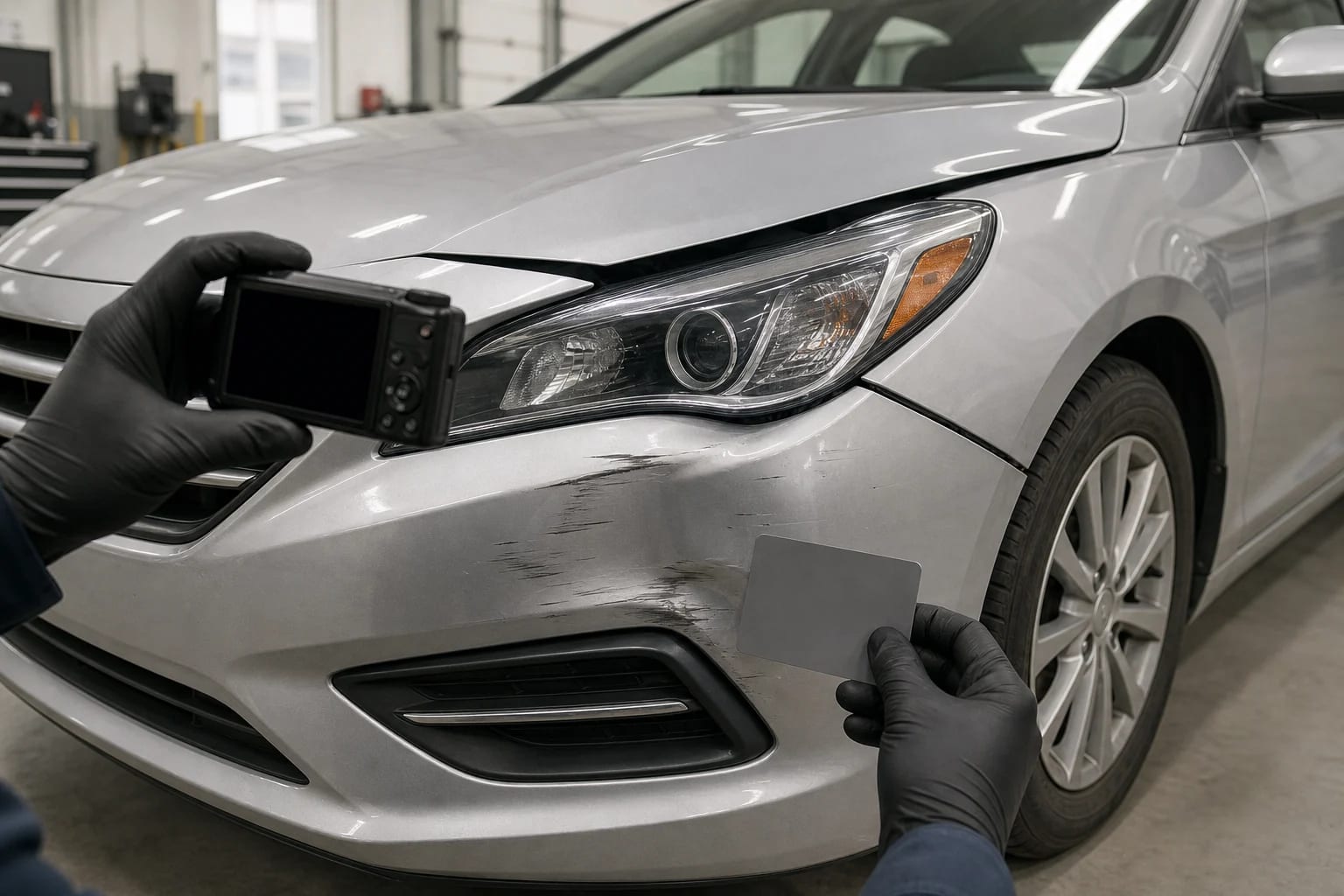
Gloved technician photographs scuffing on an unbranded silver car in a clean collision repair bay
A reliable repair file keeps each estimate, authorization, supplement, photograph, invoice, and valuation as a separate dated source.

Quick answer

Keep every insurer and shop estimate, tear-down authorization, supplement, final invoice, photograph, payment, and valuation as a separate dated version. Reconcile parts, labor, authorizations, and totals line by line, and do not treat vehicle damage or repair cost as proof of injury severity, causation, fault, or case value.

Key takeaways

  • Keep the insurer estimate, repair-shop estimate, tear-down authorization, every supplement, final invoice, payment record, and total-loss valuation as separate dated versions.
  • Photograph the vehicle before repair and after each newly exposed condition; preserve original files, claim numbers, estimate identifiers, odometer, and who created each record.
  • Reconcile parts, labor, procedures, prior damage, taxes, fees, customer authorizations, and insurer payments line by line instead of relying on the bottom-line total.
  • Vehicle damage can document property condition and repair history, but it does not by itself prove injury severity, medical causation, crash mechanics, fault, or claim value.
Hurt Advice Editorial Team

Prepared by

Hurt Advice Editorial Team

Editorial Research and Publishing Team

Source-checked editorial publishing

Why trust this article

Prepared by the Hurt Advice Editorial Team from the California Bureau of Automotive Repair’s January 2026 documentation guidance, California Department of Insurance consumer guidance, the Judicial Council’s 2026 civil instructions, and California limitations law. No attorney reviewed this displayed version.

Recent update: Original publication with a six-family repair record map, estimate version log, line-by-line reconciliation tool, authorization and invoice workflow, total-loss valuation checklist, neutral request script, evidence boundaries, and deadline cautions.

At a glance

What this guide helps you decide

Start with the question that brought you here, identify the records that can verify the facts, and use the related guidance only where it helps. This article addresses car accidents questions in California.

Main question

Decide how this topic may apply to your situation

Use "Repair Estimates After a California Injury Crash: What to Keep" to sort the facts you know, the questions still open, and whether a car accidents resource or consultation may be useful in California.

Guide map

Start with the sections most relevant to you: Quick takeaways, Who this guide is for—and the narrow task it solves, Start with six separate record families

Move through the article by issue, not by guesswork, so liability, medical proof, insurance pressure, deadlines, and next steps stay connected.

Records to gather

Connect these subjects to your records: Collision Repair Estimate, Insurer Estimate, Repair Supplement, Work Authorization

Compare the topic with records, photos, medical visits, police reports, insurer letters, and local claim details before relying on a general answer.

Trust check

Use the source trail before acting

This page includes 5 source references plus internal next-step paths so readers can verify where the guidance comes from.

Before you rely on this guide

This article is written for people dealing with injury-law questions in California. It is meant to help you understand the issue, not replace legal advice about your specific case.

What to do after this article

Start with the quick answer, skim the table of contents, and then use the links below to move into the practice area, author archive, or resource page that turns general guidance into a clearer next step for your situation.

Quick takeaways

  • Keep the insurer estimate, repair-shop estimate, tear-down authorization, every supplement, final invoice, payment record, and total-loss valuation as separate dated versions.
  • Photograph the vehicle before repair and after each newly exposed condition; preserve original files, claim numbers, estimate identifiers, odometer, and who created each record.
  • Reconcile parts, labor, procedures, prior damage, taxes, fees, customer authorizations, and insurer payments line by line instead of relying on the bottom-line total.
  • Vehicle damage can document property condition and repair history, but it does not by itself prove injury severity, medical causation, crash mechanics, fault, or claim value.

Who this guide is for—and the narrow task it solves

This guide is for a California driver, passenger, vehicle owner, family member, or representative organizing repair and valuation records after a crash that also involved an injury question. Its reader task is narrow: preserve the vehicle’s condition, identify every estimate version, reconcile what changed, and keep the property file linked to—but distinct from—the medical and liability files.

The California car-crash guide covers the broader claim area. The post-crash checklist addresses scene, insurance, treatment, and follow-up tasks. The digital-evidence guide focuses on phones, video, vehicle data, and electronic preservation. This article owns a different job: insurer and shop estimates, authorization history, supplements, invoices, repair completion, and total-loss valuation inputs.

A repair document does not diagnose an injury, reconstruct a collision, establish legal responsibility, or predict a settlement. Do not delay medical care or operate an unsafe vehicle to finish a recordkeeping task. If the car may be unsafe, follow qualified towing, inspection, repair, and manufacturer guidance.

Start with six separate record families

Do not place every PDF called an “estimate” into one undifferentiated folder. Create six source-labeled families:

  1. Condition evidence: scene photographs, tow-yard views, walk-around video, close-ups, odometer, warning lights, keys, loose parts, and the vehicle’s location.
  2. Insurer records: claim acknowledgment, adjuster estimate, photographs or scan report, valuation, comparable vehicles, deductions, payments, deductible, and written explanations.
  3. Repair-facility records: shop estimate, tear-down estimate, work order, customer authorization, supplements, parts information, sublet work, final invoice, and completion photographs.
  4. Ownership and value: registration, title or lienholder information, purchase record, trim and options, mileage history, maintenance, upgrades, and pre-crash condition photographs.
  5. Expense and use: towing, storage, rental or substitute transportation, rides, mileage, parking, and payment records, subject to policy and legal review.
  6. Injury and liability: police and witness sources, medical records, work records, and other loss evidence. Keep this linked, but never merge its conclusions into the repair file.

Give every file a received date and source. Preserve the original filename and save a working copy with a neutral name such as 2026-07-22_insurer-estimate_v1_received.pdf. Do not rename a shop estimate as a final bill or label an insurer’s photograph-based view as a complete inspection.

The first preservation pass before repair or tear-down

Begin with the condition that actually exists. If safe and lawful, photograph the exterior from all four corners, each side, front, rear, roof, wheels, underbody areas visible without crawling under an unstable vehicle, interior, restraints, child seats, cargo, warning lights, odometer, and every damaged or transferred area. Record location, date, time, photographer, and whether the vehicle had been moved, opened, washed, towed, or partly disassembled.

Keep original image and video files. Exporting screenshots, adding arrows, compressing a messaging attachment, or stripping metadata can make a copy easier to share, but it should not replace the original. Save tow intake photographs, auction or storage-yard images, police photographs if lawfully available, and the insurer or shop image set rather than assuming your own photographs show the same condition.

Before authorizing work, ask what inspection or tear-down is proposed, what will be removed, whether reassembly is possible, what it costs, who will photograph newly exposed conditions, and how parts and records will be handled. Do not demand that a shop keep a part it cannot lawfully or practically return; ask early, obtain a written response, and get case-specific advice if a component may be important.

Build a version map instead of comparing only totals

Use one row for each document. Record: document title; creator; date and time; claim, estimate, repair-order, or supplement number; vehicle identifier used; mileage; inspection method; status; total; and the version it replaces or supplements. A practical status list is insurer preliminary, shop initial, tear-down authorized, supplement requested, supplement approved, repair completed, final invoice, or total-loss valuation.

Then make a change log. For each later version, identify added or removed operations, parts classification, labor category or hours, paint and materials, calibration or scan, sublet work, tax, fees, deductible, betterment or prior-damage item, and insurer-paid versus customer-authorized amount. Quote the actual line and page rather than paraphrasing it into a conclusion.

“Estimate increased by $4,280” is incomplete. A source-labeled entry is better: “Shop supplement 2, dated July 22, added right apron repair, headlamp replacement, pre- and post-scan, and alignment; insurer response dated July 23 approved three lines and requested documentation for two.” This records the sequence without saying which position is correct.

Use a line-by-line reconciliation tool

For each disputed or changed line, keep these fields:

  • Component or operation: plain-language location and the exact estimate wording.
  • Version history: absent, repair, replace, inspect, calibrate, sublet, or removed in each dated document.
  • Part description: OEM, non-OEM aftermarket, used, rebuilt, reconditioned, or another label exactly as stated.
  • Support: photograph number, measurement or scan report, manufacturer procedure if supplied, shop note, invoice, or other identified source.
  • Authorization: who authorized what, how, and when; attach the written, oral, or electronic record described by the shop.
  • Payment position: requested, approved, denied, pending, customer-paid, deductible, or unknown.
  • Outcome: performed, not performed, changed, returned, unresolved, or not verified.

Do not convert “approved by insurer” into “required for safe repair,” or “listed by shop” into “caused by this collision.” Those may be related issues, but each needs its own support. If prior damage appears in a valuation or estimate, preserve pre-crash photographs, maintenance and repair records, and the exact basis offered rather than erasing the unfavorable entry.

What California repair documentation should show

The California Bureau of Automotive Repair’s January 2026 Write It Right guide summarizes current documentation and authorization requirements. It says a repair estimate is a paper or electronic document containing an estimated parts-and-labor price for a specific job, and a repair dealer generally needs an estimate before performing repairs. The guide states that a collision estimate must be itemized, and a new replacement crash part must be identified as OEM unless the estimate specifically identifies it as non-OEM aftermarket or used.

The same official guide explains that customer authorization must be obtained and recorded before repairs begin; written, oral, and electronic authorization have specified record details. Additional repairs call for a revised work order describing additional parts and labor, their cost, the revised total, and the customer’s authorization. A final invoice should itemize work and parts and identify whether parts are new, used, reconditioned, rebuilt, OEM, or non-OEM aftermarket as applicable.

Use those records as documents, not as automatic proof that every item was needed, paid, performed, or crash-related. Save the estimate that was actually authorized, every authorization message, the insurer estimate attached or referenced by the shop, supplements, and the final invoice. If the shop uses a third-party payor estimate, preserve both documents and their identifiers.

Keep the insurance claim timeline source-labeled

The California Department of Insurance’s consumer guide for an auto accident describes “proof of claim” as documentation in the claimant’s possession supporting the existence or amount of loss, including a repair estimate. Its overview says insurers generally must acknowledge a claim, begin investigation, provide forms and reasonable assistance within 15 days of notice; respond to communications within 15 days; and accept or deny within 40 days after receiving proof of claim. The page expressly describes this as a paraphrased overview of fair-claims regulations.

Do not treat those numbers as a promise that one estimate completes proof, that every issue must resolve on that date, or that the same clock applies to every communication. Record the notice date, what proof was sent, delivery, insurer acknowledgment, requests for more information, each response, and any written extension or explanation. Policy language, claim type, disputed facts, and governing regulations matter.

When the insurer and shop differ, ask each side to identify the exact line, document, inspection, photograph, procedure, or policy provision supporting its position. Keep the response neutral. The car-accident claim-process guide provides broader orientation; this version map is the repair-record tool within that process.

If the vehicle may be a total loss

Separate the repair file from the valuation file. The California Department of Insurance guide says actual cash value generally means fair market value unless the policy defines it otherwise. Its fair-claims overview says a total-loss settlement should reflect a comparable vehicle of like kind and quality and include taxes, license, and transfer fees; if the owner keeps the salvage, the salvage deduction should be fair, measurable, and discernible.

Request the full valuation report and record VIN decoding, trim, options, mileage, condition adjustments, prior damage, comparable vehicles, source dates, location, dealer or private-party status, taxes and fees, deductible, lienholder, salvage deduction, and any owner-retained-salvage election. Check each comparable against the actual listing or source while it is available. Save screenshots or PDFs with the access date, but do not alter them.

The CDI guide also explains that many standard policies contain an appraisal provision for disputes about the amount of a total-loss settlement. Read the actual policy before describing that option as available. An appraisal clause may address amount of loss; it does not automatically resolve coverage, fault, injury causation, or every legal dispute.

After repairs, verify the final record

Compare the final invoice with the last authorized work order and every approved supplement. Confirm that the vehicle identifier and mileage are correct, all performed work is itemized, parts classifications are stated, sublet work is identified, and totals reconcile with insurer payments, deductible, and any customer payment. Preserve warranties, calibration or scan reports actually provided, alignment or measurement records, completion photographs, and delivery acknowledgment.

If something appears incomplete, photograph the condition before additional work and ask the shop for a written explanation. The Bureau of Automotive Repair’s no-cost collision repair inspection page says its program can inspect collision repairs performed in California after the requester purchased the vehicle, check whether listed repairs are complete, and explain options if problems are found. The page also says the program does not provide a second estimate.

That inspection is a consumer resource, not a substitute for emergency safety action, a manufacturer procedure, an independent valuation, crash reconstruction, or legal advice. Record what was requested, the inspection date, vehicle condition, documents reviewed, findings received, and any later repair.

Do not use repair cost as a medical conclusion

A low estimate does not prove that no one was injured. A high estimate does not prove severe injury. Repair totals can change because of vehicle design, parts prices, labor operations, hidden damage, prior damage, insurer methods, shop methods, calibration, paint, availability, and whether the vehicle is repaired or totaled. Medical questions require clinical history, examination, testing when appropriate, treatment, and qualified opinion.

The Judicial Council’s 2026 CACI resource center publishes current California civil instructions covering negligence, causation, evidence, property damage, medical expenses, and other damages topics. Which instructions and evidence standards apply depends on the case and court rulings. A repair estimate is one source; it does not decide the full legal analysis.

Link the property file to the California injury-proof guide with identifiers and dates, but keep observations separate. “Insurer estimate lists left-front bumper repair” is a sourced property fact. “That proves the occupant’s shoulder diagnosis” is an unsupported leap.

A neutral request for the complete repair file

You can adapt this script to the actual recipient:

“Please provide the complete repair and valuation file for claim [number] and vehicle [year/make/model or VIN ending]. Please include every insurer estimate, shop estimate, tear-down authorization, work order, supplement, response, photograph or scan report, parts and labor line, valuation and comparable-vehicle source, prior-damage adjustment, customer authorization, payment record, final invoice, and completion or calibration record. Please preserve each document’s original date, identifier, and version relationship. This request seeks the existing record and does not state that any item was required, performed, caused by the crash, covered, or medically significant.”

Send it to the correct insurer, repair facility, tow or storage provider, vehicle owner, or other record holder. Keep delivery and response proof. Do not represent that the request creates a duty, guarantees production, changes policy requirements, or pauses a deadline. A licensed attorney can assess formal preservation, discovery, subpoena, inspection, or expert procedures.

Timing, mistakes, and red flags

Move quickly enough to preserve short-lived records and vehicle condition, but do not rush into unsafe inspection or unnecessary disassembly. California Code of Civil Procedure section 335.1 states a two-year period for an action for injury to or death of an individual caused by another’s wrongful act or neglect. That is not a universal deadline calculation. Accrual, tolling, public entities, minors, defendants, policy or contract duties, property claims, and other statutes can change the result.

  • Saving only the latest PDF: supplements make earlier versions part of the story.
  • Comparing totals only: line changes, authorizations, and payment positions matter.
  • Calling an estimate an invoice: proposed work and completed billed work are different records.
  • Editing originals: annotate a copy and preserve original files and metadata.
  • Ignoring prior damage: preserve it accurately and identify the source of any dispute.
  • Assuming insurer approval equals customer authorization: record both separately.
  • Signing away salvage or ownership without reading: preserve the offer, election, title, lienholder, and policy terms first.
  • Using damage as a diagnosis: keep property, mechanics, medical, liability, and damages opinions in their proper lanes.

A record request, repair negotiation, appraisal discussion, medical care, or insurance payment does not necessarily pause a legal clock. Obtain a fact-specific deadline review early.

A seven-step next-action checklist

  1. Address medical and vehicle safety first; tow or restrict use when qualified guidance calls for it.
  2. Photograph the vehicle and preserve original files before repair, cleaning, tear-down, salvage transfer, or disposal.
  3. Create the six record families and label every file by source, received date, identifier, and status.
  4. Build the estimate version map and reconcile every added, removed, approved, denied, authorized, and completed line.
  5. If total loss is proposed, preserve the full valuation, comparables, adjustments, fees, salvage terms, lienholder information, and actual policy language.
  6. Compare the final invoice and completion records with the last authorized work order and supplements; document unresolved differences.
  7. Keep repair facts separate from medical and legal conclusions, and obtain qualified California advice before evidence disappears or a deadline expires.

Hurt Advice is a lawyer-referral and legal-information service, not a law firm. This article provides general educational information, not repair, engineering, insurance, medical, or legal advice. No attorney reviewed this displayed version. A licensed California attorney can evaluate the actual vehicle records, policy, parties, injuries, evidence, and deadlines. You can use the Hurt Advice contact page to request a referral.

Frequently Asked Questions

Which repair estimates should I keep after a California crash?
Keep every version: the insurer estimate, repair-shop estimate, tear-down authorization, work order, each supplement and response, final invoice, photographs or scan reports, payments, and any total-loss valuation. Label each by creator, date, identifier, inspection method, status, and the version it changes.
Why is the repair-shop estimate different from the insurer estimate?
The documents may come from different inspections, dates, methods, and payment roles. Tear-down can expose additional conditions, and a shop may submit supplements. Reconcile each changed parts, labor, procedure, authorization, and payment line instead of assuming either bottom-line total tells the whole story.
Can a shop perform additional repairs without another authorization?
California BAR’s current guide says additional repairs or charges call for a revised work order describing the additional parts and labor, their cost, the revised total, and customer authorization recorded on the work order and invoice. Preserve the actual authorization and ask BAR or qualified counsel about a specific dispute.
What should I request when an insurer declares my car a total loss?
Request the complete valuation report, vehicle configuration, mileage, condition adjustments, prior damage, comparable vehicles and source dates, taxes and transfer fees, deductible, lienholder, salvage value, and any owner-retained-salvage terms. Read the actual policy before relying on an appraisal provision.
Does a low repair estimate mean the crash could not cause an injury?
No. Repair cost can vary with parts, labor, design, hidden damage, prior damage, methods, and valuation decisions. It does not independently diagnose injury or establish force, medical causation, fault, or case value. Medical and technical questions require their own evidence and qualified analysis.
What is the deadline for a California injury claim after a vehicle crash?
Code of Civil Procedure section 335.1 states a general two-year period for injury caused by another’s wrongful act or neglect, but it is not universal. Accrual, tolling, public entities, minors, defendants, contracts, property claims, and other law can change the result, so obtain a fact-specific calculation early.

Sources and references

Need help after an accident?

Hurt Advice intake team can review your situation, explain your options, and help you move forward with a plan that fits your case.