
Legal ExplainerBrain InjuryChecklist / Process

Neuropsychological Testing Records After a California Brain Injury

This practical California guide helps injured people and families identify a neuropsychological evaluation event, request the maintained patient-accessible record, preserve report versions, and organize clinical and everyday-function sources without self-scoring tests or making medical or legal conclusions.

Published

August 3, 2026

Updated

August 3, 2026

Reading time

11 min read

Jurisdiction

California

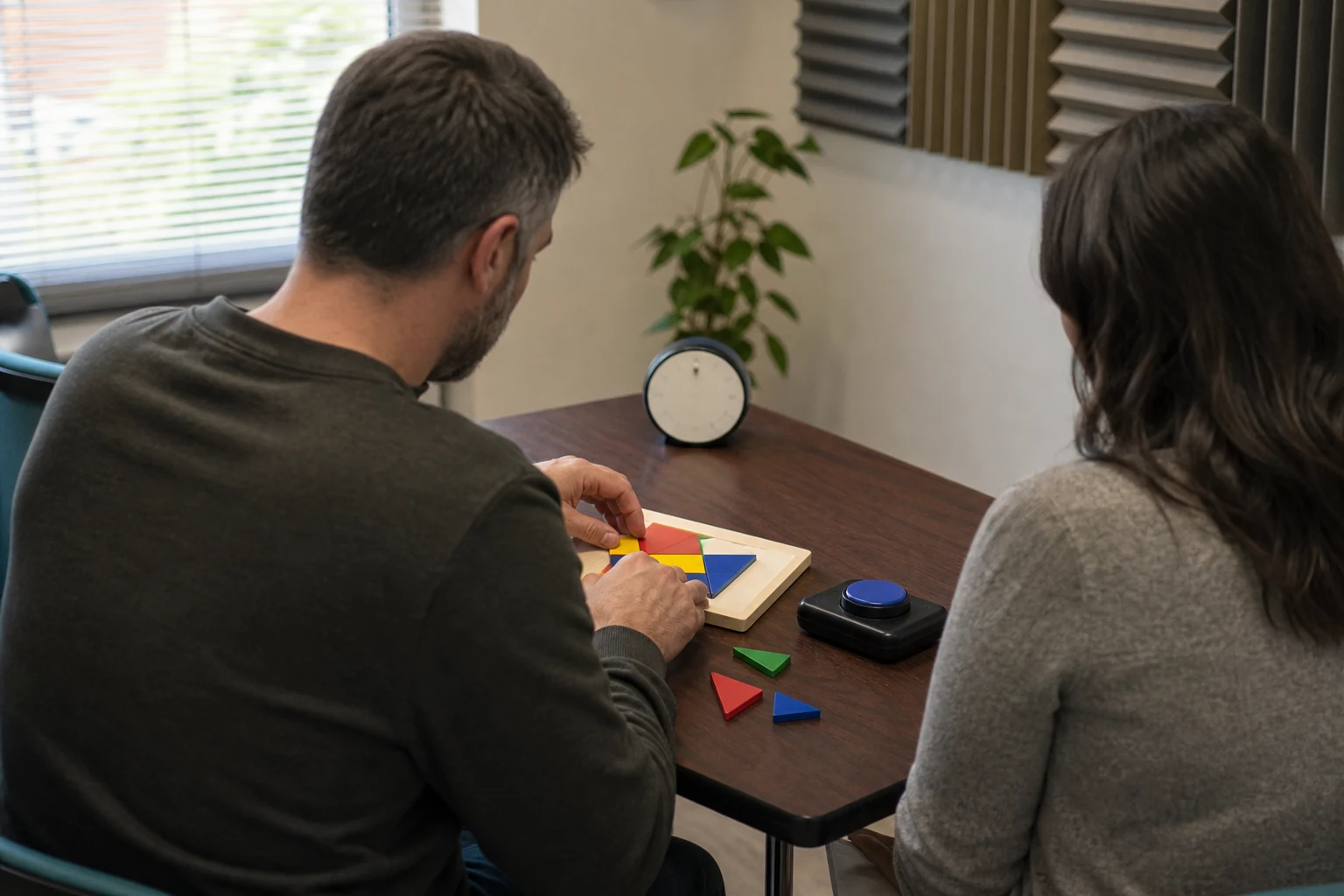
Adult completes an unbranded geometric pattern task while a neuropsychology clinician observes in an outpatient assessment room
Keep the referral question, test event, maintained report, scores, observations, collateral sources, and later versions in separate source-labeled lanes.

Quick answer

After a California brain injury, identify the evaluator and exact test event; request the maintained report and other patient-accessible records; preserve each version; and separate history, scores, observations, and everyday function sources. Do not self-score materials or treat one result as a diagnosis, cause opinion, disability rating, or legal conclusion.

Key takeaways

  • Identify the evaluator, referral question, evaluation dates, setting, and report status before requesting records.
  • Keep history, test output, behavioral observations, and everyday-function evidence in separate source lanes.
  • Preserve the original report and every later addendum or corrected version; never overwrite one version with another.
  • A score, symptom, imaging result, or work problem is one source—not a self-proving diagnosis or legal conclusion.
Hurt Advice Editorial Team

Prepared by

Hurt Advice Editorial Team

Editorial Research and Publishing Team

Source-checked editorial publishing

Why trust this article

Prepared by the Hurt Advice Editorial Team from the current official California Legislature, HHS, CDC, and VA sources cited on this page. No attorney reviewed this version. Hurt Advice is a lawyer referral and legal information service, not a law firm.

Recent update: Original publication created with a test-event identity map, four-lane source map, report-version ledger, neutral request scripts, access and amendment boundaries, and current official citations.

At a glance

What this guide helps you decide

Start with the question that brought you here, identify the records that can verify the facts, and use the related guidance only where it helps. This article addresses brain injury questions in California.

Main question

Decide how this topic may apply to your situation

Use "Neuropsychological Testing Records After a California Brain Injury" to sort the facts you know, the questions still open, and whether a brain injury resource or consultation may be useful in California.

Guide map

Start with the sections most relevant to you: Who this guide helps and what it does, Put safety and clinical care before record collection, Build a test-event identity sheet first

Move through the article by issue, not by guesswork, so liability, medical proof, insurance pressure, deadlines, and next steps stay connected.

Records to gather

Connect these subjects to your records: California Neuropsychological Testing Records, Brain Injury Evaluation Report, Cognitive Testing Records, Report Version Ledger

Compare the topic with records, photos, medical visits, police reports, insurer letters, and local claim details before relying on a general answer.

Trust check

Use the source trail before acting

This page includes 6 source references plus internal next-step paths so readers can verify where the guidance comes from.

Before you rely on this guide

This article is written for people dealing with injury-law questions in California. It is meant to help you understand the issue, not replace legal advice about your specific case.

What to do after this article

Start with the quick answer, skim the table of contents, and then use the links below to move into the practice area, author archive, or resource page that turns general guidance into a clearer next step for your situation.

Who this guide helps and what it does

This guide is for a person or family organizing neuropsychological-testing records after a California brain injury, concussion, or head-impact concern. The task is narrow: identify the evaluation event, request the records that actually exist, preserve versions, and compare clinical and everyday-function sources without trying to interpret tests independently. For the broader medical and legal context, start with the California brain-injury guide or the traumatic brain injury glossary.

Neuropsychological records can include more than a final report, but not every item someone imagines is necessarily maintained, patient-accessible, or appropriate to reproduce. Ask for named records rather than “everything,” state the evaluation date and provider, and respect limits involving proprietary test content and information created for a legal proceeding. This article does not diagnose brain injury, recommend testing, score measures, evaluate validity, or decide causation, disability, fault, or claim value.

  • Identify the evaluator, referral question, evaluation dates, setting, and report status before requesting records.
  • Keep history, test output, behavioral observations, and everyday-function evidence in separate source lanes.
  • Preserve the original report and every later addendum or corrected version; never overwrite one version with another.
  • A score, symptom, imaging result, or work problem is one source—not a self-proving diagnosis or legal conclusion.

Put safety and clinical care before record collection

Record organization is not emergency guidance. The CDC explains that mild-traumatic-brain-injury symptoms can appear immediately or hours or days later and lists danger signs that require urgent care in its official adult mild TBI and concussion instructions. Follow the treating team’s instructions and seek urgent medical help for a new or worsening concern instead of delaying care to build a file.

Do not stage memory, driving, balance, screen-use, or work tests on your own. Do not repeat copyrighted test items, photograph secure test materials, or coach answers. If the treating professional recommends observation or follow-up, record the instruction and source accurately. A personal log may help preserve what happened in daily life, but it should not become a diagnostic instrument or treatment plan; the symptom-journal guide explains a safer source-labeled approach.

Build a test-event identity sheet first

Begin with one identity sheet per evaluation event. Record the provider organization, evaluator name and professional role, referral source, referral question as written, appointment dates, location or telehealth setting, start and finish dates if the work spanned more than one day, and the date shown on the report. Note whether the file calls the event a screening, consultation, neuropsychological evaluation, cognitive assessment, rehabilitation assessment, or something else; preserve the provider’s term rather than relabeling it.

Add the report title, version date, addendum date, recipients named on the face of the document, and any measure names already disclosed in the maintained report. Do not infer a missing measure from a billing code or a generic appointment label. Record the source of each field—portal, report, invoice, referral, appointment history, or correspondence—so a later conflict can be traced.

The federal VA TBI toolkit notes that a comprehensive assessment can include a clinical interview, a neuropsychological battery, review of health records, and collateral information to help with differential diagnosis. Its official screening and assessment page is useful context for why these are separate inputs. It is not a rule that every person needs every component, and it should not be used to interpret an individual result.

Use a four-lane neuropsychological record map

A reliable file separates four evidence lanes. The clinical-history lane can include the referral, intake history, prior records reviewed, medication list, sleep or pain context documented by the provider, and diagnoses actually recorded by qualified professionals. The standardized-output lane can include the completed report, score tables or summaries maintained in the patient record, named measures, dates, and any interpretation the evaluator actually wrote.

The observation lane can include the evaluator’s documented behavioral observations, effort or validity statements as actually written, breaks, accommodations, sensory or language conditions, and who was present. The everyday-function lane can include dated work, school, therapy, driving, reading, communication, household, and witness records from their own custodians. For example, keep the vision and reading record and the audiology record separate from the neuropsychological report.

Do not collapse the lanes into a homemade score. A low, average, or high value shown in a report does not explain by itself why the result occurred, whether it reflects a change from baseline, or what it means for treatment or a California legal claim. Preserve the qualified interpretation with the version it came from, then ask the treating or evaluating professional to explain material questions.

  • Clinical history: referral, prior records reviewed, treatment context, diagnoses actually documented, and source date.
  • Standardized output: maintained report, score summary, named measure, testing date, normative statement as written, and version.
  • Behavioral observation: conditions, accommodations, breaks, language, sensory issues, participation, and evaluator wording.
  • Everyday function: work, school, family, therapy, appointment, communication, and task records held outside the test file.

Request the maintained record, not a new analysis

A focused request can ask for the final signed neuropsychological report, any preliminary or amended report that is maintained, referral and intake records, disclosed score summaries or tables in the patient record, behavioral observations or clinical notes in the accessible record set, correspondence about completion or correction, and billing or authorization records. Name the evaluator and date range and ask the provider to identify what system or department fulfilled the request.

HHS explains that, with limited exceptions, HIPAA access covers protected health information in a designated record set, including medical, billing, payment, claims, and other records used to make decisions about the individual. The official HHS right-of-access explanation also states that a covered entity is not required to create new explanatory material or an analysis that does not already exist. Ask for maintained records; do not demand a new opinion, re-scoring, litigation analysis, or custom comparison.

Access is not unlimited. HHS identifies exceptions for separately maintained psychotherapy notes and information compiled in reasonable anticipation of, or for use in, a legal proceeding, while preserving access to underlying protected health information in the designated record set. Proprietary test materials can raise additional professional, copyright, security, or validity concerns. If a provider withholds an item, ask for the written basis and the applicable process instead of assuming that the item never existed or that the refusal proves misconduct.

California access timing and request boundaries

California Health and Safety Code section 123110 provides separate inspection and copy procedures. Subject to the statute’s exceptions and conditions, an eligible patient or representative may inspect patient records during business hours within five working days after a request. A request for a paper or electronic copy must specify the records to be copied, and the provider must transmit the copies within 15 days after receiving the request. Read the current official California Health and Safety Code section 123110 for the complete rules, fees, definitions, and exceptions.

Those periods govern the state patient-record process; they are not a personal-injury filing deadline, a promise that every requested item is accessible, or a deadline for a provider to create new analysis. Log the date received, what the request specified, the response date, what was produced, the format, and any written reason for a limitation. For a general deadline orientation, use the California statute-of-limitations resource, but obtain individualized advice when timing matters.

A portal download may be useful but incomplete. Compare its table of contents, attachments, date range, report version, and provider name with the request. Preserve the portal export or ZIP in its original form, save the delivery message, and create a working copy. Do not edit the original PDF, rename it in a way that loses version identity, or publish private health information in a shared folder.

Practical tool: a report-version and source ledger

Use one row per document or source, not one row per conclusion. Recommended fields are: event ID; provider; document title; document date; evaluation date; version or addendum date; source system; original filename; page count; whether a signature is present; whether the item names measures or scores; whether attachments were included; received date; and a short source-limited note. Add a SHA-256 hash if you already use a safe evidence workflow, but do not treat a hash as proof that the content is medically correct.

Example: row one may be “portal report, dated March 4, 18 pages, unsigned.” Row two may be “signed report supplied by records office, dated March 4, 19 pages, received March 12.” Row three may be “addendum dated March 18.” The ledger should show that the three items differ; it should not silently replace row one with row two or claim why a page changed.

Add a source-status field with controlled terms: requested, acknowledged, produced, partly produced, withheld with written reason, unavailable, or follow-up needed. Add a conflict field only when two sources disagree about a concrete fact such as date, recipient, page count, or version. Quote sparingly and preserve the full source. This makes the file useful without reproducing secure test content or converting clinical language into advocacy.

  • Identity fields: event, evaluator, provider, referral question, dates, setting, report title, and version.
  • File fields: filename, source, page count, signature, attachments, received date, and working-copy location.
  • Status fields: requested, produced, limited, reason supplied, follow-up owner, and next date.
  • Comparison fields: exact conflict, source for each side, unresolved question, and who is qualified to answer it.

A step-by-step request and preservation process

First, complete the event identity sheet. Second, list each likely custodian: evaluator, clinic or hospital records office, referring provider, health plan, authorization vendor, rehabilitation provider, employer or school, and patient-held portal. Third, request the maintained record by provider, date, and record type. Fourth, save the delivery evidence and originals. Fifth, log each version and missing referenced attachment. Sixth, compare only source facts. Seventh, take interpretation questions to a qualified professional.

A neutral request can say: “Please provide an electronic copy, in a readily producible format, of the patient records maintained for the neuropsychological evaluation performed by [provider/evaluator] on [date or date range], including the final signed report, maintained prior or amended versions, referral and intake records, patient-accessible score summaries or tables, clinical notes and behavioral observations in the designated record set, and related billing or authorization records. Please identify any requested item not produced and the reason.”

A focused follow-up can say: “The report refers to [attachment, prior version, date, or source], but that item was not included. Please provide the maintained patient-accessible record or identify the office that maintains it and any written basis for a limitation.” Do not accuse the evaluator of hiding data, demand proprietary test prompts, or ask a records clerk to interpret scores. If appointments changed during the process, the appointment-change record guide provides a separate scheduling ledger.

Correct inaccuracies without rewriting the original

Separate an objective identity error from a disagreement with professional interpretation. A wrong date of birth, medication, employer, evaluation date, or statement about who attended can be listed precisely with a source. A disagreement about diagnosis, validity, causation, prognosis, or legal significance usually requires qualified discussion and should not be presented as a clerical correction. Preserve the original report before submitting any request.

California Health and Safety Code section 123111 allows a patient who inspected records under section 123110 to provide a written addendum for an item believed incomplete or incorrect. The addendum is limited to 250 words per item and must clearly request inclusion in the record; the provider must attach it and include it with later disclosure of the disputed portion. Read the current official California Health and Safety Code section 123111 before using that process.

HIPAA has a separate amendment framework. The official HHS correction guidance explains that an individual may ask a covered entity to amend protected health information in a designated record set, that the entity generally must act within 60 days, and that a denial process can include a statement of disagreement. Use the provider’s actual procedure, keep the request factual, and preserve the response and every resulting version.

Reconcile testing with real-world function carefully

A testing report captures a defined event under specific conditions. Everyday records capture different tasks, environments, dates, supports, and demands. Compare them by question, not by verdict: what task was attempted, under what conditions, with what instruction or accommodation, what was directly observed, who recorded it, and what happened afterward? Do not convert family observations into clinical findings or treat a clinic score as proof of performance in every environment.

Use a before-and-after function column only when a reliable source exists. A pre-injury school record, job description, evaluation, treatment note, or dated communication may establish context; memory alone should be labeled as recollection. Post-event sources can include therapy notes, employer attendance or accommodation records, school supports, witness observations, and task-specific logs. Keep each custodian and date visible.

Conflicts are normal and should remain visible. A person may do better in a quiet structured room than during a complex workday, or a later record may reflect recovery, medication, sleep, pain, language, sensory, or practice conditions not present earlier. Those are questions for qualified interpretation. The records ledger should show the differing sources and conditions without choosing a medical or legal answer.

Mistakes and red flags to avoid

Common mistakes include saving only the latest PDF, mixing evaluation and report dates, treating billing codes as test results, copying scores without the evaluator’s context, sharing private health records through public links, and asking family members to administer online “brain tests.” Another mistake is treating an unavailable or withheld item as proof of alteration. Record what was requested, what was produced, and the stated reason; leave the conclusion open.

Follow-up flags include an unsigned report when a signed version is referenced, a report date that predates the final testing session, a missing addendum, a page count mismatch, a named attachment not produced, an evaluation attributed to the wrong provider, or a score table that cannot be tied to the report version. These are source questions, not automatic evidence of error or wrongdoing.

Do not publish test prompts, answer keys, secure forms, private identifiers, treatment records, employer files, or school records. Do not alter PDFs, remove pages from originals, backdate a symptom log, or ask someone to recreate a memory of testing. Keep an access log for shared folders and give only the minimum necessary material to each authorized recipient.

What to do next

Create the event identity sheet, send one focused provider request, preserve the returned files unchanged, and build the version ledger before comparing content. Bring any material clinical question to the evaluator or treating professional. If a legal deadline, preservation dispute, authorization issue, or access denial may affect a California injury matter, consider prompt advice based on the specific facts.

Hurt Advice is a lawyer referral and legal information service, not a law firm. This article was prepared by the Hurt Advice Editorial Team from the official sources linked on the page and was not reviewed by an attorney. Hurt Advice does not guarantee a lawyer match, result, or recovery. If you want an intake review, you can use the contact page.

Frequently Asked Questions

What neuropsychological testing records should I request after a brain injury?
Start with the final signed report, any maintained prior or amended version, referral and intake records, patient-accessible score summaries or tables, clinical notes and behavioral observations in the designated record set, and related billing or authorization records. Name the evaluator and evaluation dates, and ask for a written reason for any limitation.
Can a patient request raw neuropsychological test materials?
Access depends on what the provider maintains in the designated record set and on applicable exceptions, professional safeguards, copyright, test security, and validity concerns. Request the maintained patient-accessible record rather than proprietary prompts or answer keys. If an item is limited, ask the provider for the written basis and available process.
How quickly must a California provider send patient-record copies?
California Health and Safety Code section 123110 states that, subject to its conditions and exceptions, a provider must transmit requested paper or electronic copies within 15 days after receiving a request that specifies the records. Inspection has a separate five-working-day rule. These are patient-record timelines, not injury-claim filing deadlines.
Does one neuropsychological test score prove a traumatic brain injury?
No. A score is one result from a defined event and must be understood with the evaluator’s methods, history, observations, conditions, other clinical information, and real-world function evidence. It does not by itself establish diagnosis, cause, disability, fault, damages, or claim value.
What should I do if a neuropsychological report has an error?
Preserve the original, identify the exact item and reliable source, and use the provider’s correction or amendment process. California section 123111 permits a limited written addendum after inspection, and HIPAA has a separate amendment process. Do not overwrite the original or present a disagreement with professional interpretation as a clerical correction.
How do I compare a test report with work or daily-life problems?
Keep the sources separate. Record the task, date, setting, instruction, accommodation, direct observation, recovery, and custodian for each real-world event. Then show the evaluator or another qualified professional the source-labeled differences. Do not convert family observations into clinical findings or a clinic score into proof of performance everywhere.

Sources and references

Need help after an accident?

Hurt Advice intake team can review your situation, explain your options, and help you move forward with a plan that fits your case.