
Legal ExplainerPersonal InjuryChecklist / Process

Hearing-Loss and Audiology Records After a California Injury

A hearing-related record becomes useful when it separates everyday communication events from clinical measurements. Document the setting, speaker or sound source, background noise, device, response, and source; request the complete ear-specific audiology file; preserve earlier hearing history; and avoid turning a personal observation or one test into a diagnosis or causation conclusion.

Published

July 21, 2026

Updated

July 21, 2026

Reading time

10 min read

Jurisdiction

California

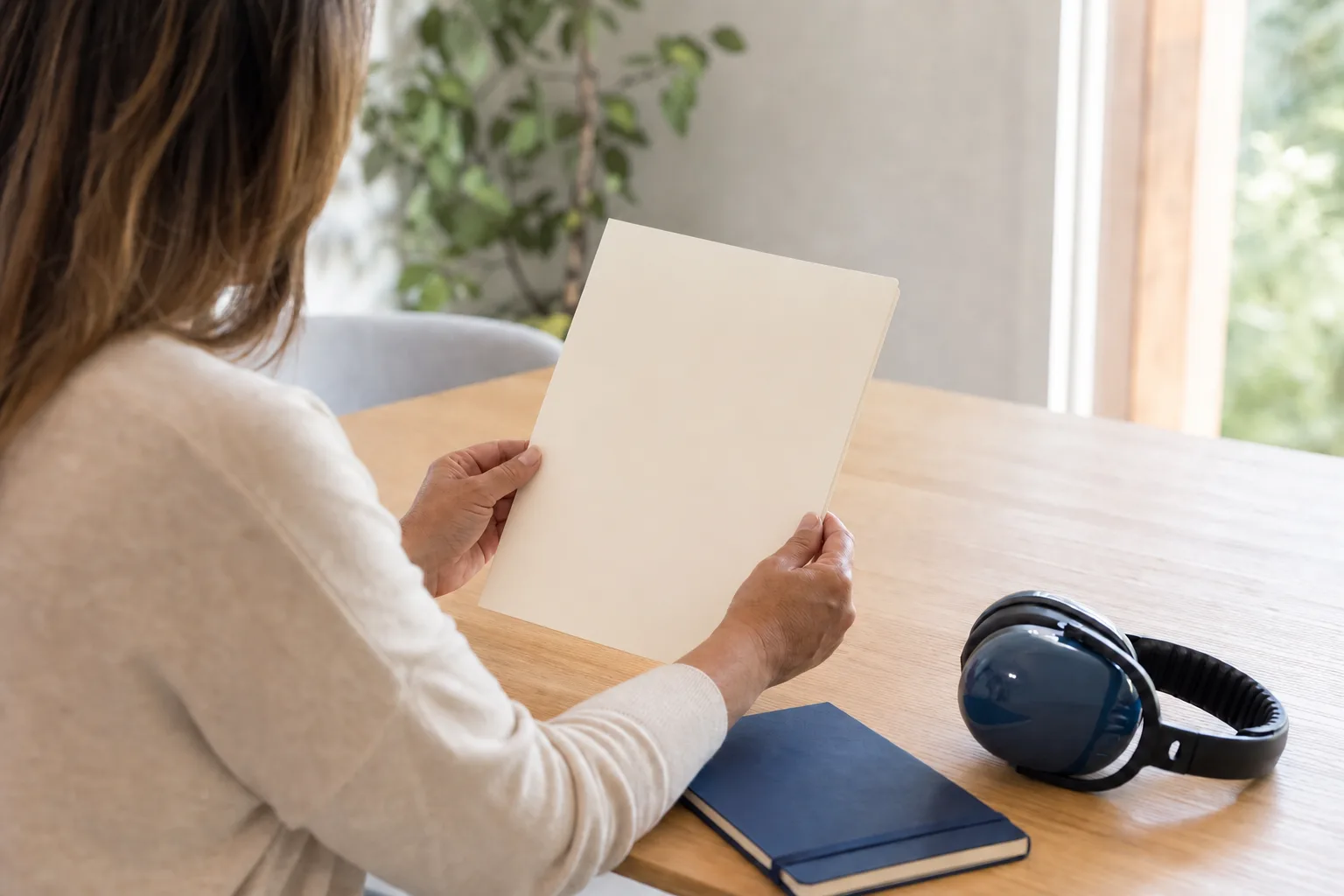
Anonymous adult organizing blank records beside blue over-ear hearing protection and a closed notebook in a bright home
A useful hearing record separates dated communication observations from formal audiology measurements, clinical interpretation, and legal conclusions.

Quick answer

After a hearing-related injury, separate real-world communication problems from clinical measurements and diagnoses. Build a dated before-and-after baseline, collect the complete audiology file for each ear, preserve work and device records, correct material chart errors through the formal process, and let qualified professionals evaluate medical meaning, causation, and California deadlines.

Key takeaways

  • Separate what you personally notice from audiology measurements, diagnoses, clinical opinions, and conclusions about what caused a hearing change.
  • Build a before-and-after baseline by setting: quiet conversation, background noise, telephone or video calls, alarms, television, driving, work, and sleep.
  • Request the actual audiology records, including each ear’s results and the professional interpretation; do not rely on a portal summary or a phone screenshot alone.
  • Preserve device settings, workplace communications, accommodation requests, receipts, and witness observations with dates and sources.
Hurt Advice Editorial Team

Prepared by

Hurt Advice Editorial Team

Editorial Research and Publishing Team

Source-checked editorial publishing

Why trust this article

Prepared by the Hurt Advice Editorial Team from current NIDCD hearing resources, California patient-record and limitations statutes, the federal health-record amendment rule, and the Judicial Council of California 2026 CACI resource center. No attorney reviewed this displayed version.

Recent update: Original publication with a six-setting communication log, audiology record map, source-labeled example, record-request workflow, chart-correction script, evidence cautions, and timing checklist.

At a glance

What this guide helps you decide

Start with the question that brought you here, identify the records that can verify the facts, and use the related guidance only where it helps. This article addresses personal injury questions in California.

Main question

Decide how this topic may apply to your situation

Use "Hearing-Loss and Audiology Records After a California Injury" to sort the facts you know, the questions still open, and whether a personal injury resource or consultation may be useful in California.

Guide map

Start with the sections most relevant to you: Quick takeaways, Who this guide is for—and what it does, Start with the hearing record, not a self-diagnosis

Move through the article by issue, not by guesswork, so liability, medical proof, insurance pressure, deadlines, and next steps stay connected.

Records to gather

Connect these subjects to your records: Hearing Loss, Audiology Records, Audiogram, Communication Impact

Compare the topic with records, photos, medical visits, police reports, insurer letters, and local claim details before relying on a general answer.

Trust check

Use the source trail before acting

This page includes 6 source references plus internal next-step paths so readers can verify where the guidance comes from.

Before you rely on this guide

This article is written for people dealing with injury-law questions in California. It is meant to help you understand the issue, not replace legal advice about your specific case.

What to do after this article

Start with the quick answer, skim the table of contents, and then use the links below to move into the practice area, author archive, or resource page that turns general guidance into a clearer next step for your situation.

Quick takeaways

  • Separate what you personally notice from audiology measurements, diagnoses, clinical opinions, and conclusions about what caused a hearing change.
  • Build a before-and-after baseline by setting: quiet conversation, background noise, telephone or video calls, alarms, television, driving, work, and sleep.
  • Request the actual audiology records, including each ear’s results and the professional interpretation; do not rely on a portal summary or a phone screenshot alone.
  • Preserve device settings, workplace communications, accommodation requests, receipts, and witness observations with dates and sources.
  • A hearing-impact log organizes evidence. It does not diagnose hearing loss, prove causation or fault, measure disability, or predict compensation.

Who this guide is for—and what it does

This guide is for an adult organizing hearing-related records after a California accident, blast, impact, product event, workplace event, or other claimed injury. A family member or representative can use the same structure when the person needs communication support. The reader task is practical: preserve a reliable before-and-after communication baseline, collect the underlying hearing records, and label every observation by source.

The existing hearing-loss educational calculator discusses broad factors that may affect an injury claim. This article does not estimate value. The personal-injury hub explains the wider service area, while the California injury-proof guide covers general evidence categories. Here, the focus is the different job of organizing hearing and communication evidence.

A log cannot decide whether a measured change is temporary or permanent, whether an accident caused it, whether prior noise or health history contributed, whether treatment is necessary, or whether a loss is legally recoverable. Those questions require the complete record and qualified medical, audiology, vocational, insurance, and legal analysis. Use this system to preserve facts accurately—not to choose a conclusion first.

Start with the hearing record, not a self-diagnosis

The National Institute on Deafness and Other Communication Disorders explains that hearing involves both detecting sound and interpreting speech. It describes formal audiometric testing as the standard method for diagnosing hearing loss and notes that testing supplies information by frequency, hearing level, ear, pattern, and speech recognition. A personal account still matters because it describes real-world impact, but it is not a substitute for formal testing.

Write only what the source supports. “I asked the speaker to repeat the sentence three times in a quiet room” is a personal observation. “The audiologist documented the right-ear result on July 22” is a sourced record statement. “The crash permanently damaged my inner ear” is a medical and causation conclusion unless an appropriately qualified professional has actually made and supported it.

Do not interpret an audiogram from an online example, average numbers from different tests, or describe a screening as a diagnosis. Record which ear was tested, the date, the examiner, the test setting, and the report’s exact terms. If a symptom is sudden, new, or worsening, seek appropriate professional guidance promptly. Recordkeeping must not delay care or emergency help.

Build a before-and-after communication baseline

Begin with an honest baseline. Identify earlier hearing tests, ear conditions, tinnitus reports, hearing devices, medications, work or recreational noise, military service, infections, head injuries, and communication limitations only when supported by records or firsthand knowledge. “No earlier difficulty” is too broad if there were prior complaints; “no hearing device and no prior audiology visit found in the records collected so far” is narrower and source-labeled.

The NIDCD adult hearing-test resource illustrates why context matters by asking about communication with family, coworkers, customers, friends, television or radio, theaters, restaurants, and social life. Do not copy the questionnaire as a self-score for a claim. Use the settings as prompts to identify where a change is actually observed, then let a health professional conduct and interpret an evaluation.

For each setting, compare the same kind of situation before and after when possible. Note room size, background sound, speaker distance, number of speakers, face visibility, ear used for a phone, device or caption use, repetitions, misunderstood words, and what changed. Avoid unsupported percentages such as “hearing is 70 percent worse.” If you did not measure a fact, say so.

Use the six-setting hearing-impact log

Create one entry for a meaningful event instead of recreating an entire week from memory. Give each entry a date, time, setting, speaker or sound source, background conditions, device status, the exact communication event, the response, and the source. Keep later recollections labeled as later recollections.

  1. Quiet conversation: number of speakers, distance, which side the speaker occupied, face visibility, repetition, and the words or instructions actually missed.
  2. Background noise: restaurant, store, traffic, equipment, music, or crowd; speaker distance; seating; whether moving closer, changing sides, or reducing noise helped.
  3. Telephone and video: device, ear, speakerphone, headset, captions, volume setting, connection quality, repetitions, and whether a written follow-up was needed.
  4. Safety signals: alarm, horn, timer, approaching vehicle, doorbell, warning tone, or verbal instruction; location, direction, distance, competing sound, and who else heard it. Do not stage a hazardous test.
  5. Work or school: meeting type, task, equipment, instruction, accommodation, written follow-up, error or delay actually observed, and the employer or school record that confirms it.
  6. Home, sleep, and social activity: television captions, family conversation, door alerts, sleep interruption, gathering size, withdrawal from an activity, and any device used.

Use neutral language. “During a four-person meeting, I missed the supervisor’s second instruction and requested it by email; the 2:18 p.m. reply contains the instruction” is stronger source organization than “I cannot hear anyone at work.” The accident symptom-journal guide offers a broader method, but this hearing log adds speaker, setting, sound, device, and communication-result fields.

A practical entry and source map

Keep the entry compact enough to maintain. This example reports function without diagnosing it:

“July 21, 6:40 p.m., kitchen, one family member about six feet to my right, dishwasher running. I asked for two repetitions of the sentence about tomorrow’s appointment and repeated back the wrong time. Family member sent a text at 6:43 with the correct time. No hearing device used. Source: same-day personal observation and preserved text. No clinical conclusion.”

Then connect each type of fact to its best source:

  • Clinical testing: audiology reports, the underlying audiogram or test output, speech testing, otolaryngology notes, imaging reports when ordered, referrals, treatment plans, and device recommendations.
  • Earlier baseline: prior hearing screenings, employment testing, military or occupational records, earlier device records, primary-care notes, and documented exposure history.
  • Daily communication: contemporaneous messages, captions or accessibility settings, calendars, family or coworker firsthand observations, and written follow-ups to misunderstood instructions.
  • Work and cost: job description, safety rules, meeting notes, accommodation requests and responses, time records, receipts, device invoices, travel records, and reimbursement statements.

Preserve original exports and messages with dates and available metadata. Work from copies. Do not secretly record private conversations without understanding California law and applicable workplace policy. The medical-care resource can help organize provider locations, and the damages evidence guide explains why different claimed losses require different records.

Request the complete audiology file

Ask the provider what records exist for the relevant date range. Depending on the visit, the file may include the order or referral, intake history, ear-specific test output, speech testing, tympanometry or other test results, professional interpretation, diagnosis codes, recommendations, device programming or fitting records, visit notes, billing, and portal messages. This is a request checklist, not a statement that every test was performed or appropriate.

California Health and Safety Code section 123110 generally gives covered patients or personal representatives rights to inspect records and obtain copies, subject to the statute’s scope, exceptions, identity verification, fees, and procedures. Its current text generally addresses inspection within five working days after receipt and transmission of requested copies within 15 days, with additional provisions for electronic format and certain X-rays.

Identify the provider, facility, date range, ear or body system, and requested record types. Ask whether graphs or test files are stored separately from the narrative note. Keep the request, identity-verification step, delivery proof, invoice, response, original download, and a dated gap list. A missing test does not prove that it never occurred; it means the collection needs follow-up.

Use a focused chart-correction request

A personal log should never overwrite a provider record. If a note identifies the wrong ear, wrong date, wrong event, wrong device, or another material factual detail, identify the exact record and support the requested correction.

45 C.F.R. section 164.526 gives an individual a right to request amendment of protected health information in a designated record set. A covered entity may require a written request and reason. The rule generally requires action within 60 days and permits one extension of no more than 30 days with written notice. It also permits denial on stated grounds and provides a process for a written statement of disagreement.

“I request amendment of the July 21 audiology note. The history identifies the left ear, but the referral and the report’s assessment identify the right ear. Please correct the history or link this request and your response to the record. Attached are the referral and the final report.”

Do not demand deletion of a clinical opinion merely because you disagree with it, ask for backdated language, or hide earlier hearing history. Preserve the request and response. If the provider denies it, keep the denial and consider the rule’s disagreement process or case-specific professional advice.

How hearing records may fit a California claim

The Judicial Council’s 2026 CACI resource center provides the official current civil instructions, including instructions addressing medical expenses, lost earnings, and physical pain or mental suffering. A hearing record, communication log, receipt, or workplace record may help organize source facts relevant to a claimed loss. None of them alone establishes liability, causation, reasonable necessity, reasonable certainty, recoverability, or an amount.

Keep the proof chain separate. An audiogram documents test results; the interpreting clinician addresses medical meaning; workplace documents address duties and accommodations; receipts address amounts paid or billed; firsthand entries describe actual communication events. A lawyer may need to connect those sources to the governing legal elements and admissibility rules. Do not label a personal log “objective proof,” and do not ask a family member or coworker to copy your wording.

Preserve both favorable and unfavorable material, including normal or unchanged results, inconsistent reports, earlier exposure, missed appointments, device use, and improvement. Accurate context is more useful than a curated file that omits facts.

Timing, preservation, and deadline cautions

Start promptly because memories fade, messages disappear, employers rotate systems, and device or provider portals can change. Save exports in their original format when possible, keep a read-only original, and record when and from whom each file was received. A preservation request should identify the material and date range; do not claim that a request automatically stops deletion in every situation.

California Code of Civil Procedure section 335.1 states a two-year period for an action for injury to or death of an individual caused by another’s wrongful act or neglect. It is not a universal deadline calculation. Accrual, tolling, the identity of defendants, public-entity claim rules, contracts, federal law, and other statutes may change what must happen and when.

Medical-record requests, treatment, insurance discussions, and settlement talks do not necessarily pause a legal clock. The California deadline guide provides orientation, but a licensed California attorney should calculate all deadlines from the actual facts as early as practical.

Mistakes and red flags to avoid

  • Self-diagnosis: do not turn ringing, muffled sound, dizziness, or communication difficulty into a diagnosed condition or cause.
  • Reading one chart in isolation: preserve the full report, ear, date, test conditions, examiner, and interpretation.
  • Reconstructing a diary: label later recollection honestly instead of presenting it as a same-day note.
  • Unsupported percentages: do not invent a loss percentage from volume settings, online tests, or a graph you do not understand.
  • Staging exposure: never recreate a loud event, remove protection, ignore restrictions, or enter danger to make evidence.
  • Editing originals: preserve raw files and annotate a working copy.
  • Ignoring earlier history: collect prior tests, devices, exposures, symptoms, and conditions accurately.
  • Secret recording: do not record conversations or workplaces without understanding consent law and policy.
  • Missing deadlines: record collection and negotiation may continue while a legal deadline runs.

Sudden, new, or worsening hearing or balance symptoms can require prompt professional attention. Follow individualized instructions and use emergency services for an emergency. This article cannot triage a condition.

A seven-step next-action checklist

  1. Write the event date, first noticed change, affected ear if known, providers, tests, devices, and record holders.
  2. Create an honest pre-event baseline from available records and firsthand sources.
  3. Start the six-setting log and label each entry as observation, message, provider record, workplace record, or another source.
  4. Request the complete audiology and related medical file, including separate test output when it exists.
  5. Preserve original messages, work records, accommodation exchanges, receipts, device records, and prior hearing information.
  6. Use a focused amendment request for a material chart error and preserve the response.
  7. Ask qualified professionals to evaluate medical meaning, conflicts, causation, and case-specific deadlines.

Hurt Advice is a lawyer-referral and legal-information service, not a law firm. This article provides general educational information, not medical or legal advice. No attorney reviewed this displayed version. For case-specific questions, a licensed California attorney can review the facts, records, defendants, and deadlines.

Frequently Asked Questions

What hearing problems should I document after an accident?
Document specific communication events rather than diagnosing a problem: quiet conversation, background noise, telephone or video calls, alarms, work instructions, television, sleep, and social settings. Note the date, setting, speaker or sound source, background conditions, device used, repetitions, result, and source.
Is my hearing-impact log the same as an audiogram?
No. A log records firsthand, real-world communication events. Formal audiometric testing supplies clinical measurements by ear, frequency, hearing level, and sometimes speech performance. Preserve both, but do not treat the log as a diagnosis or the audiogram as proof of accident causation.
Which audiology records should I request?
Ask what exists for the relevant date range, including the referral, history, ear-specific test output, speech testing, professional interpretation, visit notes, recommendations, device programming or fitting records, billing, and portal messages. Not every visit includes every item, so keep a dated gap list.
What if the hearing note names the wrong ear or event?
Identify the exact note, date, disputed statement, requested amendment, reason, and supporting source. Under 45 C.F.R. section 164.526, an individual may request amendment; the provider may accept or deny under the rule, and a denial can trigger statement-of-disagreement rights.
Can an audiogram prove that an accident caused hearing loss?
Not by itself. An audiogram measures hearing responses under stated test conditions. Causation may require comparison with earlier testing, exposure and medical history, event evidence, clinical interpretation, and other expert or legal analysis. Preserve normal, changed, and inconsistent results instead of selecting only favorable material.
What is the California deadline for a hearing-injury case?
Code of Civil Procedure section 335.1 states a general two-year period for injury caused by another’s wrongful act or neglect, but it is not universal. Accrual, tolling, public entities, defendants, contracts, and other law can change the result, so obtain a fact-specific calculation promptly.

Sources and references

National Institute on Deafness and Other Communication DisordersDo You Need a Hearing Test?

Identifies everyday communication settings that may prompt an adult to seek professional hearing evaluation.

Need help after an accident?

Hurt Advice intake team can review your situation, explain your options, and help you move forward with a plan that fits your case.