
Referral intake reviewES
Legal ExplainerPremises LiabilityChecklist / Process

California Amusement-Ride Injury Records: What to Preserve

This guide is for a rider, parent, caregiver, or witness trying to organize facts after an injury involving a mechanical amusement ride in California. Its purpose is practical: identify the ride and operator, preserve records already under your control, understand which records California rules require an operator to keep, and make a focused request without assuming that every file is public or proves fault. Hurt Advice is an injury-information and attorney-referral service, not a law firm, and this article provides general information rather than legal advice or representation.

Published

August 12, 2026

Updated

August 12, 2026

Reading time

10 min read

Jurisdiction

California

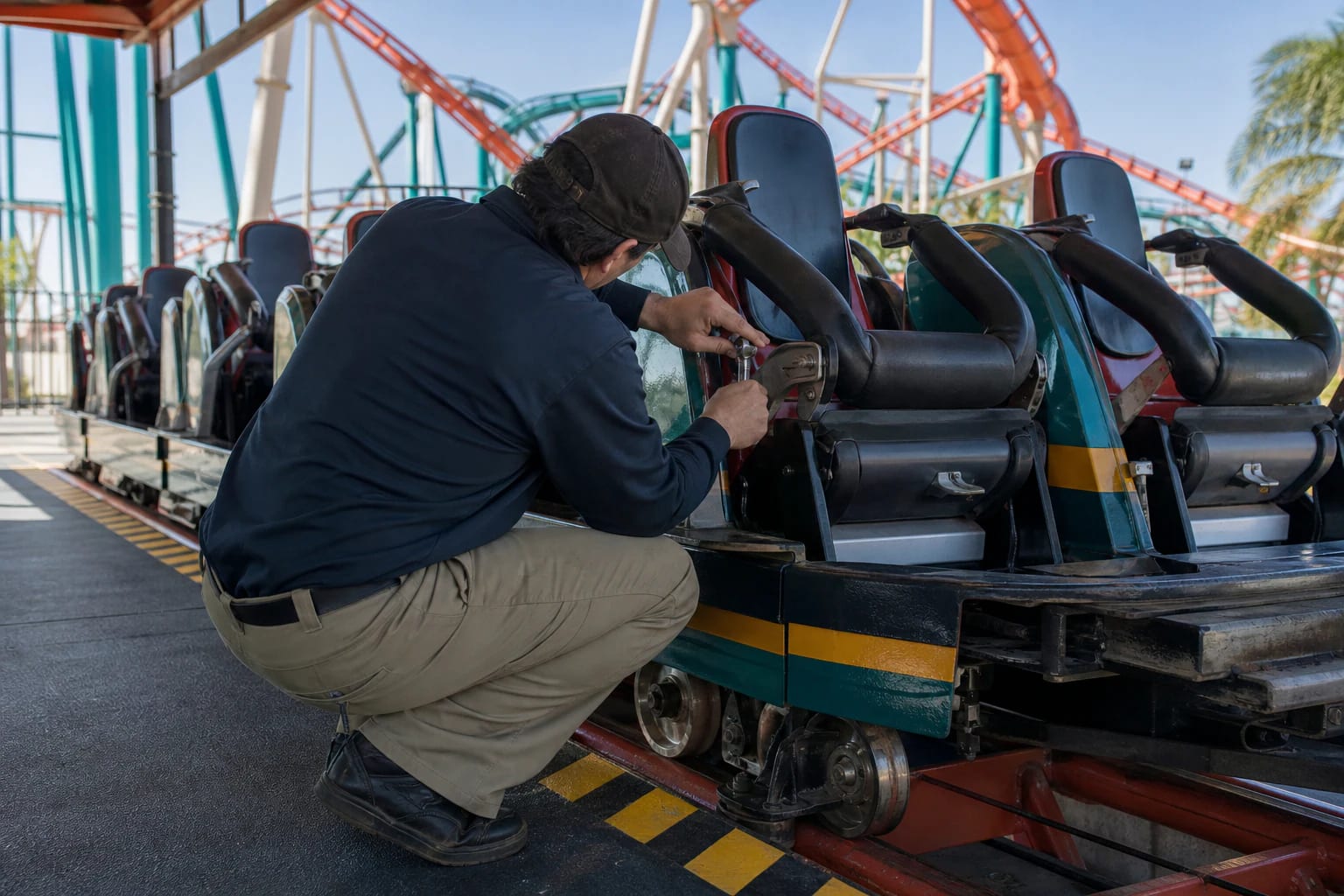
Ride technician inspecting a roller-coaster lap-bar latch at an outdoor loading platform
A technician checks a roller-coaster restraint mechanism, illustrating the ride-specific inspection and maintenance records discussed in this guide.

Quick answer

After an amusement-ride injury in California, first identify the ride, operator, location, date, and whether it was permanent or portable. Preserve your ticket, photos, witness contacts, medical timeline, and communications. Then separate operator-held maintenance and incident records from California DIR inspection or investigation files; the same document is not automatically available from every source.

Key takeaways

  • <strong>Name the exact ride and operator.</strong> A park name alone may not identify the company that operated, maintained, or inspected a particular ride.
  • <strong>Separate permanent from portable rides.</strong> California uses related but different inspection and reporting systems for fixed theme-park rides and rides assembled at fairs, carnivals, or temporary events.
  • <strong>Preserve what you control now.</strong> Tickets, receipts, photos, video, witness contacts, clothing, medical discharge papers, and messages can establish the visit and sequence without waiting for another organization.
  • <strong>Ask each custodian for what it may actually hold.</strong> The operator's maintenance ledger, a fire department response, and a DIR inspection file are different sources. A public-record request does not automatically reach a private park's internal files.
Hurt Advice Editorial Team

Prepared by

Hurt Advice Editorial Team

Editorial Research and Publishing Team

Source-checked editorial publishing

Why trust this article

Prepared by the Hurt Advice Editorial Team from current California statutes, regulations, and agency guidance, with originality, disclosure, accessibility, image, and live-page checks. No attorney reviewed this displayed version.

Recent update: Original publication explaining California amusement-ride record categories, custodians, preservation steps, and a neutral request workflow.

At a glance

What this guide helps you decide

Start with the question that brought you here, identify the records that can verify the facts, and use the related guidance only where it helps. This article addresses premises liability questions in California.

Main question

Decide how this topic may apply to your situation

Use "California Amusement-Ride Injury Records: What to Preserve" to sort the facts you know, the questions still open, and whether a premises liability resource or consultation may be useful in California.

Guide map

Start with the sections most relevant to you: Classify the attraction before requesting records, Build a four-source evidence map, Seven practical steps after the immediate response

Move through the article by issue, not by guesswork, so liability, medical proof, insurance pressure, deadlines, and next steps stay connected.

Records to gather

Connect these subjects to your records: Amusement ride injuries, Ride inspection records, Incident reports, Evidence preservation

Compare the topic with records, photos, medical visits, police reports, insurer letters, and local claim details before relying on a general answer.

Trust check

Use the source trail before acting

This page includes 6 source references plus internal next-step paths so readers can verify where the guidance comes from.

Before you rely on this guide

This article is written for people dealing with injury-law questions in California. It is meant to help you understand the issue, not replace legal advice about your specific case.

What to do after this article

Start with the quick answer, skim the table of contents, and then use the links below to move into the practice area, author archive, or resource page that turns general guidance into a clearer next step for your situation.

Classify the attraction before requesting records

Start with a factual description, not a legal label. Write down the attraction name, park or event, street address, operating date and approximate time, car or seat number if known, loading area, and the business name shown on the ticket or receipt. Save a screenshot of the attraction page and a copy of any map from the date of the visit, but do not edit the original files.

California's Department of Industrial Relations describes two main ride programs. Temporary or portable rides include equipment moved among fairs, carnivals, festivals, and community events. Permanent rides operate at places such as theme parks, water parks, boardwalks, fun centers, public parks, and malls. The DIR Amusement Ride and Tramway Unit explains that it permits temporary rides, oversees permanent-ride operations, conducts inspections, and audits permanent-ride records. It also lists attractions outside the permanent-ride program, so a fall on a walkway, an arcade injury, or an inflatable attraction may call for a different record plan.

The distinction matters because the statutes and record systems are not identical. California's Amusement Rides Safety Law covers the temporary-ride program and requires permits and inspections before public operation and at least annually. Permanent rides are governed by a separate program in Labor Code sections 7920 through 7932 and related Title 8 regulations. If classification is unclear, describe the physical ride and location to DIR rather than guessing.

This article focuses on mechanical amusement rides. For fixed playground structures, the entities and maintenance questions differ; use the separate California playground inspection and maintenance records guide.

Build a four-source evidence map

1. Your visit and device records

Keep the admission ticket, ride reservation, wristband receipt, parking receipt, photographs, original video files, and any app confirmation. Record who was present, the order of events, what the operator said, whether the ride stopped, and when symptoms or visible conditions first appeared. Preserve originals and make working copies. The site's guide to preserving digital evidence offers file-handling principles that also apply here, such as retaining original timestamps and avoiding destructive edits.

2. Medical and emergency-response records

Separate park first-aid notes from ambulance, emergency department, imaging, pharmacy, and follow-up records. If emergency services responded, note the responding fire, police, or EMS agency and any incident number. A hospital chart is not a substitute for the ride records, and a ride incident report is not a medical diagnosis. The emergency-department record guide explains how triage, orders, imaging, medication, and discharge materials fit into a treatment timeline.

3. Operator-held ride records

For permanent rides, 8 CCR section 3195.12 requires the owner or operator to maintain specified records for at least five years and make them available to the Division during an inspection. The categories include required training; maintenance, repair, inspection, and testing for each ride; reportable accidents; amusement ride incidents; and, for aquatic devices, specified water-quality and staffing determinations. The rule says an incident record should identify the authorized person present and describe the incident plus responsive inspection, repair, modification, and maintenance.

That rule does not say a private operator must hand every internal record to any requester on demand. Ask politely and specifically, keep the response, and avoid stating that a document exists unless a source confirms it. Formal access can depend on the custodian, privacy, an investigation, an agreement, or a legal process.

4. Government-held inspection or investigation files

DIR may have permit, inspection, audit, complaint, notification, or investigation material. Its public-records page routes requests by office and explains that copies of identifiable public records can be provided subject to the California Public Records Act. Records can be withheld or redacted when an exemption applies. A focused request should identify the ride, facility or event, date range, operator if known, and the Amusement Ride and Tramway Unit.

Seven practical steps after the immediate response

A simple symptom and activity journal may help organize what you personally experienced, but it should remain factual and should not replace medical care or clinical records.
  • Get appropriate medical attention. This article cannot assess an injury. Use emergency services for urgent symptoms and follow the treating clinician's instructions.
  • Make a same-day identity note. Record the attraction, exact location, date, approximate time, seat or car, operator name if visible, weather, and the names of companions.
  • Preserve originals. Keep tickets, receipts, wristbands, photographs, video, clothing, footwear, and communications in their original condition. Do not post identifying material about other guests.
  • Ask for the park or event report number. Request a copy if the operator provides one. If not, save the name or role of the person who received your report, the time, and a neutral summary of what you said.
  • Identify emergency responders. Save agency names and incident numbers. Do not assume a 911 call, park first-aid entry, and ambulance chart share the same identifier.
  • Classify the ride and custodian. Use DIR's program descriptions to distinguish permanent and temporary rides. List operator-held, responder-held, and DIR-held items separately.
  • Track requests and responses. Keep one log with date sent, recipient, exact scope, confirmation number, response date, produced items, withheld items, and follow-up question.

Use a focused, neutral request script

Adapt this wording to the correct custodian. Do not send medical details that are unnecessary to identify the event.

I am trying to identify records concerning [ride name or physical description] at [facility or event and address] on [date] between approximately [time range]. The operator name shown on my ticket or receipt is [name, if known]. Please confirm whether your office or organization maintains an incident or accident report, permit or certificate, inspection or audit record, complaint record, or investigation material for that ride and time period. For a public agency, I request reasonably identifiable, nonexempt records in the electronic format in which they are maintained. Please tell me if another office is the correct custodian or if you need a narrower description.

This script distinguishes a request from an accusation. It also avoids claiming a right to private records. For DIR, include the ART Unit and whether the ride appeared fixed or portable. For a park, separately ask whether surveillance, ride-control data, inspection entries, or maintenance entries may exist and can be preserved, without assuming the system recorded your event.

Use a three-lane reconciliation tool

For each important point, create three short entries: Observed for what you personally saw, heard, felt, photographed, or received, with the time source stated; operator record for what a park, carnival operator, or contractor documented, including the ride unit and timestamp; and independent or agency record for what EMS, fire, police, DIR, or another source recorded.

Example: your video may show the ride stopped at 3:14 p.m.; the park report may list an incident at 3:20; EMS dispatch may show a call at 3:23. Preserve all three. A difference can reflect clocks, reporting sequence, or a different event; it is a question to resolve, not proof that anyone falsified a record. Likewise, an annual certificate addresses a defined inspection, not necessarily the condition of one restraint at every later moment.

California defines a permanent-ride incident as an event, failure, or malfunction that closes the ride for more than 12 consecutive hours or reasonably and substantially appears to affect patron safety. See 8 CCR section 3195.2. That regulatory label may differ from a park's customer-service use of the word incident, so record the source of the label.

Timing and process after a serious event

For a permanent ride, 8 CCR section 344.15 requires the operator to notify the Division immediately by telephone when ride maintenance, operation, or use results in death or serious injury beyond ordinary first aid. If a death or serious injury results from a failure, malfunction, or operation, the regulation addresses preservation of the equipment or conditions for a Division investigation. Responding fire or police agencies also have a notification duty in the circumstances stated by the rule.

Temporary rides use a related reporting rule. Labor Code section 7914 requires immediate telephone reporting for specified serious events and a written accident report within 24 hours. Those are operator duties; they are not a promise that a patron will receive the report in 24 hours.

Your own process can be prompt without becoming frantic: preserve originals, make the identity note, obtain care, list custodians, and send narrow requests. Public-record production can take time, exemptions can apply, and active investigations may affect access. Claim and lawsuit deadlines depend on the parties and facts, especially if a public entity may be involved. This guide does not calculate a deadline; obtain case-specific legal advice promptly if rights or filing dates matter.

Mistakes and red flags to avoid

  • Requesting everything from one recipient. Overbroad language can obscure the ride, time, and actual custodian.
  • Confusing a park with the ride operator. Keep the facility, event promoter, ride owner, operator, maintenance contractor, and inspector separate until records connect them.
  • Editing the only photo or video. Preserve the original file and metadata before cropping, annotating, or sharing a copy.
  • Assuming no report means no event. Build the timeline from independent sources and record the custodian's exact response.
  • Treating a certificate as a guarantee. Note its date, ride identifier, scope, issuer, and relationship to the event.
  • Guessing at mechanical cause. Describe what happened in observable terms. Do not state that a restraint, brake, sensor, or employee failed without reliable evidence.
  • Posting other guests or medical details publicly. Preserve useful material privately and protect identifying information.
  • Signing or relying on an unexplained document. Keep a copy and seek individual advice before making a decision that may affect rights.

Careful next steps

Put the ride identity note, original visit evidence, report numbers, medical timeline, four-source map, request log, and reconciliation entries in one folder. Mark unknown items as unknown rather than filling gaps from memory. If a fact changes, add a dated correction instead of overwriting the earlier note.

Review Hurt Advice's editorial standards and source policy for how this guide was prepared. The platform disclosure explains that Hurt Advice publishes legal information and may route intake requests to independent participating attorneys; it is not a law firm and receiving information does not create an attorney-client relationship.

If you want to discuss the record map with an independent participating attorney, you may use the Hurt Advice contact and referral form. A request does not guarantee acceptance, representation, availability, or any result. Only a separate written agreement with an attorney or law firm can create an attorney-client relationship.

Frequently Asked Questions

Who inspects amusement rides in California?
The California Department of Industrial Relations' Amusement Ride and Tramway Unit administers programs for temporary and permanent amusement rides. Temporary rides are permitted and inspected under the temporary-ride program. Permanent rides are subject to annual qualified-safety-inspector work plus state operational inspections, audits, and discretionary inspections as described by DIR.
How long must a California permanent-ride operator keep records?
Under 8 CCR section 3195.12, the owner or operator must maintain the listed permanent-ride training, maintenance, repair, inspection, testing, accident, and incident records for at least five years and make them available to the Division during an inspection. That rule does not automatically make every private operator record public on request.
Can I request amusement-ride inspection records from California DIR?
You can ask DIR for reasonably identifiable public records it maintains, such as records tied to a named ride, facility, operator, date range, and ART Unit program. DIR may redirect the request, seek clarification, or withhold or redact material when an exemption applies. A public-record request does not reach every private park file.
What should I preserve after an amusement-ride injury?
Preserve the ticket or receipt, ride reservation, photos and original video files, witness contacts, report numbers, medical and emergency-response records, clothing or other relevant items, and communications. Write a dated ride identity note with the attraction, operator if known, location, time, car or seat, and observable sequence.
Does an annual inspection prove the ride was safe when the injury happened?
Not by itself. An inspection or certificate has a date, scope, ride identifier, and issuing person or agency. Compare it with maintenance and incident entries, the exact ride unit, later repairs, operator observations, agency records, and your time-stamped evidence. The document is one source, not a legal conclusion about a particular event.
Is a park incident report the same as a Cal/OSHA accident report?
Not necessarily. A park may use incident report as an internal customer-service or safety label. California regulations separately define reportable accidents and permanent-ride incidents, and DIR may create inspection or investigation records after notice. Keep each document's title, author, custodian, time, and ride identifier distinct.

Sources and references

Need help after an accident?

Hurt Advice intake team can review your situation, explain your options, and help you move forward with a plan that fits your case.