
Legal ExplainerPremises LiabilityChecklist / Process

Balcony and Railing Inspection Records After a California Injury

After a California balcony or railing injury, address immediate safety and medical needs first. Then identify the exact balcony and components, preserve photographs and witness observations, request inspection, complaint, maintenance, repair, permit, and access records, and log every later test or change without treating deterioration, a missing report, or a code reference as automatic proof of cause.

Published

August 1, 2026

Updated

August 1, 2026

Reading time

11 min read

Jurisdiction

California

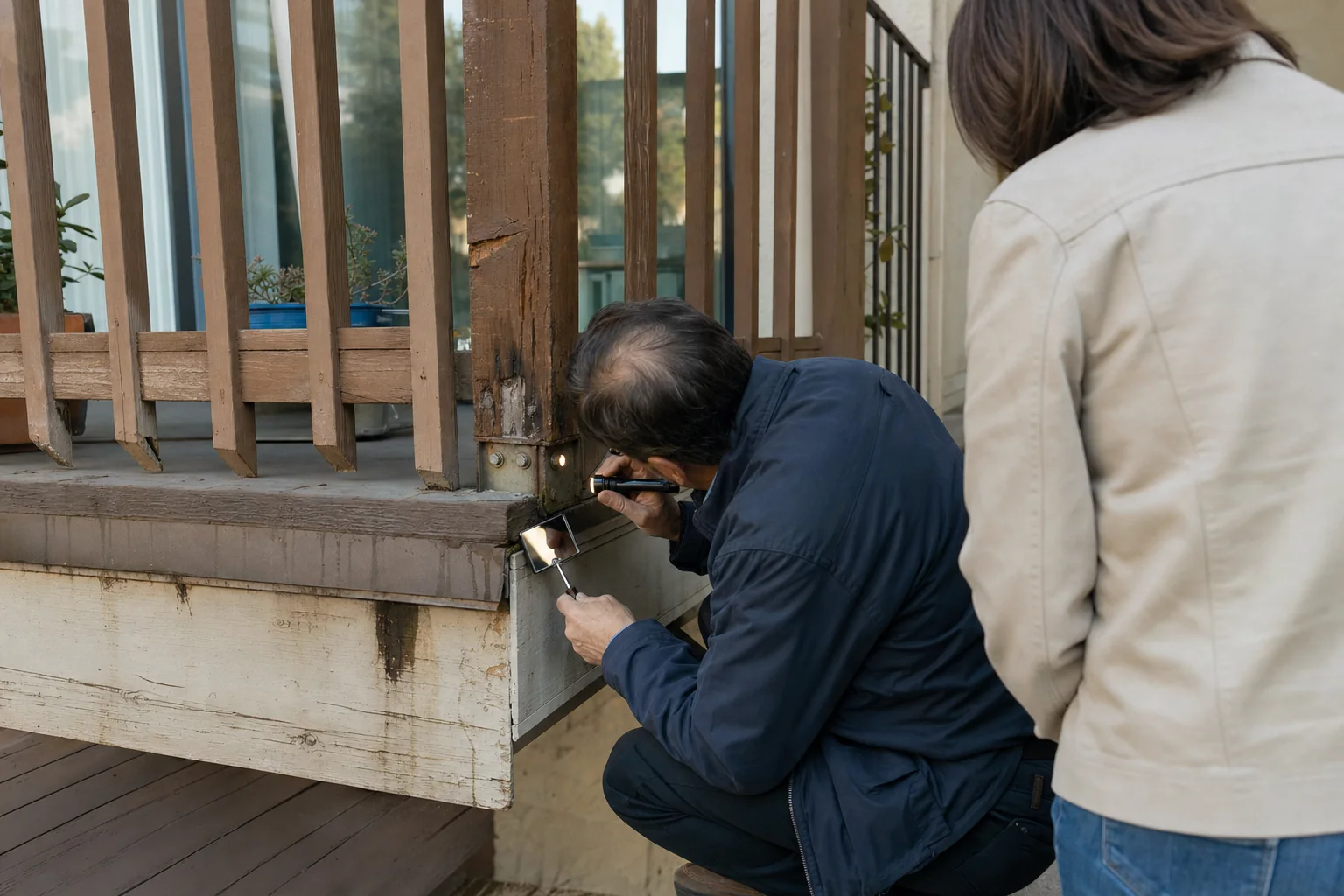
Building inspector uses a flashlight and small mirror to examine a weathered wood balcony railing base and edge connection at an apartment property
Balcony identity, inspection scope, observed condition, repairs, access restrictions, and later changes should remain separate evidence fields.

Quick answer

After a California balcony or railing injury, address immediate safety and medical needs first. Then identify the exact balcony and components, preserve photographs and witness observations, request inspection, complaint, maintenance, repair, permit, and access records, and log every later test or change without treating deterioration, a missing report, or a code reference as automatic proof of cause.

Key takeaways

  • Keep people away from a visibly damaged, unstable, restricted, or altered balcony or railing and follow emergency and building-safety directions.
  • Identify the property type before applying an inspection rule: apartment buildings and condominium associations can fall under different California statutes.
  • Preserve the whole balcony, supports, waterproofing, railings, surface, drainage, access point, surroundings, and component identifiers—not only the place that looks damaged.
  • Request original inspection reports, photographs, test results, complaint records, work orders, permits, invoices, access notices, and repair closeout records with attachments and dates.
Hurt Advice Editorial Team

Prepared by

Hurt Advice Editorial Team

Editorial Research and Publishing Team

Source-checked editorial publishing

Why trust this article

Prepared by the Hurt Advice Editorial Team from current California Legislature sources. No attorney reviewed this displayed version.

Recent update: Original publication with an apartment-versus-condominium inspection map, balcony identity sheet, inspected-reported-repaired-observed matrix, custodian map, evidence-preservation workflow, scripts, checklist, mistakes, and FAQs.

At a glance

What this guide helps you decide

Start with the question that brought you here, identify the records that can verify the facts, and use the related guidance only where it helps. This article addresses premises liability questions in California.

Main question

Decide how this topic may apply to your situation

Use "Balcony and Railing Inspection Records After a California Injury" to sort the facts you know, the questions still open, and whether a premises liability resource or consultation may be useful in California.

Guide map

Start with the sections most relevant to you: Who this guide is for—and the exact task it solves, Quick takeaways, Contents: seven balcony-record lanes

Move through the article by issue, not by guesswork, so liability, medical proof, insurance pressure, deadlines, and next steps stay connected.

Records to gather

Connect these subjects to your records: California Balcony Injury Records, Balcony Inspection Report, Exterior Elevated Elements, Balcony Railing Records

Compare the topic with records, photos, medical visits, police reports, insurer letters, and local claim details before relying on a general answer.

Trust check

Use the source trail before acting

This page includes 6 source references plus internal next-step paths so readers can verify where the guidance comes from.

Before you rely on this guide

This article is written for people dealing with injury-law questions in California. It is meant to help you understand the issue, not replace legal advice about your specific case.

What to do after this article

Start with the quick answer, skim the table of contents, and then use the links below to move into the practice area, author archive, or resource page that turns general guidance into a clearer next step for your situation.

Who this guide is for—and the exact task it solves

This guide is for a California tenant, resident, guest, property owner, association member, family member, or records organizer after an injury involving a balcony, deck, exterior walkway, stair landing, guard, or railing. It is most useful when questions concern a loose or failed railing, a surface or edge condition, water intrusion, deterioration, a structural connection, an access restriction, or work performed before or after the event.

The task is not to declare that a balcony was unsafe, that an inspection law applied, or that an owner, association, contractor, inspector, tenant, or public agency caused the injury. The task is to identify the exact exterior element, separate apartment and condominium inspection systems, preserve its as-found condition, request the records that show what was inspected and repaired, and document every later change. The balcony-collapse service page owns the broader representation topic; this article owns the narrower inspection-and-record workflow.

Hurt Advice is a lawyer referral and legal information service, not a law firm. This is general information, not legal, engineering, building-safety, medical, or repair advice. It does not establish duty, notice, violation, defect, causation, damages, admissibility, or responsibility. No attorney reviewed this displayed version.

Quick takeaways

  • Keep people away from a visibly damaged, unstable, restricted, or altered balcony or railing and follow emergency and building-safety directions.
  • Identify the property type before applying an inspection rule: apartment buildings and condominium associations can fall under different California statutes.
  • Preserve the whole balcony, supports, waterproofing, railings, surface, drainage, access point, surroundings, and component identifiers—not only the place that looks damaged.
  • Request original inspection reports, photographs, test results, complaint records, work orders, permits, invoices, access notices, and repair closeout records with attachments and dates.
  • Log every post-event restriction, shoring, test, opening, repair, removal, transfer, or disposal without assuming that a later condition proves the earlier cause.

Contents: seven balcony-record lanes

Use seven lanes: (1) immediate safety and scene control, (2) balcony-and-component identity, (3) property type and inspection scope, (4) complaints, maintenance, inspection, repair, and permit records, (5) incident observations and media, (6) post-event restrictions, testing, changes, and custody, and (7) timing and follow-up.

Create one identity sheet, one inspected-reported-repaired-observed matrix, one event clock, one custodian map, one condition-and-custody ledger, and one file manifest. Keep medical, witness, communication, and loss records in the separate accident evidence checklist.

Put safety before preservation

Call for emergency assistance when needed and follow fire, medical, property-management, engineer, and lawful public-agency directions. Do not step onto a restricted or visibly unstable balcony, lean on a questionable railing, remove finishes, probe wood, open a soffit, lift waterproofing, move shoring, or stage a load merely to create evidence.

From a safe and lawful location, record wide views showing the building face, balcony location, access door, adjacent units, surface, railing, supports, underside if visible, drainage, and surrounding fixed references. Then record closer views only if the area is safe. Photograph before measuring or touching. If a necessary emergency action changes the scene, note who directed it, the safety reason, the time, the before-and-after condition, and where any removed material went.

Preservation never requires leaving an immediate hazard accessible. A restriction, evacuation, shoring, or emergency repair can be necessary. The evidence task is to document that intervention accurately, not to obstruct it.

Build a balcony-and-component identity sheet

Start with property address, building and unit, balcony or walkway location, floor, orientation, access point, ownership or management source, property type if known, and a simple sketch tied to photographs. Distinguish a private balcony from a common walkway, stair landing, roof deck, porch, or freestanding deck. Do not guess from appearance alone.

Record the walking surface; slope and drainage paths; waterproof coating, membrane, flashing, sealant, and transitions if visible; guard or railing material; posts, pickets, rails, base plates, anchors, fasteners, welds, joints, and connections; wall or ledger interface; beams, joists, cantilevered members, columns, brackets, and underside covering; doors, thresholds, drains, scuppers, gutters, planters, nearby irrigation, and any visible staining, blistering, cracking, corrosion, displacement, patching, or biological growth.

Give each component and photograph an orientation-based identifier. “Southwest railing post at balcony B-204, viewed from exterior walkway” is more useful than “broken rail.” Mark unknown items unknown. Do not infer concealed framing, material strength, moisture content, code compliance, or cause from a photograph.

Separate the apartment and condominium inspection rules

California Health and Safety Code section 17973 addresses exterior elevated elements with wood or wood-based load-bearing components in buildings containing three or more multifamily dwelling units. It includes balconies, decks, porches, stairways, walkways, entry structures, supports, and railings that meet the statute’s definitions. The section excludes common interest developments, requires inspection of a sample of at least 15 percent of each type, and requires a signed or stamped report with photographs, test results, and enough narrative to establish a condition baseline. It states that the first inspection was to be completed by January 1, 2026, with later inspections every six years, subject to its terms and exceptions.

California Civil Code section 5551 separately addresses condominium projects with three or more attached multifamily units and exterior elevated elements for which the association has maintenance or repair responsibility. It calls for a licensed structural or civil engineer or architect to visually inspect a random and statistically significant sample at least every nine years. The report addresses identified components, current physical condition, future performance and useful life, repair recommendations, and specified project and sample counts. The statute says reports are maintained for two inspection cycles.

These are record maps, not automatic conclusions. Confirm the property type, number and arrangement of units, component construction, height and use, maintenance responsibility, permit timing, local requirements, and the current statutory text. One law may apply, another may apply, or neither may govern the particular element.

Use an inspected-reported-repaired-observed matrix

Create one row for each material component or condition and five columns:

  1. Inspected: who inspected, qualifications, date, scope, sample selection, methods, photographs, tests, findings, limitations, report, signature or stamp, and recommended follow-up.
  2. Reported: resident, guest, manager, board, vendor, or agency complaints; exact words; date; recipient; attachments; acknowledgment; response; and closure basis.
  3. Repaired or maintained: work order, authorization, contractor, permit, scope, materials, opened or concealed areas, before-and-after media, inspection, invoice, warranty, and closeout.
  4. Observed at the event: firsthand location, activity, contact, movement, sound, weather, surface, railing or support state, warnings, access control, and immediate result—without adding what the witness did not perceive.
  5. Changed later: restriction, shoring, destructive opening, test, measurement, cleaning, demolition, repair, coating, replacement, transfer, storage, data export, or disposal.

Example: an inspection report identifies a moisture-stained beam end and recommends further evaluation; a later invoice says “seal balcony edge” but lacks photographs; a resident reports railing movement three weeks later; after the incident, the property manager restricts access and a contractor opens the soffit. Those records create follow-up questions. They do not, by themselves, establish the earlier physical state or legal cause.

Map the likely record custodians

Owner, landlord, or property manager: ownership and unit map, leases or responsibility records, inspection calendar, reports, photographs, complaints, notices, work orders, vendor communications, invoices, access restrictions, incident reports, insurance notices, and authorization for later work.

Condominium association and managing agent: governing documents, component responsibility, board packets and minutes within lawful access limits, reserve-study coordination, section 5551 inspection list and report, maintenance planning, contracts, bids, decisions, notices, and repair closeout.

Inspector, engineer, architect, or contractor: engagement, qualifications, scope, element list or sample, field notes, photographs, moisture-meter or other test data, marked plans, findings, limitations, recommendations, signed report, repair design, permit documents, daily logs, removed materials, and final confirmation.

Local building or code-enforcement agency: permits, plans, corrections, inspection results, complaints, notices, orders, restrictions, emergency reports received under an applicable statute, and closeout records. Public access, exemptions, retention, and identifiers vary, so request a focused property, permit, complaint, or inspection file rather than assuming every private report is held publicly.

Insurer, investigator, or restoration vendor: first notice, photographs, scene notes, estimates, reservation or coverage communications, expert scheduling, temporary protection, water mitigation, demolition, salvage, transfer, and disposal records. Identify the actual custodian instead of asking every organization for the same unfocused file.

Preserve photographs, reports, and digital records in useful form

California Evidence Code section 250 defines a writing broadly to include photographs, pictures, sounds, electronic mail, and other recorded communications or representations. That makes native files, attachments, metadata, exports, and source context worth organizing rather than keeping only a screenshot pasted into a new document.

California Evidence Code section 1401 states that authentication is required before a writing, or secondary evidence of its content, may be received in evidence. It does not prescribe one universal method for every record. Preserve originals when available, source and custodian, received date, file name and type, timestamps and time zone, export method, attachment relationships, revisions, hash if used, and an unchanged working copy.

For photographs, keep the original sequence, full frame, orientation, capture time, device source if appropriate, and a short description of where the photographer stood. For inspection reports, keep the cover, signature or stamp, scope, element list, sample method, photographs, test data, appendices, limitations, recommendations, distribution, and later amendments together. Do not crop away context or rename an opinion as a fact.

Use a condition-and-custody ledger

Create one entry for every material event: date and time; property and component identifier; as-found state; person and organization; authority; action; safety or business reason; photograph, video, work order, permit, receipt, or report; before-and-after condition; storage; access; and any missing interval.

Track railings, posts, anchors, fasteners, surface pieces, waterproofing, flashing, sealant, drainage components, joists, beams, brackets, columns, soffit or finish pieces, samples, removed material, and temporary shoring separately when relevant. Do not remove or label a component if doing so would be unsafe or alter the scene. A qualified participant can identify it during necessary work while another person records the process.

Use precise entries: “south railing restricted by manager,” “engineer photographed post base before opening,” “contractor removed 18-inch soffit section under permit,” “wood sample transferred in sealed container,” or “coating replaced after agency approval.” If an item is unavailable, record the last confirmed custodian, expected disposition, request, response, and limitation.

Neutral request and inspection scripts

Focused records request: “Please preserve the existing records associated with [property, building, unit, balcony, walkway, component, permit, work-order, inspection, complaint, or incident identifier] for [focused date range], including inspection reports, element or sample lists, photographs, test data, complaints, notices, maintenance, repairs, plans, permits, invoices, access restrictions, incident records, post-event work, removed materials, transfers, and disposition. Please preserve original timestamps, attachments, versions, signatures, stamps, and identifier fields and identify the custodian for records you do not maintain. This request does not ask you to create a new cause analysis.”

Inspection or repair coordination: “Before voluntary testing, destructive opening, repair, coating, removal, or transfer when circumstances allow, please identify the qualified participants, authority, safety plan, exact component, as-found documentation, methods, measurements, tests, areas to be altered, removed-material handling, recording, storage, access, and final disposition. Please record emergency restrictions or repairs separately.”

Use verified contact channels and share only what is reasonably necessary. Save the request, delivery proof, acknowledgment, response, objection, appointment, production, and follow-up. These scripts are organization tools, not subpoenas, stop-work orders, guarantees of access or retention, or substitutes for legal advice.

Timing and process checkpoints

Immediately: address injury and danger, keep people away from a questionable element, follow emergency directions, make safe wide photographs, identify witnesses, record weather and access conditions, and note who first restricted or changed the area.

First organized pass: build the identity sheet, matrix, event clock, custodian map, manifest, and custody ledger. Send focused preservation requests to the likely owner, manager, association, inspector, contractor, or agency without demanding conclusions.

Before voluntary testing, opening, or repair: clarify authority and safety; document the as-found condition; identify the protocol, participants, recording, measurements, destructive steps, removed material, storage, access, and disposition. Do not delay a necessary emergency action.

Legal timing: Code of Civil Procedure section 335.1 states a two-year period for an action for injury to or death of an individual caused by another’s wrongful act or neglect. If a public entity may be involved, Government Code section 911.2 states a six-month presentation period for specified claims relating to death or injury to person or personal property. Accrual, exceptions, defendants, contract terms, and other deadlines can change the analysis. The California deadline resource is general background; individual advice may be important promptly.

Balcony and railing evidence checklist

  • Property, building, unit, balcony or walkway location, floor, orientation, access point, property type, ownership or association source, and wide context photographs.
  • Walking surface, drainage, waterproofing, flashing, sealant, thresholds, walls, railings, posts, anchors, fasteners, welds, joints, beams, joists, brackets, columns, and visible underside conditions.
  • Inspection calendar, inspector qualifications, engagement, scope, element inventory, sample selection, methods, field notes, photographs, tests, findings, limitations, report, signature or stamp, and distribution.
  • Complaints, notices, board or management records, work orders, bids, authorizations, permits, plans, daily logs, invoices, warranties, follow-up inspections, and repair closeout.
  • Original incident photographs, video, witness observations, weather, lighting, access condition, warnings, prior activity, emergency response, and the first safety restriction.
  • Post-event shoring, inspection, measurement, destructive opening, testing, repair, coating, removal, sampling, transfer, storage, access, and disposal entries with before-and-after proof.
  • Medical, wage, communication, and insurance records kept in separate lanes, with unnecessary private resident or association information excluded.

Mistakes and red flags

  • Walking onto, leaning on, loading, shaking, probing, dismantling, or staging a questionable balcony or railing merely to recreate the event.
  • Photographing only a crack, stain, loose rail, or damaged board while omitting the whole element, supports, waterproofing, drainage, access point, and fixed location references.
  • Assuming Health and Safety Code section 17973 and Civil Code section 5551 apply to the same property, component, custodian, inspection cycle, and sample method.
  • Treating a later moisture reading, opened cavity, failed component, missing report, repair, or code reference as automatic proof of the earlier condition or cause.
  • Accepting an invoice or summary marked completed without requesting the underlying scope, notes, attachments, photographs, test data, permits, and closeout records.
  • Combining owner records, association minutes, inspector opinions, contractor notes, witness observations, agency files, and later testing into one unqualified timeline.
  • Allowing removed wood, anchors, fasteners, coating, flashing, samples, or digital files to be discarded without recording identity and disposition.
  • Sending a sweeping request that collects unrelated tenant, owner, association, camera, or financial information instead of a focused component and incident file.

Careful next steps

Complete the identity sheet, five-column matrix, event clock, custodian map, manifest, and custody ledger. Keep “inspected,” “reported,” “observed,” “tested,” “repaired,” “changed later,” and “unknown” as different labels. Reconcile property, unit, component, permit, work-order, photograph, and clock identifiers across sources.

If another person needs to restrict access, shore, inspect, test, open, repair, remove, or transfer the element, clarify authority, safety, scope, recording, alteration, removed-material handling, storage, access, and disposition. Document necessary safety action without delaying it.

Hurt Advice can connect people with independent California lawyers through the contact page, but it does not promise representation or an outcome. For adjacent record methods, see the apartment stairway records guide, garage door records guide, parking-lot records guide, and broader premises-liability hub. This article was prepared by the Hurt Advice Editorial Team from the official sources listed below. No attorney reviewed this displayed version. See the editorial standards for sourcing and corrections.

Frequently Asked Questions

What balcony records should I preserve after a California injury?
Preserve the exact balcony and component identity, wide and close photographs, witness observations, inspection reports and underlying media, complaints, notices, maintenance and repair work orders, permits, plans, invoices, access restrictions, incident records, post-event inspections, testing, removed materials, transfers, and disposal records. Keep each source and time period separate.
Do California apartment and condominium balcony inspections follow the same rule?
Not necessarily. Health and Safety Code section 17973 addresses specified multifamily buildings and excludes common interest developments. Civil Code section 5551 separately addresses specified condominium projects and association-maintained exterior elevated elements. Property type, unit arrangement, component construction, height, use, responsibility, and local requirements matter.
Does a missing inspection report prove a balcony was unsafe?
No. A missing report may create an important records question, but it does not by itself establish that a statute applied, an inspection was required or omitted, the physical condition at the event, notice, causation, or responsibility. Identify the correct custodian, scope, retention period, and underlying records before drawing conclusions.
Should I test or lean on a loose balcony railing for evidence?
No. Do not load, shake, lean on, probe, dismantle, or enter a questionable balcony merely to recreate the event. Record the as-found condition from a safe and lawful location and use qualified help for any necessary restriction, inspection, testing, opening, shoring, or repair.
Who may hold balcony inspection and maintenance records?
Depending on the property, records may be held by an owner, landlord, property manager, condominium association, managing agent, inspector, engineer, architect, contractor, restoration vendor, insurer, investigator, or local building or code-enforcement agency. One custodian may not have the complete file.
What should be recorded before a balcony is repaired?
When safe and lawful, record the whole element, location, access, surface, drainage, waterproofing, railings, supports, underside, visible conditions, photographs, witnesses, restrictions, and component identifiers. Also document authority, participants, methods, areas to be opened, measurements, removed-material handling, before-and-after condition, storage, access, and disposition.

Sources and references

Current condominium-association exterior elevated element definitions, sample inspection, report contents, immediate-threat procedure, cycle, and retention provisions.

Current broad definition of a writing, including photographs, pictures, sounds, email, and other recorded communications or representations.

Current presentation timing for specified claims relating to death, personal injury, or personal property when a public entity is involved.

Need help after an accident?

Hurt Advice intake team can review your situation, explain your options, and help you move forward with a plan that fits your case.