
Legal ExplainerPremises LiabilityChecklist / Process

Parking-Lot Surveillance and Maintenance Records in California

After a California parking-lot or garage injury, map the exact zone and possible custodians, then request existing incident, surveillance, inspection, lighting, cleaning, repair, and control records. Track requested, acknowledged, produced, and unavailable sources separately; preserve original files and metadata; and compare planned, observed, and logged conditions without treating a missing record as proof of fault.

Published

July 26, 2026

Updated

July 26, 2026

Reading time

10 min read

Jurisdiction

California

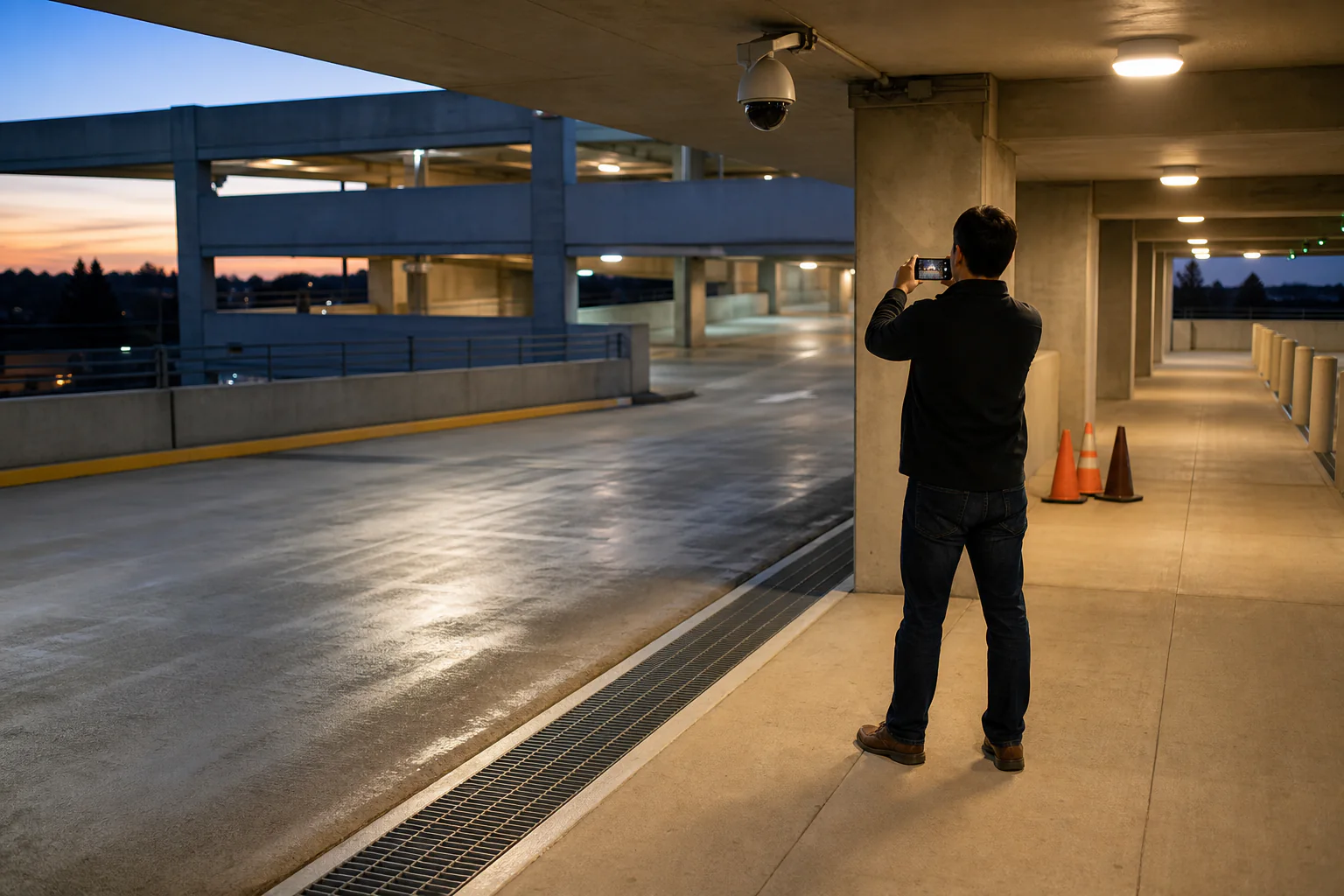
Person photographing a lit parking garage walkway beneath a security camera at dusk
A useful parking-property record file maps the exact zone, custodian, source status, time information, and integrity details without assuming that a camera or log proves what happened.

Quick answer

After a California parking-lot or garage injury, map the exact zone and possible custodians, then request existing incident, surveillance, inspection, lighting, cleaning, repair, and control records. Track requested, acknowledged, produced, and unavailable sources separately; preserve original files and metadata; and compare planned, observed, and logged conditions without treating a missing record as proof of fault.

Key takeaways

  • Identify the exact zone first: level, aisle, stair, ramp, elevator landing, payment area, walkway, entrance, curb, drain, wheel stop, or lighting segment.
  • Send narrow requests to the actual custodians. The owner, tenant, parking operator, security vendor, camera operator, cleaner, and maintenance contractor may hold different records.
  • Track four source states—requested, acknowledged, produced, and unavailable—and preserve original files, metadata, time-zone notes, and custodian explanations.
  • Do not claim that a missing video, work order, inspection, or incident report exists or proves fault. Compare what was planned, observed, and logged, and leave conflicts visible.
Hurt Advice Editorial Team

Prepared by

Hurt Advice Editorial Team

Editorial Research and Publishing Team

Source-checked editorial publishing

Why trust this article

Prepared by the Hurt Advice Editorial Team from current official California civil, evidence, public-records, and public-claim statutes. No attorney reviewed this displayed version.

Recent update: Original publication with a zone-and-custodian map, property-record packet, surveillance-integrity workflow, eight-field source ledger, planned-observed-logged comparison, neutral request script, public-record and claim timing lanes, evidence checklist, mistakes, FAQs, and next steps.

At a glance

What this guide helps you decide

Start with the question that brought you here, identify the records that can verify the facts, and use the related guidance only where it helps. This article addresses premises liability questions in California.

Main question

Decide how this topic may apply to your situation

Use "Parking-Lot Surveillance and Maintenance Records in California" to sort the facts you know, the questions still open, and whether a premises liability resource or consultation may be useful in California.

Guide map

Start with the sections most relevant to you: Quick takeaways, Who this guide is for—and what it does, Start with a zone-and-custodian map

Move through the article by issue, not by guesswork, so liability, medical proof, insurance pressure, deadlines, and next steps stay connected.

Records to gather

Connect these subjects to your records: Parking-Lot Surveillance, Parking Garage Records, Incident Reports, Lighting Work Orders

Compare the topic with records, photos, medical visits, police reports, insurer letters, and local claim details before relying on a general answer.

Trust check

Use the source trail before acting

This page includes 5 source references plus internal next-step paths so readers can verify where the guidance comes from.

Before you rely on this guide

This article is written for people dealing with injury-law questions in California. It is meant to help you understand the issue, not replace legal advice about your specific case.

What to do after this article

Start with the quick answer, skim the table of contents, and then use the links below to move into the practice area, author archive, or resource page that turns general guidance into a clearer next step for your situation.

Quick takeaways

  • Identify the exact zone first: level, aisle, stair, ramp, elevator landing, payment area, walkway, entrance, curb, drain, wheel stop, or lighting segment.
  • Send narrow requests to the actual custodians. The owner, tenant, parking operator, security vendor, camera operator, cleaner, and maintenance contractor may hold different records.
  • Track four source states—requested, acknowledged, produced, and unavailable—and preserve original files, metadata, time-zone notes, and custodian explanations.
  • Do not claim that a missing video, work order, inspection, or incident report exists or proves fault. Compare what was planned, observed, and logged, and leave conflicts visible.

Who this guide is for—and what it does

This guide is for a person injured in a California parking lot or garage, or a caregiver, who needs to organize property records without guessing what exists. It covers pedestrian falls, vehicle-pedestrian events, falling objects, gate or elevator-area events, lighting concerns, security incidents, and other parking-property conditions. It is a records workflow, not a conclusion about negligence, causation, damages, or who controlled the property.

The parking-lot and garage injury service page describes the broader claim lane. The California premises-liability resource explains the general legal framework. This article is narrower: it maps zones to custodians, lists record families, supplies a preservation-and-request script, and gives a source-status ledger for comparing planned conditions with observations and actual logs.

California Civil Code section 1714 states a general responsibility for injury caused by want of ordinary care or skill in the management of property or person, subject to the statute’s language and applicable law. That rule does not make every parking-lot injury a valid claim. Control, condition, notice, causation, comparative fault, defenses, and proof remain fact-specific. Use the broader premises-liability service hub to understand related property-injury categories.

Start with a zone-and-custodian map

A vague request for “all parking records” is difficult to route and easy to misunderstand. Start with a one-page zone map. Record the property address; public or private status if known; garage level or lot section; nearest entrance, stall, column, elevator, stair, payment station, or store; direction of travel; and the smallest practical event window. Add a sketch or ordinary photograph, but do not enter a dangerous area or recreate the event.

Then list every entity that may have created or kept a source:

  • Property owner or property manager: ownership, management agreements, inspection programs, capital projects, complaints, work orders, vendor contracts, and incident intake.
  • Tenant or business: employee reports, customer incident forms, opening or closing checks, cleaning calls, delivery records, and cameras covering its entrance.
  • Parking operator: shift logs, gate events, payment-system timestamps, space closures, patrols, customer assistance, and operator-managed cameras.
  • Security or camera vendor: patrol logs, dispatch notes, occurrence reports, camera maps, system-health alerts, export logs, and retention settings that actually existed.
  • Cleaning, lighting, paving, elevator, gate, or maintenance contractor: service tickets, inspection findings, arrival and completion times, photographs, replaced parts, and technician notes.
  • Public agency: records for a city, county, transit, university, or other public lot, including the agency division and public-records contact.

A sign, receipt, lease summary, website, tax record, or employee statement may help identify a custodian, but none automatically proves who controlled the event zone. Keep “possible custodian” separate from “confirmed custodian.”

The parking-property record packet

Ask for records tied to the event zone, date range, and issue—not every record for an entire property. A useful packet may include:

  • Incident sources: incident or occurrence report, first notice, witness names recorded by the business, employee or security notes, dispatch entries, photographs, and later addenda.
  • Surveillance sources: original exported clips for the event window and reasonable lead-in or lead-out, camera identifier, coverage map, export format, native timestamp and time zone, system-clock offset if known, and any export or access log created.
  • Inspection sources: opening, closing, hourly, route, safety, housekeeping, or supervisor checks that cover the specific zone.
  • Maintenance sources: work orders, complaints, repair tickets, preventive-maintenance schedule, technician notes, before-and-after images, materials used, closure time, and completion or reopening record.
  • Lighting sources: fixture map, inspection or meter record if one exists, outage report, service request, bulb or driver replacement, control or timer settings, and contractor response. The poor-lighting injury page covers that issue more broadly.
  • Surface and drainage sources: sweeping or cleaning log, spill or leak response, weather-related service, drain work, striping, paving, wheel-stop or curb repair, and temporary warning or barricade records.
  • Operations sources: patrol route, staffing roster limited to relevant roles, gate or elevator service, delivery or construction activity, and tenant notice affecting the zone.
  • Control sources: documents identifying the owner, manager, operator, tenant, and relevant vendor responsibilities. Request only the portions needed to understand the zone and record custodian.

The California injury-claim proof guide explains why a single report or photograph rarely resolves every disputed fact. Treat each item as one source with a defined purpose and limitation.

Preserve surveillance without changing the evidence

California Evidence Code section 250 defines a “writing” broadly to include photographs, pictures, sounds, symbols, and records regardless of how they are stored. Section 1401 states that a writing must be authenticated before it or secondary evidence of its content may be received in evidence. Those statutes do not guarantee that a camera recorded the event or that a private business must give a requester a file on demand. They do explain why source identity and integrity matter.

If a clip is voluntarily produced, preserve the downloaded file unchanged. Record the filename, byte size, received date, sender, delivery method, stated camera identifier, time zone, and any stated clock difference. Keep the transmittal email or portal receipt. Make a working copy for viewing; do not trim, enhance, re-encode, add captions, or overwrite the original. The digital-evidence preservation guide gives a broader original-file workflow.

A phone recording of a monitor is not the same source as the native export. A screenshot is not the same as a continuous clip. If only a derivative is available, label it honestly and ask whether the native file, earlier frames, additional angles, export log, and system-clock information still exist. Do not represent “camera visible on site” as “camera was working,” and do not represent “no footage produced” as “footage was destroyed.”

Use an eight-field source-status ledger

Use a responsive field ledger instead of a wide table. Create one entry for each requested source:

  1. Zone: the smallest location the record should cover.
  2. Custodian: confirmed entity and contact, or clearly labeled possible custodian.
  3. Record and date range: exact source family, event window, and surrounding period requested.
  4. Purpose: the question the source may help answer, without claiming the answer.
  5. Status: not requested, requested, acknowledged, produced, partly produced, unavailable, redirected, or disputed.
  6. Dates: request, acknowledgment, production, follow-up, and any stated deletion or unavailability date.
  7. Integrity details: filename, format, size, metadata, time zone, custodian statement, and storage location.
  8. Gap or conflict: what remains missing, inconsistent, corrected, or unknown.

Example: “Level 2 east pedestrian aisle; possible custodians: parking operator and security vendor; requested Camera P2-E clip from 6:40–7:10 p.m., camera map, time-zone/clock note, and export log; purpose: identify recorded conditions and movements; acknowledged by operator July 26; vendor redirect received July 27; no file produced yet; gap: camera ownership and retention setting not confirmed.”

This format prevents a request from being mistaken for a production and a production from being mistaken for proof of a conclusion.

Compare planned, observed, and logged conditions

For each disputed condition, create three source lanes:

  • Planned: inspection schedule, lighting plan, camera map, cleaning route, preventive-maintenance interval, contract scope, or closure procedure that actually applies to the zone.
  • Observed: contemporaneous photographs, video, witness observations, weather, visible warning, debris, surface condition, light appearance, or equipment position. Label who observed what and when.
  • Logged: completed inspection, patrol, complaint, dispatch, service ticket, repair note, incident entry, access log, or other source created during operations.

Do not force the lanes to agree. A plan may not show what happened on one date. A checked box may not reveal the entire condition. A photograph may show one angle and moment but not duration. An outage ticket may record a report without proving when an outage began. A missing entry may reflect a record gap, a different custodian, a different name, or a record that was never created.

Write the comparison neutrally: “The lighting schedule lists a 6:00 p.m. activation; the 6:42 p.m. photograph appears dim in the east aisle; the produced work order reports Fixture E-14 at 8:05 p.m.; the camera time zone and phone exposure settings remain unknown.” That is a source comparison, not a legal or technical conclusion.

A neutral preservation-and-record request script

Private entities may have different request channels and legal obligations. Use a short preservation request and ask how to submit a lawful record request. A neutral script can say:

“Please preserve existing records for the parking-property event at [address and exact zone] on [date], approximately [time and time zone], including the reasonable period before and after the event. The requested record families are: incident and dispatch entries; relevant surveillance clips and export information; camera map and system-clock information; inspections; complaints; cleaning, lighting, surface, drainage, gate, elevator, security, and maintenance work orders; photographs; and documents identifying the custodian responsible for the zone. Please confirm receipt, identify the correct custodian for any item you do not maintain, and state whether an item is unavailable or was not created. This request does not ask you to create a new report, opinion, or conclusion.”

Narrow the list to the real issue. Include alternate names for the zone or system only when supported. Do not demand admissions, threaten employees, impersonate an authority, enter restricted areas, or ask a witness to change wording. Save the exact sent message, attachment, delivery proof, and response.

Timing, private property, and public property

Act promptly because operational systems and ordinary business practices differ, but do not invent a universal camera or maintenance retention period. Ask the custodian what policy, system setting, legal hold, or backup actually applies. A preservation request is not proof that a source exists, and it is not a substitute for formal discovery or other lawful process.

If the lot or garage is held by a public agency, California Government Code section 7922.535 generally requires the agency, within 10 days after receiving a copy request, to determine whether it seeks disclosable public records in the agency’s possession and promptly notify the requester. That is a determination deadline, not a promise that every requested record is public or will be produced within 10 days. Exemptions, extensions, record location, and other rules may apply.

A separate deadline may matter when a claim concerns a public entity. Government Code section 911.2 generally requires a claim relating to injury to person or death to be presented within six months after accrual. That is a government-claim presentation rule, not the ordinary lawsuit deadline, and exceptions or other procedures may apply. The California deadline resource distinguishes common timing lanes. Do not wait for a record response to identify the correct deadline.

Evidence checklist before you share a packet

  • A one-page event-zone map with date, time window, direction of travel, and time zone.
  • A custodian list separating owner, manager, tenant, operator, security, camera, cleaning, lighting, and maintenance roles.
  • The exact sent requests, attachments, delivery proof, acknowledgments, redirects, productions, and unavailability statements.
  • Original produced files stored unchanged, plus a separate working-copy folder.
  • A source-status ledger with integrity details, gaps, and conflicts.
  • A planned-versus-observed-versus-logged comparison for each material condition.
  • Contemporaneous photographs, witness details, incident information, and medical records kept in their correct lanes.
  • Private account, medical, payment, access-code, and unrelated personal information removed from any unnecessary working copy.

A symptom journal may help organize reported day-to-day effects, but it does not replace property sources or medical records. Keep the injury-and-care file separate from the property-operations file until a specific task requires a combined index.

Common mistakes and red flags

  • Requesting “everything”: identify the zone, event window, record family, and possible custodian.
  • Assuming the visible camera recorded: request camera identity, coverage, operating status, time information, and native export without stating that footage exists.
  • Editing the only copy: preserve the original file and work from a duplicate.
  • Confusing a request with production: use separate requested, acknowledged, produced, and unavailable states.
  • Treating policy as performance: compare the plan with observations and logs; do not assume one proves the others.
  • Treating absence as fault: record the gap and the custodian explanation without supplying a legal conclusion.
  • Ignoring control: a property name, uniform, receipt, or sign may not identify the entity responsible for the exact zone or system.
  • Waiting on records before checking deadlines: public-entity and other timing rules can run while requests are pending.
  • Over-sharing sensitive material: use minimum necessary information and secure delivery.

Next steps

  1. Address safety and medical needs first; do not return to recreate a dangerous event.
  2. Build the zone map and list confirmed and possible custodians.
  3. Send narrow preservation requests for the source families that match the event.
  4. Track every source in the eight-field ledger and keep original files unchanged.
  5. Compare planned, observed, and logged conditions without hiding conflicts.
  6. Check public-entity and other deadlines independently of record production.
  7. Prepare a minimum-necessary packet for the specific insurance, medical, public-records, or legal task.

Hurt Advice is a lawyer-referral and legal-information service, not a law firm. This article provides general educational information, not legal advice, and does not decide whether a record exists or whether anyone is liable. No attorney reviewed this displayed version. You may use the Hurt Advice contact page to request a referral.

Frequently Asked Questions

How quickly should I request parking-lot surveillance video?
Promptly, because systems and ordinary business practices differ. Identify the exact zone, date, time window, and time zone, and ask the correct custodian to preserve existing clips and related export information. Do not claim that a camera was operating, recorded the event, or has a specific retention period unless a reliable source confirms it.
Who may hold records for a California parking garage injury?
Possible custodians include the owner, property manager, tenant, parking operator, security or camera vendor, cleaner, lighting contractor, paving or maintenance contractor, elevator or gate vendor, and a public agency. Map each requested source to a confirmed or possible custodian instead of sending one vague request.
What parking-lot maintenance records are useful to request?
Depending on the event, ask for zone-specific inspections, complaints, cleaning or sweeping logs, lighting reports, drainage work, paving or striping, curb or wheel-stop repair, gate or elevator service, warnings, closures, work orders, technician notes, and completion records. Request only the relevant date range and issue.
Does missing surveillance or a missing inspection log prove negligence?
No. Record the source gap, request history, and custodian explanation. A source may never have existed, may use another name, may belong to another custodian, may be unavailable, or may require a different lawful process. Do not turn absence into a factual or legal conclusion.
Can I use a phone recording of a security monitor?
Label it as a phone recording of a display, not as the native camera export. Preserve the phone file unchanged and record when, where, and by whom it was made. Ask whether the native clip, additional angles, camera identity, time-zone or clock information, and export log are available.
Are California public parking-garage records produced within 10 days?
Government Code section 7922.535 generally sets a 10-day period for an agency to determine whether a copy request seeks disclosable public records in its possession and notify the requester. It is not a universal production deadline, and exemptions, extensions, and other rules may apply.

Sources and references

Official text of California’s general ordinary-care rule for management of property or person, subject to the statute and applicable law.

Official definition of a writing, including photographs, pictures, sounds, symbols, and stored records.

Official claim-presentation timing for claims relating to injury, death, personal property, and other causes of action.

Need help after an accident?

Hurt Advice intake team can review your situation, explain your options, and help you move forward with a plan that fits your case.