
Legal ExplainerPremises LiabilityChecklist / Process

Pool Gate and Barrier Records After a California Injury

After a California pool-related injury, address safety and medical needs first. Then identify the exact property, pool, gate, latch, hinge, fence segment, and access route; preserve the as-found condition; request permit, inspection, complaint, maintenance, and repair records; and log every later test or change without treating one rule or a later gate state as automatic proof.

Published

August 1, 2026

Updated

August 1, 2026

Reading time

11 min read

Jurisdiction

California

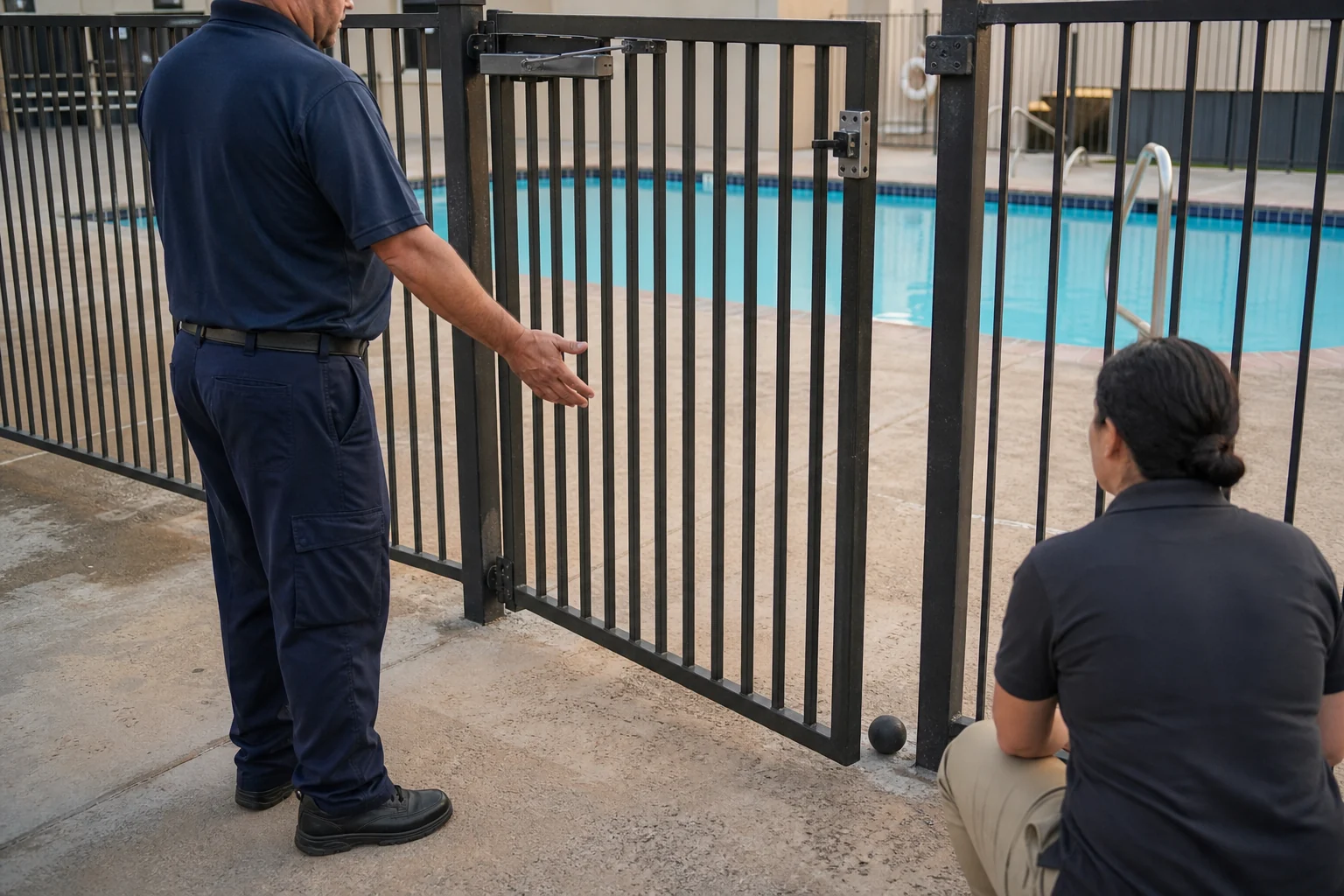
Pool technician releases a self-closing metal perimeter gate and watches its high latch engage beside an apartment swimming pool
Keep pool-access identity, approved design, inspection, maintenance, event observations, later testing, and changes in separate evidence fields.

Quick answer

After a California pool-related injury, address safety and medical needs first. Then identify the exact property, pool, gate, latch, hinge, fence segment, and access route; preserve the as-found condition; request permit, inspection, complaint, maintenance, and repair records; and log every later test or change without treating one rule or a later gate state as automatic proof.

Key takeaways

  • Protect people first: restrict unsafe access and follow emergency, medical, property, and public-agency directions before preserving records.
  • Identify the property type and permit history before applying a pool-barrier statute; a private single-family home, apartment, hotel, public facility, and licensed care setting can follow different lanes.
  • Document the whole access system—pool, gate, latch, hinge, closer, fence, doors, openings, route, surroundings, and fixed location references—not only the part that looks wrong.
  • Separate as-designed, approved, installed, inspected, maintained, reported, observed, tested, and changed-later states in one source-and-clock matrix.
Hurt Advice Editorial Team

Prepared by

Hurt Advice Editorial Team

Editorial Research and Publishing Team

Source-checked editorial publishing

Why trust this article

Prepared by the Hurt Advice Editorial Team from current California Legislature and Department of Justice sources. No attorney reviewed this displayed version.

Recent update: Original publication with a property-lane map, pool-access identity sheet, seven-state source matrix, custodian map, gate-state observation tool, request scripts, checklist, mistakes, and FAQs.

At a glance

What this guide helps you decide

Start with the question that brought you here, identify the records that can verify the facts, and use the related guidance only where it helps. This article addresses premises liability questions in California.

Main question

Decide how this topic may apply to your situation

Use "Pool Gate and Barrier Records After a California Injury" to sort the facts you know, the questions still open, and whether a premises liability resource or consultation may be useful in California.

Guide map

Start with the sections most relevant to you: Who this guide is for—and the reader task it owns, Quick takeaways, Contents: seven pool-barrier record lanes

Move through the article by issue, not by guesswork, so liability, medical proof, insurance pressure, deadlines, and next steps stay connected.

Records to gather

Connect these subjects to your records: California Pool Gate Records, Swimming Pool Barrier Inspection, Pool Gate Maintenance, Pool Access Evidence

Compare the topic with records, photos, medical visits, police reports, insurer letters, and local claim details before relying on a general answer.

Trust check

Use the source trail before acting

This page includes 6 source references plus internal next-step paths so readers can verify where the guidance comes from.

Before you rely on this guide

This article is written for people dealing with injury-law questions in California. It is meant to help you understand the issue, not replace legal advice about your specific case.

What to do after this article

Start with the quick answer, skim the table of contents, and then use the links below to move into the practice area, author archive, or resource page that turns general guidance into a clearer next step for your situation.

Who this guide is for—and the reader task it owns

This guide is for a California resident, guest, homeowner, tenant, association member, hotel guest, facility visitor, property operator, or records organizer after an injury involving access to a swimming pool or spa. It focuses on a perimeter gate, hinge, latch, closer, fence segment, wall, door, alarm, cover, opening, or access route.

The task is to identify the access system, choose the correct property and regulatory lane, preserve observations, request design, inspection, maintenance, complaint, and change records, and reconcile them by time—not to declare a violation or cause. The swimming-pool injury service owns broader representation intent; this article owns the narrower gate-and-barrier record workflow.

Hurt Advice is a lawyer referral and legal information service, not a law firm. This is general information, not legal, medical, engineering, pool-safety, code-compliance, or repair advice. It does not establish duty, notice, defect, violation, causation, damages, admissibility, or responsibility. No attorney reviewed this displayed version.

Quick takeaways

  • Protect people first: restrict unsafe access and follow emergency, medical, property, and public-agency directions before preserving records.
  • Identify the property type and permit history before applying a pool-barrier statute; a private single-family home, apartment, hotel, public facility, and licensed care setting can follow different lanes.
  • Document the whole access system—pool, gate, latch, hinge, closer, fence, doors, openings, route, surroundings, and fixed location references—not only the part that looks wrong.
  • Separate as-designed, approved, installed, inspected, maintained, reported, observed, tested, and changed-later states in one source-and-clock matrix.
  • Do not adjust or repeatedly cycle a gate merely to recreate an event; record the authority, conditions, method, and before-and-after state of any necessary inspection or repair.

Contents: seven pool-barrier record lanes

Use seven lanes: (1) immediate safety and scene control, (2) property, pool, and access-system identity, (3) the applicable property and regulatory lane, (4) permit, inspection, complaint, maintenance, and repair records, (5) firsthand observations and original media, (6) post-event testing, restrictions, changes, and custody, and (7) timing and follow-up.

Create one component identity sheet, one source-and-clock matrix, one gate-state observation log, one custodian map, one file manifest, and one change-and-custody ledger. Keep medical, witness, communication, and loss records in the broader California injury-proof guide.

Put immediate safety ahead of evidence collection

Call 911 when emergency help is needed. Keep children and other people away from an unsecured or questionable pool area. Follow lawful instructions from emergency personnel, property staff, environmental-health officials, building officials, or other responsible safety personnel. Do not prop a gate open, defeat a latch, enter a restricted area, reach through moving hardware, or leave a possible access hazard in place to preserve a photograph.

From a safe and lawful position, make wide photographs showing the pool, enclosure, every visible entrance, adjacent doors or openings, deck, fence line, surrounding fixed features, and the route a person could have used. Then make closer views of the specific gate, hinge, closer, latch, strike, posts, fence panels, ground clearance, gaps, damage, wear, obstructions, and nearby moveable objects. Record the time, weather, lighting, access state, and who first restricted or changed the area.

If an urgent lock, guard, temporary barrier, adjustment, or repair is necessary, do not delay it for documentation. When circumstances permit, record who directed the action, the safety reason, the as-found condition, the exact work, before-and-after media, removed parts, and final disposition.

Build a property, pool, and component identity sheet

Start with the address, building or unit, property type, ownership or management source, pool location, permit or facility identifier if known, and an orientation sketch. Distinguish a private single-family pool from an apartment, condominium, hotel, school, club, park, daycare, healthcare, or other facility. Mark unknown facts as unknown.

Give each access point and component a stable identifier. Record the gate location and swing direction; frame and posts; hinges; spring, closer, or gravity mechanism; latch, strike, release, lock, and handles; fence material; panels, rails, pickets, mesh, walls, openings, ground clearance, and transitions; nearby doors, alarms, covers, steps, furniture, planters, and climbable objects; and visible corrosion, looseness, binding, sagging, misalignment, damage, missing hardware, or obstruction.

Use orientation-based language such as “east perimeter pedestrian gate between apartment building 2 and pool deck, viewed from inside the enclosure.” Do not infer a measurement, code requirement, hidden mechanism, prior adjustment, operability, or cause from a photograph. The apartment injury service and hotel injury service describe the broader property contexts.

Choose the correct California pool-safety lane

California Health and Safety Code section 115922 addresses specified construction or remodeling permits for a pool or spa at a private single-family home. Subject to the statute, it requires at least two listed drowning-prevention features and says the local building code official inspects the required features before final approval. The listed options include an isolating enclosure, specified mesh fencing with a self-closing and self-latching gate, covers, door or window alarms, door-latching devices, pool alarms, and approved alternatives.

The surrounding Swimming Pool Safety Act states characteristics for an enclosure, including gate swing, self-closing and self-latching operation, latch placement, enclosure height, ground clearance, and gap limits. It also expressly excludes public pools, apartment complexes, and residential settings other than single-family homes from that article. Those details make permit records, final-inspection records, approved plans, feature selections, and later modifications important—but they do not justify applying the residential permit rule to every pool.

A separate public swimming pool statute addresses public-pool definitions, state supervision, safe operation and maintenance, local health-officer enforcement, inspection access, and selected operating records. Depending on the setting, other building, licensing, local, or facility-specific rules may matter. Confirm the property, permit, facility, component, date, and current text instead of combining private-home, public-pool, and licensed-facility requirements.

Use an as-designed through changed-later source matrix

Create one row for each gate, latch, hinge, closer, fence segment, opening, door, alarm, cover, or access route. Use these columns:

  1. Designed or approved: plans, specifications, selected safety features, permit, corrections, product or component identity, approved alternatives, and final approval.
  2. Installed: contractor, date, work scope, hardware, photographs, inspection, invoice, warranty, and deviations or substitutions.
  3. Inspected or maintained: inspector or vendor, qualifications, date, scope, checklist, measurements, functional observations, deficiencies, service, parts, follow-up, and closure.
  4. Reported: complaint or notice, exact words, date, recipient, attachments, acknowledgment, response, work order, and closure basis.
  5. Observed at the event: firsthand gate position, movement, sound, contact, obstruction, access route, lighting, weather, people present, warning, response, and immediate result.
  6. Tested later: authority, participants, date, initial state, opening position, release method, number of cycles, conditions, recording, result, and any alteration.
  7. Changed later: restriction, lock, guard, adjustment, lubrication, tightening, bending, cleaning, repair, replacement, removal, transfer, storage, or disposal.

Example: an approved plan depicts an enclosure; a final record notes two accepted features; a service invoice says “adjust pool gate”; a resident later reports that the latch sometimes misses; an incident witness describes the gate partly open; and a contractor replaces a hinge afterward. Those sources create a sequence and follow-up questions. No single row automatically proves the condition at another time or the legal cause of an injury.

Map the likely record custodians

Homeowner, owner, landlord, association, or property manager: ownership and property map, permits and plans in its possession, inspection calendar, complaints, notices, access policies, maintenance logs, work orders, vendor records, invoices, incident reports, camera retention, insurance notices, restrictions, and authorization for later work.

Pool-service, gate, fence, builder, or maintenance vendor: estimate, contract, component identity, installation or service scope, technician notes, checklist, photographs, adjustments, parts, callbacks, warranty, invoice, and communications. Ask for attachments and native media rather than only a billing summary.

Local building department: permit application, approved plans, selected safety features, corrections, inspection history, final approval, complaints, notices, and code-enforcement records within the agency file. Local environmental-health office: facility identity, public-pool permits or files, inspections, violations, correspondence, closures, and follow-up within its authority. A building department and health office may not hold the same records.

Licensed-facility regulator, school, park, hotel, club, or other operator: licensing or operating records, policies, opening and closing checks, staff assignments, incident records, maintenance, inspections, and regulator communications applicable to that setting.

Insurer or investigator: first notice, photographs, scene notes, recorded observations, estimates, expert scheduling, temporary protection, repair authorization, removed parts, transfer, and disposition. Request the focused record from its likely custodian instead of asking every organization for every pool file.

Request public-agency records without asking for a new conclusion

The California Department of Justice explains that public-record requesters should identify the record name, subject matter, and location or office when known, and that another agency’s records should be requested from that agency. Its Public Records guidance also notes that exemptions and redaction may apply. For a pool file, use the address, facility or permit identifier, date range, responsible office, and record types.

A focused request might seek existing permit applications, approved plans, inspection results, corrections, final approvals, complaints, notices, environmental-health inspections, closure or reopening records, and agency correspondence for the identified pool and dates. Ask for attachments and native electronic files when available. Do not ask the records officer to decide whether a gate complied, reconstruct an incident, identify a legal defendant, or create a chronology the agency does not maintain.

Save the request, delivery proof, acknowledgment, clarification, determination, estimated production date, invoices, production, redaction explanation, and follow-up. Keep agency records separate from private owner, vendor, witness, or insurer records.

Use a gate-state observation and change ledger

Before any voluntary functional test, create an as-found entry: date and time; property and gate identifier; observer; authority; gate position; latch and hinge appearance; visible obstruction or contact; weather and surface conditions; photographs or video; and actions already taken. If there is an immediate hazard, restrict access first.

When a qualified and authorized test is appropriate, record the starting opening position, which side the gate is released from, whether anyone pushes or assists it, the path of travel, contact or binding, whether the latch meets the strike, the resulting position, sound, rebound, number of cycles, and any condition that changes between cycles. Do not make up a pass/fail rule. Preserve the recording and the tester’s method and limitations.

Then create a separate change entry for every adjustment, lubrication, tightening, realignment, replacement, obstruction removal, lock, temporary guard, sign, fence repair, or gate removal. Identify the person, organization, authority, reason, parts, before-and-after state, removed-material handling, storage, access, and disposition. A later test belongs in the later-state column, not silently in the event-state column.

Neutral preservation and records-request scripts

Private custodian: “Please preserve existing records and original media associated with [property, pool, gate, component, permit, work order, complaint, or incident identifier] for [focused date range], including plans, permits, inspections, final approvals, checklists, complaints, notices, maintenance, service calls, parts, repairs, photographs, video, incident records, post-event testing, restrictions, removed components, transfers, and disposition. Please preserve timestamps, attachments, versions, and source identifiers and identify the custodian for records you do not maintain. This request does not ask you to create a new cause or compliance analysis.”

Public agency: “Please provide identifiable existing records for [property, facility, pool, permit, complaint, inspection, or case identifier] for [focused date range], including [specific record categories]. If another office maintains a category, please identify that office if known. Electronic copies with attachments are preferred. This request does not ask the agency to create a new record or legal conclusion.”

Test or repair coordination: “Before voluntary testing, adjustment, repair, replacement, removal, or transfer when circumstances allow, please identify the authority, safety plan, participants, exact gate and components, as-found documentation, method, conditions, recording, alterations, removed-part handling, storage, access, and disposition. Please record urgent safety work separately.”

These scripts are organization tools, not subpoenas, stop-work orders, guarantees of access or retention, or individualized legal advice.

Timing and process checkpoints

Immediately: address rescue, medical care, and access control; follow agency and property safety directions; make safe wide views; identify the exact pool and access point; record witnesses and firsthand observations; and note the first restriction or change.

First organized pass: complete the identity sheet, source matrix, custodian map, manifest, and change ledger. Send focused preservation requests to likely private custodians and identify the building or environmental-health office that may maintain agency records. The parking-lot records guide offers a related method for separating private maintenance records from public files.

Before voluntary testing or repair: clarify authority and safety, preserve the as-found condition, define the method and recording, identify what may change, and plan for removed components. Never delay an urgent correction that protects people.

Legal timing: Code of Civil Procedure section 335.1 states a two-year period for specified actions for injury to or death of an individual caused by another’s wrongful act or neglect. If a public entity may be involved, Government Code section 911.2 states a six-month presentation period for specified claims relating to death, personal injury, or personal property. Accrual, exceptions, defendants, minors, contracts, and other rules can change the analysis, so individual advice may be important promptly.

Pool gate and barrier evidence checklist

  • Property, ownership or management source, property type, building or unit, pool location, permit or facility identifier, orientation sketch, and wide context photographs.
  • Every gate, latch, strike, release, lock, handle, hinge, spring or closer, post, panel, rail, picket, mesh section, wall, opening, ground transition, nearby door, alarm, cover, and access route.
  • Plans, specifications, permit application, selected safety features, corrections, inspection history, final approval, facility file, and local or licensing communications applicable to the setting.
  • Complaints, notices, opening and closing checks, inspection and service logs, work orders, vendor notes, photographs, parts, callbacks, invoices, warranties, and closure records.
  • Original incident photographs and video, firsthand gate position and movement, sound, obstruction, weather, lighting, warnings, people present, response, and immediate access restriction.
  • Post-event inspection, testing, adjustment, lubrication, tightening, repair, replacement, removal, transfer, storage, access, and disposal entries with before-and-after proof.
  • Medical, witness, communication, wage, and insurance records kept in separate lanes, with unrelated residents, children, guests, or private facility information excluded.

Mistakes and red flags

  • Leaving a questionable gate accessible, delaying rescue, or ignoring a lawful safety direction in order to preserve the scene.
  • Photographing only the latch while omitting the whole gate, swing path, hinges, fence, pool, access route, surroundings, and fixed location references.
  • Applying the private single-family permit rule to an apartment, hotel, public pool, or licensed facility without checking the statute’s exclusions and the other applicable lane.
  • Treating approved plans, a final inspection, a service invoice, a complaint, a later failed test, or a later repair as automatic proof of the gate’s event-time condition or legal cause.
  • Repeatedly cycling, pushing, obstructing, lubricating, tightening, bending, or realigning the gate before recording the as-found state and authority for the action.
  • Combining owner records, vendor notes, agency files, witness observations, video, and later testing into one timeline without source and clock labels.
  • Accepting a summary marked inspected or repaired without asking for the scope, checklist, attachments, photographs, parts, measurements, and closure basis.
  • Sending a sweeping request that captures unrelated residents, children, cameras, financial records, or facility operations instead of the focused pool-access file.

Careful next steps

Complete the identity sheet, seven-state matrix, observation log, custodian map, manifest, and change ledger. Keep “designed,” “approved,” “installed,” “inspected,” “maintained,” “reported,” “observed,” “tested later,” “changed,” and “unknown” as separate labels. Reconcile the property, pool, gate, permit, work-order, photograph, and clock identifiers across sources.

If someone must secure, test, adjust, repair, replace, remove, or transfer the gate or barrier, clarify authority, safety, scope, recording, alteration, removed-part handling, storage, access, and disposition. Document necessary safety work without delaying it.

Hurt Advice can connect people with independent California lawyers through the contact page, but it does not promise representation or an outcome. For adjacent property-record methods, see the apartment stairway records guide, the daycare licensing records guide, and the premises-liability hub. This article was prepared by the Hurt Advice Editorial Team from the official sources listed below. No attorney reviewed this displayed version. See the editorial standards for sourcing and corrections.

Frequently Asked Questions

What pool gate and barrier records should I preserve after a California injury?
Preserve the exact pool, gate, latch, hinge, closer, fence segment, access route, and property identity; original photographs and video; permit and final-inspection records; complaints; inspection and service logs; work orders, invoices, and vendor communications; incident records; witness observations; and every post-event restriction, adjustment, test, repair, removal, or replacement. Keep sources and times separate.
Does California use the same pool-barrier rule for a house, apartment, hotel, and public facility?
No single rule should be assumed. The Swimming Pool Safety Act provisions discussed here apply to specified permitted work at private single-family homes and expressly exclude public pools, apartments, and other residential settings. Public-pool, licensed-facility, building-code, and local rules may follow different definitions, custodians, inspection paths, and records.
Does a gate that fails to latch during a later test prove how it worked at the time of an incident?
No. A later observation can be important, but it does not automatically establish the earlier gate position, adjustment, use, weather, obstruction, maintenance state, or cause. Record who performed the test, when, under what conditions, what changed first, and whether the test altered the gate.
Who may hold pool inspection and maintenance records?
Possible custodians include the owner, homeowner, landlord, property manager, homeowners association, hotel or facility operator, pool-service vendor, gate or fence contractor, builder, local building department, local environmental-health office, licensing agency, insurer, and incident investigator. Each may hold a different slice of the record.
Can I request local government pool inspection records under the California Public Records Act?
You may request identifiable records from the state or local agency that maintains them, but availability, redactions, exemptions, retention, and fees vary. Use the property address, pool or permit identifier, date range, record type, and responsible office. A public-records request does not require an agency to create a new analysis.
Should I repeatedly open or adjust a pool gate to document it?
Do not alter, repair, lubricate, tighten, bend, obstruct, or repeatedly cycle the gate merely to create evidence. Start with safe, noncontact photographs and firsthand observations. Any necessary inspection or functional test should identify authority, participants, conditions, method, recording, changes, and safety controls, while never delaying urgent hazard correction.

Sources and references

Need help after an accident?

Hurt Advice intake team can review your situation, explain your options, and help you move forward with a plan that fits your case.