
Legal ExplainerPremises LiabilityInformational

Playground Inspection and Maintenance Records After a California Injury

After a California playground injury, identify the exact site, component, surface area, and operator; preserve original photographs and present condition; then request focused inspection, complaint, work-order, repair, incident, and manufacturer records. Keep public-agency records procedures separate from private preservation requests, and mark missing sources as unknown rather than proof of fault.

Published

July 28, 2026

Updated

July 28, 2026

Reading time

12 min read

Jurisdiction

California

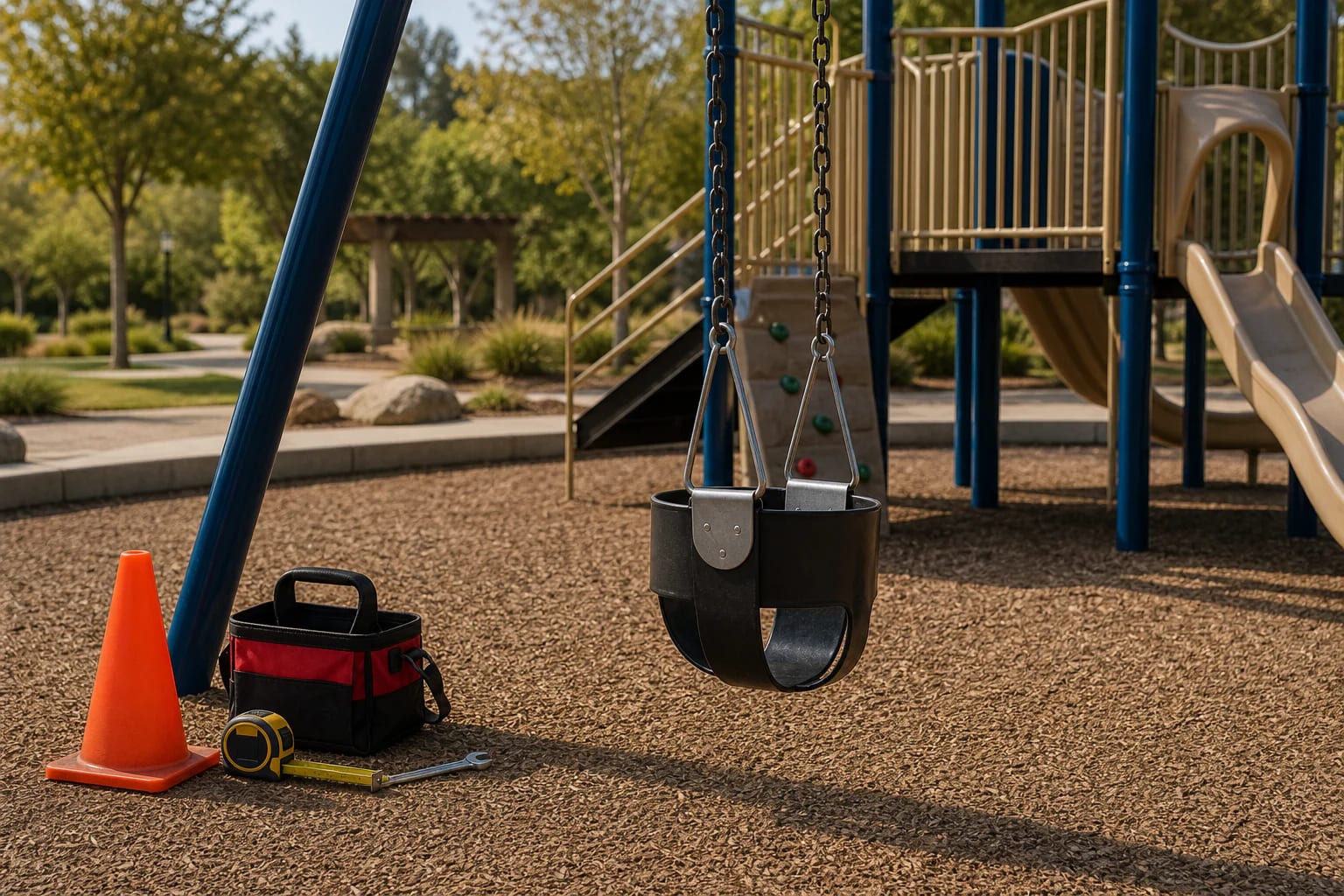
Empty public playground with a swing, protective surfacing, safety cone, tape measure, tool bag, and wrench arranged for inspection
A useful playground record file connects the exact site and component to dated inspections, complaints, work orders, repairs, incident sources, and manufacturer guidance without treating a gap as proof.

Quick answer

After a California playground injury, identify the exact site, equipment, surface, and operator; preserve original photographs and present condition; then request focused inspection, complaint, work-order, repair, incident, and manufacturer records. Use California public-record procedures only for agency-held records, keep private preservation requests separate, and label missing sources as unknown rather than proof.

Key takeaways

  • Identify the exact playground, equipment component, surface area, date, time, and operator before sending a request. A park name alone may not identify the responsible agency, school, landlord, business, contractor, or equipment custodian.
  • Preserve photographs, native files, witness details, incident communications, and the present condition before cleaning, repair, removal, resurfacing, or routine use changes what can be observed.
  • Keep public-record requests separate from private preservation requests. California public-record procedures apply to state and local agencies, not automatically to a private apartment complex, restaurant, resort, school, childcare operator, or maintenance vendor.
  • Inspection guidance, a recall, a missing checklist, or a later repair does not by itself prove a dangerous condition, notice, fault, medical cause, or legal responsibility. Build a dated source ledger and mark every gap as unknown.
Hurt Advice Editorial Team

Prepared by

Hurt Advice Editorial Team

Editorial Research and Publishing Team

Source-checked editorial publishing

Why trust this article

Prepared by the Hurt Advice Editorial Team from current U.S. Consumer Product Safety Commission, California Legislature, and California State Parks sources. No attorney reviewed this displayed version.

Recent update: Original publication draft with playground custodian map, inspection and maintenance record framework, public and private request scripts, source-status timeline, recall check, evidence checklist, and FAQs.

At a glance

What this guide helps you decide

Start with the question that brought you here, identify the records that can verify the facts, and use the related guidance only where it helps. This article addresses premises liability questions in California.

Main question

Decide how this topic may apply to your situation

Use "Playground Inspection and Maintenance Records After a California Injury" to sort the facts you know, the questions still open, and whether a premises liability resource or consultation may be useful in California.

Guide map

Start with the sections most relevant to you: Quick takeaways, Who this guide is for—and the narrow task it solves, Step 1: identify the exact site, operator, and record custodian

Move through the article by issue, not by guesswork, so liability, medical proof, insurance pressure, deadlines, and next steps stay connected.

Records to gather

Connect these subjects to your records: California Playground Records, Playground Inspection Records, Playground Maintenance Records, Public Park Records

Compare the topic with records, photos, medical visits, police reports, insurer letters, and local claim details before relying on a general answer.

Trust check

Use the source trail before acting

This page includes 4 source references plus internal next-step paths so readers can verify where the guidance comes from.

Before you rely on this guide

This article is written for people dealing with injury-law questions in California. It is meant to help you understand the issue, not replace legal advice about your specific case.

What to do after this article

Start with the quick answer, skim the table of contents, and then use the links below to move into the practice area, author archive, or resource page that turns general guidance into a clearer next step for your situation.

Quick takeaways

  • Identify the exact playground, equipment component, surface area, date, time, and operator before sending a request. A park name alone may not identify the responsible agency, school, landlord, business, contractor, or equipment custodian.
  • Preserve photographs, native files, witness details, incident communications, and the present condition before cleaning, repair, removal, resurfacing, or routine use changes what can be observed.
  • Keep public-record requests separate from private preservation requests. California public-record procedures apply to state and local agencies, not automatically to a private apartment complex, restaurant, resort, school, childcare operator, or maintenance vendor.
  • Inspection guidance, a recall, a missing checklist, or a later repair does not by itself prove a dangerous condition, notice, fault, medical cause, or legal responsibility. Build a dated source ledger and mark every gap as unknown.

Who this guide is for—and the narrow task it solves

This guide is for a parent, caregiver, injured family, or authorized representative trying to preserve and organize playground inspection, maintenance, repair, complaint, and incident sources after an injury in California. Its task is practical: identify who controls the site, request records from the right custodian, preserve present conditions, and compare dated sources without turning a record gap into a conclusion.

It does not determine whether a playground was unsafe, whether an operator had notice, whether a product was defective, whether supervision was adequate, whether an injury was caused by a particular condition, or who is legally responsible. Those questions depend on site-specific facts, admissible evidence, medical evidence, applicable law, and qualified analysis. The playground injury claims guide covers the broader legal and lawyer-comparison lane; this article stays with records, custody, and source control.

Address urgent safety and medical needs first. Do not place a child or anyone else back on equipment to recreate an event. Hurt Advice is a lawyer referral and legal information service, not a law firm, and this guide is general information rather than legal advice or representation.

Step 1: identify the exact site, operator, and record custodian

Begin with a one-page site identity sheet. Record the official facility name, street address, nearest entrance, playground area, equipment type, surface area, date and approximate time, weather and lighting, and any asset number or manufacturer label that can be photographed without moving equipment. Save a wide establishing view and closer views that show where each detail sits within the playground.

Then identify the operator lane. A city playground may involve a parks department, public works division, risk-management office, outside landscape contractor, and equipment vendor. A public-school playground may involve the district, school office, facilities department, and contractor. Private sites may involve an apartment owner or manager, homeowners association, restaurant, resort, private school, childcare operator, maintenance company, installer, or insurer. Do not assume that the person who accepts a complaint owns every responsive source.

Write down the basis for each custodian entry: a sign, website, lease communication, school notice, incident form, employee statement, work-order header, or public directory. If ownership is unclear, send a narrow request asking the recipient to identify the department or vendor that maintains the equipment and records. The California premises-liability service directory provides context for the wider property-claim family without replacing this custodian map.

Step 2: preserve present condition without staging a reconstruction

Photograph the playground as it exists from normal walking paths and public viewpoints. Capture the full structure, access points, component involved, connections, fasteners, moving parts, guardrails, platforms, use zone, surface type, surface depth markers if present, displaced material, drainage, nearby roots or borders, lighting, sight lines, and any temporary closure or repair condition. Use a scale only when it can be placed safely without moving anything. Keep the original files with metadata and make working copies for annotation.

Record what changed after the event and who reported the change. Examples include equipment being closed, a loose-fill surface being raked, a fastener tightened, a component removed, caution material installed, an area washed, photographs taken, or a contractor called. Use neutral descriptions such as “right swing connector photographed from ground level” rather than “failed connector.” If an employee or witness describes a prior complaint, preserve the exact words, date, speaker, and medium instead of paraphrasing the statement as an admitted fact.

The general accident evidence checklist can help organize photographs, witnesses, communications, reports, and treatment materials. Keep playground-specific condition files in their own folder so later copies, edits, and annotations do not replace the originals.

Step 3: build an equipment, surfacing, and document identity ledger

Create one row for each relevant component or area. Suggested fields are: site; component description; location within the site; manufacturer or label if visible; model or asset number if visible; installation or replacement date if known; manufacturer instructions located; inspection form name; last dated inspection found; complaint or work-order number; repair or closure action; photograph file name; current condition; current custodian; and source.

Keep equipment and surfacing entries separate. A swing hanger, chain, seat, slide exit, platform, barrier, climber, anchor, border, loose-fill area, unitary surface, drain, tree root, or path transition may have different inspection and repair sources. Do not estimate dimensions from a photograph unless the image contains a reliable scale and the method is documented.

The July 2025 CPSC Public Playground Safety Handbook is guidance for public playground safety. It says manufacturer maintenance instructions and recommended schedules should be followed; when those are unavailable, a schedule should be developed based on actual or anticipated use, with more frequent inspection and maintenance at frequently used playgrounds. That is a framework for identifying records to request, not proof of the schedule required at a particular site.

What inspection and maintenance records should be requested?

Ask for records by site, component, subject, and date range rather than requesting “everything about the playground.” A focused packet may include the equipment inventory; manufacturer manuals and maintenance instructions; installation, acceptance, and post-installation inspection material; routine and detailed inspection checklists; employee or contractor inspection routes; surfacing-depth or condition checks; photographs; complaints; service requests; work orders; invoices; purchase orders; parts records; closure and reopening notes; warranty communications; vendor emails; repair closeout; and incident reports.

The CPSC handbook recommends a comprehensive maintenance program, systematic inspections by personnel familiar with the playground, prompt notation and correction of problems, and retention of maintenance-inspection, repair, manufacturer-instruction, checklist, accident, and injury records. It also says the person performing an inspection should sign and date the form. Request the actual forms and native records rather than assuming that the handbook created or preserved a record at this site.

Ask for record versions and attachments. A final work-order summary may omit the original complaint, photographs, measurements, parts used, declined work, technician notes, or closeout verification. If a source refers to another source—such as “see photo,” “vendor notified,” or “repair complete”—request the referenced item and record whether it was produced, withheld, unavailable, or never identified.

Public playground lane: use a focused California public-record request

For records held by a California state or local agency, the California Public Records Act provides the procedural lane. The current Government Code sections 7922.525, 7922.530, and 7922.535 state that public records are open to inspection except as otherwise provided, require reasonably described identifiable disclosable records to be made promptly available, and require an agency to make a disclosure determination within 10 days. That 10-day period is for the determination, not necessarily delivery. A written extension of up to 14 days may be used for listed unusual circumstances.

Identify the agency that prepared, owned, used, or retained the record. California State Parks’ official Public Records Access Guidelines explain that public records can include writings, photographs, email, and other recorded information relating to public business. The guidelines recommend a clear description with dates, subjects, titles, and authors, and note that exemptions and redactions may apply. A city, county, district, or school agency may publish its own request portal and instructions.

Do not combine a preservation request with an overbroad demand for legal conclusions. Ask the agency to preserve identified existing records and provide the records it holds. If a response says no responsive record was located, record the request language, date range, search description, recipient, response date, and any suggested custodian. Do not rewrite “not located” as “never existed.”

Private playground lane: send a preservation request, not a public-record demand

A private apartment complex, restaurant, resort, private school, childcare facility, homeowners association, or contractor is not automatically subject to the California Public Records Act. Send a concise preservation request to the operator and each identified custodian. Ask that existing records and physical condition be maintained while inspection and access arrangements are considered. Do not claim a right of entry, demand confidential personal information, or authorize repair or destructive testing.

For childcare locations, the public licensing lane and the private facility lane may coexist. The California daycare licensing and incident-record guide explains how to keep facility, family, medical, and licensing sources separate. For other commercial or residential sites, use the same principle: identify which source belongs to the owner, manager, tenant, contractor, vendor, agency, witness, or family.

Private preservation should cover the exact date range and source types that may matter: inspection forms, complaints, work orders, photographs, messages, video, access logs, equipment manuals, purchase and installation files, contractor records, incident reports, and removed parts. If a recipient refuses, does not respond, or says a source is unavailable, preserve that communication without treating it as an admission.

Two practical request scripts

Public-agency records script: “Under the California Public Records Act, I request existing records for [playground name and address], [specific equipment or area], from [start date] through [end date]: inspection checklists, complaints or service requests, work orders, repair and closure records, relevant photographs, manufacturer or contractor instructions retained by the agency, and communications about the identified condition. Please provide records electronically where available. If another department holds them, please identify that custodian. Personal medical and child-identifying information is not requested.”

Private preservation script: “Please preserve the present condition of [site and component] and existing records from [date range], including inspection forms, complaints, work orders, photographs, video, messages, vendor files, incident reports, repair records, removed parts, and closure or reopening notes. This request does not authorize inspection, repair, alteration, testing, or disposal. Please identify the person who coordinates preservation and access.”

Adapt the scripts to facts you can verify. Do not include diagnoses, private child details, accusations, or a city list. Keep the sent message, attachment, delivery confirmation, recipient, and any response in the source ledger.

Use a source-status timeline instead of a fault narrative

Build a chronological ledger with these fields: event date and time; source date; source type; author or custodian; site or component; observation or action; attached file; version; related request; and status. Use status labels such as “produced,” “referenced but not produced,” “withheld with stated basis,” “not located,” “pending,” “family recollection,” or “inference.”

Example: a complaint email may report a loose part on Monday; a Tuesday inspection form may record no issue; a Wednesday work order may identify a different component; a Thursday photograph may show a closure. Preserve all four sources. Do not merge them into a single claim that the operator knew the exact condition throughout the week. The value of the ledger is that it exposes agreements, differences, missing attachments, and changed conditions.

Use the parking-lot surveillance and maintenance records guide for another example of separating camera, inspection, cleaning, lighting, complaint, and work-order custodians. The setting differs, but the source-control method is transferable.

Recall and manufacturer checks: preserve the dated result

If a manufacturer, model, or component can be identified, search the official CPSC recall listing and preserve the dated result, recall number, product description, affected identifiers, hazard description, remedy, and source URL. Keep the downloaded row or official notice with the date searched. Search results can change as notices are added or corrected.

A recall or safety notice does not by itself show that the exact playground equipment is covered, that the reported condition existed at the event time, or that it caused an injury. Match the site’s label, model, date range, component, installation records, remedy history, and current condition. If the label is missing or unreadable, record that fact and request purchase, installation, warranty, and vendor records rather than guessing.

Timing and process checkpoints

First safe opportunity: address care, identify the exact location, preserve original photographs and communications, record witnesses, and notify the operator of the specific site and component. Do not delay urgent care to collect evidence.

Next records pass: identify public and private custodians, send focused requests, preserve delivery evidence, and request referenced attachments. For a public agency, calendar the response and distinguish the statutory determination notice from production of records. For private custodians, record responses and follow-up without assuming public-record procedures apply.

Reconciliation pass: compare inspection dates, complaints, work orders, closure or reopening activity, manufacturer instructions, photographs, incident records, recall results, witness accounts, and medical sources. Organize medical records separately from playground condition records so the source for a diagnosis or treatment statement is not confused with evidence about the site.

Records-request timing is not a claim-filing deadline. Government-claim, limitation, school, childcare, contract, insurance, and other rules can be fact-specific and may be shorter than expected. This article does not calculate a deadline. If timing or preservation is disputed, obtain case-specific legal advice promptly.

Common mistakes and red flags

  • Requesting every record about every park instead of identifying the site, equipment, subject, and useful date range.
  • Using the Public Records Act against a private operator without first identifying whether a public agency actually holds responsive records.
  • Treating a 10-day public-agency determination period as a guarantee that every record will be delivered within 10 days.
  • Editing originals, stripping file metadata, circulating only screenshots, or discarding the native photograph, message, video, spreadsheet, or PDF.
  • Moving equipment, digging into surfacing, measuring unsafely, staging a reenactment, or asking a child to demonstrate what happened.
  • Calling a missing checklist proof that no inspection occurred, or calling a later repair proof that the earlier condition caused the event.
  • Publishing a child’s identity, medical details, school information, home address, private serial number, or other sensitive information in a public file.
  • Relying on a general safety checklist as the site’s maintenance contract, manufacturer instruction, local policy, or legal standard without verifying the applicable source.

Evidence checklist before you close the file

  • Exact site name, address, entrance, playground area, component, surface area, event date, and approximate time.
  • Original wide, medium, and close photographs; native files; file index; photographer; and a separate working-copy folder.
  • Operator and custodian map with the source supporting each entry.
  • Equipment and surfacing identity ledger, visible labels, manuals, purchase or installation sources, and recall snapshot.
  • Inspection forms, routes, checklists, complaints, service requests, work orders, photographs, vendor records, repair closeout, closure, and reopening sources.
  • Public-record request or private preservation request, sent copy, attachment, recipient, delivery proof, follow-up, and response.
  • Incident report, witness contact information, exact statements, related video or messages, and the source of each fact.
  • Separate medical record index, expense records where relevant, and a log of sources requested but not yet received.
  • Source-status timeline that labels produced, pending, withheld, referenced, not located, recollection, and inference entries.

Next steps and editorial disclosure

Audit the packet against three questions: Can another person identify the exact site and component? Can every statement be traced to a dated source? Can the file distinguish what was observed, what a record says, what remains missing, and what is only an inference? The California injury claim proof guide provides a broader fault, causation, and damages evidence audit.

If the operator is unclear, a condition is changing, a public agency and private contractor each point to the other, or a deadline may apply, consider case-specific legal advice. Hurt Advice can help connect people with independent California lawyers through the contact page, but Hurt Advice is not a law firm and does not promise an outcome.

This article was prepared by the Hurt Advice Editorial Team from the official sources cited above. No attorney reviewed this displayed version. It is scheduled for a source refresh so changes to CPSC guidance and California public-record procedures can be checked.

Frequently Asked Questions

What playground inspection records should I request after a California injury?
Request site and equipment inventories, manufacturer instructions, installation and acceptance records, routine and detailed inspection checklists, surfacing checks, complaints, service requests, photographs, work orders, parts and vendor records, repair closeout, closure or reopening notes, and incident reports for a focused date range.
Does California require a public agency to deliver records within 10 days?
No. Government Code section 7922.535 uses 10 days for the agency’s determination about whether the request seeks disclosable records. If records are disclosable, the agency gives an estimated availability date. A written extension of up to 14 days may apply in listed unusual circumstances.
Can I use the California Public Records Act for an apartment or restaurant playground?
Not automatically. The Act applies to records held by state and local agencies, subject to exemptions. A private owner, manager, restaurant, resort, private school, childcare operator, or contractor usually needs a focused private preservation request unless a public agency separately holds responsive records.
Does a missing inspection checklist prove the playground was not inspected?
No. Record the exact request, recipient, date range, search description, and response. Ask for nearby sources such as routes, work orders, photographs, contractor invoices, complaints, calendars, and repair notes. Label the checklist as not located or not produced rather than guessing whether it existed.
Should playground equipment be moved or tested for photographs?
Do not move, operate, load-test, dismantle, repair, or stage equipment to recreate an event. Photograph safely from ordinary viewpoints, preserve original files, and document any change reported by the operator. Site access, measurement, or inspection should be arranged safely and with proper authority.
Does a CPSC recall prove the playground equipment caused the injury?
No. Preserve the dated official recall result and then match the exact manufacturer, model, component, date range, remedy history, and site equipment. A recall may be relevant, but it does not by itself establish coverage, site condition, notice, fault, or medical cause.

Sources and references

U.S. Consumer Product Safety CommissionCPSC Recall Listing

Official downloadable recall listing for a dated manufacturer, product, and remedy check.

Need help after an accident?

Hurt Advice intake team can review your situation, explain your options, and help you move forward with a plan that fits your case.