
Legal ExplainerPremises LiabilityInformational

Apartment Stairway Fall Records in California: What to Preserve

A strong apartment-stairway record does not begin with a liability label. It begins with a safe, source-labeled account of the exact stair flight and with separate management, vendor, public-agency, communication, and medical timelines. That structure makes later questions about control, notice, maintenance, change, injury, and causation easier to evaluate without overstating what any one record proves.

Published

July 23, 2026

Updated

July 23, 2026

Reading time

10 min read

Jurisdiction

California

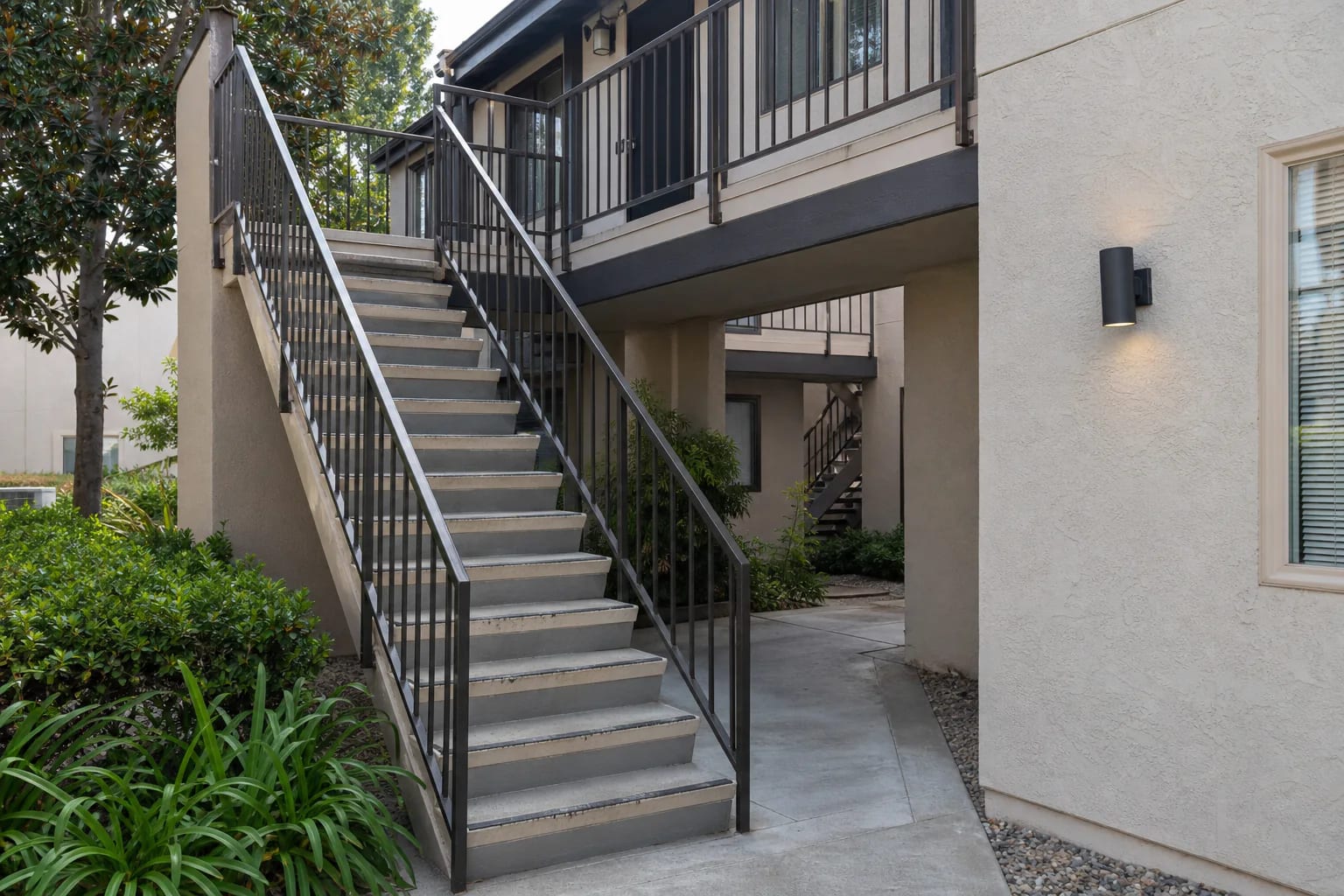
Empty exterior stairway and landing in a California apartment courtyard in daylight
A reliable apartment-stairway file separates scene observations, management records, vendor records, public-agency records, and later changes by source and date.

Quick answer

After a fall on a California apartment stairway, preserve the full scene and build four separate record lanes: your photographs and communications, property-management records, maintenance-vendor records, and local code or permit records. Track each report, inspection, assignment, repair, closure, and later change by source and date without treating any single record as automatic proof of fault.

Key takeaways

  • Photograph the exact stair flight, approach, landing, handrail, lighting, and surrounding context before cleaning, repair, weather, use, or later work changes what can be observed.
  • Build four separate source lanes: your scene and communications, property-management records, maintenance-vendor records, and local code-enforcement or permit records.
  • Create a notice timeline that records when a condition was reported, observed, inspected, assigned, worked on, closed, changed, and preserved; do not collapse those events into a fault conclusion.
  • Ask promptly for existing records and preservation, but do not state a universal camera, work-order, or complaint retention period unless the actual custodian confirms it.
Hurt Advice Editorial Team

Prepared by

Hurt Advice Editorial Team

Editorial Research and Publishing Team

Source-checked editorial publishing

Why trust this article

Prepared by the Hurt Advice Editorial Team from the current Judicial Council premises-liability instructions and official California statutes addressing ordinary care, housing conditions, and timing. No attorney reviewed this displayed version.

Recent update: Original publication with a four-source apartment-stairway record map, neutral preservation request, notice-chain timeline, management and vendor custody lanes, local-agency record workflow, timing cautions, evidence checklist, and next-step sequence.

At a glance

What this guide helps you decide

Start with the question that brought you here, identify the records that can verify the facts, and use the related guidance only where it helps. This article addresses premises liability questions in California.

Main question

Decide how this topic may apply to your situation

Use "Apartment Stairway Fall Records in California: What to Preserve" to sort the facts you know, the questions still open, and whether a premises liability resource or consultation may be useful in California.

Guide map

Start with the sections most relevant to you: Quick takeaways, Who this guide is for—and the narrow task it solves, Why the record trail matters without deciding liability

Move through the article by issue, not by guesswork, so liability, medical proof, insurance pressure, deadlines, and next steps stay connected.

Records to gather

Connect these subjects to your records: California Apartment Stairway Fall, Premises Liability Records, Notice Timeline, Maintenance Work Order

Compare the topic with records, photos, medical visits, police reports, insurer letters, and local claim details before relying on a general answer.

Trust check

Use the source trail before acting

This page includes 5 source references plus internal next-step paths so readers can verify where the guidance comes from.

Before you rely on this guide

This article is written for people dealing with injury-law questions in California. It is meant to help you understand the issue, not replace legal advice about your specific case.

What to do after this article

Start with the quick answer, skim the table of contents, and then use the links below to move into the practice area, author archive, or resource page that turns general guidance into a clearer next step for your situation.

Quick takeaways

  • Photograph the exact stair flight, approach, landing, handrail, lighting, and surrounding context before cleaning, repair, weather, use, or later work changes what can be observed.
  • Build four separate source lanes: your scene and communications, property-management records, maintenance-vendor records, and local code-enforcement or permit records.
  • Create a notice timeline that records when a condition was reported, observed, inspected, assigned, worked on, closed, changed, and preserved; do not collapse those events into a fault conclusion.
  • Ask promptly for existing records and preservation, but do not state a universal camera, work-order, or complaint retention period unless the actual custodian confirms it.

Who this guide is for—and the narrow task it solves

This guide is for a California apartment resident, guest, family member, or authorized helper organizing records after a fall on an apartment stairway. It addresses one narrow task: preserve what the stairway looked like and build a source-labeled trail of complaints, inspections, work orders, vendor activity, code records, and later changes.

The stairway-falls service guide covers the broader claim lane. The apartment-complex injury guide covers apartment claims generally. The slip-and-fall resource explains broad premises-liability concepts. This article does not repeat those owners or decide whether a landlord, manager, vendor, tenant, guest, public entity, or anyone else is legally responsible.

Get urgent medical help when needed. Do not re-enter a restricted stairway, climb on a railing, move a loose component, stage a reenactment, or delay care to collect evidence. Record only what can be done lawfully and safely.

Why the record trail matters without deciding liability

California Civil Code section 1714(a) states a general responsibility for injury caused by a lack of ordinary care in managing property or a person, while also addressing the injured person’s own conduct. The Judicial Council’s 2026 California Civil Jury Instructions place premises-liability questions in CACI Nos. 1000 and 1001, including control of the property, negligent use or maintenance, harm, and causation.

Those legal questions are why a careful file separates observation from inference. A photograph may show a stair edge on a date. A work order may show that someone assigned a task. An inspection entry may show what an inspector recorded. None of those records, by itself, proves every required element, identifies every responsible party, or resolves comparative fault and causation.

Use labels such as reported, observed, requested, received, disputed, and not yet confirmed. Avoid labels such as “code violation,” “admission,” or “the cause” unless a qualified source actually made that determination.

First preserve the scene you can lawfully observe

Start with wide photographs from the normal approach, then the entire flight, top and bottom landings, each side, handrails, stair edges, walking surface, nearby doors, drainage, exterior lighting, shadows, and the route immediately before and after the fall. Add close views only after the context is captured. Do not place an object on the stairs to dramatize a condition.

Record the date, time, weather, available natural and artificial light, camera device, photographer, exact location, whether the area had already changed, and any access limit. If a light was off, record that observation and the time; do not claim why it was off. If a surface was wet, record location and appearance without guessing the source or duration.

Preserve original files and metadata. Make working copies for annotation rather than overwriting originals. The digital-evidence guide explains the source-and-copy distinction even though this incident is not a vehicle crash.

Build a four-source apartment stairway record map

  1. Resident-held lane: original photographs and video, messages, emails, portal submissions, call notes, lease materials, prior requests you actually sent or received, witness contact information, and medical-care timing.
  2. Property-management lane: incident report, complaint or service-request history for the location, inspection entries, work orders, completion notes, staff communications, camera-preservation response, policies used for reporting and repair, and identification of the owner, manager, and insurer when provided.
  3. Vendor lane: vendor identity, assignment, scope, arrival, inspection, estimate, materials, work performed, completion, invoice, photographs, callback, and any record showing what the vendor was asked to do.
  4. Public-record lane: address-specific code complaints, inspection results, correction notices, permit records, and publicly available building records from the relevant local agency. Availability, terminology, and access differ by jurisdiction.

Keep each lane separate even when records refer to the same event. A management summary of vendor work is not the vendor’s own invoice, and a resident’s screenshot of a portal status is not necessarily the full service-request record.

Use a neutral preservation and record-request script

Adapt this script to the actual custodian and send it through a method you can later document:

“I am requesting preservation of existing records concerning the apartment stairway at [exact building, stair identifier, and location] for the period [narrow relevant dates]. Please preserve and identify available incident reports, resident complaints or service requests, inspection records, work orders and status history, maintenance or vendor assignments, estimates, invoices, completion notes, photographs or video, access-control entries relevant to the location, and any record of a change to the stairway, handrail, landing, surface, or lighting. Please also identify the appropriate contact for available copies. This request does not ask anyone to create a new record or state a legal conclusion.”

Use a narrow location and time range. Ask for existing records rather than demanding an admission. Do not impersonate a tenant, owner, lawyer, insurer, or public official. Do not ask staff to delete, alter, backdate, or “fix” a record.

Preservation and production are different. A custodian may preserve information without immediately providing it, and disputes about access, privacy, privilege, burden, ownership, or legal process may require case-specific advice.

Create a notice-chain timeline, not a single “notice” box

Use one row for each event and include: event date and time; source; exact location; condition described; person or system receiving it; record identifier; status; assigned person or vendor; inspection date; work date; completion or closure date; later change; attachment; and what remains unconfirmed.

A precise entry reads: “July 18, 8:42 p.m.; resident portal confirmation 6842; second-floor east stair wall light reported out; status shown as received; screenshot and confirmation email saved.” A later entry might read: “July 19, 10:15 a.m.; portal status changed to assigned; no assignee shown.” Keep both. Do not rewrite them as “management knew the stairs were unsafe” unless the actual record and applicable law support that conclusion.

Track verbal contacts too: speaker, organization, date, time, number called, what you asked, exact answer, promised follow-up, and confirmation sent. If memory is uncertain, say so. A same-day note is useful context, not a recording or independent transcript.

Request property-management records by location and record type

Ask for the stair identifier used by management, not just a street address. Apartment properties can have repeated stair flights, multiple buildings, and shared vendor systems. Include building number, floor, compass direction or nearby unit, landing, and the normal approach.

Useful record types can include the incident report, resident communication, service-request history, inspection checklist, work-order status history, staff assignment, vendor dispatch, estimate, authorization, invoice, completion note, photograph, camera map and preservation response, and record of later repair or replacement. Ask for the record’s native identifier and attachments when available.

Do not assume every property creates every record or uses the same label. If the response is “no record,” preserve the response, who made it, what location and date range were searched, and whether a different owner, manager, vendor, or platform held the record.

Keep maintenance-vendor records in their own custody lane

Property management may use a maintenance employee, general contractor, lighting vendor, handrail contractor, cleaning company, landscaping company, or another provider. The relevant vendor depends on the observed condition and actual work history. Do not name a company as responsible merely because its vehicle or logo appeared at the property.

If a vendor is identified, preserve the source of that identification and ask the appropriate party for the assignment, scope, inspection, estimate, work ticket, materials, completion record, photographs, invoice, and callback. Record whether the document is a draft, estimate, approved work order, completed ticket, or paid invoice; those states are not interchangeable.

Never remove fasteners, paint, tread material, lighting components, or other property to “save” it. A physical component may belong to someone else and can create safety and chain-of-custody problems. Photograph from a safe place and get specific advice before any inspection that changes the condition.

Check local code and permit records without declaring a violation

California Health and Safety Code section 17920.3 describes conditions that can make a building substandard when they exist to an extent that endangers life, limb, health, property, safety, or welfare. The statute includes general dilapidation or improper maintenance and lists structural and exit-related conditions. It does not make every worn stair edge, light outage, complaint, or repair delay an automatic statutory violation.

Identify the local building, housing, or code-enforcement agency for the address. Search its public portal or request available address-specific complaint, inspection, correction, permit, and closure records for a narrow period. Preserve the agency’s exact finding, date, status, address, unit or common-area location, and document number.

Building requirements can depend on jurisdiction, building type, construction or alteration date, adopted code edition, prior lawful conditions, and maintenance. Do not measure a photograph and announce code compliance or noncompliance. A qualified inspector or expert may need the actual site and governing records.

Connect medical timing without turning records into a diagnosis

Record when symptoms were first noticed, when care was sought, what history was given, and what activity limits were documented. Preserve discharge instructions, referrals, imaging reports, work restrictions, bills, and follow-up records you lawfully possess. Do not edit a medical record to match a later theory.

The symptom-journal guide offers a neutral way to track function over time. Keep the stairway condition file and the medical file linked by dates, but separate. A photograph of stairs cannot diagnose an injury, and an imaging report does not by itself establish who controlled or maintained the property.

If a chart has a factual error, use the provider’s correction or amendment process rather than altering a downloaded copy. Medical questions belong with qualified clinicians; legal causation and damages require case-specific review.

Treat timing as several separate clocks

There is no single “apartment stairway records deadline.” Scene conditions, lighting, surveillance, work-order statuses, staff memory, and vendor records can change on different schedules. Send focused preservation requests promptly and document delivery, but do not invent a retention period the custodian has not confirmed.

California Code of Civil Procedure section 335.1 states a two-year limitations period for an action for injury or death caused by another’s wrongful act or neglect. Accrual, parties, tolling, contracts, other claims, and exceptions can change the analysis, so this is not a personal deadline calculation.

If a public housing authority, city, county, or other public entity may be involved, California Government Code section 911.2 generally requires a claim relating to personal injury to be presented within six months after accrual. Government-claim rules have definitions, exceptions, and procedures. Seek prompt California legal advice rather than assuming an ordinary private-property timeline applies.

Use a source-and-status evidence checklist

  • Scene: wide and close images, route, stair identifier, date, time, light, weather, access limits, and original file metadata.
  • People: witness contact details, staff and vendor names as actually provided, and dated call notes without invented quotes.
  • Management: incident record, portal history, complaints, inspections, work orders, assignments, attachments, status changes, and preservation response.
  • Vendor: identity source, scope, estimate, authorization, work ticket, materials, completion, photographs, invoice, and callback.
  • Public agency: complaint, inspection, correction, permit, closure, document number, agency, status, and exact location.
  • Change log: cleaning, repair, replacement, lighting change, handrail work, painting, access restriction, and who documented the change.
  • Medical and loss: care timing, records, restrictions, bills, wage or activity documents, and source-labeled updates.

Use the California injury-proof guide to connect the lanes later. Keep unavailable, requested, received, disputed, and verified items visibly different.

Common mistakes and red flags

  • Photographing only one tread: capture the full approach, flight, landing, rail, light, and surroundings.
  • Staging the scene: do not add water, objects, tape, signs, or people to recreate what happened.
  • Combining sources: a resident screenshot, management export, vendor ticket, and code record should retain separate provenance.
  • Calling an assignment a repair: received, assigned, inspected, authorized, completed, closed, and paid are different states.
  • Assuming “no record” ends the search: document the scope searched and whether another manager, owner, vendor, or platform was identified.
  • Declaring a code violation from a photo: code applicability and site conditions require the governing records and qualified review.
  • Waiting for a broad demand: use a narrow, prompt location-and-record request while avoiding fake universal retention claims.
  • Ignoring a public-entity possibility: public housing or another public entity can trigger a different and much shorter claim process.

Next steps: a seven-part action sequence

  1. Address urgent care and safety; do not re-enter or alter a restricted or dangerous stairway.
  2. Identify the exact building, stair flight, landing, approach, date, time, and source of every observation.
  3. Preserve original scene files, messages, portal confirmations, witness contacts, and care timing.
  4. Send a narrow preservation and existing-record request to the known owner or manager and record delivery.
  5. Build separate management, vendor, and local-agency lanes with native identifiers, dates, attachments, and status changes.
  6. Audit the notice chain for gaps: report, receipt, inspection, assignment, authorization, work, closure, later change, and preservation.
  7. Use the premises-liability glossary for terminology and seek case-specific advice before a deadline, destructive inspection, recorded statement, or disputed access decision.

Hurt Advice is a lawyer-referral and legal-information service, not a law firm. This article provides general educational information, not legal, medical, engineering, building-code, investigation, or safety advice. No attorney reviewed this displayed version. A licensed California attorney can evaluate the actual property, control, records, injuries, parties, public-entity issues, and deadlines. You can use the Hurt Advice contact page to request a referral.

Frequently Asked Questions

What records should I preserve after a fall on an apartment stairway?
Preserve original scene photographs and video, messages and portal submissions, the incident report, complaint and service-request history, inspections, work-order status history, vendor assignments and invoices, camera-preservation responses, later-change records, local code or permit records, witness contacts, and medical-care timing. Keep each source in its own labeled lane.
How should I ask an apartment manager to preserve stairway records?
Identify the exact building, stair flight, landing, location, and narrow date range. Ask to preserve existing incident reports, complaints, inspections, work orders, vendor records, photographs or video, and records of changes to the stairs, handrail, surface, or lighting. Do not ask the recipient to create a new record or admit fault.
Does a maintenance work order prove the landlord knew about a dangerous stairway?
Not by itself. A work order can show what was reported or assigned, by whom, and when, but its meaning depends on the wording, location, status history, surrounding records, control of the property, actual condition, causation, and applicable law. Preserve the complete record and attachments without rewriting it as a legal conclusion.
Can I request local code-enforcement records for an apartment address?
Many local agencies provide public portals or request processes for address-specific complaints, inspections, correction notices, permits, and closure records, but availability and terminology vary. Preserve the agency, document number, date, exact location, status, and finding. Do not treat the absence of a record or a photograph alone as a code determination.
How long are apartment camera or work-order records kept?
There is no safe universal retention period for apartment video, portal data, complaints, or work orders. Systems, policies, vendors, and events differ. Send a focused preservation request promptly, document delivery, and avoid stating a deadline unless the actual custodian or governing rule confirms it.
What deadlines can apply after a California apartment stairway injury?
California Code of Civil Procedure section 335.1 states a two-year period for many injury actions, while Government Code section 911.2 generally requires a public-entity injury claim within six months after accrual. Parties, accrual, tolling, exceptions, and claim type can change the result, so obtain case-specific advice promptly.

Sources and references

Need help after an accident?

Hurt Advice intake team can review your situation, explain your options, and help you move forward with a plan that fits your case.