
Legal ExplainerPremises LiabilityChecklist / Process

Ladder Condition and Setup Records After a California Fall

After a ladder fall in California, address immediate safety and medical needs first. When it is safe and lawful, preserve the ladder, its labels, rails, rungs, feet, locks, rope, accessories, setup, original media, inspection, rental, repair, training, and custody records. Keep planned setup, firsthand observations, post-event condition, and later changes in separate evidence lanes.

Published

July 31, 2026

Updated

July 31, 2026

Reading time

10 min read

Jurisdiction

California

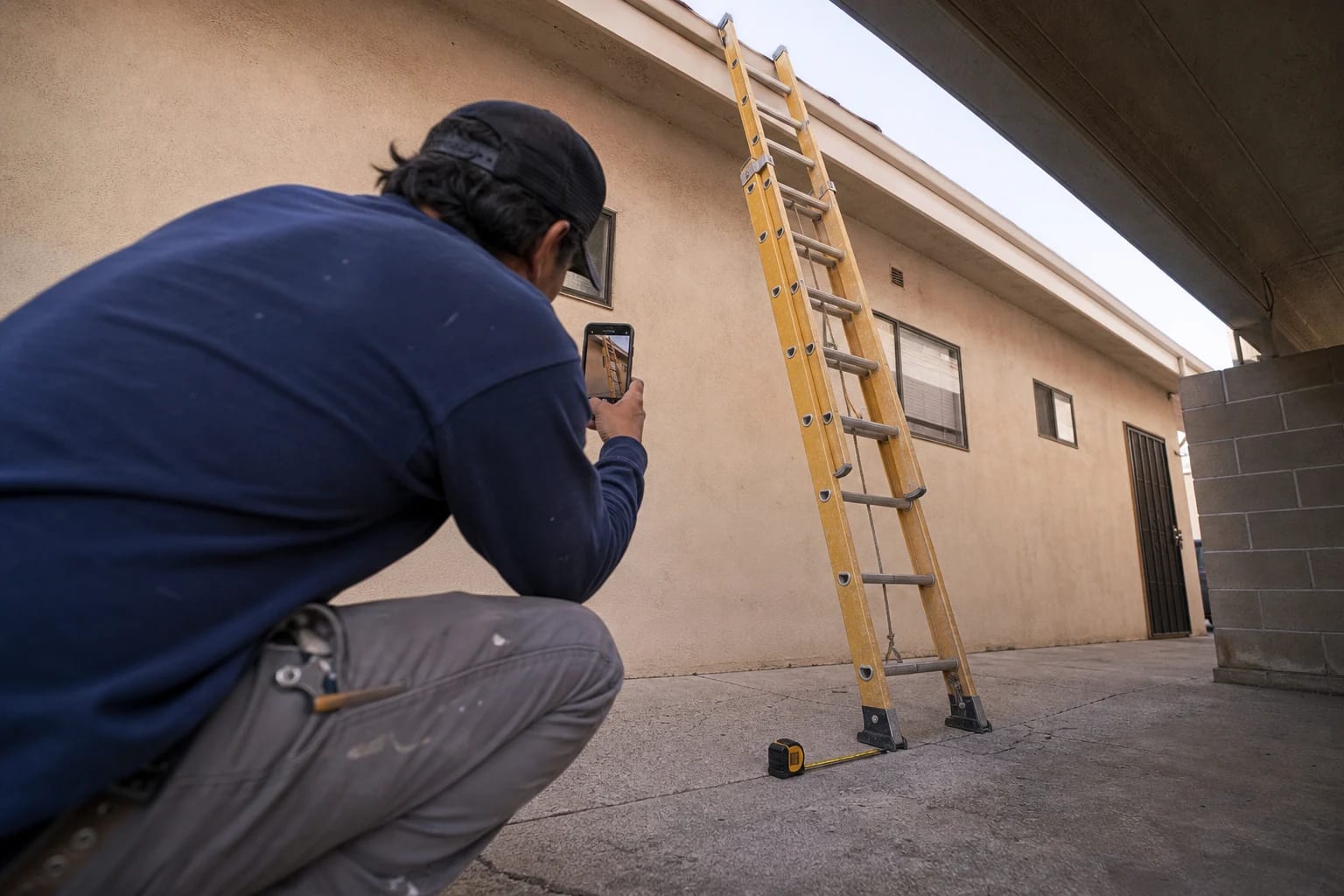
Apartment maintenance worker photographs both feet and the setup of an unbranded fiberglass extension ladder before it is moved
Ladder identity, setup, condition, firsthand observations, and later movement should remain separate evidence fields.

Quick answer

After a ladder fall in California, address immediate safety and medical needs first. When it is safe and lawful, preserve the ladder, its labels, rails, rungs, feet, locks, rope, accessories, setup, original media, inspection, rental, repair, training, and custody records. Keep planned setup, firsthand observations, post-event condition, and later changes in separate evidence lanes.

Key takeaways

  • Safety and medical needs come first; do not climb, reset, extend, fold, load, test, or stage a ladder merely to create evidence.
  • When safe and lawful, preserve the ladder, labels, feet, rails, rungs, spreaders or locks, rope, accessories, nearby surfaces, and original media as an identified set.
  • Record planned setup, source-supported configuration, firsthand observations, post-event condition, and later changes as separate states.
  • Workplace standards can supply useful record fields, but their scope depends on the setting and they do not automatically decide a California injury claim.
Hurt Advice Editorial Team

Prepared by

Hurt Advice Editorial Team

Editorial Research and Publishing Team

Source-checked editorial publishing

Why trust this article

Prepared by the Hurt Advice Editorial Team from current California Division of Occupational Safety and Health, federal OSHA, and California Legislature sources. No attorney reviewed this displayed version.

Recent update: Original publication with a ladder identity sheet, four-state setup matrix, condition inspection guide, scene and digital record workflow, custody ledger, custodian map, neutral request scripts, checklist, mistakes, and FAQs.

At a glance

What this guide helps you decide

Start with the question that brought you here, identify the records that can verify the facts, and use the related guidance only where it helps. This article addresses premises liability questions in California.

Main question

Decide how this topic may apply to your situation

Use "Ladder Condition and Setup Records After a California Fall" to sort the facts you know, the questions still open, and whether a premises liability resource or consultation may be useful in California.

Guide map

Start with the sections most relevant to you: Who this guide is for—and the narrow task it solves, Quick takeaways, Contents and the seven evidence lanes

Move through the article by issue, not by guesswork, so liability, medical proof, insurance pressure, deadlines, and next steps stay connected.

Records to gather

Connect these subjects to your records: California Ladder Fall Evidence, Ladder Condition Records, Ladder Setup Evidence, Extension Ladder Inspection

Compare the topic with records, photos, medical visits, police reports, insurer letters, and local claim details before relying on a general answer.

Trust check

Use the source trail before acting

This page includes 6 source references plus internal next-step paths so readers can verify where the guidance comes from.

Before you rely on this guide

This article is written for people dealing with injury-law questions in California. It is meant to help you understand the issue, not replace legal advice about your specific case.

What to do after this article

Start with the quick answer, skim the table of contents, and then use the links below to move into the practice area, author archive, or resource page that turns general guidance into a clearer next step for your situation.

Who this guide is for—and the narrow task it solves

This guide is for a California tenant, homeowner, visitor, worker, contractor, property manager, or family member organizing records after a fall involving a stepladder, extension ladder, single ladder, platform ladder, or other portable ladder. It may also help when an employer, contractor, property owner, rental company, repair shop, manufacturer, insurer, or public agency holds a different part of the record.

The task is source control: identify the exact ladder and its components; document the as-found setup without creating another hazard; separate what was planned, what reliable sources show was configured, what someone directly observed, and what was found later; and keep inspection, maintenance, training, rental, repair, scene, and custody records in distinct lanes. The broader scaffolding and ladder falls service page describes the service topic. This checklist focuses on the narrower condition-and-setup record job.

Hurt Advice is a lawyer referral and legal information service, not a law firm. This is general information, not legal, medical, engineering, workplace-safety, or ladder-use advice. It does not establish a defect, violation, causation, damages, admissibility, or responsibility. No attorney reviewed this displayed version.

Quick takeaways

  • Safety and medical needs come first; do not climb, reset, extend, fold, load, test, or stage a ladder merely to create evidence.
  • When safe and lawful, preserve the ladder, labels, feet, rails, rungs, spreaders or locks, rope, accessories, nearby surfaces, and original media as an identified set.
  • Record planned setup, source-supported configuration, firsthand observations, post-event condition, and later changes as separate states.
  • Workplace standards can supply useful record fields, but their scope depends on the setting and they do not automatically decide a California injury claim.
  • Document every movement, cleaning, inspection, repair, return, transfer, test, disposal decision, and missing interval.

Contents and the seven evidence lanes

The workflow has seven lanes: (1) immediate safety and scene control, (2) exact ladder identity, (3) ladder condition, (4) setup and surrounding environment, (5) event and movement timeline, (6) inspection and custody, and (7) home, property, employer, contractor, rental, repair, manufacturer, insurer, and agency records. Do not merge the lanes before identifying what each source actually supports.

Use one ladder identity sheet, one planned-set-up-observed-post-event matrix, one condition-and-custody ledger, and one file manifest. The accident evidence checklist supplies a general framework.

Put safety before preservation

Address emergency directions, active hazards, and medical needs first. Keep people away from an unstable ladder, unprotected edge, energized conductor, damaged surface, falling-object area, doorway, driveway, or active work zone. Do not climb the ladder, ask someone to hold it for a reconstruction, reopen a stepladder, change an extension ladder’s length, pull its rope, engage or release rung locks, place weight on a suspect step, or recreate a person’s position.

If emergency personnel, a supervisor, property manager, safety professional, or public agency controls the scene, record who directed movement or isolation rather than interfering. When it is safe, make wide images before close images: the full ladder, bottom and top support, nearby walking surface, doorway or traffic path, work area, landing, tools or materials, lighting, weather exposure, and objects moved during the response.

Evidence preservation does not require leaving a dangerous ladder in an occupied or insecure place. Record the safety reason for movement, person directing it, time, condition before movement when safely observable, new location, and components or accessories that moved with it.

Build an exact ladder-and-component identity sheet

Start with the ladder as found. Record whether it is a stepladder, extension ladder, single ladder, combination ladder, platform ladder, step stool, job-made ladder, or another design. Add brand, model, serial or date code, material, total length, section count, duty label, maximum intended load if legible, owner or asset number, rental or purchase identifier, and any field modification. Photograph every label in context before transcribing it. Do not clean, peel, trace, or guess a damaged identifier.

Inventory both side rails; every rung, step, and cleat; feet and shoes; spreaders, hinges, braces, locks, rope and pulley; fly and base sections; levelers, hooks, stabilizers, platforms, wheels, gates, fasteners, end caps, and manufacturer-supplied accessories. Keep a separate row for each component. “Ladder looked fine” is not an identity or condition record.

The California Division of Occupational Safety and Health’s official Title 8 section 3276 defines several portable-ladder types and addresses design, selection, care, use, inspection, maintenance, footing, support, extension, and training. Use those subjects to organize fields only where relevant. The regulation’s application depends on the workplace and facts, and it does not prove how a particular fall occurred.

Use a planned-set-up-observed-post-event matrix

Create one row for each important component or condition and four state columns:

  1. Planned: ladder type, location, task, height, landing or work surface, material carried, expected duration, and intended access route.
  2. Set up before the event: what a firsthand source or contemporaneous photo shows about opening or extension, rung-lock engagement, spreaders, feet, base surface, top support, angle, overlap, tie-off or stabilization, barricades, door control, traffic, weather, and nearby electrical conditions.
  3. Observed during the event: direct perceptions of movement, sound, contact, shift, bounce, slip, rotation, surface change, object movement, or loss of balance—without adding what the source did not see.
  4. Post-event: ladder position, open or folded state, extension length, lock and rope position, feet and rail condition, surrounding marks, debris, moved objects, rescue actions, and later inspection, cleaning, repair, or storage.

Example: “Planned: access a low eave with an extension ladder. Set up: a 2:14 p.m. photo shows both feet on concrete and both rails at the eave; base spacing was not measured. Observed: neighbor heard a scrape and then saw the ladder on its side; the neighbor did not see the beginning of the movement. Post-event: maintenance staff moved the ladder away from the walkway at 2:27 p.m.; photographs were taken after that move.” This preserves limits instead of reconstructing the fall.

Use official ladder standards carefully

California’s official portable ladder safety overview identifies state portable-ladder regulations and summarizes selection, length, duty, inspection, and maintenance topics. Section 3276 states, among other things, that portable ladders in its scope are to be maintained in good condition and inspected for visible defects frequently and after an occurrence that could affect safe use. Those are record prompts, not findings about a specific ladder or event.

For federal general-industry workplaces, OSHA’s current 29 C.F.R. 1910.23 ladder standard addresses visible-defect inspections, removal from service, spreaders or locks, surfaces, displacement risks, load, and intended use. For construction, OSHA’s 29 C.F.R. 1926.1053 contains a separate ladder standard. Preserve the work setting, employer, contractor, date, and ladder type before assuming either federal page controls.

A standard, citation, training item, or inspection log may be relevant evidence, but it does not by itself establish defect, breach, cause, admissibility, or civil responsibility. Keep official-rule research separate from the ladder, scene, witnesses, medical records, and any qualified investigation.

Document ladder condition without testing it

When safe, photograph each rail from both sides; rung-to-rail joints; feet and tread surfaces; spreaders, braces, hinges, locks, rope, pulley, and fasteners; bends, cracks, splits, corrosion, contamination, wear, repairs, tape, paint, stickers, drilled holes, missing pieces, and field modifications. Include scale and orientation without covering the condition. Record whether a condition was visible before movement or only after handling.

For an extension ladder, separately document base and fly sections, overlap, rung locks, rope path, pulley, feet, upper contact, stabilization accessories, and any marks where the rails or feet contacted surfaces. For a stepladder, separately document front and rear rails, opening position, spreaders or locks, top cap, steps, feet, rear bracing, platform, and any wall or object used as support.

Do not load-test, flex, straighten, unfold, extend, lubricate, clean, tighten, repair, or disassemble the ladder merely to see what happens. If a qualified inspection is proposed, first identify its scope, people, recording method, measurements, manipulation, destructive steps, removed parts, storage, and disposition. “No defect observed” is different from “not inspected,” and both are different from “condition changed before inspection.”

Preserve setup, scene, and original digital records

The environment can preserve facts the ladder alone cannot. Record the bottom surface, slope, cracks, seams, moisture, oil, dust, debris, mats, cords, thresholds, and contact marks. Record top support, roof or landing edge, wall finish, gutters, window or door position, nearby traffic, barricades, lighting, weather, task materials, tools, footwear when relevant, and any item carried. Do not move objects merely to improve a photograph.

Build the timeline from reliable clock sources: ladder delivery or checkout, prior inspection, setup, task start, last pre-event image, witnessed movement, emergency call, first photograph, notice to a property owner or supervisor, ladder movement, inspection, return, repair, and disposal. Keep “found at” separate from “was at before the event.” Keep the person’s memory separate from a camera timestamp, dispatch record, work order, or access log.

California Evidence Code section 250 defines a writing broadly to include photographs, sounds, and records stored in any manner. Section 1401 states an authentication requirement for writings and secondary evidence of their content. Those statutes do not guarantee admissibility. Preserve originals, source, capture method, metadata, exports, and ordinary handling rather than relying only on crops, forwarded clips, screenshots, or annotated copies.

The apartment stairway records guide addresses a different fixed-building record task. For a portable ladder, keep the movable equipment and setup timeline at the center.

Keep a condition-and-custody ledger

Create one entry per event with date and time; location; ladder or component; person or organization; as-found condition; action; safety or business reason; original photo, video, receipt, tracking, signature, or report; and limitation or missing interval. Track the ladder, each removable accessory, rope, leveler, stabilizer, platform, hardware, packaging, manual, and removed part separately.

Example: “2:22 p.m., rear walkway: tenant photographed both ladder feet, full rails, rung locks, upper contact, and concrete after emergency care began; no image shows the initial setup. 2:27 p.m.: property manager carried the ladder to a locked maintenance room to clear the walkway; no component inventory was made at the first location. 4:10 p.m.: manager photographed the stored ladder without extending it.”

Do not write “unchanged” when the record shows only that no change was observed. Use “no change observed by [source] between [times]” or “condition not recorded.” If the ladder is cleaned, folded, extended, tested, repaired, returned, shipped, discarded, or separated from accessories, keep the reason, actor, authority, before-and-after documentation, and destination.

Map records by custodian

User or household: original photos and video, purchase or rental record, packaging, manual, registration, storage, prior use, repair, messages, task notes, and contemporaneous observations. Preserve relevant material without copying unrelated private content.

Property owner or manager: maintenance requests, inspection rounds, work orders, contractor records, ladder inventory, access records, incident report, surveillance retention, witness information, photographs, prior complaints, cleanup or movement, storage, and communications. The premises-liability glossary supplies broad definitions; this article does not decide whether premises law applies.

Employer or contractor: ladder assignment, competent- or qualified-person records where applicable, pre-use and periodic inspections, training, task planning, work schedule, site photographs, supervisor communications, incident report, corrective action, subcontractor roles, and injury records. Preserve what the record says without assuming a requirement, violation, or conclusion.

Retailer, rental company, repair shop, manufacturer, insurer, or agency: listing version, invoice, delivery, checkout and return condition, included accessories, inspection, maintenance, repair, replacement, complaint, safety notice, warranty, received-item condition, proposed testing, storage, transfer, and disposition. A current listing or manual version does not prove what accompanied the ladder earlier.

Neutral request and inspection scripts

Property, employer, contractor, rental, or repair records: “Please preserve the existing records associated with [exact ladder, asset, order, rental, work order, or incident identifier] for [focused date range], including ladder identity, assignment or checkout, inspections, maintenance, repair, training, setup, photographs, video, incident response, movement, storage, return, replacement, and disposition. Please preserve original timestamps, attachments, versions, and identifier fields and identify the custodian for records you do not maintain. This request does not ask you to create a new cause analysis.”

Proposed inspection or transfer: “Before a voluntary transfer when circumstances allow, please identify the recipient, facility, scope, people involved, recording method, manipulation or load testing, destructive steps, removed-parts handling, storage, access, and return or disposition plan. Please keep the ladder and each accessory individually identified.”

Use verified current contact channels and share only what is reasonably needed. Save the request, delivery proof, acknowledgment, response, objection, transfer receipt, tracking, and follow-up. These scripts are organization aids, not subpoenas, commands, guarantees of retention, or substitutes for case-specific advice.

Timing and process checkpoints

Immediately: address hazards and care, follow emergency directions, control access if authorized, and record who moved or secured the ladder. Make safe wide and close images before voluntary changes when possible.

First organized pass: build the identity sheet, four-state matrix, scene timeline, file manifest, and custody ledger. Preserve original media and the ladder, rope, locks, feet, removable accessories, packaging, and manual as linked items.

Before return, repair, inspection, or disposal: verify recipient and authority, document condition and inventory, identify manipulation or destructive steps, clarify removed-parts handling, and create a transfer record. Safety and lawful workplace or agency processes remain controlling.

When records arrive: keep productions unchanged, log source and date, compare identifiers, preserve conflicts, and update the ledger without overwriting prior entries. If a deadline or disputed claim may be involved, the California deadline resource is only general background; seek individual advice promptly.

Ladder evidence checklist

  • Ladder type, material, length, section count, brand, model, serial or date code, duty label, owner or asset number, rental or purchase identifier, and label photographs in context.
  • Both rails; every rung, step, and cleat; feet; spreaders, hinges, braces, locks, rope, pulley, fly and base sections; levelers, stabilizers, platforms, wheels, gates, fasteners, and removable accessories.
  • Wide and close scene images showing bottom surface, top support, extension or opening position, nearby landing, doorway or traffic, task area, tools, materials, lighting, and objects moved during response.
  • Planned-set-up-observed-post-event matrix with firsthand source, clock source, proof, unknowns, and later changes.
  • Original photos, video, audio, messages, downloads, exports, and metadata stored separately from crops, annotations, conversions, and redactions.
  • Purchase, rental, assignment, inspection, maintenance, repair, training, work order, complaint, warranty, return, replacement, shipping, storage, and disposition records.
  • Condition-and-custody entries for movement, folding, extension, cleaning, inspection, testing, repair, transfer, storage, and disposal.
  • Medical, wage, property, and insurer records kept in their own lanes with unnecessary private material excluded from ladder files.

Mistakes and red flags

  • Climbing, loading, extending, folding, straightening, cleaning, or staging the ladder to demonstrate what happened.
  • Moving the ladder before safe wide and close photographs when no emergency or hazard requires immediate movement.
  • Treating a later ladder position, lock state, footprint, or rail mark as proof of the initial setup without a reliable source.
  • Treating a Cal/OSHA or federal OSHA standard as automatic proof of violation, causation, defect, or private civil responsibility.
  • Combining user memory, witness observation, incident report, inspection note, repair opinion, and later testing into one unqualified conclusion.
  • Using only screenshots when original media, exports, work orders, rental records, training files, or inspection records are available.
  • Returning or surrendering the ladder without verified recipient, inventory, condition proof, scope, alteration terms, removed-parts plan, storage, and disposition.
  • Keeping an unstable ladder in an occupied or public path solely for evidence, or obstructing emergency, workplace-safety, or lawful agency directions.

Careful next steps

Complete the identity sheet, four-state matrix, scene timeline, manifest, and custody ledger. Keep “planned,” “set up,” “observed,” “found,” “reported,” “moved later,” “inspected,” and “unknown” as different labels.

If another person or organization requests the ladder, clarify authority, safety, scope, manipulation, destructive steps, removed parts, documentation, storage, access, and disposition before a voluntary transfer when circumstances allow. If emergency personnel, an employer safety process, or a public agency already controls the item, document the custodian and follow the lawful process.

Hurt Advice can connect people with independent California lawyers through the contact page, but it does not promise representation or an outcome. This article was prepared by the Hurt Advice Editorial Team from the official sources listed below. No attorney reviewed this displayed version. See the editorial standards for sourcing, corrections, and autonomous-article disclosure.

Frequently Asked Questions

What should I preserve after a ladder fall?
When it is safe and lawful, preserve the ladder, labels, rails, rungs or steps, feet, spreaders or locks, rope, pulley, removable accessories, packaging, manual, and original scene media as an identified set. Keep purchase, rental, assignment, inspection, maintenance, repair, training, movement, and custody records. Do not climb or load the ladder to create evidence.
Should I fold, extend, or move the ladder?
Follow immediate safety and emergency directions. Otherwise, avoid unnecessary movement or manipulation until the condition and setup are documented when safely possible. Record who moved, folded, extended, or secured the ladder, when, why, its condition before and after, and the new location. Never leave an unstable ladder in an occupied or public path merely for evidence.
Does a damaged foot, rung, rail, or lock prove what caused the fall?
No. A later condition can be relevant, but it does not by itself prove when the condition arose, the earlier setup, whether a rule applied, or what caused the event or injury. Preserve original media, planned setup, firsthand observations, surrounding surfaces, prior inspections and repairs, and every later movement, inspection, or test.
What belongs in the planned-set-up-observed-post-event matrix?
Record the intended ladder, location, task, and access plan; what firsthand sources or contemporaneous records show about the setup; what a witness directly perceived during the event; and what was found afterward. Add the source, clock, proof, unknowns, rescue actions, movement, inspection, repair, and later changes. Do not fill missing states with assumptions.
Which inspection and maintenance records may matter?
Depending on the setting, useful records may include purchase or rental checkout, ladder inventory, assignment, pre-use or periodic inspections, maintenance, repair, removal from service, training, work orders, complaints, incident response, return condition, replacement, and disposition. Keep each custodian’s record separate and do not assume a particular record exists or governs the event.
Can an employer, property owner, rental company, or manufacturer inspect the ladder?
An inspection may add useful records, but it can also move, extend, load, clean, repair, disassemble, or consume components. Before a voluntary transfer when circumstances allow, verify the recipient and clarify scope, recording, manipulation, destructive steps, removed-parts handling, storage, access, and return or disposition. Do not interfere with emergency, workplace-safety, or lawful agency directions.

Sources and references

Occupational Safety and Health Administration29 C.F.R. 1910.23 — Ladders

Current federal general-industry ladder standard covering inspection, defective-ladder removal, spreaders, surfaces, placement, and intended use.

Occupational Safety and Health Administration29 C.F.R. 1926.1053 — Ladders

Current federal construction ladder standard with requirements specific to construction settings.

Need help after an accident?

Hurt Advice intake team can review your situation, explain your options, and help you move forward with a plan that fits your case.