
Legal ExplainerPremises LiabilityChecklist / Process

Garage Door Inspection and Maintenance Records After a California Injury

After a California garage door injury, address safety and medical needs first. When safe and lawful, identify the exact door, opener, controls, sensors, and hardware; preserve installation, complaint, service, test, access, and repair records; and log every post-incident movement or change without treating one damaged part or failed test as proof of cause.

Published

August 1, 2026

Updated

August 1, 2026

Reading time

14 min read

Jurisdiction

California

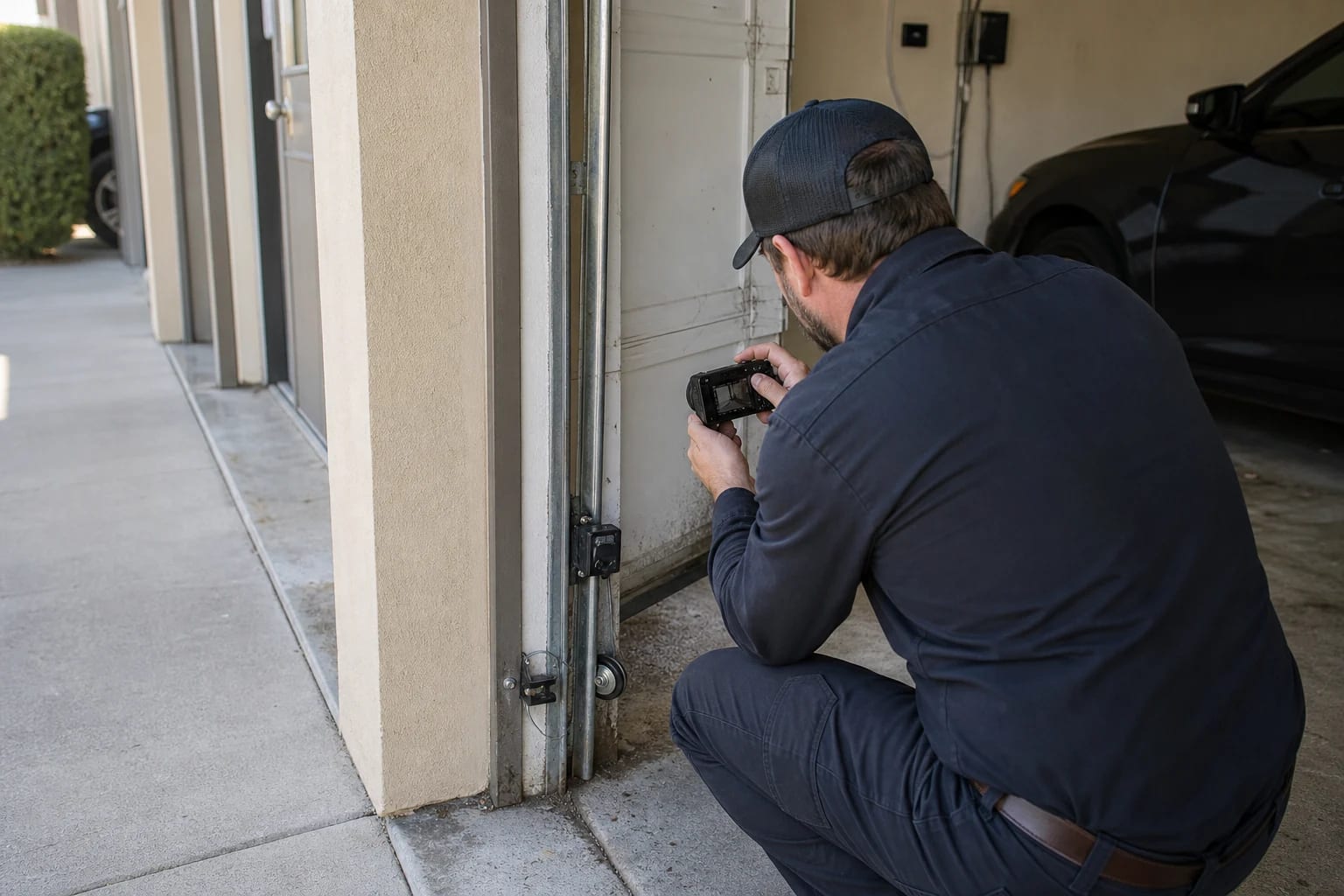
Garage door technician photographs a low-mounted safety sensor and track condition from outside an apartment garage door path
Door identity, opener and sensor state, prior service, incident observations, and later changes should remain separate evidence fields.

Quick answer

After a California garage door injury, address safety and medical needs first. When safe and lawful, identify the exact door, opener, controls, sensors, and hardware; preserve installation, complaint, service, test, access, and repair records; and log every post-incident movement or change without treating one damaged part or failed test as proof of cause.

Key takeaways

  • Keep people outside the door path and do not touch springs, cables, brackets, tracks, controls, or a damaged door merely to create evidence.
  • Identify the door, opener, controls, sensors, emergency release, power source, battery backup, and every visible component before voluntary changes when safely possible.
  • Separate installation, ordinary maintenance, complaints, prior tests, incident observations, emergency actions, and later inspections or repairs into different source lanes.
  • Request original work orders, technician notes, photographs, attachments, test results, invoices, access logs, part records, and revision history—not just an account summary.
Hurt Advice Editorial Team

Prepared by

Hurt Advice Editorial Team

Editorial Research and Publishing Team

Source-checked editorial publishing

Why trust this article

Prepared by the Hurt Advice Editorial Team from current California Legislature and U.S. Consumer Product Safety Commission sources. No attorney reviewed this displayed version.

Recent update: Original publication with a door-and-opener identity sheet, six-state source matrix, custodian map, planned-observed-logged tool, test and digital-activity rules, custody ledger, scripts, checklist, mistakes, and FAQs.

At a glance

What this guide helps you decide

Start with the question that brought you here, identify the records that can verify the facts, and use the related guidance only where it helps. This article addresses premises liability questions in California.

Main question

Decide how this topic may apply to your situation

Use "Garage Door Inspection and Maintenance Records After a California Injury" to sort the facts you know, the questions still open, and whether a premises liability resource or consultation may be useful in California.

Guide map

Start with the sections most relevant to you: Who this guide is for—and the exact task it solves, Quick takeaways, Contents: seven garage-door evidence lanes

Move through the article by issue, not by guesswork, so liability, medical proof, insurance pressure, deadlines, and next steps stay connected.

Records to gather

Connect these subjects to your records: California Garage Door Injury, Garage Door Inspection Records, Garage Door Maintenance Records, Automatic Garage Door Opener

Compare the topic with records, photos, medical visits, police reports, insurer letters, and local claim details before relying on a general answer.

Trust check

Use the source trail before acting

This page includes 6 source references plus internal next-step paths so readers can verify where the guidance comes from.

Before you rely on this guide

This article is written for people dealing with injury-law questions in California. It is meant to help you understand the issue, not replace legal advice about your specific case.

What to do after this article

Start with the quick answer, skim the table of contents, and then use the links below to move into the practice area, author archive, or resource page that turns general guidance into a clearer next step for your situation.

Who this guide is for—and the exact task it solves

This guide is for a California resident, visitor, tenant, property owner, family member, or records organizer after a person is hurt by a residential or property garage door, an automatic opener, or related hardware. It is useful when the door closed unexpectedly, failed to reverse, dropped, moved while someone was nearby, left its track, or became the subject of a later inspection or repair.

The task is not to decide that the door was defective, that a code was violated, or that any person caused the injury. It is to identify the exact door-and-opener system, preserve its as-found condition, separate maintenance from incident evidence, and request the records that can show what was installed, reported, tested, changed, and retained. The premises-liability service hub covers the broader legal topic; this checklist owns the narrower garage-door record job.

Hurt Advice is a lawyer referral and legal information service, not a law firm. This is general information, not legal, safety, engineering, medical, or repair advice. It does not establish duty, notice, defect, causation, damages, admissibility, or responsibility. No attorney reviewed this displayed version.

Quick takeaways

  • Keep people outside the door path and do not touch springs, cables, brackets, tracks, controls, or a damaged door merely to create evidence.
  • Identify the door, opener, controls, sensors, emergency release, power source, battery backup, and every visible component before voluntary changes when safely possible.
  • Separate installation, ordinary maintenance, complaints, prior tests, incident observations, emergency actions, and later inspections or repairs into different source lanes.
  • Request original work orders, technician notes, photographs, attachments, test results, invoices, access logs, part records, and revision history—not just an account summary.
  • For every movement, test, adjustment, repair, part removal, transfer, or disposal, record who acted, why, what changed, and where the system or part went.

Contents: seven garage-door evidence lanes

Use seven lanes: (1) immediate safety and scene control, (2) door-and-opener identity, (3) installation and applicable system features, (4) complaints, maintenance, service, and tests, (5) incident observations and digital activity, (6) post-incident inspection, change, and custody, and (7) owner, manager, contractor, manufacturer, insurer, and public records.

Create one component identity sheet, one installed-maintained-reported-observed-changed matrix, one event clock, one condition-and-custody ledger, and one file manifest. The broader accident evidence checklist can hold medical, witness, communication, and loss records that should remain outside the mechanical file.

Put safety before preservation

Call for emergency help when needed and follow fire, medical, property-safety, and lawful agency directions. Keep people and objects away from the travel path. Do not walk under a suspended door, pull an emergency release while it is unstable, reconnect power, bypass a sensor, loosen hardware, or handle a spring or cable.

From a safe position, photograph the full opening, door position, surrounding floor, controls, opener rail and motor unit, sensor locations, and visible debris. Record closer details only after the area is safe. Do not operate the door for a better angle.

Preservation does not mean leaving a dangerous system energized. Document the as-found condition, the safety reason for movement or shutdown, who directed it, the before-and-after state, and every removed component.

Build a door-and-opener identity sheet

Start with the property and opening: street or unit identifier, garage bay, ownership or management source, door type, number of sections, material if known, approximate dimensions, interior and exterior orientation, and nearby fixed reference points. Distinguish a vertically moving residential garage door from a sliding gate, rolling commercial door, or other barrier; different systems may have different records and rules.

For the door, record panels, hinges, rollers, vertical and horizontal tracks, brackets, springs, drums, cables, bottom fixtures, seals, locks, handles, and visible labels without moving anything. For the operator, record manufacturer, model, serial number, date or lot markings, motor unit, rail or drive type, wall control, remotes, keypad, paired apps or access systems, manual release, photoelectric sensors or edge devices, power cord, outlet, battery compartment, and any visible indicators. Photograph the whole component before transcribing a marking.

Give each photograph a simple identifier and orientation. “Left sensor viewed from inside looking out” is more reliable than “garage sensor.” Keep unknown fields marked unknown; do not fill gaps from a similar product online.

Use a six-state source matrix

Create one row for each important fact and six columns:

  1. Installed: door and opener identity, installer, date, permit or inspection if any, manuals, settings, sensor placement, battery backup, and replaced parts.
  2. Maintained: routine inspection, lubrication, balance or force work, sensor alignment, complaint response, parts, technician, test, and completion record.
  3. Reported before the incident: noise, hesitation, reversal, unexpected movement, remote or app issue, damage, prior contact, outage, or access problem, with recipient and response.
  4. Observed during the event: firsthand position, direction, speed impression, sound, warning, sensor obstruction, control use, person or object location, and immediate result—without adding what the witness did not perceive.
  5. Secured after the event: power state, door position, area control, emergency action, manual release, movement, first photographs, first inspection, and first storage location.
  6. Changed later: operation, test, adjustment, reset, disconnection, repair, part removal, cleaning, replacement, transfer, data export, overwrite, or disposal.

Example: “Tenant email two weeks earlier reported intermittent reversal; the attachment is missing. Manager work order shows sensor alignment requested but no completion note. Witness observed the door descending after a remote command but did not see the wall control. Fire personnel disconnected power and raised the door for access. Contractor replaced one roller the next morning after photographs.” The matrix preserves sources and gaps without turning sequence into a conclusion.

Map records by custodian

Owner, landlord, association, or property manager: purchase, installation, lease or responsibility allocation, resident notices, complaints, inspection calendar, work orders, vendor communications, invoices, photographs, access policies, incident reports, insurance notices, and authorization for post-incident work.

Installer or garage-door service company: estimate, model and serial data, technician notes, checklists, measurements, settings, sensor alignment, reversal or obstruction tests, warning certificate, parts, before-and-after media, signatures, dispatch history, warranty, callbacks, and removed-part disposition.

General maintenance or access-control provider: tickets, remote or keypad changes, app or controller logs, power events, camera references, technician communications, and referrals to another vendor. A closed ticket does not prove a mechanical condition was corrected.

Manufacturer, retailer, or distributor: manuals, product registration, warranty, service bulletins, complaints, recall or corrective-action records, replacement shipments, technical-support communications, and received parts.

Insurer, investigator, or public agency: notice, photographs, statements, inspection scheduling, reports, permits or inspection records within that agency's scope, and custody or release records. Identify the record owner instead of sending an unfocused request to everyone.

Compare planned, observed, and logged information

Use a three-column tool for each material feature. Planned means a manual, proposal, installation document, maintenance schedule, or work order described an intended state. Observed means a person, photograph, video, or qualified inspection captured an actual condition at a stated time. Logged means a system, technician, manager, or access platform recorded an event or completion. The columns can agree, conflict, or remain blank.

For a photo-eye sensor, for example: planned—installation instructions identified placement and alignment; observed—one sensor appeared displaced in a timestamped scene photograph; logged—a work order three days earlier recorded “realign sensors,” but no completed test attachment appears. That row raises a follow-up question. It does not prove when displacement occurred or what caused the door to move.

Apply the same method to force settings, door balance, spring or cable work, battery replacement, remote programming, power loss, complaints, and prior impacts. Preserve the exact language. “Checked,” “adjusted,” “repaired,” and “passed test” are not interchangeable unless the source supplies the method and result.

Preserve tests and digital activity without overreading them

The CPSC's official non-reversing opener guidance discusses reversal testing, external entrapment protection, periodic inspection, and taking a malfunctioning opener out of use. After an injury, however, do not repeat or stage a test unless the area is safe and a qualified process protects people and the evidence.

If a test is necessary, record the authority, purpose, qualified operator, door and opener identity, pre-test condition, power and battery state, sensor state, obstruction type and exact placement, settings, number and order of trials, video angles, measurements, result, intervention, and post-test change. Preserve failed, incomplete, and contrary trials—not only the preferred clip.

For connected openers, access systems, cameras, or smart-home platforms, preserve native exports when available, account and device identifiers, time zone, clock drift, event type, user or device source, retention limit, edits, screenshots, and export date. A log that says “close” may show a command or state report, not necessarily uninterrupted physical travel or the identity of the person who acted.

Use a condition-and-custody ledger

Create one entry for every material event: date and time; property and bay; component identifier; as-found state; person and organization; action; safety or business reason; photograph, video, work order, signature, tracking number, or report; before-and-after condition; storage; access; and any missing interval.

Track the door, opener motor unit, rail or drive, controls, sensors, battery, remotes, rollers, hinges, brackets, springs, cables, drums, damaged panels, fasteners, and removed parts separately when relevant. Do not handle springs or tensioned components to label them. A technician can apply safe identification during necessary work while another person records the process.

Use precise language: “power disconnected,” “door manually raised by fire personnel,” “left photo-eye removed by contractor,” “roller replaced,” “motor unit retained,” or “old battery discarded before request.” Do not write “unchanged” when the record only shows that no change was observed. If a part is unavailable, record the last confirmed custodian, date, expected disposition, request, response, and limitation.

Neutral preservation and inspection scripts

Focused records request: “Please preserve the existing records associated with [property, unit, garage bay, door, opener, work-order, service-call, access-system, or incident identifier] for [focused date range], including installation, replacement, manuals, complaints, inspections, maintenance, tests, technician notes, settings, parts, photographs, video, access or opener activity, power or battery events, incident reports, post-incident work, removed components, transfers, and disposition. Please preserve original timestamps, attachments, versions, and identifier fields and identify the custodian for records you do not maintain. This request does not ask you to create a new cause analysis.”

Inspection or repair coordination: “Before voluntary operation, testing, adjustment, repair, part removal, or transfer when circumstances allow, please identify the qualified participants, safety plan, system and component identifiers, as-found documentation, test protocol, manipulation, destructive steps, removed-part handling, recording method, storage, access, and return or disposition plan. Please record necessary emergency or safety changes separately.”

Use verified contact channels and share only what is reasonably needed. Save the request, delivery proof, acknowledgment, response, objection, appointment, transfer receipt, and follow-up. These scripts are organization tools, not subpoenas, stop-work orders, guarantees of access or retention, or substitutes for legal advice.

Understand the inspection boundary

Before a lawsuit, access to private property or equipment may depend on permission, control, contract, safety, an insurer process, or other law. Do not trespass, defeat a lock, interfere with a tenant or owner, or direct a contractor without authority.

In a pending California civil action, Code of Civil Procedure section 2031.010 addresses demands by a party to inspect, copy, test, or sample documents, electronically stored information, tangible things, and land within the statutory process. It does not create a general pre-suit inspection right, and other timing, form, objection, protective-order, and safety rules may matter.

California Civil Code section 1714 provides broad ordinary-care context. The application of duties to a particular owner, tenant, manager, contractor, manufacturer, installer, or other person is fact-specific. Use the records to preserve facts; do not label a person negligent from a missing document or one later condition.

Timing and process checkpoints

Immediately: address injury and danger, keep people clear, follow emergency directions, make safe wide photographs, identify witnesses and controls used, and record who first secured or moved the door.

First organized pass: build the component identity sheet, six-state matrix, event clock, file manifest, and custody ledger. Send focused preservation requests to the likely owner, manager, and service custodian without demanding conclusions.

Before voluntary operation, repair, or removal: clarify authority and safety; document the as-found system; identify the protocol, participants, recording, possible alteration, removed parts, storage, access, and disposition.

When records arrive: keep original productions unchanged, log source and date, compare model, serial, bay, component, work-order, and clock identifiers, preserve conflicts, and update the ledger without overwriting earlier entries. The California deadline resource is general background only. If an inspection, government-claim, filing, contract, insurance, or disposal deadline may matter, seek individual advice promptly.

Garage door records checklist

  • Property, unit, garage bay, door type, dimensions, orientation, owner or manager source, and full-opening photographs.
  • Door panels, tracks, rollers, hinges, brackets, springs, drums, cables, bottom fixtures, seals, locks, and visible labels recorded without unsafe handling.
  • Opener manufacturer, model, serial and date markings, motor unit, rail or drive, controls, remotes, keypad, connected service, emergency release, sensors, power, and battery backup.
  • Purchase, installation, replacement, permit or inspection, manual, warranty, product-registration, parts, and responsible-vendor records.
  • Complaints, notices, work orders, dispatch, technician notes, settings, sensor alignment, reversal or obstruction tests, warning certificates, photographs, invoices, and callbacks.
  • Original incident media, witness observations, control or remote use, access or opener logs, power events, time zone, clock limits, and the first safety actions.
  • Post-incident inspection, operation, test, adjustment, reset, repair, removal, transfer, storage, access, and disposition entries with before-and-after proof.
  • Medical, wage, communication, and insurance records kept in separate lanes, with unnecessary private or unrelated smart-home data excluded.

Mistakes and red flags

  • Operating, blocking, disconnecting, reconnecting, adjusting, or staging the door merely to recreate the event.
  • Touching or approaching a spring, cable, bottom bracket, unstable track, suspended door, or energized opener without qualified safety control.
  • Photographing only a damaged panel while omitting the full opening, opener, controls, sensors, tracks, and component identifiers.
  • Treating a later failed test, displaced sensor, broken part, access-log entry, missing work order, or battery condition as automatic proof of earlier state or cause.
  • Combining resident reports, manager summaries, contractor notes, incident observations, system logs, later tests, and opinions into one unqualified timeline.
  • Accepting an invoice marked completed without requesting technician notes, attachments, actual test method, values, parts, and before-and-after records.
  • Allowing the opener, sensor, roller, cable, spring, bracket, control, battery, or damaged section to be discarded without recording the item and disposition.
  • Sending a sweeping request that collects unrelated tenant, camera, access, or smart-home information instead of a focused incident and system record.

Careful next steps

Complete the identity sheet, six-state matrix, event clock, manifest, and custody ledger. Keep “planned,” “reported,” “observed,” “logged,” “tested,” “changed later,” and “unknown” as different labels. Reconcile identifiers and clocks across sources.

If another person needs to secure, operate, test, repair, remove, or transfer the system, clarify authority, safety, scope, recording, alteration, removed parts, storage, access, and disposition. Never delay a necessary safety action; document it.

Hurt Advice can connect people with independent California lawyers through the contact page, but it does not promise representation or an outcome. For adjacent record methods, see the apartment stairway records guide, parking-lot maintenance records guide, and playground inspection records guide. This article was prepared by the Hurt Advice Editorial Team from the official sources listed below. No attorney reviewed this displayed version. See the editorial standards for sourcing and corrections.

Frequently Asked Questions

What garage door records should I preserve after an injury?
Preserve system identity, installation and replacement records, maintenance and service work orders, complaints, reversal and sensor tests, warning certificates, battery-backup records, access or opener activity logs, incident media, witness accounts, post-incident inspections, repairs, parts, transfers, and disposal records. Keep each source and time period separate.
Should I test the garage door after an incident?
Do not operate, obstruct, disconnect, adjust, or stage a garage door merely to create evidence. A heavy door, spring, cable, bracket, track, or opener can create serious hazards. Record the as-found state from a safe location and use qualified help for any necessary safety action, inspection, or test.
Does a failed reversal test prove who caused the injury?
No. A test result may be relevant, but it does not by itself establish the door's earlier condition, the test method, maintenance history, incident sequence, legal duty, causation, or responsibility. Preserve the test protocol, operator, obstruction, sensor state, video, settings, preceding changes, and all contrary or incomplete evidence.
Who may hold garage door maintenance and inspection records?
Depending on the property and system, records may be held by an owner, tenant, landlord, property manager, homeowners association, installer, garage-door contractor, general maintenance vendor, access-control provider, manufacturer, retailer, insurer, investigator, or public building department. Do not assume one custodian has the complete file.
What should be recorded before a garage door is repaired?
When safe and lawful, record the full opening, door type, opener and controls, tracks, rollers, hinges, brackets, springs and cables from a distance, sensors, emergency release, power and battery state, visible damage, current position, photographs, witnesses, and who controlled the area. Log every safety movement or change.
Can I demand an inspection before filing a California lawsuit?
California Code of Civil Procedure section 2031.010 describes inspection demands by a party in a pending civil action; it is not a general pre-suit inspection right. Before suit, access may depend on consent, control, safety, contracts, insurance processes, or other law. Individual legal advice may be important.

Sources and references

Current residential automatic-garage-door-opener rules for reversal protection, safety devices, instructions, service testing, warning certificates, and replacement-door connections.

Current California ordinary-care statute; cited only as broad legal context, not as a conclusion about any incident.

U.S. Consumer Product Safety CommissionAutomatic Residential Garage Door Operators

Current CPSC summary identifying 16 C.F.R. Part 1211 as the mandatory federal standard for automatic residential garage door operators.

U.S. Consumer Product Safety CommissionNon-Reversing Garage Door Openers Are a Hazard

Official CPSC consumer-safety guidance on reversal protection, external entrapment protection, testing, inspection, and taking a malfunctioning opener out of use.

Need help after an accident?

Hurt Advice intake team can review your situation, explain your options, and help you move forward with a plan that fits your case.