
Legal ExplainerPersonal InjuryChecklist / Process

Ambulance Patient-Care Reports After a California Crash

A useful ambulance-record file begins with the exact provider, patient, incident, and destination. Request the complete patient-care report and identified attachments, preserve the first and later versions, and reconcile each dispatch, assessment, treatment, transport, handoff, hospital, and billing value by source without turning one timestamp, field, or clinical impression into a diagnosis or legal conclusion.

Published

August 2, 2026

Updated

August 2, 2026

Reading time

10 min read

Jurisdiction

California

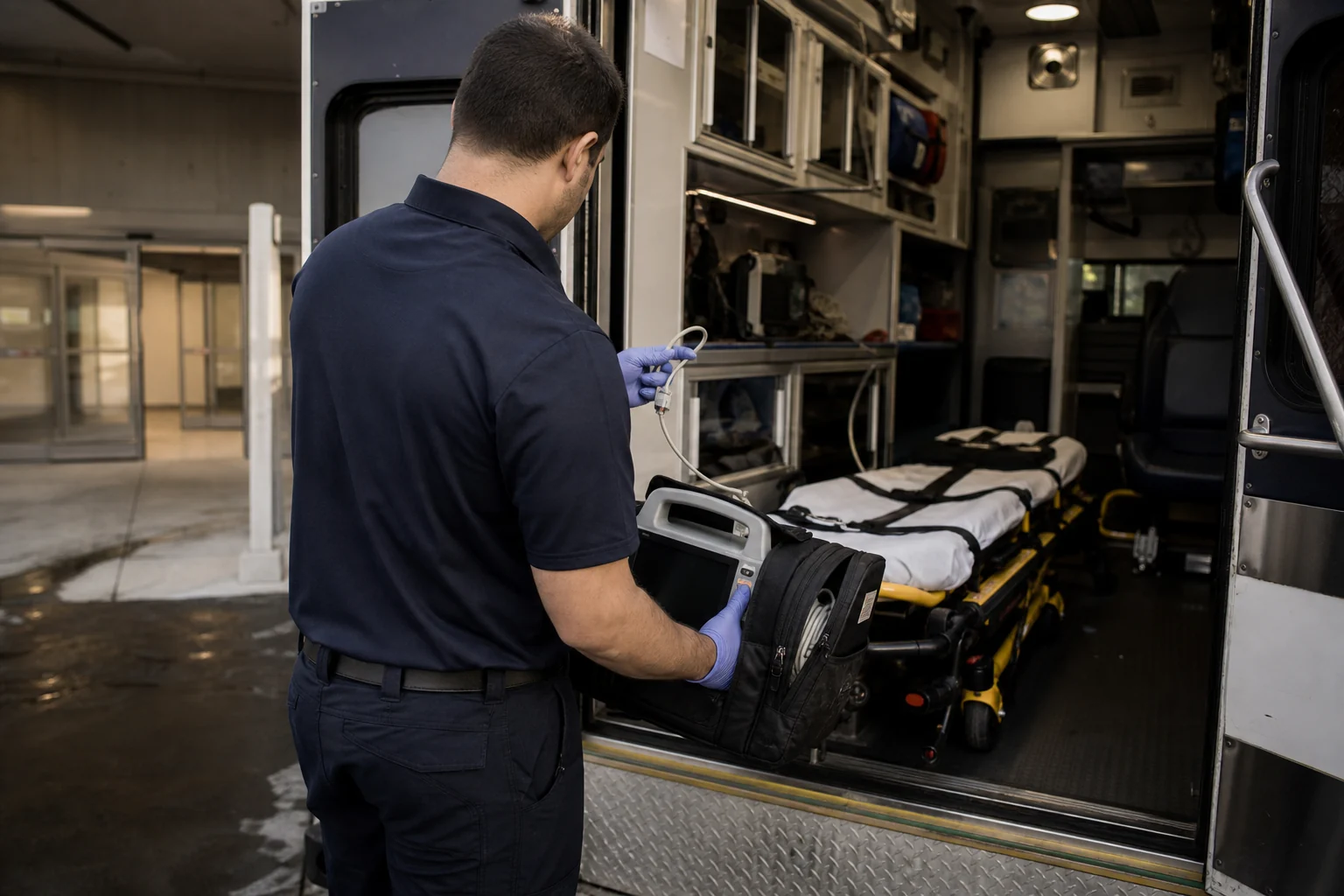
EMT checks a portable vital-sign monitor and secured empty stretcher in an unbranded ambulance after a hospital handoff
Keep dispatch, prehospital assessment, treatment, transport, handoff, hospital, billing, and report-version sources in separate evidence lanes.

Quick answer

After ambulance care for a California crash injury, identify the exact provider and run, request the complete patient-care report and maintained attachments, preserve every version, and reconcile dispatch, assessment, treatment, transport, handoff, hospital, and billing sources without treating one timestamp, checkbox, or clinical impression as a complete account.

Key takeaways

  • Identify the exact ambulance provider, unit, incident or run number, pickup location, destination, and service date before requesting records.
  • Ask for the patient-care report in readable form, then separately ask whether attachments, monitor exports, ECG strips, photographs, medication records, signatures, or amendments are maintained.
  • Keep dispatch times, ePCR times, device times, hospital times, and patient or witness recollections in separate source columns; a difference is a question, not proof of error.
  • Preserve the report as received, including page count, file name, delivery message, version date, and any later corrected or amended copy.
Hurt Advice Editorial Team

Prepared by

Hurt Advice Editorial Team

Editorial Research and Publishing Team

Source-checked editorial publishing

Why trust this article

Prepared by the Hurt Advice Editorial Team from current California Legislature and U.S. Department of Health and Human Services sources. No attorney reviewed this displayed version.

Recent update: Original publication with a provider identity sheet, four-custodian map, seven-clock prehospital timeline, ePCR access and amendment scripts, source-version ledger, checklist, mistakes, and FAQs.

At a glance

What this guide helps you decide

Start with the question that brought you here, identify the records that can verify the facts, and use the related guidance only where it helps. This article addresses personal injury questions in California.

Main question

Decide how this topic may apply to your situation

Use "Ambulance Patient-Care Reports After a California Crash" to sort the facts you know, the questions still open, and whether a personal injury resource or consultation may be useful in California.

Guide map

Start with the sections most relevant to you: Who this guide is for—and the exact task it solves, Quick takeaways, Contents: the seven record lanes

Move through the article by issue, not by guesswork, so liability, medical proof, insurance pressure, deadlines, and next steps stay connected.

Records to gather

Connect these subjects to your records: California Ambulance Patient Care Report, EMS ePCR Records, Prehospital Treatment Records, Ambulance Handoff Records

Compare the topic with records, photos, medical visits, police reports, insurer letters, and local claim details before relying on a general answer.

Trust check

Use the source trail before acting

This page includes 6 source references plus internal next-step paths so readers can verify where the guidance comes from.

Before you rely on this guide

This article is written for people dealing with injury-law questions in California. It is meant to help you understand the issue, not replace legal advice about your specific case.

What to do after this article

Start with the quick answer, skim the table of contents, and then use the links below to move into the practice area, author archive, or resource page that turns general guidance into a clearer next step for your situation.

Who this guide is for—and the exact task it solves

This guide is for a California patient, parent, personal representative, family records organizer, or other authorized requester after ambulance care connected with a crash or injury.

The task is not to diagnose an injury, grade the crew, decide fault, or turn a timestamp into a legal conclusion. It is to identify the ambulance provider and incident, request the electronic patient-care report (ePCR) and related material, preserve versions and attachments, and reconcile the prehospital timeline with dispatch, hospital, billing, and patient-held sources.

The 911 dispatch-records guide owns call audio and dispatch chronology. The ground-ambulance billing guide owns charges and payer records. The emergency-department guide begins with hospital triage and discharge. This checklist owns the transported patient's prehospital clinical report, its versions, and the transfer-of-care boundary.

Hurt Advice is a lawyer referral and legal information service, not a law firm. This is general information, not legal, medical, privacy, evidence, or records-request advice. No attorney reviewed this displayed version.

Quick takeaways

  • Identify the exact ambulance provider, unit, incident or run number, pickup location, destination, and service date before requesting records.
  • Ask for the patient-care report in readable form, then separately ask whether attachments, monitor exports, ECG strips, photographs, medication records, signatures, or amendments are maintained.
  • Keep dispatch times, ePCR times, device times, hospital times, and patient or witness recollections in separate source columns; a difference is a question, not proof of error.
  • Preserve the report as received, including page count, file name, delivery message, version date, and any later corrected or amended copy.
  • Use the report to organize questions for clinicians and counsel; do not treat a prehospital impression, checkbox, score, or missing field as a final diagnosis or fault decision.

Contents: the seven record lanes

Build seven lanes: (1) provider and incident identity, (2) dispatch and unit movement, (3) patient contact and assessment, (4) treatment and monitoring, (5) transport and destination, (6) transfer of care, and (7) report completion, attachments, amendment, and access history.

Use one provider identity sheet, one seven-clock timeline, one custodian map, one version log, and one source-reconciliation ledger. Keep general crash evidence in the car-accident checklist, and preserve original digital files using the digital-evidence workflow.

Start with the exact provider, patient, and incident

Write down the service date, approximate call and pickup times, pickup address or roadway, destination, patient name used at the scene, date of birth, ambulance company or public agency, unit number if known, incident or run number, and the hospital medical-record number if available. Do not include full identifiers in an ordinary email unless the provider's verified process calls for them.

Separate the company whose name appeared on the ambulance from the dispatch center, fire department, local EMS agency, billing company, and receiving hospital. One organization may perform more than one role, but do not assume that it holds every source.

California Health and Safety Code section 1797.227 requires an emergency medical care provider, when collecting and submitting data to a local EMS agency, to use an electronic health-record system that exports data in the current CEMSIS and NEMSIS standards, includes locally required elements, and can integrate with the local agency's data system. That statewide data rule does not mean every requester receives the statewide dataset or that every field applies to every response.

Use a four-custodian map

Dispatch or communications center: call creation, caller information subject to lawful access, priority, unit assignment, status changes, radio or CAD entries, location updates, cancellation, and transfer to another agency. Use the separate 911 guide for audio, CAD, and public-record issues.

Ambulance or EMS provider: ePCR, crew identities or certification fields, assessments, vital signs, treatment, medication administration, monitor or ECG material, signatures, refusals, destination selection, transfer of care, attachments, completion status, amendments, and billing cross-reference.

Local EMS agency: provider oversight, system data, applicable policies, and records the provider submitted under local requirements. It may not hold the complete native provider chart or its internal audit trail.

Receiving hospital: ambulance handoff material received, ED arrival and triage, hospital chart, medication reconciliation, diagnostic work, and discharge. HHS explains that the HIPAA Privacy Rule permits an ambulance service to disclose treatment information and medical history to a hospital for the patient's treatment without a separate authorization in that situation; see the official ambulance-to-hospital FAQ. That permitted handoff does not prove the hospital retained every ambulance attachment or later amendment.

Build a seven-clock prehospital timeline

Create a row for each source and record these clocks without merging them: call created; unit assigned or notified; unit en route; unit arrived; first patient contact; departed scene; arrived at destination; and transfer of care. Seven lanes are useful even though a particular record may show more or fewer fields.

For every value, record the displayed timestamp, time zone if shown, source name, file or page, person or system that entered it, whether it appears device-generated or manually entered, and any later correction. Add a separate “what this may show” and “what this does not establish” column.

Do not silently replace a source value with your preferred time. A CAD clock may reflect a button press; a monitor may have its own device clock; a narrative may be completed after the call; and a hospital arrival field may describe registration rather than ambulance bay arrival. Reconcile differences by source and event definition before drawing conclusions.

Request the report, attachments, and version context

HHS states that, with limited exceptions, the HIPAA Privacy Rule gives patients a right to inspect and obtain copies of health information about themselves maintained in a designated record set. The official Privacy Rule guidance also explains that access applies to medical and billing records used to make decisions about individuals. Coverage, identity verification, personal-representative authority, form, fees, and exceptions can be fact-specific.

Ask first for the complete readable ePCR for the identified incident. Then ask the provider to identify whether it maintains separate attachments or source files, including monitor summaries, ECG strips, rhythm strips, vital-sign exports, photographs, audio, signatures, medication administration records, refusal or consent material, destination or handoff acknowledgments, and amendment history. Do not demand that a provider create data that it does not maintain.

For electronic production, request the readily producible form you can use and preserve. California Evidence Code section 250 defines “writing” broadly to include photographs, sounds, and records stored in any manner. That definition does not make a file complete, accurate, authenticated, admissible, or medically conclusive.

Neutral access and amendment scripts

Access request: “Please provide the complete patient-care report maintained for [patient], service date [date], pickup [location], destination [facility], and incident or run number [if known]. Please include all pages and identify any separately maintained attachments, monitor or ECG files, vital-sign exports, medication records, signatures, transfer-of-care material, and corrected or amended versions. I request a readable electronic copy in the form readily producible through your verified process. Please explain any item withheld or not maintained.”

Correction or clarification request: “I am not asking that the original entry be deleted. Please review the following field in the report identified by [date, page, section, and value]. My requested clarification is [precise statement], supported by [source]. Please preserve the original report, this request, the response, and any amendment or addendum with its author and date.”

These are organizational scripts, not subpoenas, legal demands, guarantees of production, or instructions to alter a clinical record. Use the provider's verified records or privacy channel and keep delivery proof.

Read clinical fields without turning them into conclusions

Review the chief complaint, history, mechanism description, assessment, level of consciousness, pain score, vital signs, physical findings, patient statements, treatment, medication, response, transport position, destination, and transfer-of-care narrative. Preserve exact clinical labels rather than translating them into a diagnosis.

A prehospital impression can guide emergency care but is not necessarily the final hospital diagnosis. A checkbox may reflect a required field, a negative finding, an unavailable answer, or a documentation convention. A later normal value does not erase an earlier value; an earlier abnormal value does not by itself prove injury causation or severity. Ask a qualified clinician about medical meaning.

Keep patient or witness recollections in their own lane. If someone recalls a treatment or complaint not shown in the report, label both sources and the difference. Do not edit a copy to make them agree.

Use a source-and-version reconciliation ledger

For each disputed or important item, record: event or field; ePCR value; dispatch value; device or attachment value; hospital value; patient or witness account; bill or claim value; source date; report completion date; amendment date; custodian; and unresolved question.

Mark each source as original received, later copy, amendment, addendum, export, screenshot, summary, or unknown. Preserve the delivery email or portal message, file name, page count, byte size when useful, and any metadata available without modifying the file. Store annotations in a working copy, not over the only original.

If a later report differs, keep both. Ask whether the change is an amendment, corrected demographic field, completed narrative, newly attached device export, or different display format. Do not call a difference concealment or falsification without reliable evidence and fact-specific review.

Ambulance patient-care report evidence checklist

  • Provider identity, unit, crew fields, incident or run number, service date, pickup, destination, and patient identifiers used for the request.
  • Complete readable ePCR with all pages, narratives, assessments, vital signs, treatment, medication, response, destination, signatures, and transfer-of-care fields.
  • Separately maintained monitor summaries, ECG or rhythm strips, vital-sign exports, photographs, audio, attachments, refusal or consent material, and handoff acknowledgments when they exist.
  • Dispatch and CAD records kept separate from the clinical ePCR; hospital triage and chart kept separate from the prehospital record; billing records kept separate from care documentation.
  • Original delivery message, file name, format, page count, received date, version date, completion status, amendment or addendum, author, and response to any correction request.
  • Seven-clock timeline and source ledger showing exact values, source definitions, conflicts, missing fields, and unresolved questions.
  • Minimum-necessary privacy copies with unrelated identifiers, other patients, payment information, and sensitive material excluded or secured.

Mistakes and red flags

  • Requesting records from the hospital only and assuming its chart includes the ambulance provider's complete native report and attachments.
  • Using a bill, claim form, dispatch log, or ED note as if it were the patient-care report.
  • Combining dispatch, device, narrative, and hospital timestamps without recording what each clock represents.
  • Treating a blank, default, late-entered, or amended field as automatic proof of what happened.
  • Calling a prehospital impression a final diagnosis or using one vital sign to decide causation, severity, or damages.
  • Overwriting the first copy with an annotated or later version and losing the delivery and amendment context.
  • Sending full medical identifiers through an unverified email address or sharing the report more broadly than needed.
  • Assuming patient access alone reaches dispatch audio, public-agency records, internal quality files, third-party device data, or litigation discovery.

Careful next steps

Finish the provider identity sheet, four-custodian map, seven-clock timeline, version log, and reconciliation ledger. Label every item as recorded, reported, observed, inferred, amended, unavailable, or unknown.

Bring medical interpretation questions to a qualified clinician. Bring authorization, subpoena, deadline, public-entity, preservation, and evidence questions to a licensed California attorney who can assess the actual facts.

Hurt Advice can connect people with independent California lawyers through the contact page, but it does not promise representation or an outcome. This article was prepared by the Hurt Advice Editorial Team from the official sources listed below. No attorney reviewed this displayed version. See the editorial standards for sourcing, corrections, and autonomous-article disclosure.

Frequently Asked Questions

What is an ambulance patient-care report?
An ambulance patient-care report, often called a PCR or ePCR, is the provider’s prehospital record for a response or patient contact. Depending on the event and system, it may include incident identity, crew, patient statements, assessment, vital signs, treatment, medication, monitoring, transport, destination, handoff, signatures, attachments, completion status, and later amendments.
How do I request an ambulance report after a California crash?
Identify the patient, service date, pickup, destination, provider, and incident or run number, then use the provider’s verified medical-records or privacy process. Request the complete readable patient-care report and ask whether separate monitor files, ECG strips, vital-sign exports, photographs, signatures, transfer-of-care material, attachments, or amended versions are maintained. Follow identity and representative-authority requirements.
Is the ambulance report the same as the 911 dispatch record?
No. Dispatch or CAD records generally track the call, priority, unit assignment, status, location, and communications. The ambulance patient-care report documents the provider’s prehospital patient contact, assessment, treatment, transport, and handoff. They may share identifiers and times, but keep them as separate sources and ask what each timestamp means.
Is an ambulance bill the same as the patient-care report?
No. A bill or claim record documents charges, codes, payer submissions, adjustments, and payment activity. It may reference the run, level of service, transport, or mileage, but it is not a substitute for the clinical patient-care report. Reconcile billing and clinical records without assuming one proves the completeness or accuracy of the other.
What if the ambulance report and hospital chart show different times?
Record both values, the source, and the event each field describes. Dispatch, monitor, narrative, bay-arrival, registration, triage, and transfer-of-care clocks may use different systems or definitions. A difference should prompt a focused question; it does not automatically prove that either record is false or that the difference affected care or a legal claim.
Can I ask to correct an ambulance patient-care report?
You can ask the provider’s privacy or records office about its amendment process and identify the exact field, page, value, requested clarification, and supporting source. Preserve the original report, request, response, and any amendment or addendum. Do not ask that the original entry be deleted, and do not assume a disagreement guarantees a change.

Sources and references

Need help after an accident?

Hurt Advice intake team can review your situation, explain your options, and help you move forward with a plan that fits your case.