
Referral intake reviewES
Legal ExplainerPersonal InjuryChecklist / Process

California Temporary Disabled Parking Placards After Injury

After an injury, you may qualify for a temporary California disabled parking placard if an authorized medical professional certifies a qualifying limitation. Submit a complete REG 195 application, identity proof, and the applicable fee through DMV. Use restricted parking only with valid authorization, and follow the issued placard’s expiration date and rules for transporting its holder.

Published

September 10, 2026

Updated

September 10, 2026

Reading time

10 min read

Jurisdiction

California

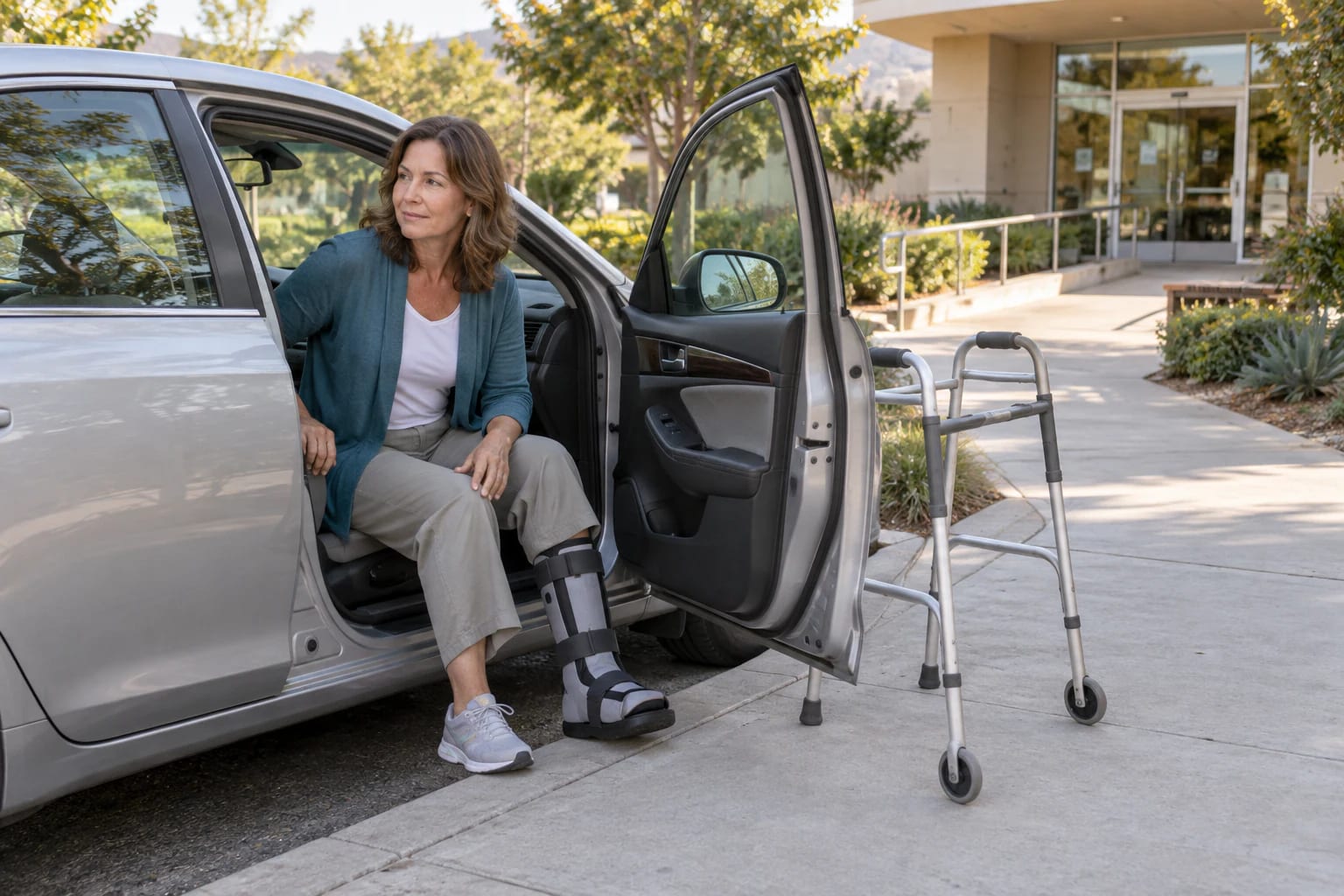
A woman wearing a walking boot sits in a car’s open passenger doorway beside a walker near a clinic entrance.
Illustrative passenger arrival during injury recovery. A medical professional assesses placard eligibility; DMV issues the parking authorization.

Quick answer

After an injury, you may qualify for a temporary California disabled parking placard if an authorized medical professional certifies a qualifying limitation. Submit a complete REG 195 application, identity proof, and the applicable fee through DMV. Use restricted parking only with valid authorization, and follow the issued placard’s expiration date and rules for transporting its holder.

Key takeaways

  • An injury does not automatically qualify you; an authorized medical professional must assess and certify the relevant disability.
  • For a new temporary placard, prepare REG 195, identity proof, the required signatures, and the applicable fee.
  • A filing confirmation is not an issued placard. Wait for valid parking authorization before using restricted spaces.
  • Track the printed expiration date and use the placard only for the person to whom it was issued.
Hurt Advice Editorial Team

Prepared by

Hurt Advice Editorial Team

Editorial Research and Publishing Team

Source-checked editorial publishing

Why trust this article

Prepared by the Hurt Advice Editorial Team using California DMV guidance, REG 195, and the Vehicle Code. No attorney reviewed this displayed version. Medical professionals assess certification; DMV determines issuance.

Recent update: Original guide to temporary California disabled parking placard applications and permitted use after injury.

Who this guide helps

This guide is for someone recovering from an injury in California who needs to reduce the distance between a vehicle and a destination. It also helps a family member arranging rides. The task is to prepare a temporary disabled person parking placard application and understand its limits. It is separate from proving fault, obtaining disability income, or deciding whether someone can safely drive.

You might first raise the question after a leg injury makes ordinary parking difficult. Describe the actual limitation to your treating professional: the assistance you use, where access is difficult, and how the limitation has changed. Do not assume that wearing a boot, having surgery, or receiving an insurance payment establishes eligibility. The DMV eligibility guidance ties qualification to specified mobility or other impairments.

The personal injury hub explains broader claim issues. If you need help describing everyday walking difficulties for a clinical discussion, the ankle injury activity-record guide offers a separate organizing method.

Choose the temporary application for a temporary need

DMV distinguishes temporary, permanent, and travel placards. Temporary placards address temporary disabilities. Permanent placards have a different duration and renewal process. Travel placards address specified travel situations; they are not a shortcut for a California resident applying because of a new temporary injury.

Under Vehicle Code section 22511.59, a temporary disability application requires professional certification describing the disability and its expected ending date. The placard expires no later than 180 days after issuance or the certified expected termination date, whichever comes first. Six months is a maximum, not an automatic entitlement.

Illustrative example: your professional certifies a temporary limitation ending before the maximum period. Plan around the shorter date shown on the issued placard. A later follow-up appointment does not itself extend that date. If your needs change, ask the professional and DMV about the appropriate next application rather than altering the placard or assuming permanent status.

Ask the right professional to complete the certification

The current REG 195 application and instructions divide the work between applicant and medical professional. You provide personal information and sign the applicant certification. The professional supplies their identifying information, assesses the applicable condition, selects the appropriate placard type, provides the temporary ending date, and signs the medical certification.

The form lists authorized professions and limits some certifications by the condition involved. For example, its instructions allow a podiatrist to certify a disability related to the foot or ankle. Do not assume that any person involved in treatment can sign every category. Ask the treating office whether an appropriately licensed professional there can assess your application.

For specified categories, section 6A requires a meaningful description of the illness or disability. A symptom alone or an unexplained abbreviation may be insufficient. Leave that assessment to the professional. Do not write a diagnosis for them, select an impairment to improve your chances, or change the certified date.

A useful request is: “I am having difficulty getting from ordinary parking to my appointments. Could the appropriate clinician assess whether I qualify for a temporary disabled parking placard and complete REG 195 if appropriate? Please tell me whether an appointment is needed and how I can receive the completed form.”

Assemble a complete REG 195 packet

Download REG 195 from DMV when preparing the application. The version checked for this guide is marked revision November 2023 and contains three pages. Page one is instructions; pages two and three contain the application and certification. The form expressly requires both application pages for processing.

  • Applicant information: true full name, birth date, physical address, mailing address when different, and the other requested contact information.
  • Identity document: a copy of acceptable proof of name and birth date, following the official requirements.
  • Requested placard: the temporary option and consistent medical certification.
  • Signatures: completed applicant and authorized medical-provider certifications, including the required dates and professional details.
  • Fee and delivery: the applicable payment and the complete submission through the route you choose.

Before sending, compare the name across the application, identity document, and medical section. Check that the final page is included and legible. The paper form calls for ink and original signatures and warns that alterations, cross-outs, or whiteout can void it. If something is wrong, ask the appropriate signer to complete a clean form. Keep a readable copy for your own records.

Choose online, mail, or office submission

Online: the official DMV placard application page asks you to upload a completed REG 195 signed by your medical provider, plus acceptable proof of full name and birth date. Listed examples include a state-issued driver’s license or ID, a U.S. birth certificate, or a valid unexpired U.S. passport or passport card. The page links additional document options. Prepare the files before starting and follow the current upload and payment instructions.

Mail: DMV’s general guide directs applicants to mail the original completed and signed application to the address on the form. Use the address printed on the current REG 195 for an original application. Do not copy an address from replacement instructions or an old third-party guide; the transaction matters.

Office: DMV also lists in-person submission. Check the selected office’s current service information before arranging transportation, and bring the complete packet. An office visit does not remove the certification or identity requirements.

Choose one route and retain its confirmation. If status is unclear, ask DMV about that submission before starting another. Keep personal identity and medical documents in the official application channel rather than posting them in a public question or sending them to an unrelated contact.

Separate the fee, filing receipt, and issued placard

At the source check for this guide, DMV’s fee schedule lists a $6 fee for a temporary parking placard. Section 22511.59 also specifies that amount. Payment methods and transaction service charges can depend on the submission route, so review the actual payment screen or current office instructions. Do not confuse the free permanent-placard renewal process with a new temporary application.

Keep three stages separate: you requested medical certification; you submitted an application; DMV issued the placard. A clinic’s completed form proves the first step. A payment or upload confirmation records submission. Neither document substitutes for a valid issued placard when claiming parking privileges.

Record the submission date, method, confirmation number if supplied, and any requested follow-up. If DMV returns the application, identify the specific missing or invalid item, obtain the proper correction, and follow the return instructions. Do not assume that paying again fixes a missing signature. Ask DMV about current processing and follow-up instead of planning around a guaranteed arrival date.

Plan the trip while the application is pending

Until you have valid parking authorization, arrange a lawful way to reach the destination. Call the clinic or facility to ask where passengers may be dropped off, whether the entrance has an accessible route, and whether assistance is available. Confirm the actual entrance rather than relying only on the building’s street address.

Use an inquiry such as: “I have a temporary mobility limitation and need to plan my arrival. Where is your accessible passenger drop-off, and how do I reach the appointment area from there? Is assistance available, and does it need to be arranged beforehand?”

A placard application does not settle driving ability, weight-bearing restrictions, or the assistance needed to transfer. Ask your treating professional about those issues. If someone else drives, agree on the pickup location and communication plan. The medical transportation guide can help organize an arranged trip; it does not establish that a ride is covered or available.

Know where the issued placard allows parking

According to DMV’s parking-privilege guidance, a valid placard allows parking in spaces bearing the accessibility symbol, at authorized blue curbs, beyond the usual limit at green curbs, in on-street metered spaces without charge, and in areas requiring a resident or merchant permit. Read the signs at the actual location and ask the operator or enforcement agency about unclear restrictions.

The placard does not authorize parking in the striped access aisle beside an accessible space. DMV also lists red, yellow, and white curbs among the places where the placard does not grant parking permission. Keep access aisles clear even for a short stop; another passenger may need the space to enter or leave a vehicle.

The published metered-parking privilege concerns on-street meters. Do not treat it as a promise that every private garage, hospital lot, or valet service is free. Ask about that facility’s prices and rules before entering. Choose a space that supports the access you actually need, without blocking another person’s route.

Use it for the holder and track expiration

You do not need to own or drive the vehicle to use your placard. REG 195 explains that the placard belongs to the qualified person, and its accompanying identification card must be kept with that person whenever the placard is used. This matters when a relative or caregiver supplies the car.

Vehicle Code section 4461 allows another person to use the placard in the holder’s presence or reasonable proximity for the purpose of transporting that holder. It prohibits lending the privilege to someone not entitled to it. A family relationship is not permission to use your placard for an unrelated shopping trip while you remain at home.

When the placard arrives, check its details and expiration date. Add a reminder before expiration if the limitation is continuing, and ask DMV and the professional about the required next steps. The temporary-placard statute limits consecutive renewals to six; it does not promise six automatic extensions. A lost or damaged placard involves DMV’s replacement process, not permission to make your own substitute.

Keep a short application-to-expiry checklist

Use a dated checklist rather than one folder labeled “DMV.” It makes the unfinished step easier to identify:

  1. Professional assessment requested; appointment or office response recorded.
  2. REG 195 completed, with matching applicant details and both required application pages.
  3. Identity proof and payment prepared for the chosen official route.
  4. Submission confirmation retained; any return notice answered through its instructions.
  5. Issued placard and identification card received and checked.
  6. Expiration recorded; ongoing need discussed before the valid period ends.

If a helper handles scanning or mailing, confirm what was sent and keep the original or copy appropriate to that route. Record a missing response as unresolved instead of assuming approval. For a DMV inquiry, have the submission details ready and ask: “Can you confirm the status of my temporary placard application and tell me whether a specific item is missing?”

Keep other access requests and injury decisions separate

Common mistakes are treating a diagnosis as automatic approval, submitting only the applicant page, uploading an unreadable certification, using the wrong mailing instructions, or assuming a caregiver can borrow the privilege. Avoiding these problems starts with checking the actual form and issued placard.

Parking is only one access issue. Home accessibility planning and court disability accommodations involve different decisions and requests. A DMV application does not submit those requests or resolve an injury claim. Choose the next action that matches your immediate need: professional assessment, a missing application item, DMV status, or a practical arrival plan.

This guide was prepared by the Hurt Advice Editorial Team from the linked official sources, checked September 10, 2026. Read our editorial standards and advertising and referral disclosure. You may use Hurt Advice’s contact page for injury information and referral support.

Hurt Advice is a lawyer referral and legal information service, not a law firm. This general guide does not provide medical certification, approve a placard, establish representation, or create an attorney-client relationship. Contacting the site does not file a DMV application or guarantee a lawyer, free legal services, or an outcome.

Frequently Asked Questions

Does a broken leg automatically qualify me for a temporary placard?
No. An authorized medical professional must assess whether your limitation meets the applicable requirements and complete the certification. A diagnosis, boot, or cast by itself is not an issued parking authorization.
How much does a temporary California disabled parking placard cost?
DMV’s fee schedule lists $6 for a temporary placard at the September 10, 2026 source check. Review the current payment instructions and any transaction service charge for the route you choose.
How long is a temporary placard valid?
It expires no later than 180 days after issuance or the medical professional’s certified expected termination date, whichever is earlier. Follow the expiration on the issued placard; a follow-up appointment does not automatically extend it.
Can I use my placard when a family member drives?
Yes, you do not have to own or drive the vehicle. The use must be for transporting you, consistent with the holder-presence or reasonable-proximity rule. Your family member cannot borrow the privilege for an unrelated trip.
Can I park in an accessible space while my application is pending?
An application, medical certification, payment, or upload confirmation is not a valid issued placard. Arrange a lawful drop-off or other access plan while waiting for DMV’s decision and parking authorization.

Sources and references

Need help after an accident?

Hurt Advice intake team can review your situation, explain your options, and help you move forward with a plan that fits your case.