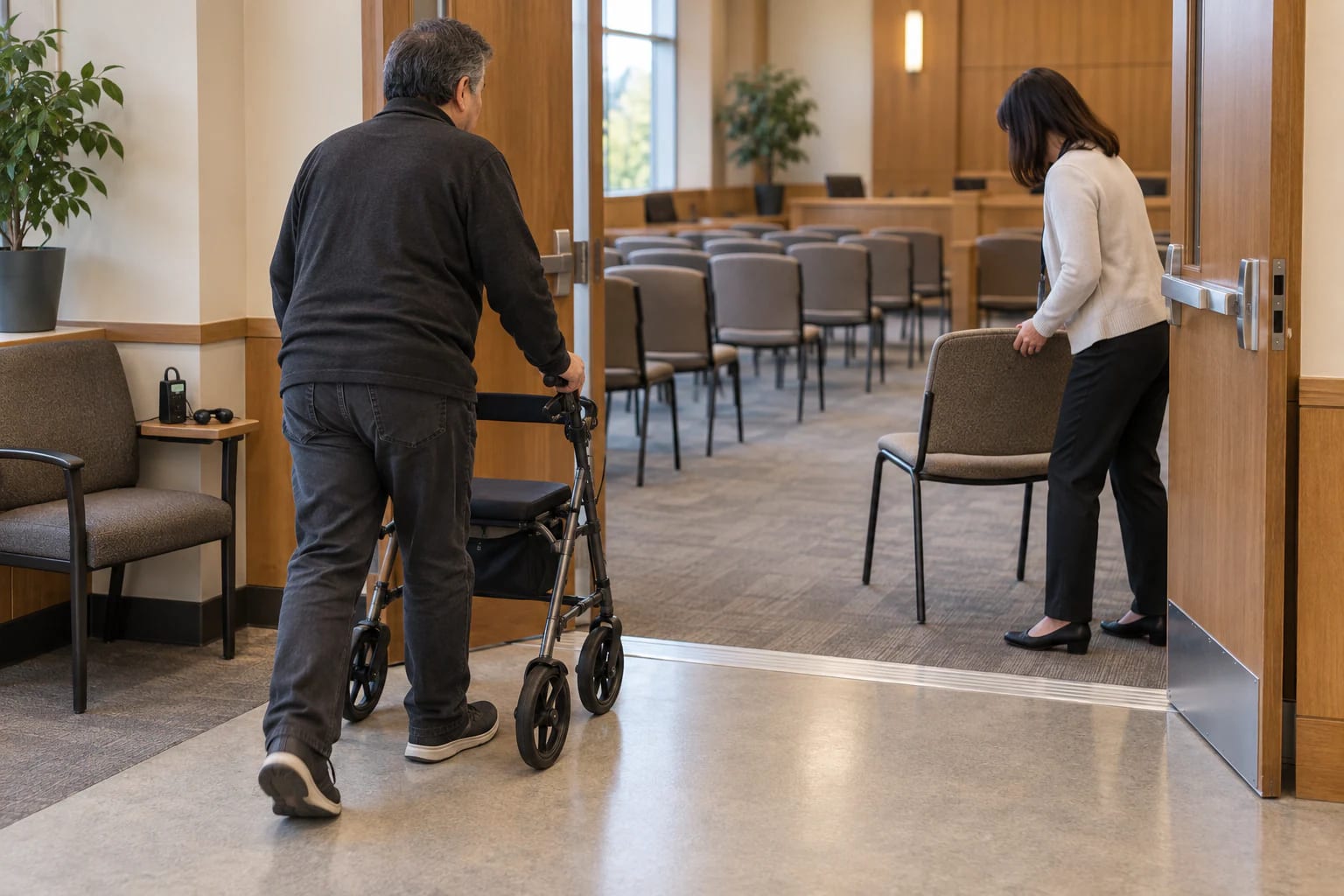

Who can request help with a California court appearance?
An injury may make a courthouse visit difficult in ways a hearing notice does not address. You might need to sit while waiting, hear speakers clearly, read an accessible document, or use an unobstructed route into the hearing room. A request should explain the particular obstacle you face when using the court's services.
California Rules of Court, rule 1.100 covers people with disabilities participating as parties, witnesses, jurors, lawyers, or interested attendees. Having an injury does not by itself establish that a particular accommodation must be granted. The court considers the disability-related need and requested support.
This guide helps you prepare an access request. Questions about whether someone caused your injury, what your losses are, and whether to bring a claim belong in a separate discussion. The personal injury information hub introduces those broader issues.
How do you turn a participation barrier into a clear request?
Start with the activity that is difficult, then explain what would help you participate. Saying that you need assistance leaves staff to guess whether the problem concerns entering the building, waiting, understanding speech, or giving an answer. Connect the request to the actual court activity and explain the relevant medical condition briefly and accurately.
These are illustrative ways to organize a request, not examples of court approvals:
| Participation barrier | Support to discuss with the coordinator | Detail that helps explain the request |
|---|---|---|
| A mobility aid cannot pass between closely placed chairs | An unobstructed route and suitable seating | Which aid you use and where passage becomes difficult |
| Standing through check-in or a long wait causes difficulty | A seated waiting arrangement | The task requiring standing and the support needed |
| Hearing several speakers is difficult | An appropriate listening device or communication aid | Whether amplification helps and how you usually communicate |
| Reading a standard paper document is inaccessible | An accessible document format | The format or assistive technology you can use |
| Sustained participation is difficult | A discussion of breaks or another effective arrangement | How the difficulty affects the court activity |
For communication, a device that helps one person may not help another. The U.S. Department of Justice's effective communication guidance considers the person's usual communication method and the context, complexity, and duration of the exchange. Explain what works for you instead of assuming that a particular device is the only option.
Your existing hearing evaluation records may help you describe a communication difficulty, but do not send an entire medical file automatically. Ask what additional information the court actually needs and how to provide it securely.
How do you find the right ADA coordinator?
Use the official website of the court where the appearance or service will occur. Find its disability accommodation or ADA information and check whether the listed contact serves your courthouse. A county may have several court locations; the building on your hearing notice is a useful starting point.
Ask about the confidential delivery method, the correct recipient, and whether that court uses an additional local process. Also ask how you will receive confirmation. Keep the contact information with your hearing notice so you can reach the same office if the location changes.
The Judicial Branch's Court Accessibility guidance explains the role of ADA coordinators and gives examples of accommodations. Contacting that office is different from asking the judge to decide an issue in your case.
You can begin with this procedural inquiry:
I need to request a disability accommodation for an upcoming court appearance. Please tell me who handles requests for this courthouse, how to send the request confidentially, and how I can confirm it was received. I would also like to know how the court will communicate its decision.
This opening asks about the process without disclosing medical details to an unverified recipient. Follow the coordinator's instructions when providing the actual accommodation request.
What should you prepare before completing MC-410?
Put together a short request-preparation checklist. You do not need to build a second injury-claim evidence file simply to organize the practical information:
- The court, courthouse, case number if applicable, and scheduled appearance or service.
- Your role, such as party, witness, or attendee.
- The specific activity that is difficult and the relevant medical condition.
- The accommodation requested and when you need it.
- A reliable way for the court to contact you confidentially.
- Questions about the entrance, waiting area, hearing room, equipment, or other arrangements.
- A copy of the completed request and a record of its delivery.
Under rule 1.100(c), a request may be oral, written, or made using MC-410. It must describe the accommodation sought and the medical condition supporting the request; the court may ask for additional information. A functional explanation is useful, but it is not a substitute for answering the required questions accurately.
Use the official Disability Accommodation Request, form MC-410. The statewide self-help instructions direct applicants to complete and sign page one; page two is for the court's response. If you have trouble using the form, ask the coordinator about assistance or another permitted way to request support.
When should you request an accommodation?
Rule 1.100(c)(3) calls for requests as far in advance as possible and at least five court days before the accommodation is needed. The court may waive that timing requirement. Five court days are not simply five calendar days; ask the coordinator about the applicable court calendar rather than estimating from a phone reminder.
If the appearance is closer, contact the coordinator promptly. Explain when the need arose and when the court activity occurs. Do not decide on your own that a late request is pointless, and do not assume that the requested support is available until the court responds.
Keep the accommodation request separate from deadlines in the underlying case. Submitting MC-410 is not an automatic continuance, permission to miss a hearing, or an extension of the time to file a lawsuit. The Court Accessibility guidance specifically distinguishes accommodations from extending statutes of limitations. The California lawsuit deadline resource explains why claim timing needs its own review.
How can you protect medical details when delivering the request?
Follow the confidential route identified by the court, rather than treating the request like an ordinary publicly filed case document. The California Courts self-help instructions explain that the request is confidential and should not go through ordinary e-filing. Local delivery instructions still matter; do not assume every court accepts the same email address, portal, or mailing method.
Rule 1.100 protects accommodation information, including medical and personal details, subject to a written confidentiality waiver or disclosure required by law. Confidential does not mean that the court needs no explanation. Provide the information required for the access request, and ask before attaching unrelated treatment histories, billing records, photographs, or insurance correspondence.
Keep a copy somewhere you can retrieve privately. Record when and how you delivered it and retain any acknowledgment. If you receive no confirmation, check with the coordinator rather than repeatedly sending sensitive attachments to different court addresses.
If you think you sent medical details through the wrong channel, contact the court promptly for instructions. Do not assume that emailing another copy removes the first one or makes an already filed document confidential.
What should you confirm after the court responds?
Read the response for the actual support granted, any alternative offered, and how long the accommodation applies. A broad request can produce a narrower arrangement. For example, support for one hearing does not necessarily resolve arrangements for a later appearance in another building.
Use four separate notes: what you requested, what the court approved, the dates or duration covered, and the logistics still unresolved. Keep a fifth note for your next follow-up. Separating these items prevents a discussion about possible help from being mistaken for a completed arrangement.
For a listening aid, ask where to collect it and whom to contact if it does not function. For accessible seating, confirm where to check in. If the court location or time changes, ask whether the arrangement remains in place. These are practical confirmation questions, not assumptions about what a particular courthouse supplies.
The rule requires a prompt decision and a written response when a request is denied in whole or in part. It also addresses the accommodation or alternative to be provided and its duration. Preserve the response itself, rather than relying only on your recollection of a conversation. See rule 1.100(e).
What if the request is denied or the alternative will not work?
Read the stated reason carefully. Rule 1.100(f) limits denial grounds to failure to satisfy the rule's requirements, an undue financial or administrative burden, or a fundamental alteration of the service, program, or activity. A missing detail and a finding about the proposed accommodation are different problems.
If an alternative does not address your participation barrier, explain the remaining difficulty precisely. For instance, say why you cannot use the offered communication method, rather than simply repeating that you disagree. Keep the exchange focused on access; accommodation communications cannot be used to argue the merits of your case.
Rule 1.100(g) provides different review routes for decisions by nonjudicial personnel and judicial officers, with short 10-day time limits tied to delivery or sending of the response. The judicial-officer route involves a petition for writ of mandate. Seek prompt procedural or legal help; do not calculate your individual deadline from this overview or assume that an informal follow-up pauses it.
What mistakes are worth avoiding before the appearance?
Do not treat a request, an acknowledgment, and an approval as interchangeable. Keep each separately. Likewise, a helper's assurance about available equipment is not a substitute for confirming the court's actual arrangement.
Avoid including settlement demands, arguments about fault, or requests for a favorable ruling in access communications. Do not interpret an accommodation as evidence that the court has accepted the injury claim. Court accessibility also does not provide a free lawyer as an accommodation, as the Judicial Branch explains.
Finally, distinguish courthouse access from changes needed at home. The home accessibility planning guide concerns a separate setting and set of practical questions. A helpful arrangement in one place does not establish what another location has approved.
Where can you get help with the next step?
For delivery, equipment, and access arrangements, return to the court's ADA coordinator. For case deadlines, review procedures, or legal strategy, consider speaking with a lawyer. You can read Abraham Chuljyan's attorney profile when considering an independent legal consultation; the link does not mean that he reviewed this article or has agreed to handle your matter.
Hurt Advice provides legal information and lawyer referrals, not legal representation as a law firm. Its editorial standards explain how information is prepared. The contact page offers an optional information and referral route; sending a message does not submit an accommodation request to a court or create an attorney-client relationship.