
Legal ExplainerPersonal InjuryChecklist / Process

Eye-Exam and Ophthalmology Records After a California Injury

This practical California guide helps injured people identify each eye-care event, request maintained exam and test records, preserve left-eye, right-eye, both-eye, and version details, and reconcile clinical sources with daily function without self-interpreting results or making medical or legal conclusions.

Published

August 3, 2026

Updated

August 3, 2026

Reading time

12 min read

Jurisdiction

California

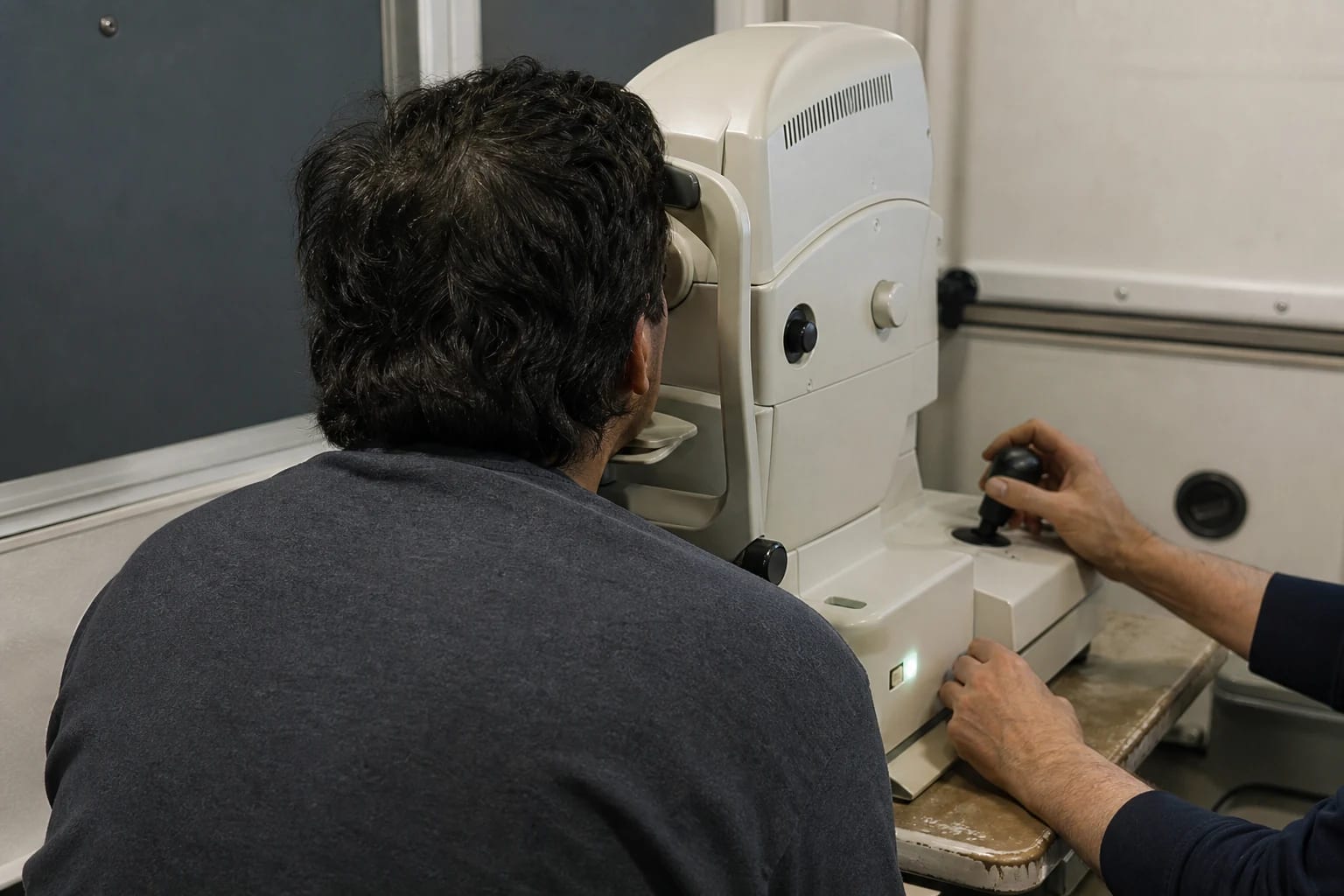
Adult patient undergoes unbranded retinal imaging while an ophthalmic technician operates the focus control from a rear-oblique angle
Keep each eye-care event, laterality, named test, maintained output, image or report version, prescription, and function source in separate labeled lanes.

Quick answer

After a California eye injury or vision concern, identify each eye-care visit and the left, right, or both-eye records involved; request the maintained exam note, named test outputs, images, prescriptions, referrals, billing records, and amendments; preserve every version; and keep clinical findings separate from daily-function evidence. Do not interpret one measurement as diagnosis, cause, disability, fault, or claim value.

Key takeaways

  • Identify the provider, visit, laterality, correction used, named test, and report version before comparing results.
  • Keep exam notes, machine outputs, images, prescriptions, billing records, and daily-function sources in separate lanes.
  • Preserve every original and amended version; never replace an earlier report with a later file.
  • A single acuity, pressure, field, or imaging result is one source—not a diagnosis or legal conclusion by itself.
Hurt Advice Editorial Team

Prepared by

Hurt Advice Editorial Team

Editorial Research and Publishing Team

Source-checked editorial publishing

Why trust this article

Prepared by the Hurt Advice Editorial Team from the current official California Legislature, HHS, GovInfo, National Eye Institute, and Social Security Administration sources cited on this page. No attorney reviewed this version. Hurt Advice is a lawyer referral and legal information service, not a law firm.

Recent update: Original publication created with an eye-event identity sheet, six-lane test-source map, laterality-and-version ledger, neutral request scripts, access and amendment boundaries, and current official citations.

At a glance

What this guide helps you decide

Start with the question that brought you here, identify the records that can verify the facts, and use the related guidance only where it helps. This article addresses personal injury questions in California.

Main question

Decide how this topic may apply to your situation

Use "Eye-Exam and Ophthalmology Records After a California Injury" to sort the facts you know, the questions still open, and whether a personal injury resource or consultation may be useful in California.

Guide map

Start with the sections most relevant to you: Who this guide helps and what it does, Put eye safety and clinical care first, Build one eye-event identity sheet per visit

Move through the article by issue, not by guesswork, so liability, medical proof, insurance pressure, deadlines, and next steps stay connected.

Records to gather

Connect these subjects to your records: California Eye Exam Records, Ophthalmology Records, Visual Field Test Records, Retinal Imaging Records

Compare the topic with records, photos, medical visits, police reports, insurer letters, and local claim details before relying on a general answer.

Trust check

Use the source trail before acting

This page includes 5 source references plus internal next-step paths so readers can verify where the guidance comes from.

Before you rely on this guide

This article is written for people dealing with injury-law questions in California. It is meant to help you understand the issue, not replace legal advice about your specific case.

What to do after this article

Start with the quick answer, skim the table of contents, and then use the links below to move into the practice area, author archive, or resource page that turns general guidance into a clearer next step for your situation.

Who this guide helps and what it does

This guide is for a person or family organizing eye-exam and ophthalmology records after a California injury, head impact, or new vision concern. The task is narrow: identify each eye-care event, request the maintained records that exist, preserve left-eye, right-eye, and both-eye details, and keep clinical findings separate from daily-function evidence. For a different reader task focused on reading, screens, changing light, and driving, use the vision-change function-record guide.

An eye-care file may include visit notes, measurements, test outputs, images, prescriptions, referrals, messages, authorization records, and later corrections, but not every clinic creates or maintains the same items. This article does not diagnose an eye condition, recommend or interpret testing, compare a person with a legal standard, or decide causation, disability, fault, damages, or claim value. Those questions require qualified medical and legal analysis based on the actual facts.

  • Identify the provider, visit, laterality, correction used, named test, and report version before comparing results.
  • Keep exam notes, machine outputs, images, prescriptions, billing records, and daily-function sources in separate lanes.
  • Preserve every original and amended version; never replace an earlier report with a later file.
  • A single acuity, pressure, field, or imaging result is one source—not a diagnosis or legal conclusion by itself.

Put eye safety and clinical care first

Record collection is not emergency or treatment guidance. After an eye injury or sudden vision concern, follow the treating professional’s instructions and seek prompt medical help when advised instead of delaying care to build a file. Do not press on the eye, repeat a painful maneuver, drive to recreate a symptom, stare into a bright light, or try to reproduce a clinic test at home. Preserve what happened without staging it.

The National Eye Institute explains that a dilated eye exam may include visual acuity, visual field, eye-muscle function, pupil response, tonometry, and dilation, with other testing depending on the person’s needs. Its current dilated-eye-exam overview is useful for naming distinct exam components, not for deciding which tests a particular injured person should receive or what a result means. Ask the treating eye professional those questions.

If a personal log is useful, record time, task, viewing condition, correction worn, what stopped the task, what was directly observed, and the source. Do not turn the log into a self-test or diagnostic score. The symptom-journal guide gives a source-labeled structure that avoids retrospective filling and medical conclusions.

Build one eye-event identity sheet per visit

Start with a separate identity sheet for each emergency, optometry, ophthalmology, imaging, surgery, therapy, or follow-up event. Record the organization, clinician name and role, location, visit date, referral source, reason for visit as documented, and whether the source refers to the left eye, right eye, or both eyes. Preserve the clinic’s wording instead of changing “screening,” “exam,” “consultation,” “imaging,” or “follow-up” into a stronger label.

Add the correction used during the event if the record states it, such as none, glasses, contacts, pinhole, or best correction. Note whether dilation was documented, which named tests appear, whether an image or report is referenced, and the displayed finalization, signature, addendum, or amendment date. Do not infer laterality from a filename, assume that a billing code proves a test occurred, or guess that an image belongs to a visit merely because the dates are close.

Give every event a neutral ID, such as “Eye-2026-03-04-ClinicA.” Link each received file to that ID while retaining the original filename. If a visit spans more than one department or system, create separate source rows rather than merging them. This lets a later reviewer see which provider maintained each note, output, image, prescription, or bill.

Use a six-lane eye-record source map

A useful file separates six source lanes. The history lane contains the referral, intake history, prior eye records reviewed, medications or conditions actually documented, and the clinician’s recorded reason for the visit. The acuity-and-refraction lane contains maintained measurements and correction details. The pressure-and-anterior-segment lane contains tonometry and front-of-eye findings as the clinician recorded them.

The alignment-and-response lane can include pupil response, eye-muscle function, alignment, and other observed examination elements. The field-and-imaging lane can include maintained visual-field outputs, retinal or optic-nerve images, scan reports, photographs, and the clinician’s interpretation when those items exist in the accessible record. The function-and-administration lane contains patient-reported task effects, work or school sources, prescriptions, referrals, scheduling, authorizations, billing, and communications.

Do not collapse the lanes into a homemade score. The National Eye Institute lists different exam components because they answer different clinical questions. A normal-looking value in one lane does not erase a documented concern in another, and an abnormal-looking value does not explain its cause or legal significance. Preserve the source and ask a qualified clinician to reconcile material differences.

  • History: referral question, symptoms as documented, prior records reviewed, medication context, and source date.
  • Acuity and refraction: eye, distance or near context, correction used, measurement, and report version.
  • Pressure and anterior segment: named method or observation, laterality, time, conditions stated, and clinician wording.
  • Pupil, alignment, and motility: task performed, observed response, eye or both-eye context, and source.
  • Visual field and imaging: test or image name, eye, acquisition date, output/report identity, and amendment status.
  • Function and administration: task records, prescriptions, referrals, scheduling, authorization, billing, and messages.

Request the maintained record, not a new analysis

A focused request can ask for the visit note, final signed report, maintained prior or amended versions, named test outputs, patient-accessible images or image reports, prescriptions, referrals, orders, after-visit instructions, portal messages, and related billing or authorization records for a stated provider and date range. Ask the records office to identify any referenced attachment that was not included. Avoid demanding “every eye record everywhere” without identifying likely custodians.

HHS explains that, with limited exceptions, the HIPAA Privacy Rule gives an individual access to medical and billing records held by covered providers and plans. Its current medical-record rights page also distinguishes access from correction. The controlling regulation, 45 C.F.R. § 164.524 in the official 2025 CFR, describes access to protected health information in a designated record set and lists exceptions and denial procedures.

The access right does not require a clinic to create a new comparison, explanation, image reconstruction, causation opinion, disability analysis, or litigation report that it does not maintain. If an item is not produced, ask whether it is not maintained, outside the designated record set, subject to a stated exception, held by another custodian, or available through a specified process. Preserve the response without treating it as proof that the record never existed or was concealed.

California access timing and request boundaries

California Health and Safety Code section 123110 provides separate inspection and copy procedures. Subject to its conditions and exceptions, an eligible patient or representative may inspect patient records during business hours within five working days after the provider receives a request. A copy request must specify the records to be copied, and the provider must transmit paper or electronic copies within 15 days after receiving it. Read the current official California Health and Safety Code section 123110 for the full rules, fees, format provisions, and exceptions.

These patient-record periods are not a personal-injury filing deadline and do not guarantee that every imagined output exists or is accessible. Log the date received, exact scope, identity verification requested, response date, production format, records included, and written reason for any limitation. For general civil-claim timing orientation, consult the California statute-of-limitations resource, but obtain case-specific legal advice when a deadline may matter.

A portal download can be useful yet incomplete. Compare the export date range, attachments, test names, eye laterality, report version, and provider with the original request. Preserve the downloaded ZIP or PDF and delivery message unchanged, then make a separate working copy. Do not crop, relabel, or overwrite the original in a way that loses identity or version information.

Practical tool: a laterality and version ledger

Use one row per document, output, image set, prescription, message, or bill—not one row per conclusion. Recommended columns are: event ID; provider; document or test name; visit date; acquisition date; left, right, or both eyes; correction used if stated; dilation status if stated; source system; original filename; report or image identifier; signature/finalization date; version or addendum date; received date; and current storage location.

Add a source-status field with controlled terms: requested, acknowledged, produced, partly produced, referenced but missing, withheld with written reason, held by another custodian, or follow-up needed. Add a comparison field only for concrete differences such as laterality, date, test name, correction, page count, report version, or stated recipient. Do not write “wrong” when the records merely use different methods, conditions, or clinical language.

Example: row one may be “left-eye field output, acquired April 2, portal PDF, unsigned.” Row two may be “both-eye clinic note, visit April 2, signed April 4.” Row three may be “amended note, dated April 12, received April 15.” The ledger shows how the sources relate without claiming that the field output proves diagnosis, that the note explains daily function, or why an amendment was made.

  • Identity fields: event, provider, visit, named test, eye laterality, correction, dilation, and source system.
  • File fields: original filename, image/report ID, pages or file count, signature, acquisition date, and received date.
  • Status fields: requested, produced, partly produced, referenced, limited, custodian, follow-up owner, and next date.
  • Comparison fields: exact difference, source on each side, clinical question, and the qualified person asked to reconcile it.

A step-by-step request and preservation process

First, complete the event identity sheet. Second, list each likely custodian: emergency department, optometrist, ophthalmologist, imaging center, hospital records office, referring clinician, pharmacy, health plan, authorization vendor, employer or school, and patient portal. Third, request named maintained records by provider and date. Fourth, save delivery evidence and originals. Fifth, log every item and referenced attachment. Sixth, compare only source facts. Seventh, take interpretation questions to the treating or reviewing professional.

A neutral request can say: “Please provide an electronic copy, in a readily producible format, of the patient records maintained for eye care by [provider/clinic] on [date or date range], including visit notes, final signed reports, maintained prior or amended versions, named test outputs, patient-accessible images or image reports, prescriptions, referrals, orders, after-visit instructions, portal messages, and related billing or authorization records. Please identify any requested item not produced and the reason.”

A focused follow-up can say: “The [note/report/message] dated [date] refers to [test, image, attachment, prescription, or later version], but that item was not included. Please provide the maintained patient-accessible record or identify its custodian and any written basis for a limitation.” Keep the tone factual. Do not accuse staff of alteration, ask a records clerk to interpret results, or demand a new opinion. Track scheduling changes separately with the appointment-change record guide.

Reconcile clinical records with daily function carefully

An eye exam captures a defined event under stated conditions. Daily records capture different tasks, environments, distances, lighting, supports, fatigue, and timing. Compare them by question rather than verdict: which eye or both eyes, what task, what correction, what viewing condition, what was directly observed, who recorded it, and what happened afterward? Keep a clinician’s finding, a patient report, and a witness observation labeled as different source types.

The Social Security Administration’s adult visual-disorder evidence rules illustrate why corrected acuity, visual-field testing, eye laterality, method, and exam documentation cannot be treated as interchangeable. Those technical rules apply to Social Security disability evaluation; they are not a California injury-claim formula, a home scoring guide, or proof that a person meets any other medical or legal standard.

Before-and-after comparisons need reliable sources. A prior prescription, eye exam, school record, job requirement, license restriction, or dated task record may provide context; recollection should be labeled as recollection. Post-event sources may include clinic notes, therapy, work accommodation, attendance, reading, screen, navigation, or transportation records. Use the injury-claim proof guide to keep source, fact, and conclusion separate.

Correct identity errors without rewriting the original

Separate an objective identity issue from a disagreement with professional interpretation. A wrong visit date, patient name, eye laterality, correction, medication, provider, or statement about who attended can be identified precisely with a reliable source. A disagreement about diagnosis, prognosis, causation, test reliability, disability, or legal significance usually is not a clerical correction and should be discussed with a qualified professional. Preserve the original before requesting any change.

HHS states that a person may ask a covered provider or plan to amend information believed incorrect or incomplete, that the organization must respond, and that a denied request can be followed by a statement of disagreement. Use the provider’s actual process and keep the request narrow: identify the record, exact disputed item, proposed factual correction, and supporting source. Preserve the request, acknowledgement, decision, amendment or addendum, and later disclosed version.

Do not edit the received PDF, erase a result, substitute a preferred word, or circulate a working annotation as though it were the clinic’s amended record. A sidecar note can identify a question for review, but it should name its author and date and remain separate from the source file. If the provider issues a corrected version, retain both and connect them in the ledger.

Mistakes and red flags to avoid

Common mistakes include saving only the newest portal file, mixing visit and acquisition dates, dropping eye laterality, treating a billing code as a result, copying a number without its method or correction context, assuming every image has a narrative report, and merging clinic findings with daily observations. Another mistake is posting private eye images or health records to a public sharing link. Use access controls and share only with authorized recipients.

Follow-up questions are reasonable when a signed report is referenced but absent, a note names an image or field test not included, laterality conflicts across files, a report predates its stated acquisition date, a prescription version cannot be identified, a page or attachment count differs, or an amendment is mentioned but missing. These are record-identity questions, not automatic evidence of negligence, alteration, causation, or wrongdoing.

Do not recreate an exam, edit an image, rename files so version identity is lost, backfill a log from memory without labeling it, or ask a witness to adopt clinical language. Keep an untouched source set, a working set, and a simple access log. If the organization becomes difficult, focus on event, eye, date, source, version, and next request rather than writing conclusions into filenames.

Next steps and Hurt Advice disclosure

Finish one event sheet and one laterality/version ledger before sending a second request. Confirm the provider, date, eye, named record, and custodian; preserve the original response; and list only concrete missing or conflicting items. Then ask the treating eye professional to explain medical questions and obtain individualized legal advice if a California claim, authorization, public-entity issue, or deadline may be involved.

The eye-injury resource can help organize factors that may require professional review, but it does not estimate a guaranteed result. Hurt Advice is a lawyer referral and legal information service, not a law firm. This article was prepared by the Hurt Advice Editorial Team from the official sources linked on this page and was not reviewed by an attorney. Hurt Advice does not guarantee a lawyer match, outcome, or recovery. To request an intake review, use the contact page.

Frequently Asked Questions

What eye-exam records should I request after a California injury?
Request the maintained visit note, final signed report, prior or amended versions, named test outputs, patient-accessible images or image reports, prescriptions, referrals, orders, after-visit instructions, portal messages, and related billing or authorization records. Name the provider and date range, and ask for a written reason for any requested item not produced.
How should I organize left-eye and right-eye test results?
Use one row per source and record the event, provider, visit and acquisition dates, left, right, or both-eye laterality, correction used if stated, named test, source system, report or image identifier, version, and received date. Preserve the original file and do not infer laterality from a filename alone.
How quickly must a California provider send patient-record copies?
California Health and Safety Code section 123110 states that, subject to its conditions and exceptions, a provider must transmit requested paper or electronic copies within 15 days after receiving a request that specifies the records. Inspection has a separate five-working-day rule. These are patient-record timelines, not injury-claim filing deadlines.
Does one visual acuity, pressure, field, or imaging result prove an eye injury?
No. One result comes from a defined event and must be understood with the eye tested, method, correction, conditions, clinician observations, other medical information, and daily function sources. It does not by itself establish diagnosis, cause, disability, fault, damages, or claim value.
What should I do if an ophthalmology record lists the wrong eye or date?
Preserve the original, identify the exact item and reliable supporting source, and use the provider’s correction or HIPAA amendment process. Keep the request, response, and every resulting version. Do not overwrite the original or present a disagreement with professional interpretation as a clerical correction.
How do I compare an eye exam with reading, screen, work, or driving problems?
Keep the sources separate. Record the task, date, eye or both-eye context, correction, distance, lighting, instruction, accommodation, direct observation, and custodian for each daily event. Then ask a qualified eye professional to reconcile material differences. Do not convert a witness observation into a clinical finding or one clinic result into proof of performance everywhere.

Sources and references

Federal agency guidanceHHS — Your Medical Records

Official overview of access, copying, correction, and statement-of-disagreement rights under HIPAA.

Need help after an accident?

Hurt Advice intake team can review your situation, explain your options, and help you move forward with a plan that fits your case.