
Legal ExplainerPersonal InjuryChecklist / Process

Dental Trauma Imaging and Treatment Records After a California Injury

This practical California guide helps injured people identify each tooth or jaw site and dental-care event, request maintained charts and imaging, preserve treatment and version history, and reconcile clinical, cost, and function sources without interpreting images or making medical or legal conclusions.

Published

August 3, 2026

Updated

August 3, 2026

Reading time

11 min read

Jurisdiction

California

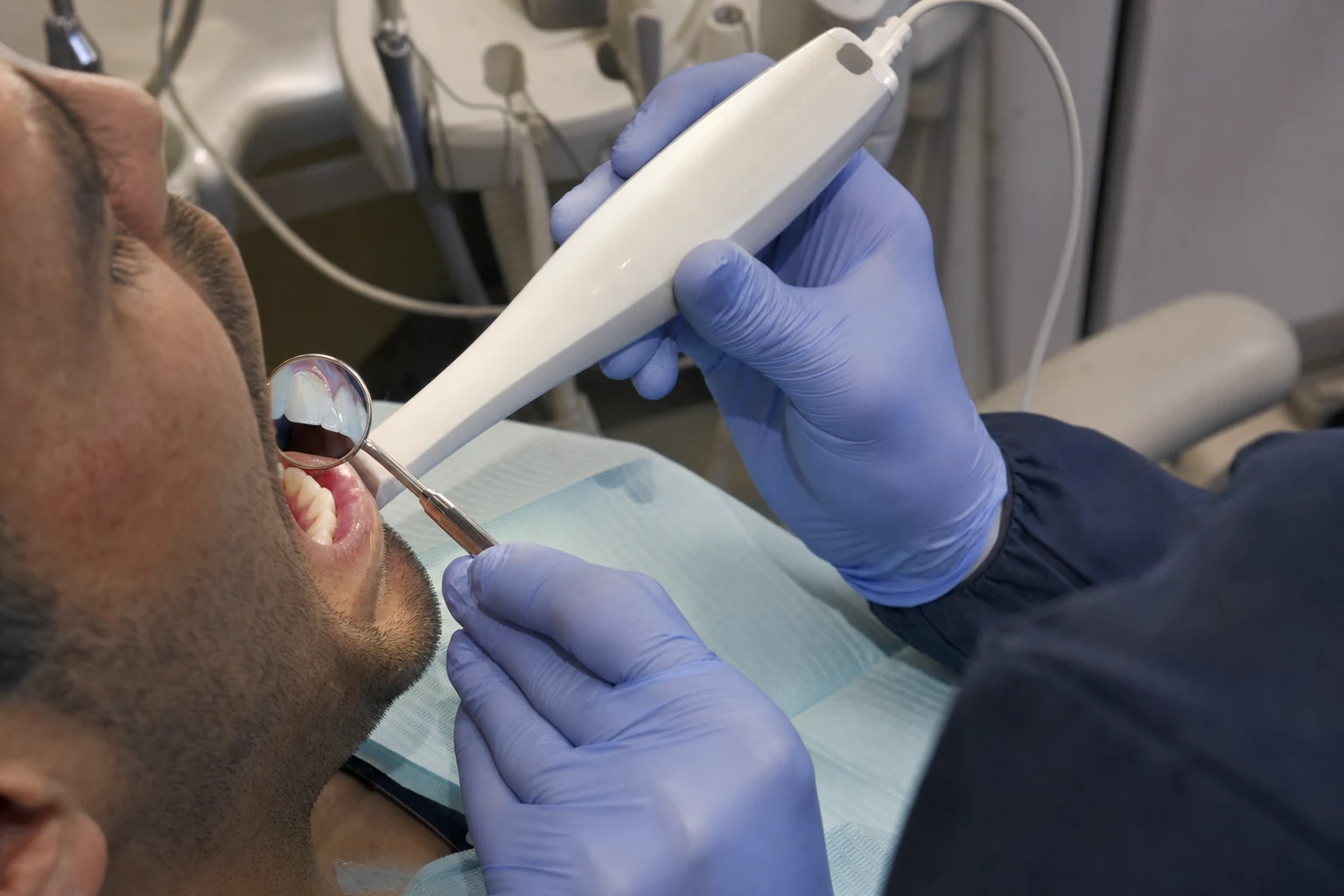
Dental clinician documents a small non-graphic chipped front tooth with an unbranded intraoral scanner and dental mirror
Keep tooth or jaw identity, chart notes, radiographs, photographs, treatment states, specialty sources, costs, and later versions in separate evidence lanes.

Quick answer

After dental trauma in California, identify the tooth or jaw site and every care event; request the maintained chart, radiographs, photographs, referrals, procedures, laboratory, billing, and amendment records; preserve each version; and keep clinical, cost, and daily-function sources separate. Do not interpret one image, code, invoice, or later treatment as proof of cause, fault, or value.

Key takeaways

  • Identify the tooth or jaw site, provider, encounter, procedure, image set, and version before comparing records.
  • Keep chart notes, radiographs, photographs, referrals, laboratory work, billing, and function sources in separate lanes.
  • Preserve the as-found, provisional, definitive-treatment, and follow-up states without overwriting an earlier source.
  • One image, code, invoice, or later procedure does not establish diagnosis, causation, fault, damages, or claim value by itself.
Hurt Advice Editorial Team

Prepared by

Hurt Advice Editorial Team

Editorial Research and Publishing Team

Source-checked editorial publishing

Why trust this article

Prepared by the Hurt Advice Editorial Team from current official California Legislature, HHS, GovInfo, NIDCR, and American Dental Association sources cited on this page. No attorney reviewed this version. Hurt Advice is a lawyer referral and legal information service, not a law firm.

Recent update: Original publication created with a tooth-and-event identity map, six-lane dental source map, treatment-and-version ledger, neutral request scripts, California access boundaries, and current authoritative citations.

At a glance

What this guide helps you decide

Start with the question that brought you here, identify the records that can verify the facts, and use the related guidance only where it helps. This article addresses personal injury questions in California.

Main question

Decide how this topic may apply to your situation

Use "Dental Trauma Imaging and Treatment Records After a California Injury" to sort the facts you know, the questions still open, and whether a personal injury resource or consultation may be useful in California.

Guide map

Start with the sections most relevant to you: Who this guide helps and what it does, Address urgent dental and medical needs first, Build a tooth-and-event identity map

Move through the article by issue, not by guesswork, so liability, medical proof, insurance pressure, deadlines, and next steps stay connected.

Records to gather

Connect these subjects to your records: California Dental Trauma Records, Dental Radiographs, Tooth Injury Treatment Records, Intraoral Photographs

Compare the topic with records, photos, medical visits, police reports, insurer letters, and local claim details before relying on a general answer.

Trust check

Use the source trail before acting

This page includes 6 source references plus internal next-step paths so readers can verify where the guidance comes from.

Before you rely on this guide

This article is written for people dealing with injury-law questions in California. It is meant to help you understand the issue, not replace legal advice about your specific case.

What to do after this article

Start with the quick answer, skim the table of contents, and then use the links below to move into the practice area, author archive, or resource page that turns general guidance into a clearer next step for your situation.

Who this guide helps and what it does

This guide is for a person or family organizing dental-trauma records after a California crash, fall, impact, or other injury. The task is narrow: identify the exact tooth or jaw site and each care event, request the records actually maintained, preserve every version, and keep clinical sources separate from cost and daily-function evidence. It is not a treatment plan, imaging interpretation, negligence opinion, or claim-value estimate.

Dental records can be fragmented across an emergency department, general dentist, endodontist, oral surgeon, imaging center, laboratory, pharmacy, health plan, and patient portal. A useful file connects those sources without pretending they all say the same thing. If emergency-department records are part of the chain, use the triage-and-discharge record guide to preserve that separate encounter.

  • Identify the tooth or jaw site, provider, encounter, procedure, image set, and version before comparing records.
  • Keep chart notes, radiographs, photographs, referrals, laboratory work, billing, and function sources in separate lanes.
  • Preserve the as-found, provisional, definitive-treatment, and follow-up states without overwriting an earlier source.
  • One image, code, invoice, or later procedure does not establish diagnosis, causation, fault, damages, or claim value by itself.

Address urgent dental and medical needs first

Record organization must not delay urgent care. A broken or displaced tooth, uncontrolled bleeding, facial swelling, breathing difficulty, inability to close the jaw, or other serious concern belongs with a qualified dental or medical professional. Do not move a loose tooth, recreate a bite, repeat a painful motion, remove an appliance, or stage a photograph for evidence. Follow the treating professional’s instructions and document what occurred naturally.

The National Institute of Dental and Craniofacial Research describes dental trauma as including tooth fracture, displacement, or complete loss. Its Oral Health in America summary is useful for recognizing that these are different clinical categories, not for deciding which category applies to a specific person. Preserve the clinician’s terminology instead of translating a note into a stronger label.

A personal log can record the time, food or task, speaking or chewing context, prescribed restriction, medication actually taken, interruption, and source. Do not test limits or turn the log into a diagnostic score. The symptom-journal guide provides a source-labeled approach that avoids retrospective filling and medical conclusions.

Build a tooth-and-event identity map

Create one identity row for each emergency, dental, specialty, imaging, laboratory, pharmacy, and follow-up event. Record the organization, clinician name and role, date, location, referral source, reason for the encounter as documented, and the exact tooth, region, or jaw site stated in the source. If the chart uses a tooth-numbering system, copy the identifier exactly and do not convert it from memory.

When stated, add whether the source concerns a primary or permanent tooth, upper or lower arch, right or left side, front or back region, and a named tooth surface. Note whether the source is a clinical note, treatment plan, radiograph, CBCT data set, image report, intraoral photograph, referral, prescription, laboratory order, invoice, benefit document, or message. Missing detail stays blank rather than guessed.

Give each event a neutral ID such as “Dental-2026-04-08-ClinicA.” Retain the original filename and delivery package. If an image set and report have different acquisition, interpretation, signature, or delivery dates, give them separate rows connected to the same event. That distinction prevents a later report from silently replacing the original image identity.

Use a six-lane dental-record source map

A practical source map separates six lanes. The clinical-chart lane contains history as recorded, examination findings, diagnosis wording, procedure notes, instructions, consent or refusal documentation, and follow-up entries. The imaging lane contains radiographs, CBCT or other maintained image data, acquisition details, reports, and image identifiers when those items exist. The photograph lane contains intraoral or extraoral photographs and their dates.

The referral-and-specialty lane contains communications among the general dentist, endodontist, oral surgeon, orthodontist, prosthodontist, emergency department, or other provider. The laboratory-and-device lane contains impressions or scan references, prescriptions to a dental laboratory, appliance or restoration identity, delivery, adjustment, and remake records when maintained. The administration-and-function lane contains scheduling, authorization, benefits, billing, payment, missed work or school, and dated eating, speaking, sleep, or hygiene observations.

The American Dental Association’s current patient-record documentation guidance lists clinical notes, radiographs, photographs, treatment plans, referrals, follow-up records, instructions, consent materials, and correspondence as distinct record components, while describing financial information as separately maintained. That professional guidance helps define likely custodians; it does not prove that every listed item exists in a particular file.

  • Clinical chart: history, examination, clinician wording, procedure note, instructions, consent, and follow-up.
  • Imaging: image type, tooth or region, acquisition date, series or file identity, report, and version.
  • Photographs: view, date, source device or system if stated, original filename, and delivery package.
  • Referrals and specialty care: sender, recipient, question, attachment list, encounter, and response.
  • Laboratory and device: order, tooth or region, material or appliance as stated, dates, adjustments, and remake status.
  • Administration and function: authorization, billing, benefits, scheduling, task observation, custodian, and date.

Request the maintained record, not a new opinion

A focused request can ask for the complete clinical chart for a defined provider and date range; signed treatment and procedure notes; maintained prior or amended versions; radiographs, CBCT or other patient-accessible images and reports; intraoral photographs; referrals and consultation responses; prescriptions and instructions; laboratory or appliance records; portal messages; and related billing or authorization records. Ask the records office to identify any referenced attachment that was not included.

HHS explains that, with limited exceptions, the HIPAA Privacy Rule gives an individual access to medical and billing records held by covered providers and plans. The agency’s medical-record rights page distinguishes access from correction. The official 45 C.F.R. § 164.524 sets the federal designated-record-set access framework, exceptions, request procedures, timing, and denial rules.

An access request does not require a provider to create a new image interpretation, comparison, chronology, causation opinion, disability analysis, or litigation report that it does not maintain. If an item is not produced, ask whether it is not maintained, held by another custodian, outside the accessible record set, subject to a stated limitation, or available through a specified image-transfer process. Preserve the response without treating it as proof of concealment or destruction.

Understand California access timing and X-ray handling

California Health and Safety Code section 123110 provides separate inspection and copy procedures. Subject to the statute’s conditions and exceptions, an eligible patient or representative may inspect patient records during business hours within five working days after the provider receives a request. A copy request must specify the records, and the provider must transmit the paper or electronic copies within 15 days after receiving it. Read the current official section 123110 for format, fee, identity, exception, and other details.

The same section has a specific X-ray provision: copies of X-rays need not be provided under that section when the original X-rays are transmitted to another health care provider upon the patient’s written request within the stated period, subject to the statute’s terms. Do not summarize a missing image as refusal until you confirm which subsection, transfer option, format, custodian, and written response apply. Federal rights may also require separate analysis.

These patient-record periods are not a personal-injury filing deadline. Log request date, scope, authorization, identity verification, response date, production format, included files, transfer destination, fees, and written reason for any limitation. For general timing orientation, see the California statute-of-limitations resource and obtain individualized legal advice when a deadline may matter.

Practical tool: treatment-and-version ledger

Use one row per source, not one row per conclusion. Recommended fields are event ID; provider; tooth or jaw site exactly as stated; source type; visit date; image acquisition date; procedure date; signature or finalization date; original filename; image series or report identifier; version or addendum date; received date; custodian; and storage location.

Add a treatment-state field using neutral terms: as-found observation, emergency stabilization, provisional restoration or appliance, definitive treatment as documented, follow-up, adjustment, replacement, or later unrelated care. A later crown, root-canal entry, extraction, implant, appliance, or repair should never overwrite the earlier state. Keep pre-injury comparison records in their own rows and label their dates and custodians.

Example: row one may be “emergency note, upper front region, April 8, signed April 8.” Row two may be “periapical image, tooth number copied from file, acquired April 8, original export received April 12.” Row three may be “specialty consultation, April 10, signed April 11.” The ledger shows sequence and identity without claiming the image proves cause or that later treatment proves the earlier condition.

  • Identity fields: event, provider, tooth or region, numbering system if stated, dentition, surface, and source type.
  • Time fields: incident, visit, acquisition, procedure, signature, addendum, delivery, and follow-up dates.
  • Version fields: original filename, series or report ID, page or file count, prior version, amendment, and custodian.
  • State fields: as found, stabilized, provisional, definitive, adjusted, replaced, later care, and exact supporting source.

Follow a step-by-step request and preservation process

First, complete the event map. Second, list likely custodians. Third, request named maintained records by provider and date range. Fourth, save the delivery email, portal notice, envelope, or transfer confirmation. Fifth, preserve the original ZIP, PDF, image files, and metadata unchanged. Sixth, inventory every item and referenced attachment. Seventh, compare only concrete identity and version facts. Eighth, take medical interpretation to the treating or reviewing professional.

A neutral request can say: “Please provide an electronic copy, in a readily producible format, of the patient records maintained for dental care by [provider or clinic] from [date] through [date], including the clinical chart, signed treatment and procedure notes, maintained prior or amended versions, radiographs or other patient-accessible images and reports, intraoral photographs, referrals, consultation responses, prescriptions, instructions, laboratory or appliance records, portal messages, and related billing or authorization records. Please identify any requested item not produced and the reason.”

A focused follow-up can say: “The [note, referral, report, or message] dated [date] refers to [image, attachment, consultation, procedure, or later version], but that item was not included. Please provide the maintained patient-accessible item or identify its custodian and the written basis for any limitation.” Keep the tone factual. Do not ask a records clerk to interpret an image or accuse anyone of altering a record.

Reconcile imaging, treatment, cost, and function without merging them

Clinical notes record a defined encounter. Radiographs and photographs are different source objects. A procedure note records what the clinician documented doing. A laboratory order describes requested work. An invoice or benefit statement records financial processing. A personal or witness log records daily observations. Compare them by tooth or site, date, source, version, and question rather than forcing them into one narrative.

For function, record concrete activities such as eating a particular texture, speaking for a stated period, sleeping, hygiene, wearing an appliance, attending work or school, or following a prescribed restriction. Label who observed the event and whether the entry was contemporaneous or later recollection. Do not recreate pain, chew unsafe food, remove a restoration, or turn a self-recorded task into a clinical test.

For costs, preserve estimates, treatment plans, invoices, payments, adjustments, benefit explanations, and out-of-pocket receipts as separate sources. The dental-injury resource and facial-fracture resource can help organize questions, but neither predicts a result. Use the injury-claim proof guide to keep source, fact, and conclusion distinct.

Preserve provider identity, entries, corrections, and later versions

California Business and Professions Code section 1683 states that each dentist, dental health professional, or other licensed health professional who performs a service in a dental office must identify themselves in the patient record next to the service and date the treatment entry. The current official California Dentistry Act text provides the full wording and surrounding provisions. Copy the stored identifier rather than guessing who performed a task.

Separate an objective identity issue from disagreement with professional judgment. A wrong patient name, date, tooth identifier, provider, or statement about who attended can be identified precisely with a reliable source. Diagnosis, prognosis, image interpretation, treatment choice, causation, and necessity are professional questions. Preserve the original and use the provider’s correction or HIPAA amendment process for a focused request.

If a corrected note, addendum, amended plan, replacement image report, or new treatment plan is issued, retain every version. Record when each was created, signed, received, and disclosed. Do not edit the clinic’s PDF, rename files so version identity disappears, or circulate a working annotation as though it were the provider’s record.

Mistakes and red flags to avoid

Common mistakes include saving only the latest portal PDF, dropping the tooth or jaw site, converting tooth numbers without identifying the numbering system, treating a billing code as proof of a procedure, treating a report as the original image set, merging pre-injury and post-injury care, and treating an estimate as an invoice. Another mistake is posting private dental images to a public link. Use access controls and share only with authorized recipients.

Follow-up is reasonable when a note references an image or attachment that is absent; a referral lists files not delivered; image and report dates cannot be matched; provider identity is missing; a page or file count differs; the treatment state cannot be identified; or an amendment is mentioned but not included. These are record-identity questions, not automatic proof of negligence, alteration, causation, or wrongdoing.

If the concern involves dental treatment itself rather than the underlying injury, the dental-malpractice service page explains a different reader task. Do not label an unwanted outcome as malpractice from the record alone. A qualified professional must evaluate the facts, standard of care, causation, and harm, and Hurt Advice cannot make that determination.

Next steps and Hurt Advice disclosure

Finish one event map and one treatment-and-version ledger before sending a second request. Confirm the provider, date, tooth or site, source type, version, and custodian; preserve the original response; and list only concrete missing or conflicting items. Then ask a qualified dental professional to explain medical questions and obtain individualized legal advice if a California claim or deadline may be involved.

Hurt Advice is a lawyer referral and legal information service, not a law firm. This article provides general California information and cannot diagnose an injury, interpret dental imaging, decide whether care was reasonable, establish causation or fault, calculate damages, or promise an outcome. No attorney reviewed this autonomous Editorial Team article. The Hurt Advice Editorial Team prepared it from the current sources cited on this page.

If you want help identifying an independent California attorney who can review the actual records and facts, use the contact form. Submitting information does not create an attorney-client relationship, and representation begins only if an independent lawyer or law firm agrees and the parties enter a separate written agreement.

Frequently Asked Questions

What dental-trauma records should I request after a California injury?
Request the maintained clinical chart, signed treatment and procedure notes, prior or amended versions, radiographs or other patient-accessible images and reports, intraoral photographs, referrals and consultation responses, prescriptions, instructions, laboratory or appliance records, portal messages, and related billing or authorization records for a defined provider and date range.
How should I identify a tooth or jaw site in the record?
Copy the provider’s exact tooth number, numbering system if stated, jaw or region, right or left side, primary or permanent dentition, and tooth surface without converting or guessing. Keep each source’s wording and leave unstated fields blank.
How quickly must a California provider send patient-record copies?
California Health and Safety Code section 123110 states that, subject to its conditions and exceptions, a provider must transmit requested paper or electronic copies within 15 days after receiving a request that specifies the records. Inspection has a separate five-working-day rule. These are record-access periods, not injury-claim filing deadlines.
Must a California provider give me copies of dental X-rays?
Section 123110 contains a specific X-ray provision: copies need not be provided under that section when the original X-rays are transmitted to another health care provider upon the patient’s written request within the stated period and subject to the statute’s terms. Confirm the format, transfer option, custodian, and any federal access right for the actual request.
Does a radiograph, billing code, or later procedure prove what caused the dental injury?
No. Each item is one source from a defined context. It must be considered with tooth or site identity, dates, clinical findings, prior records, treatment notes, other images, and qualified interpretation. One image, code, invoice, or later treatment does not by itself establish diagnosis, causation, fault, damages, or claim value.
What should I do if a dental record lists the wrong tooth, date, or provider?
Preserve the original, identify the exact disputed item and reliable supporting source, and use the provider’s correction or HIPAA amendment process. Keep the request, response, and every resulting version. Do not overwrite the source or present disagreement with professional judgment as a clerical correction.

Sources and references

Federal agency guidanceHHS — Your Medical Records

Official overview of HIPAA access, copying, correction, and statement-of-disagreement rights.

Need help after an accident?

Hurt Advice intake team can review your situation, explain your options, and help you move forward with a plan that fits your case.