
Legal ExplainerWorkplace InjuryChecklist / Process

Machine Lockout and Maintenance Records After a California Workplace Injury

A reliable machine-injury file starts with safety and exact identity: the facility, machine, task, energy sources, control points, and custodians. Preserve only lawful observations from a safe distance, request existing event-date procedures and records, and compare planned, performed, verified, restored, and later-changed states without touching equipment or turning one lock, log, or later inspection into a legal conclusion.

Published

August 2, 2026

Updated

August 2, 2026

Reading time

11 min read

Jurisdiction

California

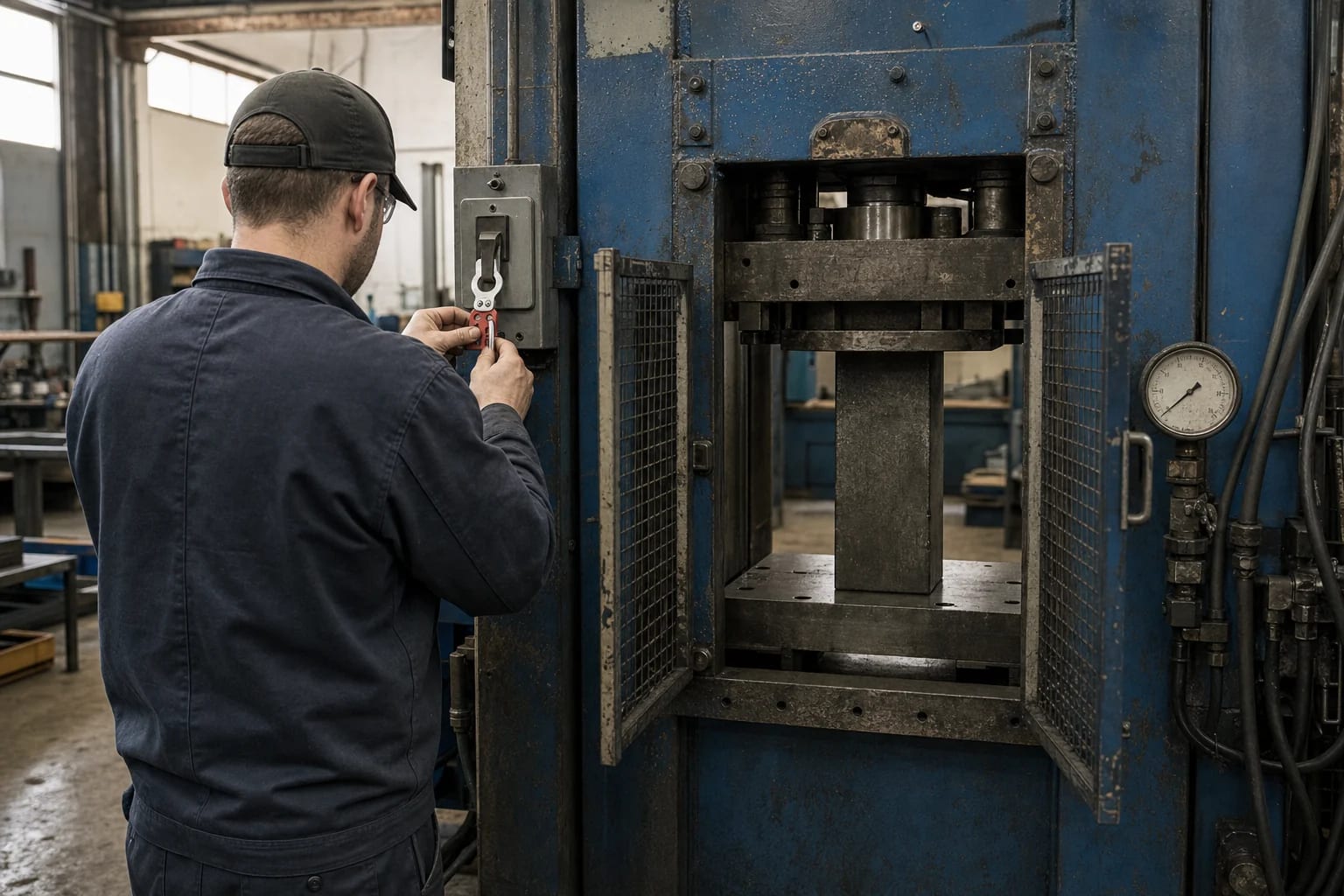
Maintenance technician applies a personal lockout device beside an open guarded hydraulic press secured by a steel ram block
Keep machine identity, energy sources, written procedure, isolation, stored-energy control, work performed, restoration, and later changes in separate source lanes.

Quick answer

After a California workplace machine injury, identify the exact equipment and task, map every hazardous-energy source, preserve safe observations, and request the event-date lockout, inspection, maintenance, training, contractor, incident, and change records without touching equipment or treating one lock, procedure, or later condition as complete proof.

Key takeaways

  • Address emergency care and scene safety first; never enter a restricted area or touch, start, stop, reset, block, photograph closely, or test equipment unless an authorized safety professional controls the task.
  • Identify the machine by facility, line, location, function, owner, asset number if lawfully visible, and the exact task underway—not by a generic label such as press or conveyor.
  • Map electrical, mechanical, hydraulic, pneumatic, thermal, chemical, gravitational, and other stored-energy sources separately; a stopped control panel is not the same as verified isolation.
  • Request existing procedures, inspection certifications, work orders, contractor records, training, incident forms, photographs, and change records without assuming every requester has a right to every private file.
Hurt Advice Editorial Team

Prepared by

Hurt Advice Editorial Team

Editorial Research and Publishing Team

Source-checked editorial publishing

Why trust this article

Prepared by the Hurt Advice Editorial Team from current California Department of Industrial Relations, California Legislature, and U.S. Occupational Safety and Health Administration sources. No attorney reviewed this displayed version.

Recent update: Original publication with a machine-and-energy identity map, five-state lockout sequence, four-custodian request map, neutral preservation scripts, source-comparison ledger, checklist, mistakes, and FAQs.

At a glance

What this guide helps you decide

Start with the question that brought you here, identify the records that can verify the facts, and use the related guidance only where it helps. This article addresses workplace injury questions in California.

Main question

Decide how this topic may apply to your situation

Use "Machine Lockout and Maintenance Records After a California Workplace Injury" to sort the facts you know, the questions still open, and whether a workplace injury resource or consultation may be useful in California.

Guide map

Start with the sections most relevant to you: Who this guide is for—and the exact task it solves, Quick takeaways, Contents: the five machine states and four custodians

Move through the article by issue, not by guesswork, so liability, medical proof, insurance pressure, deadlines, and next steps stay connected.

Records to gather

Connect these subjects to your records: California Machine Lockout Records, Hazardous Energy Control, Machine Maintenance Records, Lockout Tagout Procedure

Compare the topic with records, photos, medical visits, police reports, insurer letters, and local claim details before relying on a general answer.

Trust check

Use the source trail before acting

This page includes 6 source references plus internal next-step paths so readers can verify where the guidance comes from.

Before you rely on this guide

This article is written for people dealing with injury-law questions in California. It is meant to help you understand the issue, not replace legal advice about your specific case.

What to do after this article

Start with the quick answer, skim the table of contents, and then use the links below to move into the practice area, author archive, or resource page that turns general guidance into a clearer next step for your situation.

Who this guide is for—and the exact task it solves

This guide is for a California worker, family records organizer, union or other authorized representative, or attorney preparing to investigate an injury connected with cleaning, unjamming, adjusting, setting up, repairing, or maintaining a machine.

The task is not to approach the machine, recreate the event, remove a guard, test a control, handle a lock, or decide whether a safety rule was violated. It is to identify the exact machine and energy sources, preserve lawful observations from a safe distance, request existing records from the correct custodians, and compare the planned, performed, verified, restored, and later-changed states.

The workplace incident-record guide owns Cal/OSHA and employer incident files. The shift, payroll, and training guide owns broader employment records. The power-tool guide owns portable-tool and guard evidence. This checklist owns the fixed machine, hazardous-energy map, machine-specific procedure, servicing sequence, and lockout handoff.

Hurt Advice is a lawyer referral and legal information service, not a law firm. This is general information, not legal, workplace-safety, engineering, medical, evidence, or records-request advice. No attorney reviewed this displayed version.

Quick takeaways

  • Address emergency care and scene safety first; never enter a restricted area or touch, start, stop, reset, block, photograph closely, or test equipment unless an authorized safety professional controls the task.
  • Identify the machine by facility, line, location, function, owner, asset number if lawfully visible, and the exact task underway—not by a generic label such as press or conveyor.
  • Map electrical, mechanical, hydraulic, pneumatic, thermal, chemical, gravitational, and other stored-energy sources separately; a stopped control panel is not the same as verified isolation.
  • Request existing procedures, inspection certifications, work orders, contractor records, training, incident forms, photographs, and change records without assuming every requester has a right to every private file.
  • Keep planned procedure, firsthand observation, system log, later inspection, and expert opinion in separate columns; no one record proves how the machine was configured at the event time.

Contents: the five machine states and four custodians

Build five states: (1) normal operation before service, (2) shutdown and energy isolation, (3) stored-energy restraint and verification, (4) cleaning, unjamming, setup, repair, or maintenance work, and (5) restoration, testing, shift transfer, or later change.

Use four custodian lanes: employer or site operator; outside maintenance contractor; equipment owner, lessor, installer, or manufacturer; and Cal/OSHA or another public agency. Keep general workplace facts in the workplace-injury resource, and do not mix this machine file with unrelated coworkers' private information.

Start with safety and the exact machine identity

Record only what can be gathered lawfully and safely: facility, building or department, production line, machine location, ordinary function, make or model if already documented, employer asset number if available, owner or lessor, control-station location, guard or access-point identity, and the task being performed. Note the event date, approximate time, shift, supervisor, operator, maintenance crew, and outside company without publishing personal identifiers.

Do not return to an uncontrolled scene. Do not move a lock, tag, guard, workpiece, tool, hose, block, switch, breaker, valve, key, or emergency stop. A later photograph can document a later condition, but it should not be labeled as the event condition without reliable continuity evidence.

If a machine, component, or digital log may be changed or discarded, ask a California attorney promptly about focused preservation. A preservation request is not permission to enter private property, operate equipment, interfere with safety work, or take employer property.

Make a machine-and-energy identity map

Create one row for every potential energy source identified in an existing procedure, diagram, label, manual, work order, or qualified inspection. Useful categories can include electrical supply; rotating or translating mechanical parts; hydraulic pressure; compressed air; heat; chemicals; gravity; springs, flywheels, capacitors, suspended loads, or material under tension; and energy that can reaccumulate.

For each row, record the source, isolating device, location, control point, lock or tag position shown in the source, blocking or restraint method, verification step described, and the document or witness supporting the entry. Keep “not yet identified” as an honest status.

California Title 8 section 3314 defines locked out in terms of effective isolation or securing from mechanical, hydraulic, pneumatic, chemical, electrical, thermal, or other hazardous energy. The rule also addresses stopping and de-energizing equipment, mechanical blocking when necessary, written hazardous-energy procedures, group lockout, shift changes, periodic inspection, outside personnel, and training. The exact requirements depend on the machine, task, industry, and facts; do not convert the regulation into a do-it-yourself checklist at an uncontrolled scene.

Build the five-state lockout and servicing ledger

State 1—normal operation: identify the ordinary operator, controls, guard position, material flow, known work order, reported problem, jam, alarm, or change that preceded service.

State 2—shutdown and isolation: list the planned shutdown sequence, each energy-isolating device, personal or group lock information already documented, notifications, and who was described as authorized. Do not infer isolation merely because a display was dark or production had stopped.

State 3—stored-energy restraint and verification: separately log blocks, pins, chocks, valves, pressure relief, discharge, restraint, dissipation, and the verification method described in an existing record. Keep any system reading, photograph, and witness account in separate source fields.

State 4—work performed: record the task, work-order version, tools, removed guard or part, contractor, start and stop times, testing or positioning interval, and any change in crew.

State 5—restoration or later change: record inspection before restart, removal or transfer of devices, employee notification, test cycle, returned guard, shift handoff, repair, later inspection, or evidence movement. A later compliant state does not prove the earlier state, and a later problem does not by itself prove the event cause.

Use the California procedure, inspection, and training records carefully

Section 3314 says an employer's hazardous-energy control procedure must outline its scope, purpose, authorization, rules, shutdown, isolation, blocking, securing, device placement or transfer, and verification requirements. It generally calls for written machine-specific steps, with limited grouping conditions. It also addresses group responsibility, personal devices, continuity during shift or personnel changes, and at least annual periodic inspection certifications identifying the machine or equipment, date, included employees, and inspector.

California Title 8 section 3203 separately requires a written Injury and Illness Prevention Program (IIPP) with hazard identification, investigation, correction, training, and employee-access provisions. It provides access to the current IIPP, but states that the copy need not include every implementation record. Section 3203 also describes inspection and training documentation and retention rules, subject to stated exceptions.

Federal OSHA's 29 C.F.R. section 1910.147 is a useful official comparison for energy-control programs, procedures, training, inspections, contractors, verification, stored energy, and shift changes. California operates its own state plan, so do not assume the federal wording is the controlling rule for every California workplace or industry. Ask qualified counsel or a safety professional which provisions apply.

Request records from four different custodians

Employer or site operator: current and event-date machine procedure; relevant IIPP version; incident report; work order; maintenance request; pre-use or periodic inspection; applicable training record; shift handoff; lockout or group-lock documentation; contractor communication; photographs or video; control or alarm export; repair; and post-event change record, if maintained and lawfully available.

Outside maintenance contractor: scope, dispatch, technician assignment, site sign-in, job hazard or energy-control material, work order, parts, service notes, photographs, test or restart record, invoice, and communications. Do not assume the site and contractor hold identical versions.

Equipment owner, lessor, installer, or manufacturer: exact machine identity, installation or modification record, manuals, energy-isolation information, service bulletins, warranty or repair history, and supplied replacement parts. A generic manual is not proof of the configuration at the event time.

Cal/OSHA or another agency: ask for records the agency actually maintains, using the correct process and respecting investigation, privacy, privilege, and disclosure limits. The separate incident-record guide explains the distinction between employer-held and agency-held material.

Know the narrow access rights—and their limits

California Title 8 section 14300.35 provides specified employees, former employees, personal representatives, and authorized employee representatives access to required injury and illness records, subject to privacy and role limits. It states that relevant Cal/OSHA Form 300 records and an individual's Form 301 incident report generally must be provided by the end of the next business day, with a stated exception for establishments in NAICS Code 5121.

That rule does not automatically make every maintenance file, coworker record, video, control log, trade secret, contractor file, or investigation note available through an informal request. Section 3203 gives access to the IIPP itself but says the provided Program need not include all implementation records. Separate rights may arise through collective bargaining, authorization, a public-record process, subpoena, discovery, or another law.

Keep requests focused and minimum-necessary. Ask the custodian to identify withheld, unavailable, superseded, or not-maintained categories instead of treating silence as proof that a record never existed.

Neutral preservation and records-request scripts

Preservation notice: “Please preserve existing records and physical or digital evidence concerning [machine identity], [facility and location], [date and approximate time], and [task]. This includes the event-date machine configuration; energy-control procedure; work order; inspection, maintenance, training, contractor, incident, photograph, video, alarm, control, repair, and change records; and records identifying lawful custodians. This request does not ask anyone to delay emergency or safety work. Please document necessary movement, testing, repair, or alteration and preserve available before-and-after records.”

Focused request: “Please identify and provide the records I am authorized to receive for the machine and event above. Please keep original dates and versions, identify the custodian and source system, and state whether a requested category is maintained, superseded, unavailable, or withheld. Please do not include unrelated employee medical, personal, or confidential information.”

These are organization prompts, not subpoenas, guarantees, or instructions to violate safety, privacy, privilege, trade-secret, bargaining, or evidence rules.

Use a planned–performed–verified–restored comparison

For every important step, create columns for: planned procedure; work order; firsthand observation; lock or group-lock record; control or alarm log; photograph or video; inspection or maintenance note; contractor record; later change; and unresolved question.

Record the exact machine, source date, time zone, author or system, file name, page, version, and whether the item is original received, export, screenshot, summary, annotation, or unknown. Preserve the first copy and delivery context; annotate only a working copy.

Use status labels such as documented, reported, observed, inferred, changed later, unavailable, withheld, and unknown. Do not use “missing” when the search scope is unclear. Do not use “violation,” “defect,” “cause,” or “tampering” unless reliable evidence and qualified analysis support the term.

Timing, process, and deadline checkpoints

Immediately: obtain medical care, report the injury through the employer's process, preserve personal messages and lawfully held photographs, and write a source-labeled recollection without revisiting the machine.

Within days: identify the machine, task, employer, contractor, owner, witnesses, work order, and likely energy sources. Request the specific Cal/OSHA records and IIPP access that apply, and ask counsel about focused preservation before routine production, repair, data rotation, or disposal changes the evidence.

When records arrive: preserve each version, compare the five states, log gaps as questions, and route engineering or safety meaning to a qualified professional.

California Code of Civil Procedure section 335.1 states a two-year period for an action for injury or death caused by another's wrongful act or neglect. California Government Code section 911.2 generally requires a claim relating to injury to person or personal property against a public entity to be presented within six months after accrual. Workers' compensation, public-entity, third-party, product, contract, and other paths can involve different rules. The deadline resource is background only; obtain fact-specific California advice promptly.

Machine lockout and maintenance evidence checklist

  • Exact facility, line, machine, location, function, owner, asset identity, control station, service point, event task, date, shift, and involved employer or contractor.
  • Machine-and-energy map covering electrical, mechanical, hydraulic, pneumatic, thermal, chemical, gravitational, residual, and reaccumulating sources when applicable.
  • Event-date hazardous-energy procedure, machine-specific or permitted group steps, disconnect locations, blocking, verification, group-lock, contractor, and shift-change provisions.
  • Work request, work order, job scope, service notes, parts, tools, guard or component removal, start and stop times, testing, restart, and invoice records.
  • Relevant IIPP, hazard communication, inspection certifications, training documentation, Form 300 and the injured person's Form 301 when the access rule applies.
  • Lawfully preserved photographs, video, system or alarm exports, witness accounts, contractor files, agency records, and later repair or configuration changes kept in separate source lanes.
  • Original delivery messages, file names, page counts, dates, versions, custodians, unavailable or withheld responses, and a planned–performed–verified–restored reconciliation ledger.

Mistakes and red flags

  • Returning to an uncontrolled machine, crossing a restricted area, or touching a lock, tag, guard, block, valve, switch, workpiece, hose, or control to make a photograph look clearer.
  • Calling a stopped machine de-energized, or treating one padlock as proof that every hazardous-energy source was identified, restrained, and verified.
  • Using a generic manual or current procedure as proof of the event-date machine configuration or work sequence.
  • Combining employer, contractor, equipment-owner, witness, system-log, and later-inspection sources without preserving their separate versions and clocks.
  • Assuming access to the IIPP, Form 300, or the injured worker's Form 301 creates automatic access to every private maintenance, coworker, video, or investigation file.
  • Treating an absent, late, corrected, or conflicting record as automatic proof of negligence, causation, spoliation, or dishonesty.
  • Sharing coworker medical or personal information, trade-secret material, access credentials, or sensitive machine-security details more broadly than necessary.

Careful next steps

Finish the machine identity sheet, energy map, five-state sequence, four-custodian request map, version log, and comparison ledger. Keep safety observations factual and mark every conclusion as a question until qualified review supports it.

Bring machine, guarding, energy-isolation, and restart questions to a qualified safety or engineering professional. Bring authorization, workers' compensation, third-party, product, preservation, subpoena, public-agency, and deadline questions to a licensed California attorney who can assess the actual facts.

Hurt Advice can connect people with independent California lawyers through the contact page, but it does not promise representation or an outcome. This article was prepared by the Hurt Advice Editorial Team from the official sources listed below. No attorney reviewed this displayed version. See the editorial standards for sourcing, corrections, and autonomous-article disclosure.

Frequently Asked Questions

What machine lockout records should I preserve after a California workplace injury?
Start with the exact machine and task. Preserve lawfully held event photographs and messages, then request existing hazardous-energy procedures, machine-specific shutdown and isolation steps, work orders, inspection certifications, maintenance and contractor notes, relevant training, incident records, control or alarm exports, and later repair or change records. Keep each custodian, date, and version separate.
Does a padlock prove a machine was fully de-energized?
No. A visible lock can be an important fact, but it does not by itself identify every electrical, mechanical, hydraulic, pneumatic, thermal, gravitational, chemical, residual, or reaccumulating energy source. Review the applicable procedure, isolating devices, blocking or restraint, verification record, system data, and qualified observations before drawing a conclusion.
Can an injured California worker get the employer’s IIPP?
California Title 8 section 3203 provides employee access to the Injury and Illness Prevention Program and describes how access may be provided. The regulation also says the Program copy need not include all records of steps taken to implement and maintain it. Other files can have different access, privacy, bargaining, subpoena, discovery, or public-record rules.
Can a worker request Cal/OSHA Form 300 or Form 301 records?
California Title 8 section 14300.35 provides specified employees, former employees, personal representatives, and authorized employee representatives access to required injury and illness records, subject to role and privacy limits. It includes access timing for relevant Form 300 records and the injured worker’s Form 301 report, with a stated NAICS 5121 exception.
What if an outside contractor was servicing the machine?
Create separate employer and contractor lanes. Request the site procedure, contractor scope, dispatch, technician assignment, work order, energy-control or job material, service notes, photographs, testing, parts, invoice, and communications from the lawful custodian. Do not assume the on-site employer and outside company hold identical records or used identical clocks and versions.
Should I return to photograph the machine after the injury?
Do not return to an uncontrolled or restricted machine area or touch equipment to create evidence. Use photographs you lawfully possess, request existing employer, contractor, or agency images, and ask counsel about safe, authorized inspection and preservation. A later photograph should be labeled as a later condition unless reliable continuity evidence supports more.

Sources and references

California Department of Industrial RelationsCalifornia Code of Regulations, Title 8, section 3314

Current California hazardous-energy control requirements for machine cleaning, repair, servicing, setup, and adjustment, including procedures, group lockout, shift changes, inspections, outside personnel, and training.

California Department of Industrial RelationsCalifornia Code of Regulations, Title 8, section 3203

Current Injury and Illness Prevention Program requirements, employee access, workplace inspection, investigation, correction, training, and implementation-record provisions.

Need help after an accident?

Hurt Advice intake team can review your situation, explain your options, and help you move forward with a plan that fits your case.