Useful ankle-injury records connect a specific task to a date, setting, assistance level, and source. Record what happened while standing, walking, using stairs, crossing uneven ground, or changing footwear; note what ended the task and how long recovery took. Keep the original clinical, therapy, work, school, purchase, and transportation records beside your own neutral log instead of trying to turn the log into a diagnosis.
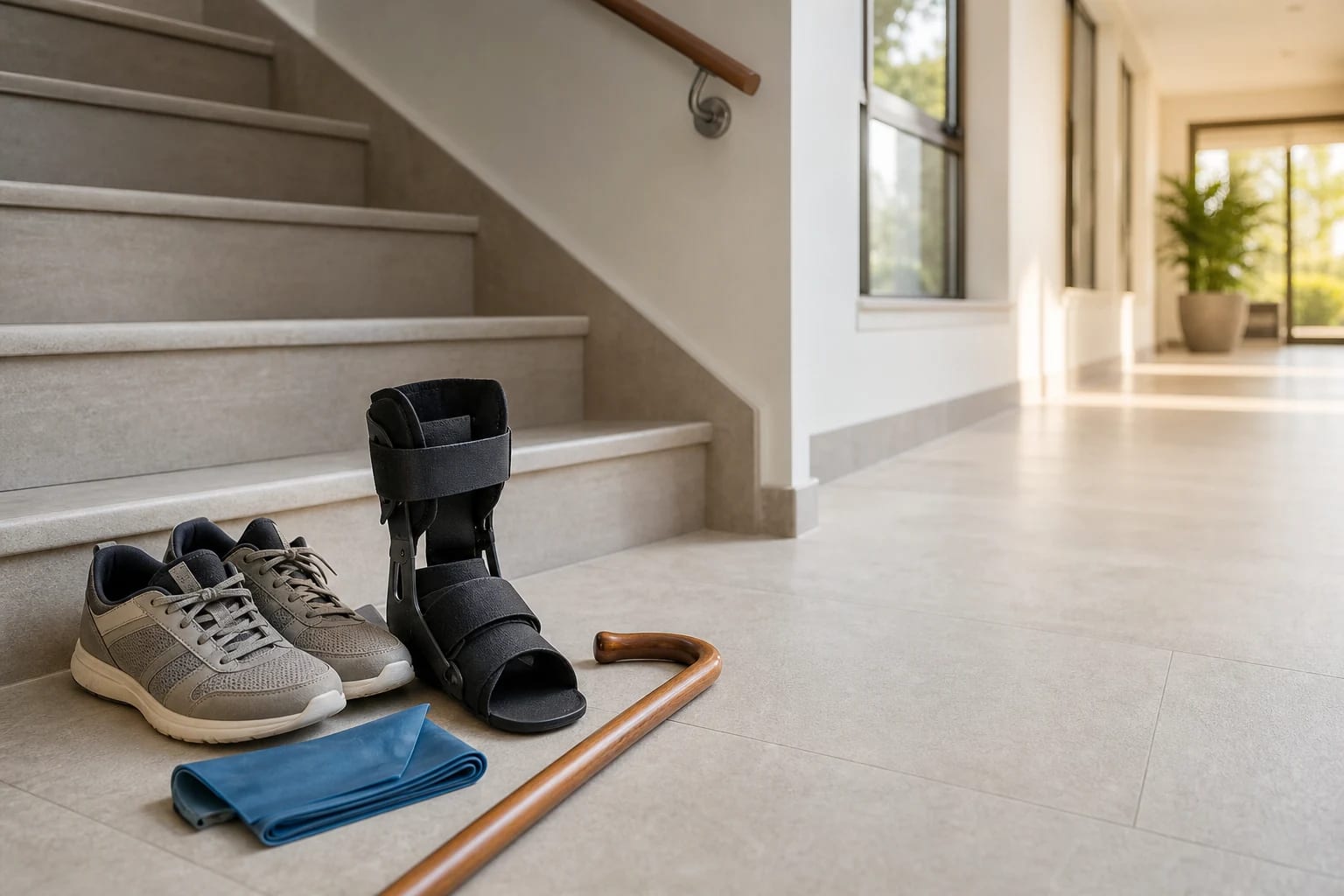
Quick answer
After a California ankle injury, build a source-labeled record of specific standing, walking, stair, surface, footwear, assistance, and recovery tasks. Compare ordinary before-event activities with current activities, preserve original clinical, therapy, work, school, and daily-life records, and mark estimates and source conflicts clearly. Never test unsafe limits, self-diagnose, or use the log as a treatment plan.

Prepared by
Hurt Advice Editorial TeamEditorial Research and Publishing Team
Source-checked editorial publishing
Why trust this article
Prepared by the Hurt Advice Editorial Team from current California statutes and official California, CMS, and Social Security sources. No attorney reviewed the displayed version; no attorney is identified as author or reviewer.
Recent update: Initial source-supported publication prepared July 24, 2026.
Table of contents
- 1. Quick answer and key takeaways
- 2. Who this guide is for and what it does
- 3. Start with safety, care, and the original record
- 4. Build a before-and-after task baseline
- 5. Use a standing-and-walking ledger
- 6. Collect the records by custodian
- 7. Reconcile records without rewriting them
- 8. A neutral request script
- 9. Track timing without turning the article into a deadline calculator
- 10. Common mistakes and red flags
- 11. Practical next steps
Quick answer and key takeaways
- Use ordinary tasks and surfaces as anchors: standing at a counter, walking from parking, stairs, curbs, uneven ground, and required footwear.
- Separate what you personally observed from what a clinician measured, an employer recorded, or another person reported.
- Preserve normal days, harder days, improvement, setbacks, assistance, and recovery time; selective notes are less useful than consistent ones.
- Get medical help for urgent symptoms and ask qualified clinicians about activity limits; a documentation guide is not a treatment plan.
Who this guide is for and what it does
This guide is for a California patient, parent, caregiver, or authorized helper organizing the functional story after an ankle injury. The injury may have followed a vehicle crash, fall, bicycle incident, workplace event, or another occurrence. It may involve a fracture, sprain, tendon problem, surgery, or an uncertain diagnosis. This article does not decide the diagnosis, cause, prognosis, disability level, or legal value.
The task is narrower than a general symptom diary. The symptom-journal guide covers broad day-to-day symptoms, while the knee function guide focuses on stairs and kneeling with a different joint. Here, the record centers on ankle-dependent standing, walking, surfaces, footwear, supports, and recovery.
The goal is a faithful source map: original medical records stay medical records; your notes stay your notes; work and school records keep their own dates and authors. When sources disagree, preserve the difference. Do not revise an old note to make it match a later interpretation.
Start with safety, care, and the original record
Seek urgent evaluation for symptoms or circumstances that concern you, especially after substantial trauma, a new deformity, an open wound, rapidly changing sensation or circulation, or an inability to move safely. California's official ankle-and-foot treatment guideline identifies several potential red-flag patterns for clinical evaluation, including fracture or dislocation and rapidly progressive neurological or vascular compromise. That Division of Workers’ Compensation guideline is clinician-facing and is not a self-diagnosis checklist.
Do not test your maximum standing or walking ability for evidence. Follow the activity, weight-bearing, brace, crutch, medication, and follow-up instructions actually given to you. If an instruction is unclear, ask the treating office to clarify it in the clinical channel. A legal-information article should never override individualized care.
Preserve the first versions of discharge instructions, visit summaries, imaging reports, work notes, therapy plans, device instructions, and portal messages. Save files with their original names and dates; make a working copy for highlighting. The site's accident evidence checklist can hold scene, witness, insurance, and loss records that sit outside the ankle-function file.
Build a before-and-after task baseline
Begin with ordinary life before the event. Avoid broad labels such as “active” or “limited.” Identify repeatable tasks: how long you usually stood while cooking or working; the route from parking to a workstation; the number and type of stairs at home; customary walking for errands; uneven surfaces at work; and footwear required for a job, school, transit, or caregiving.
Then record the same task after the event using the same unit when possible. If you know a distance, duration, stair count, or number of stops from an ordinary source, record it. If you do not know, use a stable landmark: “front door to mailbox,” “parking space to pharmacy counter,” or “ground floor to second-floor bedroom.” Do not invent precision after the fact.
CMS therapy guidance illustrates why prior function and current function should be kept distinct. Its official outpatient therapy documentation article describes prior level of function, usual home responsibilities, obstacles such as stairs, current mobility, gait, balance, and meaningful daily activities as useful clinical documentation elements. That Medicare guidance governs provider documentation and payment; it does not determine a California injury claim.
- Task: name the activity, not just the body part.
- Setting: level floor, stairs, curb, slope, gravel, wet surface, or another relevant condition.
- Assistance: handrail, brace, cane, crutches, another person, modified footwear, or none.
- Outcome: completed, stopped, changed method, sat down, delegated, or postponed.
- Recovery: note what happened next without assigning a medical cause yourself.
Use a standing-and-walking ledger
A compact ledger is more usable than pages of repeated adjectives. Create one row per meaningful activity, appointment, change, or setback. Keep the raw row even if a later record adds context. If you correct a mistake, add a dated correction rather than silently replacing the original entry.
Use six fields for every row: date and time; task and surface; starting point; assistance; what happened; and recovery plus source. Keep the fields in the same order so entries can be compared without forcing a wide table on a phone or printed page.
The example is a format, not a suggested symptom pattern. Use your own facts. Distinguish estimated distance from measured distance. A phone step count may be a secondary source, but device settings, carrying position, missing days, and changed gait can affect what it captures. Preserve an export or screenshot with date and account context rather than copying only a favorable number.
- Example 1 — July 27, 8:10 a.m.; parking space to clinic on level pavement; usual route and ordinary shoes; brace and handrail at curb; paused once and reached check-in; sat in waiting room; personal observation.
- Example 2 — July 29, 6:00 p.m.; six home stairs; after a therapy visit; rail and step-to pattern; stopped at landing; resumed after rest; caregiver also present.
Collect the records by custodian
An ankle-function file often spans more than one provider. Request records from the emergency department or urgent care, imaging facility, orthopedist or podiatrist, primary-care office, physical or occupational therapy provider, pharmacy, and medical-equipment supplier when each actually participated. Ask for the portion you need rather than assuming one portal contains every image, report, order, message, and billing record.
California Health and Safety Code section 123110 generally gives an adult patient, an authorized minor patient, or a patient representative rights to inspect covered patient records after a request and to obtain copies, subject to statutory exceptions, identity verification, and permitted costs. The current section 123110 text states five working days for inspection and 15 days for copies under its ordinary request provisions. Other rules and special request lanes can differ, so read the statute and the provider's process rather than treating those periods as universal litigation deadlines.
Outside health care, preserve time-clock or scheduling changes, written accommodation requests and responses, attendance records, delivery or ride receipts, parking records, school absence or modification records, footwear and brace receipts, and contemporaneous messages about task changes. Keep privacy in mind: collect what serves the reader task, restrict sharing, and avoid posting medical or employment details publicly.
- Clinical: visit notes, orders, imaging reports, operative reports, restrictions, referrals, and therapy records.
- Devices: prescription or recommendation, fitting note, supplier record, instructions, repair or replacement, and receipt.
- Work or school: schedule, task change, missed time, written request, response, and actual return pattern.
- Daily life: transportation changes, paid help, canceled activities, delegated tasks, and original messages or receipts.
Reconcile records without rewriting them
Make a source-status table with columns for date, source, exact observation, and unresolved difference. A therapy note may record a measured task in a clinic while your log describes a longer route at home. An imaging report describes an image; it does not automatically describe standing tolerance. A work note may state a restriction without showing how every shift unfolded. Each record answers a different question.
If a note contains a factual error, use the provider's established amendment or patient-statement process. Keep the original request, the response, and any amendment. Do not edit a downloaded PDF, ask a witness to copy your wording, or create a backdated daily log. The California injury-claim proof guide explains how medical, incident, wage, and daily-life sources fit together without converting one source into another.
Use neutral language: “the report states,” “I observed,” “the employer recorded,” or “the device export shows.” Reserve medical conclusions for qualified clinicians and legal conclusions for a lawyer applying the law to the full facts.
A neutral request script
A patient may adapt this script: “I am requesting an electronic copy of the records I am entitled to receive for care from [date] through [date]. Please include visit and therapy notes, orders, restrictions, imaging reports, device recommendations, discharge instructions, and portal communications maintained by your office. Please tell me if imaging files or billing records are held by a different custodian. I prefer the records in their readily producible electronic form. This request does not ask anyone to change the clinical record.”
For a work, school, transportation, or supplier record, identify the event window and record type without demanding legal conclusions: “Please preserve and provide, if available to me, the schedule changes, written task modifications, attendance entries, and communications for [date range]. Please identify the custodian if another department maintains them.”
Authorization, employment, school, insurance, and litigation rules can affect access. Do not misstate your authority or use another person's credentials. A personal request script is not a subpoena and does not create a duty that the law or contract does not otherwise impose.
Track timing without turning the article into a deadline calculator
Start preservation promptly because memories fade, portal access changes, and ordinary business records can be overwritten under their own systems. That practical reason is different from a court filing deadline. Keep a calendar for care, requests, responses, work changes, and consultation; record the source for every date.
California Code of Civil Procedure section 335.1 states a two-year period for an action for injury or death caused by another's wrongful act or neglect. The exact statutory text is short, but applying it is not. Accrual, defendant identity, government entities, age, incapacity, delayed discovery, workers’ compensation, contracts, and other claims or statutes can change the analysis. Do not wait for a two-year anniversary or use this page to calculate a filing date.
The federal SSA-3373 adult function report separately asks about walking and standing when Social Security gathers information about functioning. It is a useful illustration of task-specific questions, not a template to complete unless the Social Security Administration requests it and not proof of eligibility, disability, causation, or damages.
Common mistakes and red flags
Do not perform a risky “test walk,” stop treatment for documentation purposes, or ignore new concerning symptoms. Do not round every entry to the same distance or duration, copy yesterday's language, or omit improvement. Avoid diagnosing a ligament tear from swelling, assigning causation from timing alone, or treating a brace purchase as proof that a device was medically required.
Other mistakes include deleting original files after making a summary, using only cropped screenshots, mixing two people's records, sharing protected information in a public review, letting an app overwrite an export, or submitting a clinician-facing form as if you authored the clinical findings. Preserve metadata and source identity.
Be alert to requests to sign a broad release you do not understand, to surrender original evidence without a receipt, to exaggerate a statement, or to post about the incident publicly. Get case-specific advice before making consequential transfers or statements.
- Red flag: a serious or changing health concern—contact an appropriate medical professional or emergency service.
- Red flag: an approaching or uncertain legal deadline—ask a California lawyer to calculate it from the actual facts.
- Red flag: a record conflict—preserve both sources and seek a proper clarification or amendment.
- Red flag: a request for originals—identify what is requested, why, who will hold it, and whether a verified copy and receipt are appropriate.
Practical next steps
Create one folder for originals and one for working copies. Add a custodian index, a request log, and the standing-and-walking ledger. Record the ordinary before-event task, the comparable current task, assistance, surface, completion, and recovery. Then list gaps without guessing: missing images, unknown device custodian, unclear restriction, or absent work schedule.
Bring the organized file to treating clinicians for care questions and to a California lawyer for legal questions. Hurt Advice provides legal information and may collect intake details for possible referral to a participating attorney; Hurt Advice is not a law firm and does not promise representation, a lawyer match, a free service, or an outcome. The contact page is an intake route, not an attorney-client relationship.
For sourcing and update practices, read the editorial standards. This autonomous article was prepared by the Hurt Advice Editorial Team and was not reviewed by an attorney. Related records-focused articles appear in the Personal Injury article archive.
Frequently Asked Questions
What should I write down about walking after an ankle injury?
Record a specific route or task, date and time, surface, footwear, assistance used, whether you completed or changed the task, what made you stop, and what happened afterward. Mark estimates as estimates and identify whether the entry is your observation, a witness observation, a device export, or a clinical measurement.
Should I test how long I can stand for an injury record?
No. Do not create a maximum-effort test or disregard medical instructions to produce evidence. Record ordinary activities that actually occur and follow individualized safety, weight-bearing, brace, and therapy guidance from qualified clinicians.
Are pain scores enough to document an ankle injury?
Pain scores can be one part of a record, but task-specific context is often clearer: standing at a counter, walking a known route, using stairs, wearing required footwear, needing assistance, stopping, and recovering. Do not convert those observations into a diagnosis or impairment rating.
Can I request my California ankle treatment records?
California Health and Safety Code section 123110 generally provides eligible patients or representatives rights to inspect covered patient records and obtain copies, subject to exceptions, identity verification, and permitted costs. Follow the provider’s process, specify the records and date range, and read the current statute for the exact rules.
What if my ankle records disagree with my daily log?
Keep both. Identify the author, setting, date, task, and measurement for each source. Use the provider’s established amendment or patient-statement process for a factual error, and preserve the request and response. Do not alter an original record or backdate a replacement log.
How long do I have to bring a California ankle-injury claim?
No single answer fits every event. Code of Civil Procedure section 335.1 states a two-year period for injury caused by another’s wrongful act or neglect, but accrual, public entities, defendant identity, age, incapacity, workers’ compensation, contracts, and other laws can change the deadline. Ask a California lawyer to calculate it promptly from the actual facts.
Sources and references
California Division of Workers’ CompensationACOEM Ankle and Foot Disorders Guideline
Official clinician-facing guideline used only for safety context, clinical history and examination categories, and the warning not to self-diagnose.
California statuteCalifornia Health and Safety Code § 123110
Current patient-record inspection and copy rights, ordinary timing provisions, costs, identity verification, and exceptions.
Federal health agencyCMS Outpatient Physical and Occupational Therapy Services (A57067)
Official provider guidance illustrating prior function, objective and subjective information, meaningful activities, gait, balance, home obstacles, and progress documentation.
Federal benefits agencySSA-3373-BK Function Report — Adult
Official form cited only as an example of task-specific standing and walking questions, not as a claim template or proof of eligibility.
California statuteCalifornia Code of Civil Procedure § 335.1
Exact two-year text for injury or death caused by another’s wrongful act or neglect, with applicability limits explained in the article.
Related Resources
→
How to Verify Sam Ryan Heidari’s California and Nevada Attorney Records
Check Sam Ryan Heidari’s California and Nevada attorney records, see what his firm biography and awards verify, and use a practical source checklist.
personal injury→
Postponing California Small Claims Court After an Injury
Request a California small claims postponement after injury: SC-150, service, filing, supporting papers, fees and confirmation of the court's decision.
personal injury→
California Temporary Disabled Parking Placards After Injury
Apply for a temporary California disabled parking placard: medical certification, REG 195, identity proof, fees, expiration, and permitted use.
personal injury→
California Court Fee Waivers After Injury-Related Income Loss
Prepare a California civil fee-waiver request after injury income loss: financial eligibility, FW-001, court decisions, deadlines, and later repayment.
personal injury→
California Court Disability Accommodations After an Injury
Request California court disability accommodations after an injury: MC-410, confidential delivery, timing, practical access needs, and court responses.
personal injury→
Dental Trauma Imaging and Treatment Records After a California Injury
Organize California dental-trauma charts, radiographs, photographs, procedures, lab work, bills, and versions with a source-backed checklist.
personal injuryNeed help after an accident?
Hurt Advice intake team can review your situation, explain your options, and help you move forward with a plan that fits your case.