
Legal ExplainerPersonal InjuryChecklist / Process

Knee Injury Stairs and Kneeling Records: A California Guide

A knee function record becomes useful when it replaces a general symptom label with dated, source-labeled tasks. Track stairs, kneeling, squatting, walking, driving, and work duties separately; connect each change to the right medical, employment, or daily-life record; and preserve uncertainty instead of guessing or making a diagnosis.

Published

July 20, 2026

Updated

July 20, 2026

Reading time

10 min read

Jurisdiction

California

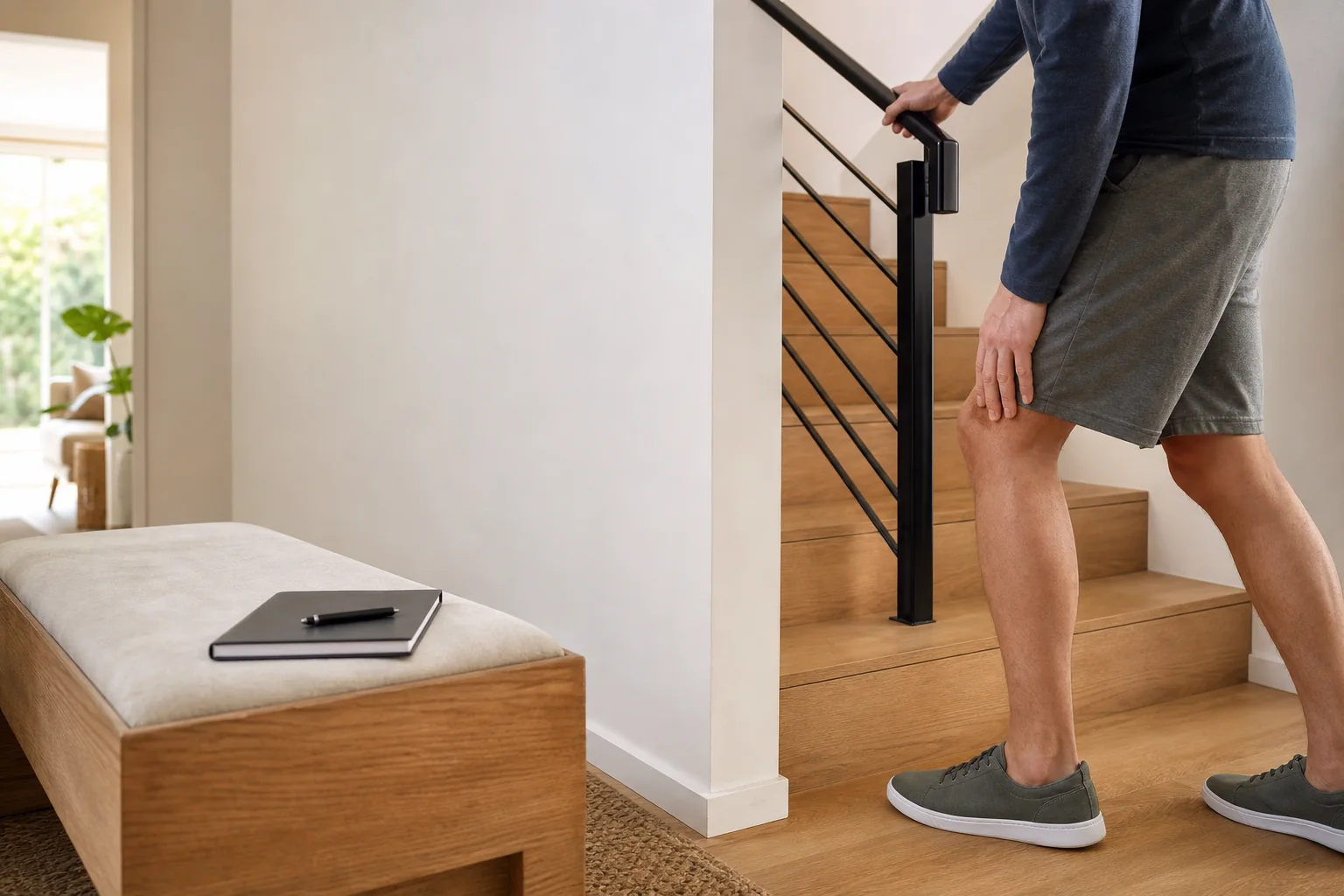
Anonymous adult using a stair handrail while protecting one knee beside a closed notebook in a bright home
A useful knee function record separates the specific task, dated observation, assistance, duration, and source without turning a log into a diagnosis.

Quick answer

After a knee injury, document specific tasks instead of writing only “knee pain.” Separate stairs, kneeling, squatting, walking, driving, and work duties; record each dated attempt, assistance, duration, and source; preserve the medical and work records; and use a focused amendment request for material chart errors without turning observations into diagnoses or legal conclusions.

Key takeaways

  • Separate knee tasks instead of writing only “knee pain”: stairs, kneeling, squatting, standing up, walking, driving, and work duties can change in different ways.
  • Record one dated attempt at a time with location, repetitions or duration, handrail or assistance, symptoms noticed, what changed, and the source for each fact.
  • Keep personal observations separate from diagnoses, imaging findings, provider restrictions, employer records, and legal conclusions.
  • Request the actual records and preserve every version; if a chart is inaccurate, use a focused amendment request instead of silently editing your own copy.
Hurt Advice Editorial Team

Prepared by

Hurt Advice Editorial Team

Editorial Research and Publishing Team

Source-checked editorial publishing

Why trust this article

Prepared by the Hurt Advice Editorial Team from current MedlinePlus materials, California patient-record and limitations statutes, federal health-record access and amendment rules, and the Judicial Council of California 2026 CACI resource center. No attorney reviewed this displayed version.

Recent update: Original publication with a six-task knee function log, baseline method, record-source map, medical-record request workflow, chart-correction script, and timing checklist.

At a glance

What this guide helps you decide

Start with the question that brought you here, identify the records that can verify the facts, and use the related guidance only where it helps. This article addresses personal injury questions in California.

Main question

Decide how this topic may apply to your situation

Use "Knee Injury Stairs and Kneeling Records: A California Guide" to sort the facts you know, the questions still open, and whether a personal injury resource or consultation may be useful in California.

Guide map

Start with the sections most relevant to you: Quick takeaways, Who this guide is for—and what it is designed to do, Start with the knee record, not an assumed diagnosis

Move through the article by issue, not by guesswork, so liability, medical proof, insurance pressure, deadlines, and next steps stay connected.

Records to gather

Connect these subjects to your records: Knee Injury, Stairs, Kneeling, Squatting

Compare the topic with records, photos, medical visits, police reports, insurer letters, and local claim details before relying on a general answer.

Trust check

Use the source trail before acting

This page includes 7 source references plus internal next-step paths so readers can verify where the guidance comes from.

Before you rely on this guide

This article is written for people dealing with injury-law questions in California. It is meant to help you understand the issue, not replace legal advice about your specific case.

What to do after this article

Start with the quick answer, skim the table of contents, and then use the links below to move into the practice area, author archive, or resource page that turns general guidance into a clearer next step for your situation.

Quick takeaways

  • Separate knee tasks instead of writing only “knee pain”: stairs, kneeling, squatting, standing up, walking, driving, and work duties can change in different ways.
  • Record one dated attempt at a time with location, repetitions or duration, handrail or assistance, symptoms noticed, what changed, and the source for each fact.
  • Keep personal observations separate from diagnoses, imaging findings, provider restrictions, employer records, and legal conclusions.
  • Request the actual records and preserve every version; if a chart is inaccurate, use a focused amendment request instead of silently editing your own copy.
  • A function log organizes evidence. It does not diagnose the knee, establish causation or fault, measure disability, or predict a settlement.

Who this guide is for—and what it is designed to do

This guide is for a person organizing functional evidence after a knee injury connected to a California accident or injury matter. It may also help a family member or representative keep records orderly. The reader task is narrow: document how the knee functions during specific activities and connect those observations to the correct medical, work, and daily-life sources.

The existing knee-injury educational calculator, ACL tear calculator, and meniscus tear calculator discuss broad claim factors. This article does not estimate claim value. The personal-injury hub explains the wider service area.

A log cannot decide diagnosis, medical necessity, causation, fault, impairment, work capacity, damages, insurance coverage, or case value. Those questions depend on the full record and qualified medical, employment, vocational, insurance, and legal analysis. Use the method below to preserve facts accurately, not to choose a conclusion first and build a story around it.

Start with the knee record, not an assumed diagnosis

MedlinePlus explains that the knee joint includes bone, cartilage, ligaments, fluid, muscles, and tendons, and that knee problems can cause pain and difficulty walking or interfere with activities such as getting up from a chair. That variety is why “knee injury” should remain an organizing label until a qualified professional documents something more specific.

Copy diagnoses, side, body part, imaging findings, procedures, restrictions, and treatment plans exactly from the source that states them. Do not convert clicking into a meniscus diagnosis, instability into an ACL diagnosis, swelling into proof of structural damage, or difficulty on stairs into a permanent limitation. If two records use different terms, preserve both with the author and date and ask the treating office for clarification.

Documentation should never delay care. Follow individualized instructions from the treating team, and seek prompt professional or emergency guidance for a new or worsening problem when appropriate. A recordkeeping article cannot triage symptoms or replace an examination.

Build a before-and-after activity baseline

Begin with an honest baseline. For each important activity, record what was ordinary before the event, the source for that information, and the first documented change afterward. Useful baseline sources may include work schedules, exercise or training records, home layout, transportation routines, earlier medical records, photographs, calendar entries, or a family member’s firsthand knowledge.

Do not write “I had a perfect knee” when the history includes earlier symptoms, treatment, arthritis, surgery, sports injuries, or work limitations. Instead separate the facts: “occasional soreness after long hikes, no prior treatment in the two years before the incident,” or “prior right-knee arthroscopy; returned to full shifts before this event.” Accuracy about prior history can help a qualified reviewer distinguish an earlier condition, a new event, and a claimed aggravation. It does not itself prove which explanation is correct.

Use the same unit before and after when possible. Compare flights of stairs, minutes standing, blocks walked, time driving, number of kneeling transitions, or the precise job task. Avoid unsupported percentages such as “80 percent worse” unless you define how the figure was calculated.

Use the six-task knee function log

Create one entry only when an activity is attempted or meaningfully changes. Do not fill a page from memory at the end of the month. For each entry, label the source as personal observation, provider record, employer record, photograph or video, device data, receipt, message, or another identifiable record.

  1. Stairs: direction, number of steps or flights, handrail, leading leg, step-over-step or one-step pattern, pause, assistance, and what happened immediately afterward.
  2. Kneeling: surface, affected knee, support or pad, time to lower, duration, help needed to rise, and whether the task was completed, changed, or stopped.
  3. Squatting and rising: depth only as personally observed, support used, repetitions, balance, pace, and the object or task involved.
  4. Walking and standing: route or location, minutes or distance, surface, footwear, rest, support, pace change, and recovery time.
  5. Driving and transfers: vehicle, seat position, entering or leaving, pedals, trip duration, stops, and whether another driver was used. Do not drive contrary to medical advice or when it is unsafe.
  6. Work and household tasks: the real duty, not just the title—floor level, lifting, carrying, ladder or stair use, kneeling, standing, pace, schedule, equipment, help, and the source for any restriction.

Use neutral language. “At step 7, used both hands on the rail and paused for 40 seconds” is more useful than “the stairs proved my case.” Record a symptom only as a personal report unless a clinical source documents it. Do not stage a difficult task for a photograph, repeat a movement solely to produce evidence, or push beyond medical guidance.

A practical entry you can copy

Keep the entry compact enough to maintain consistently. This example separates observation from source and avoids a diagnosis:

“July 20, 7:35 a.m., home staircase, 12 steps upward. Used right handrail and led with left leg one step at a time. Paused after step 8. Personally noticed right-knee pressure and stiffness; did not measure swelling. Reached landing in 1 minute 18 seconds. Sat for 6 minutes before dressing. Source: same-day personal observation and phone timer. No photograph. Provider has not evaluated this entry.”

A work version can read: “Scheduled stock check, aisle 4, lower shelves. Knelt once on foam pad for 22 seconds, used shelf to rise, then asked supervisor for standing assignment. Supervisor message at 10:14 confirms reassignment. Timecard shows full shift.” Preserve the message and timecard rather than paraphrasing them into the log.

Do not add a pain number you did not record at the time, copy yesterday’s entry into today, or make every day look identical. “Not observed,” “not attempted,” and “unknown” are valid entries.

Connect each observation to the right record holder

Build a source map instead of one oversized folder. Medical sources may include final visit notes, imaging reports and available images, orthopedic records, procedure reports, therapy evaluations and progress notes, home instructions, work-status forms, portal messages, and billing records. The medical-care resource can help organize provider locations.

Work and income sources may include job descriptions, schedules, timecards, pay stubs, payroll summaries, written duty offers, leave records, supervisor messages, accommodation records, mileage, and reimbursement documents. Daily-life sources may include receipts for paid help, calendars, transportation records, contemporaneous messages, and lawfully created photographs. Keep original files with creation dates when available and store a separate working copy.

The Judicial Council’s 2026 CACI resource center includes official instructions addressing categories such as medical expenses, lost earnings, and physical pain and mental suffering. A knee log may help organize source facts relevant to a claimed loss, but it does not establish liability, causation, reasonable necessity, reasonable certainty, recoverability, or an amount. The damages evidence guide explains why different claimed losses need different records.

Request medical records with a gap list

California Health and Safety Code §123110 generally gives covered patients or personal representatives rights to inspect records and obtain copies, subject to the statute’s scope, exceptions, identity verification, fees, and procedures. The current text generally requires inspection within five working days after receipt and transmission of requested copies within 15 days. It also addresses electronic format and certain X-ray handling.

45 C.F.R. §164.524 separately provides a federal right of access to protected health information in a designated record set, with exceptions. It generally requires a covered entity to act on an access request within 30 days and permits one extension of no more than 30 days if the rule’s written-notice conditions are met. The state and federal rules have different wording and scope, so do not combine their timelines into one promise.

Identify provider, facility, knee side, date range, and record types. Ask for final signed notes rather than relying only on after-visit summaries. Keep the request, identity verification, delivery proof, invoice, response, original export, and a dated gap list. A missing report is not proof that an event did or did not occur; it is a follow-up item.

Use a focused chart-correction request

A personal log should never overwrite the medical record. If a chart lists the wrong knee, wrong accident date, wrong medication, or another material factual error, identify the exact note, date, statement, requested amendment, and supporting source.

The HHS Office for Civil Rights medical-records guide says that a person who believes medical or billing information is incorrect can request a change or amendment. The provider or plan must respond; if it does not agree, the individual may submit a statement of disagreement to be added to the record. The HHS guide cites 45 C.F.R. §164.526.

“I request amendment of the July 18 orthopedic note. The history says ‘left knee,’ but the visit, imaging order, and attached radiology report concern the right knee. Please amend the side to ‘right knee’ or link this request and your response to the record. Attached: the July 18 imaging order and report.”

Do not demand removal of an accurate clinical opinion merely because you disagree with it, ask a provider to backdate language, or conceal prior history. If the provider denies the request, preserve the denial and consider the rule’s disagreement process or case-specific advice.

Timing: preserve evidence without guessing the deadline

Start the log and source requests promptly because memories fade, messages disappear, video may be overwritten, and providers or employers may use different retention systems. Send a specific preservation request only when appropriate and keep delivery proof. Do not represent that a request automatically creates a legal duty or prevents routine deletion in every situation.

California Code of Civil Procedure §335.1 states a two-year period for an action for injury to or death of an individual caused by another’s wrongful act or neglect. That general rule is not a universal deadline calculation. Accrual, tolling, defendants, contracts, federal law, and other statutes can change the analysis.

If a public entity or employee may be involved, a much shorter claims process can matter. Government Code §911.2 generally requires a claim relating to injury to person or property to be presented within six months after accrual. A government claim is not the lawsuit itself, and additional rules govern presentation, response, late claims, and filing suit. The California deadline guide provides orientation, but a licensed California attorney should calculate the deadline for the actual facts.

Common mistakes and safety red flags

  • One vague sentence: “My knee hurts all the time” does not identify task, date, duration, assistance, or source.
  • Diagnosis by observation: a sound, sensation, or difficult movement is not a substitute for clinical evaluation.
  • Recreating history: do not label a later reconstruction as a same-day log.
  • Editing originals: keep original records and files; annotate a separate working copy.
  • Ignoring prior history: disclose and source earlier symptoms, treatment, or restrictions accurately.
  • Staging evidence: do not repeat stairs, kneeling, squats, or work tasks to make a dramatic photo or video.
  • Unsafe surveillance: do not record private conversations or restricted workplaces without understanding the applicable law and policy.
  • Missing the legal clock: record requests and negotiations do not necessarily pause a deadline.

Stop the documentation exercise if it conflicts with care, medical restrictions, or basic safety. New or worsening symptoms require appropriate professional guidance, not more entries. Call emergency services for an emergency.

A seven-step next-action checklist

  1. Write the exact event date, knee side, providers, and known record holders.
  2. Create the six-task baseline for stairs, kneeling, squatting, walking or standing, driving, and work or household activity.
  3. Start one dated observation per meaningful attempt; use “unknown” rather than guessing.
  4. Request final medical records and maintain a gap list by provider and date range.
  5. Preserve schedules, pay records, messages, receipts, and original digital files in separate source folders.
  6. Send a focused amendment request for any material chart error and preserve the response.
  7. Have a qualified professional review conflicts and deadlines before a short period expires.

Hurt Advice is a lawyer-referral and legal-information service, not a law firm. This article provides general educational information, not medical or legal advice. No attorney reviewed this displayed version. For case-specific questions, a licensed California attorney can review the facts, defendants, records, and deadlines.

Frequently Asked Questions

What should I record about stairs after a knee injury?
Record direction, number of steps or flights, handrail use, leading leg, step pattern, pauses, assistance, time, what changed, and what happened afterward. Label the entry as personal observation unless a provider or other record states the fact. Do not repeat stairs merely to create evidence.
How should I document kneeling or squatting limits?
Identify the surface, affected knee, support or pad, time to lower, duration, depth only as personally observed, repetitions, help used to rise, task purpose, and whether the activity was completed, changed, or stopped. A log does not diagnose why the movement is difficult.
Can a knee function log prove my diagnosis or settlement value?
No. A log organizes dated observations and sources. It cannot establish diagnosis, medical necessity, causation, fault, impairment, disability, damages, insurance coverage, or settlement value. Those issues require the complete record and appropriate qualified professionals.
How quickly can I get California medical records?
California Health and Safety Code section 123110 generally requires covered providers to permit inspection within five working days and transmit requested copies within 15 days, subject to the statute’s scope, exceptions, verification, fees, format, and X-ray rules. Federal access rules use different wording and timing.
What can I do if a medical note lists the wrong knee or date?
Identify the exact note, error, requested amendment, reason, and supporting source. Under 45 C.F.R. section 164.526, an individual may request amendment; the covered entity may accept or deny under the rule, and a denial can trigger statement-of-disagreement rights. Preserve every request and response.
What is the California deadline for a knee injury claim?
Code of Civil Procedure section 335.1 states a general two-year period for injury caused by another’s wrongful act or neglect, while Government Code section 911.2 generally requires certain public-entity injury claims within six months after accrual. Exceptions and other rules can change the result, so obtain a fact-specific calculation promptly.

Sources and references

U.S. National Library of MedicineKnee Injuries and Disorders

Explains knee structures, varied knee problems, and functional effects such as difficulty walking or rising.

U.S. Department of Health and Human ServicesYour Medical Records — Corrections

Current OCR consumer guidance on requesting amendment and submitting a statement of disagreement under 45 C.F.R. §164.526.

States the general six-month claim-presentation period for injury to person or property claims involving public entities.

Need help after an accident?

Hurt Advice intake team can review your situation, explain your options, and help you move forward with a plan that fits your case.