
Legal ExplainerCar AccidentsChecklist / Process

California Crash 911 and Dispatch Records: What to Request

After a California crash, identify each emergency-communications custodian and request existing records by source family. Keep call audio, CAD data, dispatch notes, unit timestamps, radio traffic, police, fire, and EMS records distinct; preserve originals and responses; and compare clocks without turning missing or different timestamps into unsupported conclusions.

Published

July 26, 2026

Updated

July 26, 2026

Reading time

12 min read

Jurisdiction

California

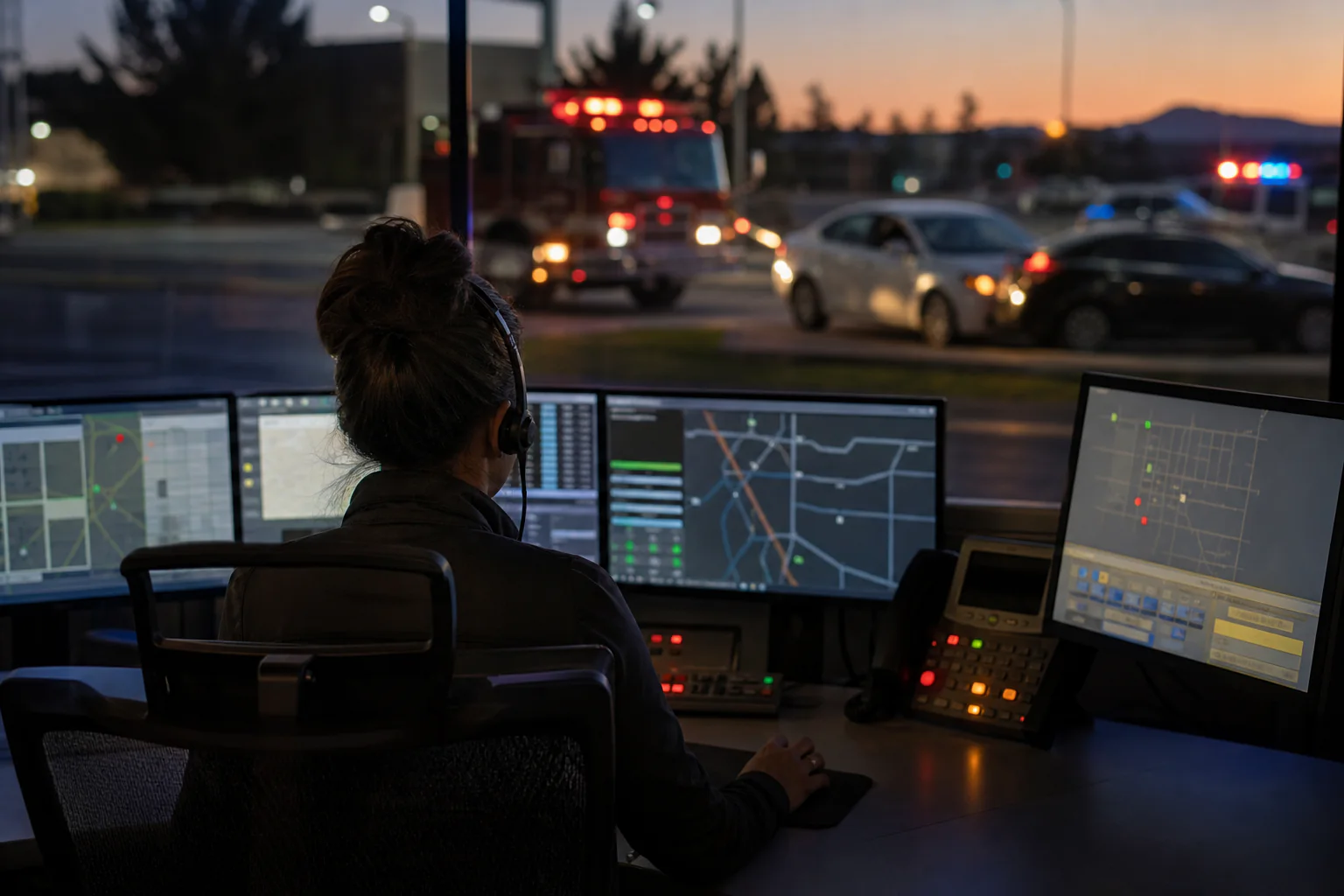
Public-safety dispatcher at an emergency communications console with a non-graphic roadside crash response visible at dusk
A reliable emergency-response chronology keeps each 911, CAD, radio, police, fire, and EMS source tied to its actual custodian, identifier, clock, and production status.

Quick answer

After a California crash, identify the primary 911 center, any transfer agency, dispatch center, police or CHP, fire department, and EMS provider. Request existing call audio, CAD event data, dispatch notes, unit-status times, radio traffic, and linked identifiers. Preserve original files and agency responses, then compare source clocks without treating a gap or timestamp difference as proof of fault.

Key takeaways

  • Identify the actual custodians before requesting anything: the primary 911 answering point, any transfer agency, the dispatch center, responding police or CHP agency, fire department, and EMS provider may hold different records.
  • Ask for record families, not conclusions: existing 911 audio, CAD event data, dispatch notes, unit-status timestamps, radio traffic, incident identifiers, and the agency response explaining what was produced, withheld, redirected, or unavailable.
  • Normalize every time to a stated time zone and keep source clocks separate. A difference among caller, CAD, radio, police, fire, ambulance, and hospital times is a question to investigate—not proof of fault.
  • There is no single statewide retention or disclosure promise for every crash record. Request promptly, preserve original files and transmittals, and track public-record access separately from litigation discovery.
Hurt Advice Editorial Team

Prepared by

Hurt Advice Editorial Team

Editorial Research and Publishing Team

Source-checked editorial publishing

Why trust this article

Prepared by the Hurt Advice Editorial Team from current official California public-records and evidence statutes and California Courts guidance. No attorney reviewed this displayed version.

Recent update: Original publication with a multi-agency custodian map, 911/CAD/radio record packet, accurate public-record and law-enforcement limits, source-status ledger, clock-normalization tool, neutral request script, discovery distinction, evidence checklist, mistakes, FAQs, and next steps.

At a glance

What this guide helps you decide

Start with the question that brought you here, identify the records that can verify the facts, and use the related guidance only where it helps. This article addresses car accidents questions in California.

Main question

Decide how this topic may apply to your situation

Use "California Crash 911 and Dispatch Records: What to Request" to sort the facts you know, the questions still open, and whether a car accidents resource or consultation may be useful in California.

Guide map

Start with the sections most relevant to you: Quick takeaways, Who this guide is for—and what it does, Start with a multi-agency custodian map

Move through the article by issue, not by guesswork, so liability, medical proof, insurance pressure, deadlines, and next steps stay connected.

Records to gather

Connect these subjects to your records: California 911 Records, CAD Event History, Dispatch Notes, Unit-Status Timestamps

Compare the topic with records, photos, medical visits, police reports, insurer letters, and local claim details before relying on a general answer.

Trust check

Use the source trail before acting

This page includes 5 source references plus internal next-step paths so readers can verify where the guidance comes from.

Before you rely on this guide

This article is written for people dealing with injury-law questions in California. It is meant to help you understand the issue, not replace legal advice about your specific case.

What to do after this article

Start with the quick answer, skim the table of contents, and then use the links below to move into the practice area, author archive, or resource page that turns general guidance into a clearer next step for your situation.

Quick takeaways

  • Identify the actual custodians before requesting anything: the primary 911 answering point, any transfer agency, the dispatch center, responding police or CHP agency, fire department, and EMS provider may hold different records.
  • Ask for record families, not conclusions: existing 911 audio, CAD event data, dispatch notes, unit-status timestamps, radio traffic, incident identifiers, and the agency response explaining what was produced, withheld, redirected, or unavailable.
  • Normalize every time to a stated time zone and keep source clocks separate. A difference among caller, CAD, radio, police, fire, ambulance, and hospital times is a question to investigate—not proof of fault.
  • There is no single statewide retention or disclosure promise for every crash record. Request promptly, preserve original files and transmittals, and track public-record access separately from litigation discovery.

Who this guide is for—and what it does

This guide is for a person injured in a California traffic crash, or a caregiver, who needs a reliable emergency-response chronology after immediate safety and medical needs have been addressed. If the event just happened, begin with the California car-accident checklist. The narrower task here is to identify, request, preserve, and compare records created when someone called 911 and public-safety agencies coordinated the response.

A 911 call, computer-aided dispatch event, radio transmission, police report, fire incident report, ambulance patient record, and hospital chart are not interchangeable. They may use different event numbers, clocks, terminology, access rules, and custodians. This article supplies a custodian map, a focused record list, a neutral request script, a source-status ledger, and a clock-normalization tool. It does not determine negligence, causation, damages, response adequacy, or whether any particular record must be disclosed.

The California car-accident hub covers the broader claim context. The injury-claim proof guide explains why one document rarely proves every disputed element. Here, the reader task is simpler and more disciplined: build a source-controlled sequence without filling gaps with assumptions.

Start with a multi-agency custodian map

Write the date, approximate call time, location, direction of travel, nearest cross streets or landmarks, callback number used, and any incident or report number already known. Then list the agencies in the order the response may have moved. Do not assume the city whose name appears in the mailing address answered the call.

  • Primary public-safety answering point: the center that first received the 911 call. It may hold the original audio, caller-number or location fields maintained by its system, initial event data, and transfer information.
  • Secondary answering point or transferred agency: a police, fire, medical, highway, campus, transit, or neighboring jurisdiction center that received the transferred call or event.
  • Dispatch center: the center that assigned police, fire, EMS, or other units. One center may dispatch several agencies, or separate centers may maintain separate CAD events.
  • Responding law-enforcement agency: local police, sheriff, California Highway Patrol, campus police, or another agency that created an incident or traffic-collision report and related logs.
  • Fire department: the agency that may hold its own incident number, dispatch timestamps, unit-status history, narrative, photographs, and operational records.
  • EMS provider: a public or private ambulance provider that may hold dispatch and transport records plus protected patient information. Access to a person’s medical record is a different lane from a general public-record request.

If a caller was transferred, ask the first center to identify the receiving agency and any transfer timestamp or identifier it maintains. If a unit came from a neighboring city or contracted provider, record both the dispatching entity and the responding entity. A custodian can redirect a request without proving it never possessed another part of the event.

The 911 and dispatch record packet

Use the smallest practical event window and request existing records by name. Depending on the agency and event, the packet may include:

  • 911 audio and associated event data: the original call recording, call start and end times, transfer information, event number, and fields the agency says are maintained with the call.
  • CAD event history: incident creation time, initial and updated call type, location entries, narrative updates, agency or unit recommendations, dispatch time, en-route time, arrival time, clearing time, disposition, and corrections or supplements that are part of the event history.
  • Dispatch notes or incident chronology: an export showing the sequence of entries and the source or operator identifiers the agency can lawfully provide.
  • Radio traffic: existing audio or logs for the relevant talkgroup and time window, plus any agency-provided channel, time-zone, or clock explanation.
  • Unit-status and response records: the identifiers and status timestamps for responding police, fire, EMS, tow, traffic-control, or supervisor units, without asking the agency to create a new analysis.
  • Linked identifiers: 911 call number, CAD event number, police incident or collision-report number, fire incident number, ambulance run number, and any transfer or mutual-aid number.
  • Record-status response: the agency’s written acknowledgment, production, redaction explanation, withholding basis, redirect, estimate, or statement that a requested item is not held or cannot be located.

Ask for native or ordinary export formats the agency already uses, not a new custom report. A transcript can help with review, but it is not a substitute for the original audio. The digital-evidence preservation guide explains how to keep original downloads, metadata, and transmittal records separate from working copies.

Use California public-record procedures accurately

California Government Code sections 7922.525 through 7922.545 contain several useful request rules. Section 7922.525 says public records are open to inspection during agency office hours except as otherwise provided, and reasonably segregable portions should be available after exempt portions are removed. Section 7922.530 addresses a request that reasonably describes identifiable records and, subject to exemptions and applicable fees, calls for prompt availability and an exact copy unless impracticable.

Section 7922.535 generally gives an agency 10 days after receiving a copy request to determine whether it seeks disclosable public records in the agency’s possession and to notify the requester. In stated unusual circumstances, written notice may extend the determination period by no more than 14 days. These are determination rules, not a promise that every 911, CAD, radio, or investigative record will be produced within 10 days.

Section 7922.540 says a written response denying a written request in whole or part must identify the names and titles or positions of those responsible and justify withholding under the referenced statute. Preserve the exact response. Do not rewrite “withheld,” “redacted,” “not held,” “not located,” and “redirected” as though they mean the same thing.

Expect law-enforcement limits and privacy redactions

Government Code section 7923.600 states that the California Public Records Act does not require disclosure of specified complaints, investigations, intelligence information, security procedures, or investigatory and security files maintained or compiled by listed agencies, subject to other statutes and exceptions. That text is a warning against assuming that every crash-related dispatch record is automatically public. It is not a basis for a requester to declare every 911 or CAD item categorically exempt.

An agency may redact private, medical, witness, juvenile, security, or other protected information, invoke an applicable exemption, or identify another lawful access process. A private ambulance provider may not be subject to the same public-record route as a city dispatch center. A patient or authorized representative may have a separate medical-record process. Keep those lanes distinct and avoid putting Social Security numbers, full medical histories, account credentials, or unrelated third-party details into a broad request.

If an agency cites a statute or policy, record the exact citation, date, decision-maker, and scope. Ask whether a reasonably segregable portion, event chronology without protected fields, or another existing nonexempt record can be produced. Do not pressure an employee to bypass the agency’s official channel.

Build a source-status ledger

Create one responsive entry for each record family instead of a wide table. Use these eight fields:

  1. Agency and custodian: exact center, department, provider, records unit, and contact channel.
  2. Identifier: call, CAD, incident, collision, fire, ambulance, or transfer number; label unknown values as unknown.
  3. Record and window: the existing item requested and the precise date, time range, and time zone.
  4. Purpose: the factual question it may help answer, without stating the answer.
  5. Status: not requested, requested, acknowledged, redirected, partly produced, produced, redacted, withheld, unavailable, or disputed.
  6. Dates: request, acknowledgment, determination, estimate, production, follow-up, and appeal or other process if one exists.
  7. Integrity details: filename, format, byte size, sender, delivery method, stated clock, time zone, and storage location.
  8. Gap or conflict: what remains missing, corrected, inconsistent, or unexplained.

Example: “City communications center; CAD event number unknown; requested existing 911 audio, CAD event history, transfer time, and police dispatch timestamps for 7:05–7:35 p.m. Pacific on July 18; purpose: identify the source sequence; acknowledged July 19; center redirected fire-radio audio to county fire; CAD PDF produced July 23; original call audio pending; agency states the CAD export displays server time; transfer event number still unknown.”

Normalize the clocks without forcing agreement

Create one row per source event: source, event label, displayed timestamp, stated time zone, clock or server note, original identifier, and confidence note. Useful events may include call connection, transfer, CAD creation, dispatch, unit acknowledgment, en route, arrival, patient contact, transport departure, hospital arrival, police-report creation, and later correction.

Never silently convert a time. Keep the displayed value and add a normalized comparison value only when the time zone or offset is supportable. Note daylight-saving status, a caller’s approximate recollection, a device clock, and an agency server timestamp separately. “7:12 p.m.” in a witness message is not automatically the same kind of evidence as “19:12:04” in a CAD export.

Compare sources neutrally: “CAD shows police dispatch at 19:13:22; the fire event shows unit dispatch at 19:14:01; the 911 audio begins at 19:10:47 according to the agency player; the player’s time zone is not stated; the caller recalls dialing at about 7:10.” This identifies the next question. It does not prove delay, fault, reasonableness, or medical causation.

For an ambulance-related crash or response question, the ambulance-crash evidence guide covers vehicle, operator, and agency sources. The ground-ambulance billing guide addresses billing and coverage reconciliation, which should remain separate from the dispatch chronology.

A neutral 911 and dispatch records request script

Adapt this script to the agency’s current portal, form, email, or mailing instructions:

“I request copies of existing records for the traffic incident at [location] on [date], using Pacific time unless the record states another zone. The event window is [start] through [end]. Known identifiers are [list, or ‘unknown’]. Please search for: (1) existing 911 call audio and associated event or transfer data; (2) the CAD event history and dispatch narrative; (3) responding-unit status timestamps; (4) relevant dispatch radio audio or logs; and (5) linked incident, collision, fire, ambulance, transfer, or mutual-aid identifiers. Please provide existing electronic records in their ordinary export format when available. If another agency holds an item, please identify that custodian if known. For any partial denial, redaction, withholding, or unavailable item, please preserve the written determination and applicable basis. This request does not ask the agency to create an opinion, transcript, reconstruction, or new report.”

Attach only what helps locate the event. Do not include medical records or sensitive identity documents unless the verified process specifically requires them. Save the exact request, attachments, receipt, confirmation number, and every response.

Public-record access is not litigation discovery

A voluntary request or public-record request is not the same as a subpoena. The California Courts’ current business-record subpoena guide explains that, in a pending case, a subpoena can order a nonparty witness to produce business records and describes a formal process involving court-issued forms, service, production, and potential consumer or employee notice. It also cautions that the process can be complicated.

Do not use a blank subpoena, a preservation letter, or a public-record request as though it were a court order. Do not assume a subpoena is available before a case exists or that it overrides privacy, objection, notice, or scope rules. A lawyer can determine whether public-record procedures, authorization, discovery, subpoena, court order, or another route fits the specific custodian and dispute.

Request and litigation clocks are also separate. Check the California deadline resource and qualified advice promptly; waiting for a 911 or dispatch response does not pause every insurance, government-claim, filing, evidence, or lawsuit deadline.

Preserve audio and exports as evidence sources

California Evidence Code section 250 defines “writing” broadly to include sounds, pictures, symbols, and other recorded communications regardless of storage method. Section 1401 states that authentication is required before a writing, or secondary evidence of its content, may be received in evidence. Those statutes do not guarantee admissibility or disclosure. They explain why the source, original file, and production chain matter.

Keep the downloaded audio or export unchanged. Record its filename, size, received date, sender, portal or email, event number, stated time zone, and any cover letter. Store a working copy for listening, annotation, transcription, or conversion. If you create a transcript, label who prepared it, the file version used, inaudible segments, and any corrections; do not present it as an agency-certified transcript unless the agency actually certified it.

A screen recording of a portal player, a phone recording of a speaker, or a screenshot of CAD entries is a derivative. Preserve it honestly, but ask whether the ordinary native export and transmittal information remain available. The content may be useful even when incomplete; the label should never overstate the source.

Evidence checklist

  • Event date, exact location, smallest useful time window, callback number used, and known identifiers.
  • A custodian map for the primary answering point, transferred center, dispatch center, police or CHP, fire, and EMS provider.
  • The exact request, attachments, receipt, acknowledgment, determination, redirect, production, redaction, withholding, and follow-up.
  • Original 911 audio, CAD exports, radio files, event histories, and transmittals stored unchanged.
  • A source-status ledger distinguishing every record family and decision state.
  • A clock-normalization sheet retaining displayed times, stated zones, offsets, identifiers, and uncertainty.
  • Police, fire, ambulance, hospital, witness, phone, photograph, and vehicle sources kept in separate lanes until comparison.
  • A minimum-necessary sharing copy with unrelated personal, medical, and security information removed when appropriate.

If the crash involved a fleeing driver, use the hit-and-run record guide to keep the criminal, restitution, compensation, insurance, and civil lanes distinct from this emergency-communications file.

Common mistakes and red flags

  • Sending one request to the police department: the first answering point, dispatch center, fire department, and EMS provider may be separate custodians.
  • Requesting “all records”: name the event, time window, identifiers, and record families.
  • Calling 10 days a production deadline: section 7922.535 addresses the agency’s determination and notice, with stated extensions, not universal production within 10 days.
  • Calling a gap proof of delay: preserve the gap and seek the source or clock explanation without supplying a conclusion.
  • Combining clocks silently: retain displayed values, time zones, offsets, and source types.
  • Editing the only audio file: preserve the original and work from a copy.
  • Treating a transcript as the recording: keep both and label the transcript’s author, version, and limits.
  • Using a request as a subpoena: voluntary access, public records, medical authorization, and litigation discovery are different processes.
  • Waiting on records before checking deadlines: identify applicable clocks independently and promptly.

Next steps

  1. List every known event number, agency, location detail, and time reference.
  2. Confirm the primary answering point and every transfer, dispatch, police, fire, and EMS custodian.
  3. Send a narrow request through each custodian’s official channel.
  4. Preserve each response and original file; update the source-status ledger.
  5. Normalize clocks only with a supported time-zone or offset note.
  6. Keep public-record access, medical records, insurance, and litigation discovery in separate lanes.
  7. Ask a qualified California lawyer to assess disputed access, preservation, deadlines, subpoenas, or legal significance when needed.

Hurt Advice is a lawyer-referral and legal-information service, not a law firm. This article provides general educational information, not legal or medical advice, and does not decide what an agency must disclose or whether any person or entity is liable. No attorney reviewed this displayed version. You may use the Hurt Advice contact page to request a referral.

Frequently Asked Questions

Can I request a California 911 call recording after a crash?
You can ask the agency that received the call for existing audio and associated event information. Whether it holds and discloses the requested material depends on the record, custodian, exemptions, privacy rules, investigation status, and other law. Identify the exact date, location, time window, callback number, and known event number.
What is a CAD record after a traffic crash?
A computer-aided dispatch record may contain an event number, call type, location, narrative updates, dispatch actions, unit identifiers, status timestamps, transfers, and disposition fields. Systems and exports differ. Ask for the existing event history and the agency’s time-zone or clock explanation rather than assuming every field exists.
Does California require 911 or dispatch records to be produced within 10 days?
No universal 10-day production promise applies. Government Code section 7922.535 generally gives an agency 10 days to determine whether a copy request seeks disclosable public records in its possession and notify the requester. It allows a written extension in stated unusual circumstances. Production timing and disclosure limits are separate questions.
Who should receive a request for crash dispatch records?
Possible custodians include the primary 911 answering point, a transferred or secondary center, the dispatch center, responding police or CHP agency, fire department, and public or private EMS provider. Map each record family to its likely custodian and ask for a redirect when the recipient identifies another holder.
Do different dispatch timestamps prove an emergency-response delay?
No. A difference may reflect separate event creation, transfer, dispatch, acknowledgment, en-route, arrival, patient-contact, or server clocks. Preserve each displayed value, source, identifier, time zone, and clock note. A qualified reviewer can assess significance after the source differences are understood.
Is a transcript of a 911 call the same as the audio?
No. Preserve the original audio or ordinary agency export when available. A transcript is a derivative that may help review, but it can omit tone, pauses, overlapping speech, or inaudible content. Label who prepared it, which file version was used, and whether the agency certified it.

Sources and references

Official text addressing specified law-enforcement complaints, investigations, intelligence, security procedures, and investigatory files.

Official definition of a writing, including recorded sounds, pictures, symbols, and stored communications.

Need help after an accident?

Hurt Advice intake team can review your situation, explain your options, and help you move forward with a plan that fits your case.