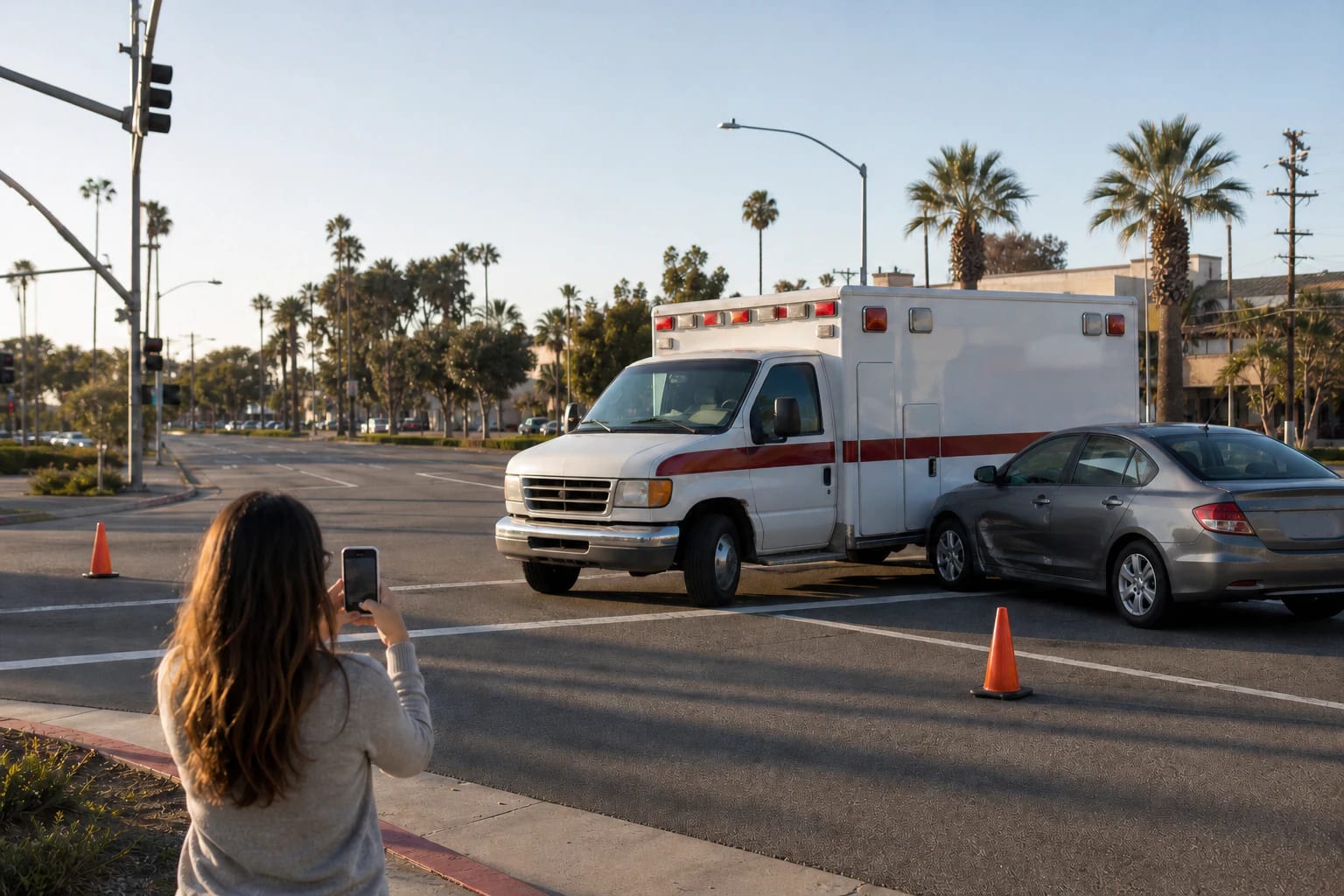
After a California ambulance crash, preserve two connected files: the road-collision evidence and the emergency-medical-service record trail. Identify the ambulance owner, operator, employer, dispatching agency, unit number, response status, and receiving facility. Public and private ambulances can follow different claim procedures, while lights and sirens do not answer every fault question.
Quick answer
After a California ambulance crash, identify the ambulance owner, operator, employer, dispatcher, response status, and patient-record custodian. Preserve both collision evidence and EMS records. Public and private ambulances may follow different claim paths, and lights or sirens do not eliminate every safety question. A public-entity claim may require action much sooner than an ordinary lawsuit.

Prepared by
Hurt Advice Editorial TeamEditorial Research and Publishing Team
Source-checked editorial publishing
Why trust this article
Prepared by the Hurt Advice Editorial Team using cited sources and the published editorial standards. Attorney review is shown only when a named attorney reviewed this version.
Recent update: Original publication explaining ambulance-operator identity, emergency-driving evidence, EMS records, and California public-entity claim timing.
Table of contents
- 1. What is the short answer?
- 2. Who does this guide help, and why does ownership matter?
- 3. Use this operator-and-records decision tool
- 4. Do lights and sirens make the ambulance automatically right?
- 5. How do public-entity liability and employee immunity fit together?
- 6. What should you do during the first hour and first day?
- 7. Which records belong on the ambulance-crash evidence checklist?
- 8. How can a patient request ambulance medical records?
- 9. Use this focused preservation request script
- 10. What California government-claim timing may apply?
- 11. Which mistakes and red flags weaken an ambulance-crash file?
- 12. What are careful next steps?
What is the short answer?
- Photograph the intersection, vehicle positions, damage, lane controls, sight lines, warning lights, unit markings, and nearby cameras from a safe place.
- Ask who owned, operated, employed, dispatched, and regulated the ambulance; those may be different organizations.
- Preserve the ePCR or patient care report, dispatch timeline, audio, onboard video, telematics, maintenance, and personnel assignment where they exist.
- If a public entity may be involved, treat the Government Claims Act as an urgent separate track rather than relying on an ordinary lawsuit deadline.
Who does this guide help, and why does ownership matter?
This guide is for a patient riding inside an ambulance, a driver or passenger in another vehicle, a bicyclist, a pedestrian, or a family member organizing records after a serious ambulance collision. It also helps when the first report says only “ambulance” and does not identify the legal operator. It does not decide fault, immunity, coverage, or damages.
The word ambulance describes a vehicle function, not one legal organization. California Vehicle Code section 165 includes publicly owned and operated ambulances and privately owned or operated ambulances licensed by the California Highway Patrol to respond to emergency calls within the definition of an authorized emergency vehicle. Read the current section 165 text. A city fire department, county service, fire district, hospital system, private ambulance company, or contractor can therefore appear in the same factual story.
That identity affects where records may be kept, whose employee was driving, which insurance or risk office receives notice, and whether a government-claim presentation may be required. Start with identity before making a liability conclusion. The California injury-claim proof guide explains how to separate duty, breach, causation, and harm instead of treating one document as the whole case.
Use this operator-and-records decision tool
Make one row in your evidence log for every organization named on the ambulance, collision report, medical bill, dispatch record, or hospital transfer document. Then use these lanes to decide what to verify next:
- Public owner or operator: record the city, county, fire district, public hospital, joint-powers agency, or other public entity; obtain the risk-management claim instructions; and preserve the dispatching agency and employee assignment.
- Private owner or operator: record the exact company name, vehicle owner, employer, insurance information, CHP license or permit details that are publicly available, and any contract connecting the company to a public agency or hospital.
- Mixed public-private response: do not assume the contractor and public agency are interchangeable. Preserve the service contract, dispatch role, chain of command, vehicle ownership, and who controlled the trip.
- Identity still unknown: use the unit number, license plate, incident number, patient bill, 911 agency, receiving facility, and collision-report agency to trace the correct entities. Do not send one generic request and assume it reached everyone.
Do lights and sirens make the ambulance automatically right?
No. Vehicle Code section 21055 provides specified rules-of-the-road exemptions when an authorized emergency vehicle is responding to an emergency call, engaged in rescue operations, or in another listed emergency function, and when the driver uses a siren as reasonably necessary and displays a lighted red lamp visible from the front. The exact triggers and conditions are in section 21055. A return trip, nonemergency transfer, positioning move, or disputed warning-device history may require a different factual analysis.
Section 21056 separately says section 21055 does not remove the duty to drive with due regard for everyone using the highway and does not protect an arbitrary exercise of the privileges. See section 21056. The useful question is not simply “Were lights on?” It is what the ambulance was doing, whether the statutory conditions were met, what each road user could perceive, and how the driving related to the collision.
Preserve evidence that can test those facts: dispatch timestamps, call priority, CAD entries, siren or warning-light activation data if recorded, onboard video, traffic-signal phases, intersection cameras, witness originals, vehicle speed and braking information, and the driver’s route. Keep what you personally saw or heard separate from what another person later told you.
How do public-entity liability and employee immunity fit together?
California statutes contain more than one rule, so a slogan about “government immunity” is unsafe. Vehicle Code section 17001 states that a public entity is liable for death, personal injury, or property injury proximately caused by a negligent or wrongful act or omission in operating a motor vehicle by its employee acting within the scope of employment. Read section 17001. The statute does not itself prove negligence, causation, employment, or scope in a particular crash.
Vehicle Code section 17004 states that a public employee is not personally liable for civil damages arising from line-of-duty operation of an authorized emergency vehicle while responding to an emergency call or in other listed circumstances. Read section 17004. Because the provisions address different actors and conditions, preserve the employer, public entity, driver assignment, dispatch purpose, response status, and full collision sequence for case-specific analysis.
This guide does not predict how those statutes, Government Code immunities, contractual relationships, or case law apply to a specific public or private ambulance. The government-immunity glossary can help with vocabulary, while the public-transit claim guide offers a separate example of why operator identity matters.
What should you do during the first hour and first day?
Start with safety and medical needs. Do not enter traffic or interfere with emergency care to collect evidence. If you can act safely, use the California car-accident checklist and record the precise time, location, direction of travel, weather, visibility, traffic controls, and sequence of impacts. The California car-accident hub can orient you to the broader collision process without replacing the ambulance-specific record trail.
Photograph all visible sides of the vehicles, their final positions, damage, debris, tire or scrape marks, lane lines, signal heads, signs, curb geometry, obstructions, and camera locations. Capture the ambulance unit number and operator name without photographing patients or private medical information. Get witness contact details and ask for original files rather than edited social-media clips.
Ask for the collision-report number, the investigating agency, the ambulance incident or run number, the dispatching agency, the receiving facility, and the legal name of the ambulance operator. Preserve your clothing, damaged child restraints, bicycle gear, mobility devices, or other physical items in their post-crash condition. Follow the digital-evidence guide to retain originals, metadata, and two backups.
Which records belong on the ambulance-crash evidence checklist?
Not every system creates every record. Ask for preservation and identification without claiming that a particular file must exist or is immediately public. Keep a request log showing the custodian, date sent, delivery proof, response, and any follow-up.
- Collision file: agency report, diagrams, photographs, witness information, 911 calls, traffic-camera or nearby private video, measurements, citations, tow records, and supplemental reports.
- EMS response file: CAD and dispatch entries, call priority, timestamps, radio traffic, unit-status history, route, incident or run number, and the identities and roles of assigned personnel.
- Vehicle file: ownership, registration, CHP authorization where relevant, insurance or risk office, maintenance and inspection records, warning-device maintenance, telematics, onboard video, event data where available, and post-crash inspection.
- Patient-care file: electronic patient care report or PCR, assessments, interventions, medication record, transfer-of-care documentation, receiving-facility record, ambulance bill, and later treatment records.
- Organization file: employer, contractor and subcontractor identities, service agreement, dispatch/control provisions, applicable driving or emergency-response policies, training and qualification records, and incident review.
- Damages file: medical bills and records, symptoms and limitations, wage loss, repair or total-loss evidence, replacement services, travel costs, and a dated chronology. The accident evidence checklist provides a broader folder structure.
How can a patient request ambulance medical records?
If you were the patient, ask the ambulance provider’s medical-records or privacy office for the ePCR or patient care report, attachments, medication and vital-sign record, transport chronology, and transfer-of-care documentation in the designated record set. The federal HIPAA access rule generally gives an individual a right to inspect and obtain a copy of protected health information about that individual in a designated record set, subject to stated exceptions. The HHS audit protocol reproduces the section 164.524 access standard and procedures.
California’s Emergency Medical Services Authority describes statewide ambulance-patient-offload reporting that uses electronic patient care record documentation. The current EMSA APOT regulation text is useful proof that ePCR data can be part of the EMS record environment; it does not mean every APOT field is relevant to every crash or automatically available to every requester.
A patient-access request, a public-records request, a preservation notice, an insurance claim, and a Government Claims Act presentation are different tools. Sending one does not automatically perform the others or extend a deadline. If someone other than the patient requests records, authorization, personal-representative, minor, deceased-patient, privacy, and redaction rules may affect access.
Use this focused preservation request script
A short factual request is easier to route than a broad accusation. Adapt this script separately for the ambulance operator, dispatching agency, investigating agency, and any public entity:
“I am preserving records concerning the ambulance collision on [date] at approximately [time] near [location]. Please identify the ambulance owner, operator, employer, dispatching agency, unit number, incident or run number, and collision-report number. Please preserve relevant dispatch and radio records, available onboard or nearby video, warning-light or siren activation data if recorded, telematics and vehicle data, inspection and maintenance records, personnel assignment, applicable response and driving policies, incident review, photographs, and communications. If I was the patient, please also tell me the process for requesting my ePCR or patient care report and transfer-of-care record. Please identify the correct process for requesting releasable copies. This request does not ask anyone to admit fault or waive a lawful privilege or exemption.”
Send through a verifiable channel and keep the exact version, attachments, delivery proof, acknowledgments, clarifying questions, denials, and productions. Narrow a request when the custodian reasonably needs a date, location, unit, or incident number. Do not publish medical details or witness identities while trying to locate records.
What California government-claim timing may apply?
When a claim that must be presented involves death, personal injury, or injury to personal property, Government Code section 911.2 generally requires presentation no later than six months after the cause of action accrues. Read section 911.2. The trigger is not merely that an ambulance was present: the correct public entity, cause of action, accrual date, exceptions, and any late-claim procedure need individual analysis. A private ambulance claim does not become a public-entity claim solely because 911 dispatched it.
Government Code section 910 lists required claim information, including claimant and notice addresses, the date, place, and circumstances, a general description of injury or loss, and public employees if known. Review the complete section 910 requirements. Section 915 identifies recipients and presentation methods for local and state entities. Check section 915 before choosing an address or electronic portal.
Government Code section 945.4 generally bars a damages suit against a public entity on a claim subject to presentation until the written claim has been presented and acted on or deemed rejected, subject to its stated exceptions. See section 945.4. An incident report, medical-record request, public-records request, insurer notice, or call to a department is not automatically a compliant claim.
For comparison, Code of Civil Procedure section 335.1 states a two-year period for an action for injury to or death of an individual caused by another’s wrongful act or neglect. Read section 335.1. Do not use that general period to postpone analysis of a shorter claim-presentation requirement or another special statute.
Which mistakes and red flags weaken an ambulance-crash file?
The most damaging mistakes usually come from collapsing several systems into one. A collision report may identify drivers but not the complete dispatch chain. An ambulance bill may identify a billing entity but not the vehicle owner or public contractor. A medical chart may document treatment but not the road sequence.
- Assuming every ambulance is publicly owned, or that every private ambulance follows only an ordinary private-insurance process.
- Treating lights and sirens as automatic proof of faultlessness, or treating their absence in one witness account as conclusive proof.
- Sending a records request and believing it also presented a government claim or stopped a deadline.
- Requesting “all records” without a date, time, location, unit, incident number, or named custodian, then losing the routing history.
- Saving social-media copies while losing the original witness video, metadata, upload context, or the witness’s contact information.
- Signing a medical, property, or liability release before confirming which claims, parties, and losses the document covers.
- Posting patient details, photographs, theories, or accusations publicly while the facts and privacy boundaries are still uncertain.
What are careful next steps?
Build a one-page chronology with the emergency call, dispatch, ambulance departure, collision, medical care, transfer, report requests, and responses. Create an entity map showing owner, operator, employer, dispatcher, public entity, contractor, insurer or risk office, investigating agency, and medical-record custodian. Mark each entry as confirmed, reported, or unknown.
Use the police-pursuit evidence guide only if law-enforcement pursuit facts are actually present; do not import pursuit-specific immunity questions into an ordinary ambulance response. Use the public-transit guide for a second example of public-versus-private operator identification, not as a substitute for ambulance-specific facts. Browse the car-accident article archive only for the next question your evidence file actually raises.
Hurt Advice is a lawyer referral and legal information service, not a law firm. Its editorial standards explain the sourcing and attribution boundary for guides like this one. This guide is general information, not individual legal advice. Reading it or contacting Hurt Advice does not create an attorney-client relationship, guarantee routing or representation, promise free legal services, or predict coverage, value, timing, or an outcome. A participating lawyer must independently accept and evaluate any matter.
Frequently Asked Questions
Are all California ambulances operated by a government agency?
No. Vehicle Code section 165 includes publicly owned and operated ambulances and certain privately owned or operated ambulances licensed by the California Highway Patrol to answer emergency calls. Identify the exact owner, operator, employer, dispatcher, and any public contract before choosing a claim process.
Do ambulance lights and sirens automatically defeat a negligence claim?
No. Vehicle Code section 21055 provides specified traffic-law exemptions only under its listed emergency and warning-device conditions. Section 21056 preserves a duty to drive with due regard for highway users and does not protect an arbitrary exercise of those privileges. The complete facts still matter.
What records should a patient request after an ambulance collision?
Ask the ambulance provider how to request the ePCR or patient care report, assessments, interventions, medication and vital-sign record, transport chronology, attachments, and transfer-of-care documentation. Also preserve the ambulance bill and receiving-facility record. Access and authorization rules depend on who requests the records.
How long do I generally have to present a California public-entity injury claim?
Government Code section 911.2 generally requires a claim for death, personal injury, or injury to personal property to be presented no later than six months after accrual when the claim is one that must be presented. Entity identity, accrual, exceptions, and late-claim procedures need prompt case-specific analysis.
Is a public-records or medical-record request the same as a government claim?
No. A records request seeks access to information, while Government Code sections 910, 911.2, and 915 govern the contents, timing, and presentation of a government claim. A preservation request, collision report, insurer notice, or medical-record request does not automatically perform that separate statutory step.
Does Hurt Advice represent me after an ambulance crash?
No. Hurt Advice is a lawyer referral and legal information service, not a law firm. Reading this guide or submitting intake information does not create an attorney-client relationship, guarantee routing or representation, promise free legal services, or predict coverage, value, timing, or an outcome.
Sources and references
Defines publicly owned ambulances and qualifying privately owned or operated ambulances within the authorized-emergency-vehicle category.
California statuteCalifornia Vehicle Code section 21055 — emergency-driving exemptions and conditions
Lists the emergency functions, warning-device conditions, and specified rules-of-the-road exemptions.
California statuteCalifornia Vehicle Code section 21056 — due-regard limit
Preserves the duty of due regard and excludes arbitrary exercise of section 21055 privileges.
California statuteCalifornia Vehicle Code section 17001 — public-entity vehicle operation
States a public-entity liability rule for injury proximately caused by negligent or wrongful vehicle operation by an employee acting within scope.
California statuteCalifornia Vehicle Code section 17004 — public-employee emergency-vehicle immunity
States the personal civil-damages immunity and its line-of-duty emergency-operation conditions.
California statuteCalifornia Government Code section 910 — claim contents
Lists claimant information, occurrence details, injury or loss description, employee identification if known, and amount instructions.
California statuteCalifornia Government Code section 911.2 — presentation timing
States the six-month presentation period for covered death, personal-injury, and personal-property claims after accrual.
California statuteCalifornia Government Code section 915 — presentation method
Identifies recipients and delivery methods for claims to local and state public entities, subject to the section text.
California statuteCalifornia Government Code section 945.4 — suit prerequisite
States the claim-presentation prerequisite for covered public-entity damages suits and references statutory exceptions.
States the general two-year period for covered injury or death actions caused by wrongful act or neglect.
Federal agency protocolHHS Audit Protocol — 45 C.F.R. section 164.524 access controls
Reproduces the individual access standard and implementation checks for protected health information in a designated record set.
California regulationCalifornia EMS Authority — APOT regulation text
Documents the statewide APOT program and the electronic patient care record documentation environment.
Related Resources
→
Rental-Car Return and Damage Records After a California Crash
Preserve rental agreements, pickup and return condition, damage claims, coverage, tow, repair, and custody records after a California crash.
car accidents→
Tire Condition, Tread, and Repair Records After a California Crash
Preserve tire identity, vehicle corner, tread, pressure, TPMS, repair, recovery, inspection, and custody records after a California crash.
car accidents→
Seat-Belt and Event Data After a California Crash: What to Preserve
Preserve seat-belt components, lawful EDR access, native crash data, acquisition details, limitations, hashes, and custody after a California crash.
car accidents→
Child Car Seat Evidence After a California Crash: Recalls and Replacement
Preserve car seat labels, recall results, post-crash conditions, custody, manufacturer guidance, and California insurance replacement records.
car accidents→
California Crash 911 and Dispatch Records: What to Request
Map custodians and request 911 audio, CAD event data, dispatch notes, unit times, radio traffic, and linked records after a California crash.
car accidents→
California Road-Construction Traffic-Control Plans: Records to Request
Identify a California road project and request traffic-control plans, revisions, closure logs, inspections, contractor records, and corrective actions.
car accidentsNeed help after an accident?
Hurt Advice intake team can review your situation, explain your options, and help you move forward with a plan that fits your case.