An uninvolved person injured during a California police pursuit should treat the event as two connected investigations: the collision itself and the law-enforcement decision trail. Preserve scene evidence, identify the fleeing and pursuing vehicles, and record every involved agency. Public-entity rules and immunities are fact-specific, and the claim-presentation clock may be much shorter than an ordinary injury deadline.
Quick answer
A California police-pursuit crash can involve the fleeing driver, one or more public agencies, special vehicle immunities, and a government-claim deadline that may arrive quickly. This guide explains the liability lanes, the records to request, and a practical evidence plan for an uninvolved injured person.

Prepared by
Hurt Advice Editorial TeamEditorial Research and Publishing Team
Source-checked editorial publishing
Why trust this article
Prepared by the Hurt Advice Editorial Team from current California statutes, California Courts guidance, and California Highway Patrol pursuit materials. No attorney reviewed this displayed version.
Recent update: Original California guide to police-pursuit crash evidence, public-entity liability, statutory immunities, and government-claim timing.
Table of contents
- 1. What is the short answer?
- 2. Who does this guide help, and why does the distinction matter?
- 3. Who may be responsible after a pursuit-related collision?
- 4. What do California pursuit immunities actually say?
- 5. Do lights and sirens end the negligence question?
- 6. What should you do during the first 24 hours?
- 7. Which pursuit records belong on the evidence checklist?
- 8. How do you send a focused preservation and records request?
- 9. What government-claim deadline may apply?
- 10. How can a responsibility matrix prevent a missed issue?
- 11. Which medical and damages proof should be kept separate?
- 12. What mistakes and red flags should make you pause?
- 13. What are careful next steps?
What is the short answer?
- Get medical help and use the California car-accident checklist to preserve immediate facts.
- Record which vehicle struck whom; suspect-vehicle and police-vehicle collisions can raise different statutory questions.
- Identify every city, county, state, or other agency that initiated, joined, supervised, or ended the pursuit.
- Preserve witness video, traffic-camera locations, vehicle data, dispatch details, and the pursuit report before routine retention erases useful context.
- Do not rely on a two-year personal-injury assumption when a government claim may need to be presented within six months.
Who does this guide help, and why does the distinction matter?
This guide is for an uninvolved driver, passenger, bicyclist, pedestrian, or property owner harmed when a suspected violator fled from law enforcement. It also helps a family organize records after a serious injury or death. It does not decide whether a pursuit was justified or whether any person or agency is liable.
The first distinction is mechanical: did the fleeing vehicle hit you, did a police vehicle hit you, or did evasive movement cause a separate collision? The second is organizational: which agency employed each officer, who supervised the pursuit, and whether agencies crossed jurisdictions. The third is legal: California uses different rules for public-entity motor-vehicle liability, individual officer immunity, emergency-driving privileges, and pursuit-policy immunity.
Those lanes cannot be collapsed into “the police caused it” or “the suspect is solely responsible.” A reliable file separates driving conduct, causation, policy compliance, agency identity, immunity, damages, and insurance. Hurt Advice’s injury-claim proof guide shows how to keep fault, causation, and harm in separate evidence folders.
What do California pursuit immunities actually say?
Vehicle Code section 17004 gives a public employee immunity from civil damages resulting from operation of an authorized emergency vehicle in the line of duty while responding to an emergency call or immediately pursuing an actual or suspected law violator. The text concerns the public employee; it should not be paraphrased as a universal ruling that every public entity is immune from every pursuit-related claim.
Vehicle Code section 17004.7 creates another, narrower public-agency immunity. Under subsection (b), an agency employing peace officers may be immune from damages resulting from a collision of a vehicle operated by an actual or suspected violator who is being, has been, or believes they are being or have been pursued—but only when the agency has adopted and promulgated a compliant written pursuit policy and provides regular annual training meeting the statute.
Section 17004.7 lists minimum policy subjects: when to initiate, how many units may participate, communications, supervisor control, driving and intervention tactics, speed factors, air support, termination, apprehension, interjurisdictional coordination, and post-pursuit reporting and review. The court decides statutory compliance as a question of law. A claimant should therefore preserve the policy, training, certifications, supervision records, and the facts of the collision rather than assume immunity either applies or fails.
Do lights and sirens end the negligence question?
No. Vehicle Code section 21055 exempts an authorized emergency-vehicle driver from specified rules of the road when the vehicle is responding to an emergency, engaged in rescue operations, or in immediate pursuit, and when the driver sounds a siren as reasonably necessary and displays a lighted red lamp visible from the front.
But Vehicle Code section 21056 says section 21055 does not relieve the driver of the duty to drive with due regard for everyone using the highway or protect the driver from consequences of an arbitrary exercise of those privileges. Whether the statutory conditions were met and how the conduct relates to injury require the complete facts.
Preserve evidence that can test those conditions: forward-facing and rear-facing video, witness descriptions, audio, signal phases, intersection geometry, speed evidence, dispatch timing, and the location of pursuing units. A witness may remember lights but not sirens, or may hear a siren without seeing which vehicle produced it. Keep direct observations separate from later media summaries.
What should you do during the first 24 hours?
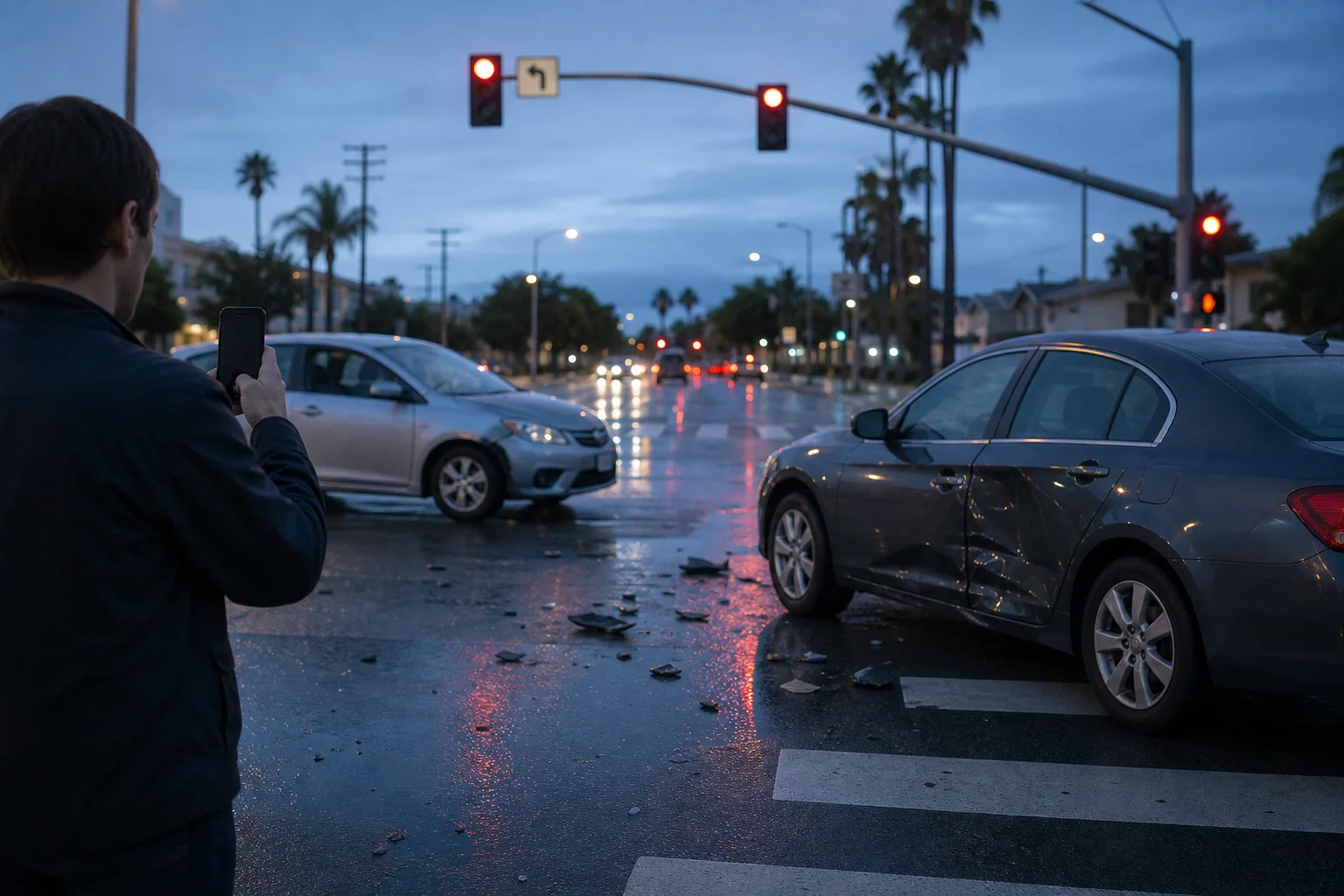
Start with safety. Call emergency services, accept appropriate medical evaluation, and avoid entering a traffic lane to collect evidence. If you can do so safely, photograph final vehicle positions, debris fields, skid or tire marks, traffic controls, lane markings, sight lines, weather, lighting, and nearby businesses or homes that may have cameras.
Collect names and contact details for witnesses, but do not ask them to coordinate stories. Record the precise time, direction of travel, sequence of impacts, and which lights or sirens you personally observed. Photograph all sides of each involved vehicle and any identifying public-unit number visible from a lawful location. Preserve your original files and metadata; the digital-evidence preservation guide explains why screenshots and edited clips are weaker than source files.
Get the collision-report number and ask which agency is investigating the crash. Also ask which agency initiated and supervised the pursuit. These may differ. If a suspected fleeing driver leaves the scene, use the hit-and-run action guide for the additional vehicle-description and witness steps.
Which pursuit records belong on the evidence checklist?
California Highway Patrol materials identify the CHP 187A Allied Agency Pursuit Report as a pursuit-reporting form, and CHP’s legislative reporting describes a statewide Pursuit Reporting System. An individual’s access to a specific record depends on public-records law, exemptions, investigation status, privacy, and other restrictions. A request is a way to identify and preserve records, not a promise that every item will be produced immediately.
- Communications: computer-aided dispatch entries, radio traffic, unit status logs, supervisor instructions, and timestamps.
- Video and audio: dash camera, body-worn camera, aircraft video, traffic cameras, automated plate-reader records when lawfully relevant, and 911 calls.
- Pursuit administration: initiating-officer report, supervisor review, termination decision, after-action analysis, CHP 187A or equivalent submission, and interagency communications.
- Policy and training: crash-date pursuit policy, amendments, annual training materials, officer certifications, and records showing which policy version applied.
- Vehicle evidence: event-data information where available, telematics, maintenance, damage scans, photographs, tow records, and inspection opportunities.
- Private evidence: witness originals, business or residential video, rideshare or navigation records, phone photographs, medical records, wage proof, and property-loss documents.
How do you send a focused preservation and records request?
Use a short, factual request. Avoid accusing an officer, declaring that a policy was violated, or demanding records you cannot identify. One practical script is:
“I am preserving records concerning the pursuit and collision on [date] at approximately [time] near [location]. Please identify the incident, pursuit, and collision report numbers and the agencies and units involved. Please preserve dispatch and radio records, available vehicle or body-camera video, supervisor communications, pursuit reports and reviews, applicable pursuit-policy and training records, photographs, vehicle data, and interagency communications. Please tell me the correct process for requesting releasable copies. This request does not ask you to admit fault or waive any lawful exemption.”
Send the request to each relevant agency through a verifiable channel and keep the submission, delivery proof, acknowledgments, denials, and produced files. A public-records request is not the same as a Government Claims Act presentation. It does not extend a claim deadline, file a lawsuit, or guarantee preservation. If an agency asks for clarification, answer narrowly and keep the correspondence.
What government-claim deadline may apply?
Government Code section 911.2(a) generally requires a claim relating to death, personal injury, or injury to personal property to be presented no later than six months after the cause of action accrues. Accrual, the proper entity, exceptions, and late-claim procedures can be complicated. Treat six months as an urgent issue to analyze, not as a do-it-yourself promise that every matter shares one calendar date.
Government Code section 910 lists required claim information, including claimant and notice addresses, the occurrence’s date, place, and circumstances, a general description of injury or loss, known public employees, and specified amount information. Sending only medical bills, a records request, or an insurer notice may not satisfy those requirements.
The California Courts Self-Help Guide explains that a person generally must submit a government claim before suing an agency and highlights multiple deadlines. It also warns that a written rejection can start another six-month period to sue. Government Code section 945.6 contains the governing suit-timing language, including different treatment when compliant written notice is or is not given. Get case-specific advice promptly.
How can a responsibility matrix prevent a missed issue?
Build a four-column table labeled “actor,” “conduct or role,” “evidence,” and “open question.” Put the fleeing driver in one row, each vehicle owner or insurer in another, and each public agency in its own row. Add the initiating officer, supervisor, joining units, and crash investigator only when their roles are known.
Example: a suspect vehicle enters an intersection against a red light and hits an uninvolved driver. City A initiated the pursuit; County B joined; CHP investigated the collision. The suspect-driver row holds signal, speed, identity, ownership, and coverage proof. City A’s row holds initiation, supervision, policy, training, communications, and section 17004.7 questions. County B’s row holds its joining decision and records. CHP’s row may concern evidence custody and reporting without implying that CHP caused the crash.
Then add a deadline column. Calendar the six-month claim-presentation issue separately for every potentially relevant public entity, along with insurance notice, evidence requests, medical follow-up, and any ordinary civil limitation period. A single calendar entry labeled “lawsuit deadline” hides too much.
Which medical and damages proof should be kept separate?
A pursuit may dominate the news, but a claim still needs careful proof of injury, causation, treatment, work loss, property damage, and other legally recoverable harm. Tell medical providers how the collision occurred and describe symptoms accurately without exaggeration. Keep discharge instructions, imaging, referrals, prescriptions, therapy records, bills, mileage, wage records, repair estimates, and receipts.
Use a dated symptom and activity record when it is genuinely useful. The symptom-journal guide explains how to record changes without turning the journal into advocacy. Preserve pre-crash records when they may be relevant; a prior condition does not automatically defeat causation, but incomplete history can damage credibility.
Do not post pursuit video, medical details, or speculation on social media. Do not sign a broad release because one insurer offers property-damage payment. Ask what parties, claims, and damages the document would release.
What mistakes and red flags should make you pause?
Pause when anyone offers a simple answer before identifying the vehicles, agencies, policies, and collision sequence.
- Assuming an officer’s individual immunity automatically eliminates every possible claim against a public entity.
- Assuming section 17004.7 applies without examining whether the collision involved the suspect vehicle and whether the agency satisfied the written-policy and annual-training conditions.
- Treating lights and sirens as automatic proof of reasonable driving or treating their absence as proven from one witness’s memory.
- Sending a public-records request and believing it is a government claim under section 910.
- Waiting for a final collision report before analyzing the six-month presentation issue.
- Requesting only dash-camera video while overlooking dispatch, supervisor, body-camera, traffic-camera, air-support, policy, and training records.
- Editing, compressing, or reposting the only copy of a witness video instead of preserving the original.
- Accepting guarantees about liability, immunity, representation, cost, settlement value, timing, or outcome.
What are careful next steps?
Finish the actor-and-evidence matrix, preserve originals, and identify each public entity before sending focused requests. Calendar the government-claim issue immediately. If a request is denied or delayed, keep the response and continue protecting other evidence instead of assuming the missing record proves either side.
This guide was prepared by the Hurt Advice Editorial Team under the site’s editorial standards. No attorney reviewed this displayed version. Read the attorney-advertising and referral notice before asking Hurt Advice to help locate a participating lawyer.
Hurt Advice is a lawyer-referral and legal-information service, not a law firm. Reading this article or contacting Hurt Advice does not create an attorney-client relationship, promise representation, guarantee an outcome, or establish that legal services will be free. A participating lawyer, if available and if the matter is accepted, must independently evaluate the facts, agencies, immunities, deadlines, evidence, and law.
Frequently Asked Questions
Can a public agency be liable when a fleeing driver hits an innocent person in California?
Possibly, but liability is not automatic. Vehicle Code section 17004.7 may immunize an agency from damages resulting from a pursued suspect vehicle’s collision when the agency has a compliant written pursuit policy and annual training. The collision sequence, responsible entities, policy, training, causation, and other immunities require case-specific review.
Is the pursuing officer personally liable for a police-pursuit crash?
Vehicle Code section 17004 gives a public employee immunity for damages resulting from line-of-duty operation of an authorized emergency vehicle during an immediate pursuit. That employee rule should not be treated as a complete answer about every public entity, vehicle, or legal theory.
Do police lights and sirens automatically defeat a negligence claim?
No. Vehicle Code section 21055 grants specified traffic-law exemptions when its conditions are met, while section 21056 preserves a duty to drive with due regard for highway users and does not protect an arbitrary exercise of those privileges. The evidence must show what happened.
How long do I have to file a government claim after a California pursuit crash?
Government Code section 911.2 generally requires a death, personal-injury, or personal-property claim to be presented within six months after accrual. Accrual, the correct entity, exceptions, and late-claim procedures are fact-specific, so obtain prompt advice instead of calculating from this FAQ alone.
Is a public-records request the same as a California government claim?
No. A records request seeks access to releasable agency records. A Government Claims Act presentation must satisfy separate statutory requirements, including the information described in Government Code section 910. One does not automatically substitute for or extend the other.
What evidence disappears fastest after a police pursuit crash?
Private surveillance, witness files, dispatch and unit-status context, vehicle data, and routine video can become harder to obtain with time. Preserve your originals immediately, identify every agency and camera location, and send focused preservation or records requests through verifiable channels.
Sources and references
Public-entity motor-vehicle liability.
Public-employee emergency-vehicle immunity.
Pursuit-policy and annual-training immunity conditions.
Emergency-vehicle traffic-law exemptions and conditions.
Due-regard and arbitrary-exercise limits.
Required contents of a government claim.
Six-month personal-injury claim-presentation rule.
Timing to commence suit after claim action.
court guidanceCalifornia Courts: Ask a government agency to pay you
Official overview of government-claim sequence and deadlines.
agency guidanceCalifornia Highway Patrol programs and pursuit form
CHP 187A Allied Agency Pursuit Report reference.
Related Resources
→
Rental-Car Return and Damage Records After a California Crash
Preserve rental agreements, pickup and return condition, damage claims, coverage, tow, repair, and custody records after a California crash.
car accidents→
Tire Condition, Tread, and Repair Records After a California Crash
Preserve tire identity, vehicle corner, tread, pressure, TPMS, repair, recovery, inspection, and custody records after a California crash.
car accidents→
Seat-Belt and Event Data After a California Crash: What to Preserve
Preserve seat-belt components, lawful EDR access, native crash data, acquisition details, limitations, hashes, and custody after a California crash.
car accidents→
Child Car Seat Evidence After a California Crash: Recalls and Replacement
Preserve car seat labels, recall results, post-crash conditions, custody, manufacturer guidance, and California insurance replacement records.
car accidents→
California Crash 911 and Dispatch Records: What to Request
Map custodians and request 911 audio, CAD event data, dispatch notes, unit times, radio traffic, and linked records after a California crash.
car accidents→
California Road-Construction Traffic-Control Plans: Records to Request
Identify a California road project and request traffic-control plans, revisions, closure logs, inspections, contractor records, and corrective actions.
car accidentsNeed help after an accident?
Hurt Advice intake team can review your situation, explain your options, and help you move forward with a plan that fits your case.