
Legal ExplainerCar AccidentsInformational

Who Can Be Liable When a Teen Driver Causes a California Crash?

A California crash involving a driver under 18 can create several different responsibility questions. The minor, license-application signer, custodial parent or guardian, vehicle owner, and insurer are not interchangeable. A reliable review starts with each role’s exact statutory trigger, then matches it to records rather than assumptions.

Published

July 15, 2026

Updated

July 15, 2026

Reading time

12 min read

Jurisdiction

California

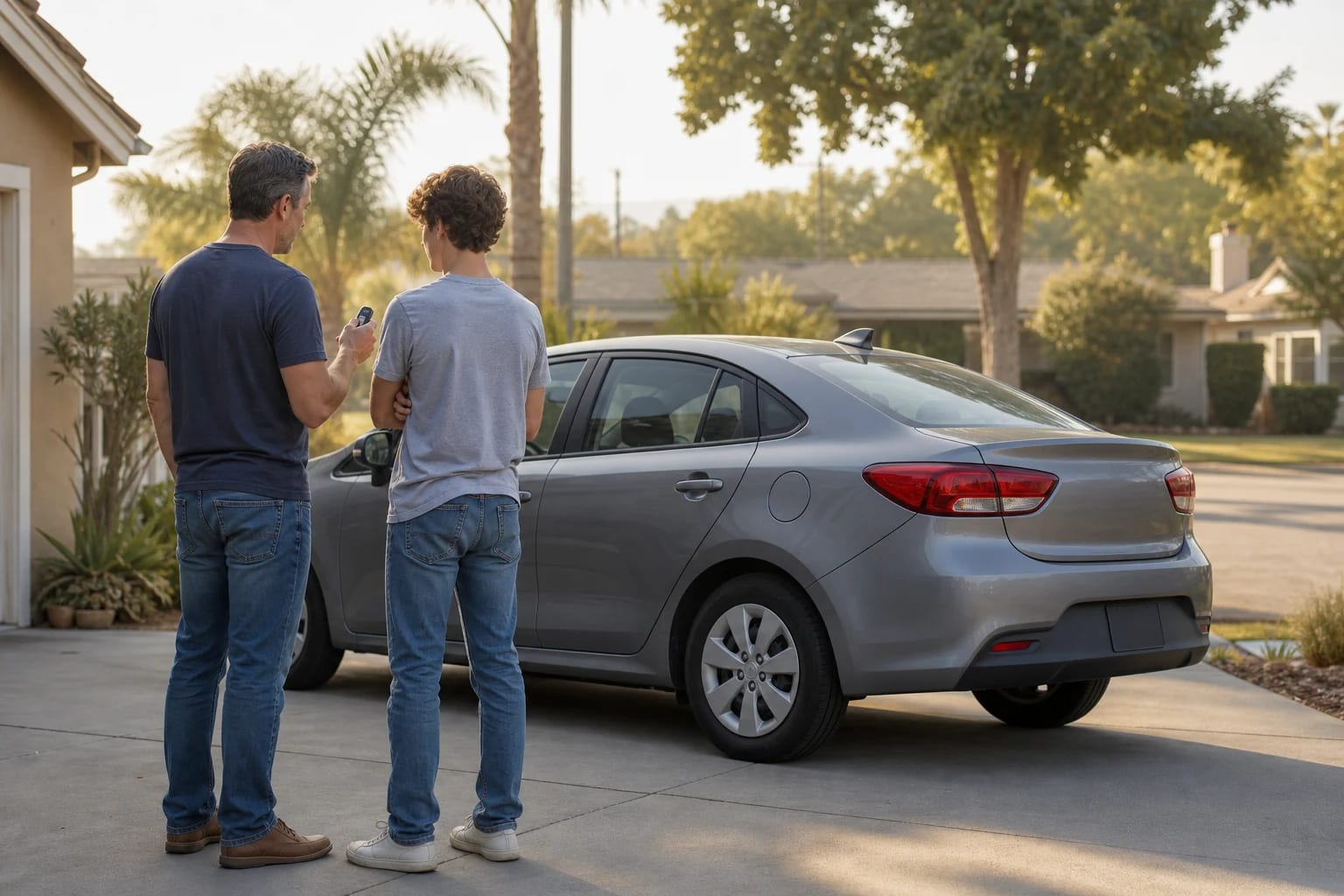
An adult and teenage driver review car keys beside a family sedan in a California driveway
Responsibility after a minor-driver crash can depend on who signed the license application, who permitted the trip, who owned the vehicle, and what the policy covers.

Quick answer

In California, a crash caused by a driver under 18 can raise separate questions about the minor, the person who signed the license application, a parent or guardian who permitted the trip, and the vehicle owner. Liability and statutory limits depend on each route’s exact trigger; insurance coverage is a separate contract question.

Key takeaways

  • A parent-child relationship alone does not identify who signed the license application, who had custody, who permitted the trip, or who owned the vehicle.
  • Permission can matter in both the minor-driver and vehicle-owner statutes, but the person giving permission and the relevant property interest may differ.
  • The statutory 15/30/5 figures discussed below are narrow imputed-liability limits, not a statement of current insurance requirements or an automatic ceiling on every claim.
  • Preserve the role-defining records before making assumptions about who must respond to a claim.
Hurt Advice Editorial Team

Prepared by

Hurt Advice Editorial Team

Editorial Research and Publishing Team

Source-checked editorial publishing

Why trust this article

Prepared by the Hurt Advice Editorial Team using current California statutes, source checks, image review, accessibility review, and live-publication controls. No attorney reviewed the displayed version.

Recent update: New July 2026 guide separating minor-driver, license-signer, custody-permission, vehicle-owner, and insurance questions.

At a glance

What this guide helps you decide

Start with the question that brought you here, identify the records that can verify the facts, and use the related guidance only where it helps. This article addresses car accidents questions in California.

Main question

Decide how this topic may apply to your situation

Use "Who Can Be Liable When a Teen Driver Causes a California Crash?" to sort the facts you know, the questions still open, and whether a car accidents resource or consultation may be useful in California.

Guide map

Start with the sections most relevant to you: What should families know first?, Who does this guide help, and why do the roles matter?, Who can be part of the responsibility matrix?

Move through the article by issue, not by guesswork, so liability, medical proof, insurance pressure, deadlines, and next steps stay connected.

Records to gather

Connect these subjects to your records: Teen driver liability, Minor driver crashes, Parental permission, Vehicle owner liability

Compare the topic with records, photos, medical visits, police reports, insurer letters, and local claim details before relying on a general answer.

Trust check

Use the source trail before acting

This page includes 7 source references plus internal next-step paths so readers can verify where the guidance comes from.

Before you rely on this guide

This article is written for people dealing with injury-law questions in California. It is meant to help you understand the issue, not replace legal advice about your specific case.

What to do after this article

Start with the quick answer, skim the table of contents, and then use the links below to move into the practice area, author archive, or resource page that turns general guidance into a clearer next step for your situation.

What should families know first?

California does not answer a teen-driver crash with one automatic “parent liability” rule. Start by separating the driver, the person who signed the driver-license application, the parent or custodian who permitted the trip, the registered owner, and the insurance contract. One person may occupy more than one role, but each role has its own factual trigger.

For the license-application chapter, Vehicle Code section 17700 defines a minor as a person under 18. That definition should not be stretched to every driver commonly described as a “teen”; an 18- or 19-year-old is outside this particular minor-driver chapter.

  • A parent-child relationship alone does not identify who signed the license application, who had custody, who permitted the trip, or who owned the vehicle.
  • Permission can matter in both the minor-driver and vehicle-owner statutes, but the person giving permission and the relevant property interest may differ.
  • The statutory 15/30/5 figures discussed below are narrow imputed-liability limits, not a statement of current insurance requirements or an automatic ceiling on every claim.
  • Preserve the role-defining records before making assumptions about who must respond to a claim.

Who does this guide help, and why do the roles matter?

This guide is for people investigating a California collision caused by a driver under 18, including injured people, parents, guardians, vehicle owners, and families receiving insurance correspondence. Hurt Advice’s teen-driver accident service guide covers the broader claim and case-review lane. This article answers a narrower question: which records distinguish the possible responsibility paths?

The roles matter because an insurance card may identify a named insured without proving who signed a DMV application. Registration may identify an owner without proving who permitted the particular trip. A family relationship may explain access to the vehicle without establishing custody or the statutory permission facts. The California car-accident hub can help with the broader collision process, but the responsibility matrix here should be completed separately.

This is educational information, not a conclusion about any person’s liability. Applying terms such as permission, custody, ownership, negligence, and proximate result can require disputed facts and other law.

Who can be part of the responsibility matrix?

Use five lanes rather than writing “the parents” at the top of the file. The goal is to match facts and documents to each legal question before negotiating or requesting information.

  • Minor driver. Record the driver’s exact age on the crash date, license status, conduct, route, and purpose of the trip. The driver’s own alleged negligence remains the starting event.
  • License-application signer. Identify the person who actually signed and verified the minor’s driver-license application; do not substitute the policyholder or emergency contact.
  • Parent, person, or guardian having custody. Ask who had custody and whether that person gave express or implied permission for the minor to drive on the highway.
  • Vehicle owner. Confirm title or registration and whether the owner expressly or impliedly permitted this driver to use the vehicle.
  • Insurance participants. Identify every potentially relevant policy, named insured, covered vehicle, coverage position, and claim number. Coverage is a contract question and should not be inferred from family status alone.

When does the driver-license application matter?

Under Vehicle Code section 17707, civil liability of a minor arising from driving on a highway during minority is imposed on the person who signed and verified the minor’s license application. The statute makes that signer jointly and severally liable with the minor for damages proximately resulting from the minor’s negligent or wrongful driving. The trigger is the verified application signature—not simply being a parent, paying the premium, or appearing on registration.

Section 17707 states two important qualifications beside that rule. An employer who signed is subject to the section only if an unrestricted license was issued pursuant to the employer’s written authorization. The section also says liability may not be imposed under sections 17707 or 17708 on the state, a county, or a probation officer or child protective services worker acting as an officer of the court for damages caused solely by the negligence or willful misconduct of a minor whose application that worker signed while the minor was a dependent or ward of the court.

Ask for the actual application-signing identity through an authorized DMV or litigation process rather than relying on memory. A declaration-page name, school record, or household assumption is not a substitute for that fact. Keep the response with the driver’s age and license-status records so the section’s threshold facts can be checked together.

When does custody and permission matter?

A separate rule appears in Vehicle Code section 17708. It applies to civil liability of a minor, whether licensed or not, arising from driving on a highway with the express or implied permission of the parents or the person or guardian having custody of the minor. When its elements are met, the statute imposes that liability on the identified parent, person, or guardian and makes that person jointly and severally liable with the minor for damages proximately resulting from the minor’s negligent or wrongful driving.

The words “having custody” and “express or implied permission” are not decorative. Ask who had custody at the relevant time, who controlled access to the vehicle, what the minor was told, whether similar use had been allowed before, and whether any restriction was communicated. A disputed permission issue should be documented with contemporaneous messages, key access, household arrangements, and neutral witness information rather than reconstructed from a single later conversation.

The statute’s “whether licensed or not” language also means lack of a license does not by itself defeat this particular permission-based path. It does not mean every custodian is automatically liable whenever an unlicensed minor drives; the custody, permission, highway-driving, and underlying liability facts still matter.

When does vehicle ownership create a separate question?

Vehicle ownership is a different lane. Vehicle Code section 17150 makes an owner responsible for death or injury to a person or property resulting from a negligent or wrongful act in operating the vehicle by a person using it with the owner’s express or implied permission. The driver does not have to be the owner’s child for this statute to be relevant.

Confirm ownership for the crash date rather than assuming the person who kept the keys, paid the premium, or appeared at the scene held title. Then investigate the owner’s permission separately from permission by a parent or custodian. For example, a parent might sign a license application while an aunt owns the borrowed vehicle; the records for those roles will not be the same.

Use Hurt Advice’s claim-proof map for negligence and damages evidence, but keep signer, custody, permission, and ownership proof in labeled folders so missing facts remain visible.

What limits do sections 17709 and 17151 actually state?

For liability imposed under sections 17707 and 17708, Vehicle Code section 17709(a) caps one person or a group collectively at $15,000 for injury to or death of one person in one accident; subject to that one-person limit, $30,000 for injury to or death of all persons in one accident; and $5,000 for damage to others’ property in one accident. The trigger matters: section 17709 names liability under sections 17707 and 17708. It is not a general cap on the minor’s own liability, every defendant, every legal theory, or all available insurance.

For owner liability imposed by the owner-liability chapter and not arising through a principal-agent or master-servant relationship, Vehicle Code section 17151(a) separately states $15,000 for death of or injury to one person in one accident, $30,000 for death of or injury to more than one person in one accident subject to the one-person limit, and $5,000 for damage to others’ property in one accident. Those are the section’s imputed-owner-liability figures, not a summary of policy limits or a promise of recovery.

Sections 17709(b) and 17151(b) also distinguish punitive or exemplary damages imposed for the operator’s conduct from damages based on the other person’s own wrongful conduct. Each section withholds liability under its imputed route for punishment based on the driver’s conduct while expressly declining to immunize a person from punitive damages for that person’s own wrongful conduct. Whether any separate claim exists requires facts and case-specific legal analysis.

Can the minor-driver and owner limits be added together?

Not when the exact overlap described by Vehicle Code section 17714 exists. If judgment is entered against the same defendant under the minor-license-application chapter and also under the private-owner article, based on the minor’s same negligent or wrongful act or omission, the judgments are not cumulative. Recovery against that defendant is limited to the amount in section 17709.

That noncumulative rule should be kept beside the two statutory paths in the matrix. It prevents a simple arithmetic mistake—adding the signer/custodian imputed limit to the owner imputed limit against the same defendant under the stated overlap. It does not answer whether another person, a different legal basis, direct wrongful conduct, or a policy provides a separate source of responsibility or coverage.

Do not use “stacking” as a shortcut without identifying the defendant, theory, judgment, and statutory trigger. Keep the liability and insurance analyses separate.

Which evidence should be collected first?

Collect role-defining evidence before ordinary repair, phone, or insurance activity changes it. Keep original electronic files when practical, and use Hurt Advice’s digital-evidence guide for handling steps. A request does not prove that a recipient has a record or a duty to keep it.

  • Driver facts: date of birth, license status, license restrictions, trip purpose, route, passengers, and statements made at the scene.
  • Application signer: the verified driver-license application or an authorized record identifying who signed it, plus any employer written authorization if that exception is raised.
  • Custody and permission: parenting or guardianship records when relevant, key access, household rules, prior-use patterns, messages, and testimony about express or implied permission.
  • Ownership and vehicle: registration or title for the crash date, loan or lease records if relevant, photographs, repair status, onboard data, and the identity of anyone who controlled the vehicle.
  • Insurance: every policy number, declaration page available to you, named insured, covered vehicle, driver listing, claim number, reservation-of-rights letter, denial, and written coverage explanation.
  • Collision and harm: report number, scene photographs, witness contacts, medical records and bills, lost-income records, property-damage estimates, and a dated chronology. The car-accident checklist provides a broader collection list.

What step-by-step process keeps the investigation organized?

First, confirm the driver’s age on the crash date. Then identify the vehicle owner, verified license-application signer, custody and permission facts, and every potentially relevant policy without assuming those roles belong to one person.

Next, compare each document to one element in the responsibility matrix. Mark a fact “confirmed,” “disputed,” or “unknown,” and record the source. Do not convert silence into permission, ownership, or coverage. Send focused written questions, keep proof of delivery, and preserve every response in its original format. Hurt Advice’s insurance-claims resource can help you track carrier communications without collapsing coverage into liability.

Act promptly because vehicles may be repaired, phones replaced, messages deleted in ordinary use, and recollections become less precise. This article does not calculate a filing deadline, notice period, or preservation duty. Those can depend on who is involved, the claim, and exceptions. A person who needs a deadline calculation should obtain advice based on the actual crash date and parties.

What practical request script can you use?

Neutral records request: “I am organizing records concerning the crash on [date] involving [vehicle]. Please confirm in writing what records you can provide or identify for: (1) the driver’s age and license status on that date; (2) the person who signed and verified the driver-license application; (3) ownership of the vehicle; (4) who gave express or implied permission for this trip; and (5) each potentially relevant insurance policy and claim number. If you dispute a requested fact or cannot provide a record, please state that clearly. This request does not ask you to admit liability.”

Carrier follow-up: “Please identify the insured, vehicle, claim number, and the coverage position for this occurrence. If coverage is reserved, limited, or denied, please provide the written basis and identify the policy provision you rely on. I am not agreeing that any identified limit resolves liability or damages.”

The script does not override privacy, DMV access rules, policy terms, or formal discovery. A recipient may decline to provide material to a third party. Keep the response and ask which authorized process is available rather than guessing what a missing document proves.

How might the matrix work in a real-world pattern?

Consider a hypothetical 17-year-old who drives an aunt’s sedan with the aunt’s permission. One parent previously signed and verified the minor’s license application, while a different parent had custody on the crash date. The teen is alleged to have caused a collision. This pattern creates questions; it does not supply the answers.

The minor’s conduct belongs in the driver lane. The verified signer belongs in the section 17707 lane. Custody and express or implied permission belong in the section 17708 lane. The aunt’s ownership and permission belong in the section 17150 lane. The aunt’s policy, any household policy, and each carrier’s written position belong in the separate coverage lane. Section 17714 may matter only if the same defendant faces the overlapping statutory judgments it describes.

Changing one fact can change the analysis. An 18-year-old is outside this chapter’s minor definition; a different owner needs different records; disputed permission needs its own proof. A family label is not a legal conclusion.

Which mistakes and red flags deserve a pause?

Pause when someone compresses distinct roles into “the parents” or treats a policy limit as the whole answer. Each conclusion should trace to a person, date, document, and statutory trigger.

  • Calling an 18- or 19-year-old a minor for this chapter without checking section 17700.
  • Assuming the parent who bought insurance also signed and verified the license application.
  • Treating permission by a custodian as identical to permission by the vehicle owner without proving both roles.
  • Presenting the 15/30/5 figures as current insurance minimums, a universal damages cap, or an automatic settlement value.
  • Adding the signer/custodian and owner imputed limits against the same defendant without checking section 17714.
  • Relying on an oral coverage statement while ignoring a reservation, exclusion, identified policy provision, or the possibility that another policy exists.
  • Editing original messages or vehicle data, or sending the only copy of a record away without keeping a readable original.
  • Accepting a guarantee of representation, coverage, fault, value, timing, or outcome.

What are careful next steps?

Complete the five-lane matrix, save the records, and list disputed or unknown facts. Compare each carrier’s written position with available policy materials. For immediate tasks, review what to do after a car accident. Do not sign a release or assume a deadline from this guide.

This article was prepared by the Hurt Advice Editorial Team under the site’s editorial standards. No attorney reviewed this displayed version. Readers who want to evaluate public credentials and practice information may review Armen Akaragian’s verified profile; that link does not imply that he reviewed this article, is available, will accept a matter, or has evaluated these facts.

Hurt Advice is a lawyer-referral and legal-information service, not a law firm. Read the attorney-advertising and referral notice. Using this article or contacting Hurt Advice does not create an attorney-client relationship, promise representation, guarantee an outcome, or establish that any legal service will be free. A participating lawyer, if available and if the matter is accepted, must independently evaluate the people, records, insurance, deadlines, and applicable law.

Frequently Asked Questions

Are California parents automatically liable whenever their teen causes a crash?
No. California’s statutes ask different questions. Section 17707 focuses on who signed and verified the minor’s license application. Section 17708 focuses on custody and express or implied permission. Ownership and owner permission are addressed separately. A parent may fit more than one role, one role, or none, depending on the facts.
Does the name on the insurance card prove who signed the license application?
No. A named insured, policyholder, registered owner, custodial parent, and license-application signer may be different people. Obtain an authorized record identifying the verified signer instead of treating insurance paperwork or family memory as proof of the DMV application.
Can section 17708 matter if the minor was not licensed?
Yes, potentially. Vehicle Code section 17708 expressly refers to a minor “whether licensed or not,” but its other elements still matter: highway driving, the minor’s underlying civil liability, custody, and express or implied permission. Lack of a license does not make every parent or guardian automatically liable.
What if the parent did not own the car?
Do not merge the roles. The license signer and custodial-permission questions can be different from the vehicle-owner question. Confirm title or registration for the crash date and separately investigate whether that owner expressly or impliedly permitted the use. An aunt, grandparent, employer, or another person might own the vehicle.
Do the statutory 15/30/5 figures determine insurance coverage or the value of the whole case?
No. Section 17709 limits liability imposed under sections 17707 and 17708, while section 17151 states a separate limit for specified owner liability. Those figures are not a statement of current policy limits, a guarantee that coverage exists, or an automatic cap on every person or theory.
Can Hurt Advice decide who is liable or become my lawyer?
No. Hurt Advice is a lawyer-referral and legal-information service, not a law firm or court. Using this guide or contacting Hurt Advice does not create an attorney-client relationship or guarantee representation. Any participating lawyer must independently accept the matter and evaluate the facts, deadlines, policies, and law.

Sources and references

Need help after an accident?

Hurt Advice intake team can review your situation, explain your options, and help you move forward with a plan that fits your case.