
Legal ExplainerCar AccidentsChecklist / Process

Child Car Seat Evidence After a California Crash: Recalls and Replacement

After a California crash involving a child restraint, address safety first, then preserve the exact seat, installed position, labels, official recall result, post-crash facts, manufacturer instructions, insurance replacement records, and custody history as separate sources. This keeps a necessary safety replacement from erasing evidence or becoming an unsupported conclusion about defect, installation, causation, or fault.

Published

July 27, 2026

Updated

July 27, 2026

Reading time

11 min read

Jurisdiction

California

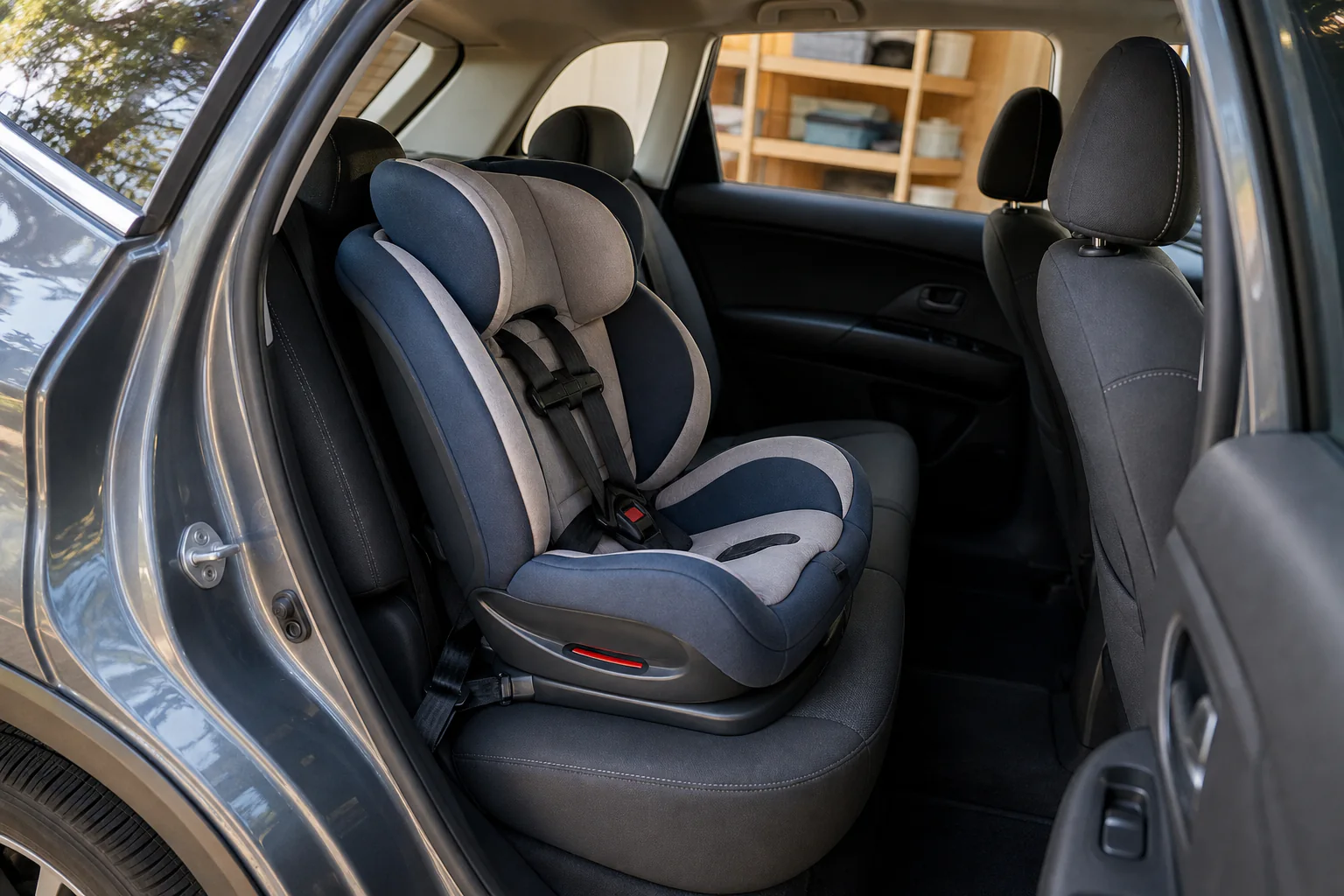
Empty blue-gray child car seat installed in the rear of an unbranded family vehicle with the passenger door open
A reliable post-crash restraint record preserves the exact seat identity, installed position, official recall result, crash facts, custody, and replacement sources before the old seat is altered or discarded.

Quick answer

After a California crash, photograph the child car seat in place when safe, save its model and manufacture labels, run a dated NHTSA recall search, and record each post-crash condition separately. Replace the seat when applicable safety guidance requires it, while preserving the old restraint and building the California insurance replacement packet.

Key takeaways

  • Address the child’s safety and appropriate medical care first. Do not keep using a restraint when the manufacturer, a recall remedy, or NHTSA post-crash guidance calls for replacement.
  • Photograph the exact seat before moving it when that can be done safely: full seat, installation path, harness, base, anchor points, labels, model, manufacture date, and any visible change. Preserve originals and metadata.
  • A recall search is tied to the brand and model information entered and the search date. Save the result, but do not treat a no-result screen as proof that the seat was properly installed, undamaged, or free of every possible defect.
  • California replacement coverage and evidence preservation are separate tasks. Build the insurance packet without surrendering, returning, repairing, dismantling, or discarding the seat until custody and preservation questions are resolved.
Hurt Advice Editorial Team

Prepared by

Hurt Advice Editorial Team

Editorial Research and Publishing Team

Source-checked editorial publishing

Why trust this article

Prepared by the Hurt Advice Editorial Team from current official California Legislature and National Highway Traffic Safety Administration statutes and safety resources. No attorney reviewed this displayed version.

Recent update: Original publication with exact-seat identity and recall workflow, five-condition post-crash ledger, California replacement-coverage packet, custody controls, scripts, checklist, timing, mistakes, FAQs, and next steps.

At a glance

What this guide helps you decide

Start with the question that brought you here, identify the records that can verify the facts, and use the related guidance only where it helps. This article addresses car accidents questions in California.

Main question

Decide how this topic may apply to your situation

Use "Child Car Seat Evidence After a California Crash: Recalls and Replacement" to sort the facts you know, the questions still open, and whether a car accidents resource or consultation may be useful in California.

Guide map

Start with the sections most relevant to you: Quick takeaways, Who this guide is for—and what it does, Step 1: separate California use law from the evidence question

Move through the article by issue, not by guesswork, so liability, medical proof, insurance pressure, deadlines, and next steps stay connected.

Records to gather

Connect these subjects to your records: California Child Car Seat Crash Evidence, Child Passenger Restraint Records, NHTSA Car Seat Recall Search, Car Seat Replacement After Crash

Compare the topic with records, photos, medical visits, police reports, insurer letters, and local claim details before relying on a general answer.

Trust check

Use the source trail before acting

This page includes 6 source references plus internal next-step paths so readers can verify where the guidance comes from.

Before you rely on this guide

This article is written for people dealing with injury-law questions in California. It is meant to help you understand the issue, not replace legal advice about your specific case.

What to do after this article

Start with the quick answer, skim the table of contents, and then use the links below to move into the practice area, author archive, or resource page that turns general guidance into a clearer next step for your situation.

Quick takeaways

  • Address the child’s safety and appropriate medical care first. Do not keep using a restraint when the manufacturer, a recall remedy, or NHTSA post-crash guidance calls for replacement.
  • Photograph the exact seat before moving it when that can be done safely: full seat, installation path, harness, base, anchor points, labels, model, manufacture date, and any visible change. Preserve originals and metadata.
  • A recall search is tied to the brand and model information entered and the search date. Save the result, but do not treat a no-result screen as proof that the seat was properly installed, undamaged, or free of every possible defect.
  • California replacement coverage and evidence preservation are separate tasks. Build the insurance packet without surrendering, returning, repairing, dismantling, or discarding the seat until custody and preservation questions are resolved.

Who this guide is for—and what it does

This guide is for a California parent, guardian, vehicle owner, or authorized representative organizing a child restraint after a crash. Its narrow purpose is to identify the exact seat, preserve its post-crash state, save the official recall result and manufacturer instructions, apply NHTSA’s post-crash framework without rewriting the facts, and assemble the records relevant to California replacement coverage.

It does not decide whether a restraint was defective, whether it was installed correctly, whether a child’s injury was caused by the crash or the seat, whether a driver or manufacturer is legally responsible, or what any claim may be worth. The defective child car seat service guide helps identify the possible legal lane. This article is the seat-specific records workflow that should remain source-controlled before those conclusions.

If a child may be injured, obtain appropriate care and follow emergency or provider instructions. Do not delay safety decisions to collect evidence. Do not place a child back into a restraint that should not be used, recreate the crash, test a damaged seat, cut straps, disassemble components, or drive an unsafe vehicle to improve documentation. When the seat must be removed for safety, photograph its position first if feasible, record who removed it and why, and keep every component together.

Step 1: separate California use law from the evidence question

California Vehicle Code section 27360 generally requires a child under eight to be properly secured in a rear seat in an appropriate child passenger restraint system meeting applicable federal motor vehicle safety standards, subject to statutory exceptions. It separately requires a child under two to be rear-facing unless the child weighs at least 40 pounds or is at least 40 inches tall, and it directs compliance with the restraint manufacturer’s height and weight limits.

Those rules answer a use requirement. They do not establish that a particular seat was defective, that a specific installation was correct, or that the restraint caused an injury. Preserve the actual child’s age and size source, the seat’s manufacturer limits, the vehicle manual, and the observed installation separately. Avoid converting “the law required a restraint” into “this exact restraint and installation complied,” because that second statement needs its own evidence.

Record the vehicle year, make, model, and VIN in a private claim file; seating position; whether the seat used lower anchors, a vehicle belt, a top tether, a load leg, or another manufacturer-approved method; and the relevant pages of both manuals. Do not publish a child’s identifiers or the vehicle VIN. Use a coded file name and keep the identity key separately.

Step 2: create an exact seat-identity and recall snapshot

Take sharp photographs of the entire restraint and every identifying label you can reach without altering it. Capture the brand, model name or number, date of manufacture, serial or lot information if present, and any separate base label. Photograph the shell, harness, chest clip, buckle, adjuster, padding, base, connectors, tether, inserts, accessories, warning labels, and the way the restraint sat in the vehicle. Keep the receipt, box, registration card, manual, prior photographs, installation-check record, warranty contact, and purchase or gift history.

NHTSA’s official used car seat safety checklist explains why the date-of-manufacture and model labels matter: that information is needed to check recalls and age, and the checklist also asks whether the restraint has all parts and its instruction book. The checklist is a safety screen, not proof of the seat’s pre-crash history. If any history is unknown, record “unknown” rather than assuming the seat was never involved in a prior crash or modification.

Use NHTSA’s official recall search and select the car-seat search path. NHTSA explains that car-seat, tire, and equipment searches return general results for recalls, investigations, complaints, and manufacturer communications based on the product information entered. Save a PDF or screenshot that shows the search date, brand, model entry, result, and URL. Then compare the model and manufacture-date range in any notice with the label photographs and contact the manufacturer through a verified channel for product-specific remedy instructions.

A blank or no-result search does not answer whether the label was read correctly, whether the exact manufacture range was included, whether a later recall will issue, whether the seat was installed as instructed, or whether crash forces changed it. NHTSA’s broader car seat safety page directs caregivers to register a seat for recall notices and to follow the particular restraint and vehicle manuals. Preserve the registration confirmation and later notices as new dated sources; do not overwrite the original recall snapshot.

Step 3: build a post-crash condition-and-custody ledger

NHTSA’s current car seat use after a crash guidance recommends replacement after a moderate or severe crash and says a seat does not automatically need replacement after a minor crash. NHTSA defines a minor crash only when all five conditions apply: the vehicle could be driven away; the door nearest the restraint was not damaged; no vehicle occupant was injured; air bags, if present, did not deploy; and the restraint has no visible damage. NHTSA also says to follow the manufacturer’s instructions.

Do not compress those conditions into one memory-based “minor crash” label. Give each field its own source and status:

  • Vehicle movement: driven away, towed, moved only within the scene, or unknown; identify the police, tow, repair, photograph, or witness source.
  • Nearest door: which door was nearest the seat and what photographs, estimate, repair record, or inspection says about damage.
  • Occupant injury: who reported an injury and where that fact is recorded. Keep medical conclusions in qualified medical records.
  • Air bags: deployed, not deployed, or unknown by position and source; preserve vehicle photographs and repair data.
  • Visible restraint condition: shell, base, belt path, connectors, harness, buckle, tether, padding, stress marks, deformation, broken or missing part, contamination, or no visible change. “No visible damage” is not the same as a technical inspection.
  • Manufacturer instruction: exact manual version or verified manufacturer communication and what it says about post-crash use.
  • Handling and custody: who removed the seat, date and time, storage location, packaging, transfers, access, photographs, and any proposed return, inspection, surrender, or disposal.

Example entry: “Crash July 27, 4:12 p.m. Child seat in right-rear position. Vehicle towed at 5:31 p.m. according to tow receipt. Right-rear door photographed with exterior damage; repair-estimate status pending. Curtain air bag visible deployed in scene photograph. Seat removed July 28 by vehicle owner after full-position and label photographs; stored indoors with base and inserts together. NHTSA five-condition screen not satisfied because vehicle was not driven away, nearest-door damage is unresolved, and an air bag deployed. Manufacturer instruction requested; no defect or causation conclusion.”

The repair-estimate record guide helps preserve estimate versions and repair sources. The digital evidence guide explains original-file and metadata handling for photographs, messages, app exports, and video.

Step 4: assemble the California replacement-coverage packet

California Insurance Code section 11580.011 addresses child passenger restraint replacement within specified automobile liability, uninsured-motorist property-damage, collision, and physical-damage coverage circumstances. Among other provisions, it requires covered policies described in the statute to address replacement when the restraint was damaged, was in use by a child during an applicable accident, or sustained a covered loss while in the vehicle. The statute also describes an insurer’s obligation, upon a claim under the listed coverage, to ask whether a restraint was in use or in the vehicle and to replace or reimburse as the section provides.

Do not rewrite that into “every crash guarantees a free seat.” Identify the policy, coverage part, insured vehicle, claim number, crash or loss, whether a child was using the restraint, whether the seat was in the vehicle, and what the insurer says is covered. Preserve the declaration page, relevant policy language, claim acknowledgment, adjuster communications, photographs, seat identity, NHTSA/manufacturer guidance, purchase receipt, replacement quote or receipt, reimbursement, deductible explanation, and any request for surrender.

Subdivision (f) says an insured who has acquired a replacement may surrender the replaced restraint to the nearest California Highway Patrol office. “May” is not the same as a command to surrender it immediately. If the restraint’s condition may be relevant to a product, installation, vehicle, insurance, or injury dispute, resolve preservation and inspection questions before surrendering, returning, cutting, recycling, or discarding it. A replacement purchase can address safety without silently ending the custody record for the old seat.

Use a four-column reconciliation: requested, source produced, amount or action, and unresolved reason. Keep safety retirement, replacement purchase, reimbursement, evidence storage, and final disposition as separate events. A reimbursement does not prove a product defect; a recall does not prove that the recalled condition caused this crash outcome; and a preserved seat does not eliminate the need for medical, vehicle, witness, and other evidence.

Practical request scripts

To the insurer:

Please confirm the claim and coverage part being used for the child passenger restraint that was [in use by a child / in the vehicle] during the [date] crash or covered loss. The restraint is [brand, model, manufacture date, and seating position]. Please identify the records required for replacement or reimbursement under the applicable policy and California Insurance Code section 11580.011, any purchase or amount requirements, and whether you request possession or surrender of the replaced restraint. Please preserve claim communications and do not authorize disposal or alteration while evidence-preservation questions are being resolved.

To the manufacturer:

Please confirm the post-crash and recall guidance applicable to this exact restraint: [brand, model, manufacture date, serial or lot if available]. The crash occurred on [date]. I am requesting existing product instructions, recall or remedy information, and the verified process for a safety report or inspection. I am not authorizing repair, dismantling, return, or disposal through this request. Please identify any photographs or information needed and preserve the original communication record.

Use verified contact information from the manufacturer or NHTSA. Do not send a child’s medical records, full date of birth, or unrelated private details when model and crash information is enough. Retain delivery proof and every response version.

Evidence checklist

  • Seat brand, model, manufacture date, serial or lot, base identity, and full label photographs.
  • Receipt, retailer, registration card or confirmation, manual version, box, accessories, prior-use history, and installation-check source.
  • Vehicle year, make, model, private VIN record, seating position, installation method, and relevant vehicle-manual pages.
  • Wide and close scene photographs showing the seat position, nearest door, vehicle damage, air bags, belt or anchor path, and surrounding interior.
  • NHTSA recall search input, dated result, recall notice, investigation or communication result, and verified manufacturer response.
  • NHTSA five-condition post-crash ledger with one source and status for each field.
  • Police information, tow receipt, vehicle inspection, estimate versions, repair records, insurer communications, and witness sources.
  • Child and occupant care records kept in a private medical lane without unsupported diagnoses in the evidence ledger.
  • Policy and coverage part, claim number, adjuster request, replacement quote or receipt, payment, reimbursement, deductible explanation, and surrender request.
  • Custody log for removal, storage, transfers, access, inspection, return, surrender, recycling, or final disposition.

The car accident checklist covers fast-changing scene sources. The broader injury evidence checklist connects the restraint file to witness, communication, medical, insurance, and loss proof. The California injury proof guide explains why no single source decides every disputed element.

Timing and process

  1. Address safety and care. Follow emergency, provider, manufacturer, recall, and NHTSA guidance appropriate to the facts.
  2. Photograph before moving when feasible. Preserve the seat position, installation path, labels, nearest door, air bags, and vehicle condition.
  3. Secure the old seat. Keep the shell, base, inserts, accessories, manual, and packaging together; log removal and storage.
  4. Save the identity snapshot. Record model, manufacture date, purchase, registration, manual version, and prior history.
  5. Run and save the official recall search. Date the input and result; compare any notice to the exact label range.
  6. Complete all five post-crash fields. Use sourced facts rather than one conclusion label.
  7. Open the replacement packet. Ask the insurer for the applicable coverage part, required proof, payment process, and disposition request.
  8. Reconcile without altering. Separate safety replacement, reimbursement, product questions, custody, and final disposition.
  9. Track other deadlines independently. Records and reimbursement work do not extend insurance, product-reporting, court, government-claim, preservation, or other deadlines. The California deadline resource is only a starting point.

Mistakes and red flags

  • Photographing only the front: the base, belt path, anchors, tether, labels, nearest door, and installed position can answer different questions.
  • Searching recalls from memory: use label photographs and save the exact brand/model input and date.
  • Treating a no-result screen as a safety clearance: recall status, installation, crash exposure, missing parts, age, and manufacturer instructions are separate checks.
  • Calling the crash minor without all five facts: NHTSA’s definition requires every listed condition, plus manufacturer instructions still matter.
  • Continuing use to preserve evidence: child safety comes first; replace or retire the seat when guidance requires it and preserve the old seat securely.
  • Allowing tow-yard or repair personnel to discard the seat: give a narrow written preservation instruction and log custody.
  • Cutting straps before preservation is resolved: common disposal practices can permanently alter condition evidence.
  • Assuming reimbursement proves defect or fault: coverage can exist without resolving causation, product condition, or legal responsibility.
  • Sending unnecessary child information: use a coded identity and share only what the safety, claim, or care task requires.
  • Waiting for every record before addressing time-sensitive issues: safety, care, recall, insurance, preservation, and legal advice can run on different clocks.

Next steps

  1. Photograph the restraint, labels, installed position, nearest door, air bags, and vehicle condition.
  2. Record the exact seat and base identity, purchase, registration, manual, accessories, and prior history.
  3. Save the official NHTSA recall result and verified manufacturer guidance as dated sources.
  4. Complete each NHTSA post-crash field with its own source; do not force unknowns into yes or no.
  5. Store the old restraint and every component securely while replacement and preservation questions are resolved.
  6. Send the insurer a narrow replacement-coverage request and reconcile required proof, payment, and proposed disposition.
  7. Keep medical, vehicle, seat, recall, insurance, and custody sources in separate folders linked by one timeline.
  8. If a serious injury, product defect, evidence-loss risk, public entity, insurer dispute, or deadline may matter, seek qualified advice promptly.

Hurt Advice is a lawyer-referral and legal-information service, not a law firm. You may use the contact page to request an intake review. Any attorney-client relationship requires a separate written agreement with a participating attorney, and no result is promised.

Frequently Asked Questions

Should I replace a child car seat after a California crash?
NHTSA recommends replacement after a moderate or severe crash and says a seat does not automatically need replacement after a minor crash. A minor crash must satisfy all five NHTSA conditions, and the manufacturer’s instructions still control for the exact seat. Address safety first, save the sourced facts, and do not keep using a seat when applicable guidance requires replacement.
What should I photograph on a child car seat after a crash?
Photograph the full installed position; shell, harness, buckle, base, anchors, tether, belt path, inserts, and accessories; every model and manufacture label; the nearest vehicle door; air-bag condition; vehicle damage; and any visible change. Keep original files and metadata, and photograph before removal when that can be done safely.
How do I check whether a child car seat was recalled?
Use the official NHTSA recall search with the brand and model information from the restraint label. Save the input, date, result, URL, and any notice. Compare the notice’s model and manufacture-date range to the exact seat, register the restraint for later notices, and contact the manufacturer through a verified channel for remedy instructions.
Does a no-recall result prove the car seat was safe?
No. A no-result screen does not prove the label was entered correctly, that no later recall will issue, that the seat was properly installed, that all parts were present, or that the crash did not change the restraint. Keep recall status, installation, crash facts, manufacturer instructions, condition, and custody as separate checks.
Will California auto insurance replace a child car seat?
California Insurance Code section 11580.011 addresses replacement within specified liability, uninsured-motorist property-damage, collision, and physical-damage coverage circumstances. Coverage depends on the policy and facts. Ask the insurer to identify the applicable coverage part, required proof, reimbursement process, and any proposed surrender or disposition of the old seat.
Can I throw away or surrender the old car seat after reimbursement?
Do not alter, return, surrender, recycle, or discard it until safety, insurance, custody, and evidence-preservation questions are resolved. California law says an insured who acquired a replacement may surrender the old restraint to a CHP office, but immediate surrender is not always the right evidence step. Secure the seat and document final disposition.

Sources and references

National Highway Traffic Safety AdministrationNHTSA Recall Search

Official recall, investigation, complaint, and manufacturer communication search for car seats and equipment.

National Highway Traffic Safety AdministrationCar Seat Use After a Crash

Official post-crash replacement recommendation and five-condition minor-crash definition.

National Highway Traffic Safety AdministrationUsed Car Seat Safety Checklist

Official model, manufacture-date, recall, parts, manual, and crash-history safety checklist.

National Highway Traffic Safety AdministrationCar Seats and Booster Seats

Official seat selection, installation, manufacturer-instruction, inspection, registration, and recall resources.

Need help after an accident?

Hurt Advice intake team can review your situation, explain your options, and help you move forward with a plan that fits your case.