
Legal ExplainerCar AccidentsChecklist / Process

California Road-Construction Traffic-Control Plans: Records to Request

A road-construction record file should begin with the exact project, event period, and custodians—not a conclusion. Identify the road owner, project team, contractor, traffic-control subcontractor, inspectors, and record systems; then keep the governing plan, approved revisions, lane-closure records, field inspections, original scene evidence, complaints, corrections, and later changes in separate source lanes.

Published

July 24, 2026

Updated

July 24, 2026

Reading time

10 min read

Jurisdiction

California

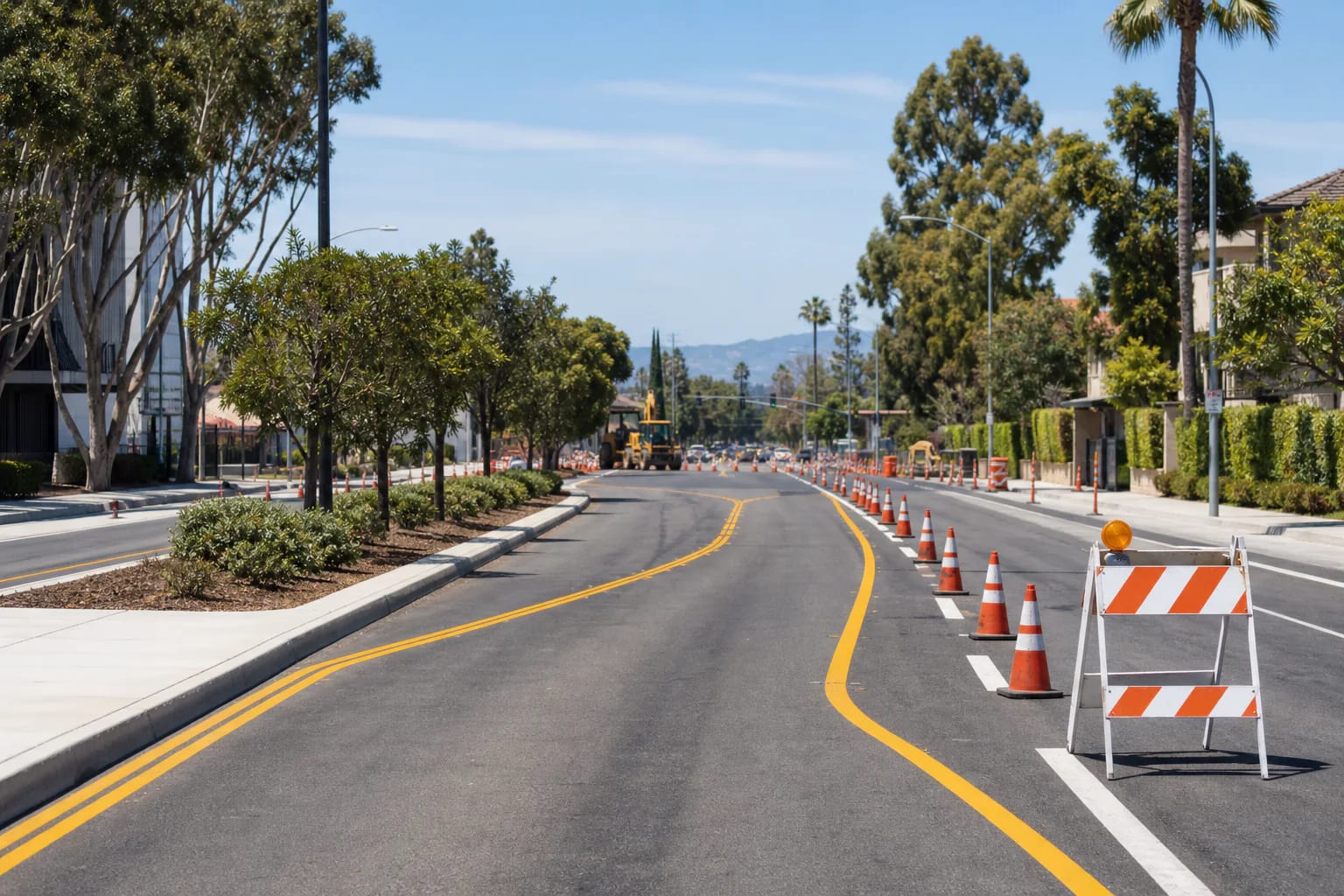
Empty California city road with an orderly temporary lane shift, orange cones, a barricade, and distant construction equipment
A reliable work-zone file separates the approved traffic-control plan, field installation, inspections, original observations, complaints, corrections, and later changes by source and time.

Quick answer

After a California road-construction incident, identify the exact project and every record custodian. Request the governing temporary traffic-control plan, approved revisions, closure and staging records, field inspections, contractor logs, complaints, and corrective actions. Keep planned, approved, installed, inspected, observed, and later-modified facts separate; no single record proves a violation or fault.

Key takeaways

  • Identify the exact project and every record custodian before requesting documents; the road owner, project owner, contractor, traffic-control subcontractor, and inspecting agency can hold different parts of the file.
  • Request the plan that governed the event period, its approved revisions, lane-closure or staging records, daily and drive-through inspections, contractor or flagger records, complaints, and corrective actions.
  • Keep planned, approved, installed, inspected, observed, reported, corrected, and later-modified facts in separate lanes.
  • A traffic-control plan, photograph, daily report, missing record, or later repair does not by itself prove a violation, dangerous condition, causation, or fault.
Hurt Advice Editorial Team

Prepared by

Hurt Advice Editorial Team

Editorial Research and Publishing Team

Source-checked editorial publishing

Why trust this article

Prepared by the Hurt Advice Editorial Team from the current California MUTCD 2026, current Caltrans Construction Manual traffic and inspection guidance, official Caltrans public-record routing, and current California statutes governing public-record determinations and public-entity claim timing. No attorney reviewed this displayed version.

Recent update: Original publication with a project-and-custodian map, six-part temporary-traffic-control packet, neutral records-request script, current-standard source guide, source-status reconciliation ledger, evidence checklist, timing cautions, common mistakes, FAQs, and next-step sequence.

At a glance

What this guide helps you decide

Start with the question that brought you here, identify the records that can verify the facts, and use the related guidance only where it helps. This article addresses car accidents questions in California.

Main question

Decide how this topic may apply to your situation

Use "California Road-Construction Traffic-Control Plans: Records to Request" to sort the facts you know, the questions still open, and whether a car accidents resource or consultation may be useful in California.

Guide map

Start with the sections most relevant to you: Quick takeaways, Who this guide is for—and the narrow task it solves, Start with the exact project, location, movement, and time

Move through the article by issue, not by guesswork, so liability, medical proof, insurance pressure, deadlines, and next steps stay connected.

Records to gather

Connect these subjects to your records: California Road Construction, Temporary Traffic Control Plan, Work Zone Records, Lane Closure Records

Compare the topic with records, photos, medical visits, police reports, insurer letters, and local claim details before relying on a general answer.

Trust check

Use the source trail before acting

This page includes 6 source references plus internal next-step paths so readers can verify where the guidance comes from.

Before you rely on this guide

This article is written for people dealing with injury-law questions in California. It is meant to help you understand the issue, not replace legal advice about your specific case.

What to do after this article

Start with the quick answer, skim the table of contents, and then use the links below to move into the practice area, author archive, or resource page that turns general guidance into a clearer next step for your situation.

Quick takeaways

  • Identify the exact project and every record custodian before requesting documents; the road owner, project owner, contractor, traffic-control subcontractor, and inspecting agency can hold different parts of the file.
  • Request the plan that governed the event period, its approved revisions, lane-closure or staging records, daily and drive-through inspections, contractor or flagger records, complaints, and corrective actions.
  • Keep planned, approved, installed, inspected, observed, reported, corrected, and later-modified facts in separate lanes.
  • A traffic-control plan, photograph, daily report, missing record, or later repair does not by itself prove a violation, dangerous condition, causation, or fault.

Who this guide is for—and the narrow task it solves

This guide is for a California driver, rider, pedestrian, passenger, family member, or authorized helper organizing records after an incident near road construction. It solves one narrow task: identify the project and build a source-labeled temporary-traffic-control file for the exact road, direction, location, date, and time period.

The construction-zone accident service guide covers the broader claim lane. The road-defect evidence topic addresses wider scene evidence. This article focuses on the plan, revisions, closure and staging records, inspections, contractor records, complaints, and changes that can show what was supposed to be installed, what was recorded in the field, and what happened later.

Do not enter a closed lane, construction area, median, shoulder, or equipment zone to collect evidence. Do not move cones, barricades, signs, lights, or materials. Address urgent medical needs first and collect only what can be obtained safely and lawfully.

Start with the exact project, location, movement, and time

“The work zone on the highway” is not a usable record locator. Record the road name and number, city and county, travel direction, nearest cross street, ramp, milepost, bridge, address, or project sign location. Identify the lane, shoulder, sidewalk, bicycle path, crossing, or detour involved. Preserve the best-supported event time and a reasonable surrounding window.

Write down what supports each detail. A photograph’s original metadata, a 911 or dispatch record, a receipt, a vehicle event record, and a witness estimate are different time sources. Keep uncertainty visible. “Photo created at 7:42:16 p.m.” is different from “witness recalls sometime after 7:30.”

Save original photographs and videos before making annotated copies. The digital-evidence preservation guide explains why an untouched original, metadata, export history, and labeled working copy should remain distinct.

Build a project-and-custodian map

Start with the agency responsible for the road: a city, county, Caltrans district, or another public entity. Ask for the project name and number, contract number, resident engineer or public-works contact, construction manager, prime contractor, traffic-control subcontractor, inspector, and records officer for the event date. Do not assume that the logo on one vehicle identifies every custodian.

For a state-highway project, Caltrans’ current Construction Manual section on traffic describes roles for resident engineers, construction engineers, inspectors, contractors, and traffic operations. It also refers to a Lane Closure System for reporting and managing closures. That official manual helps name possible record lanes for Caltrans work; it does not establish who held records for a city, county, utility, or private project.

Preserve each referral with the agency, person or unit, date, contact channel, exact answer, project identifier, and ticket or request number. A useful custody map can have several holders without implying that any one holder caused the incident.

Request a six-part temporary-traffic-control packet

  1. Governing plan: the contract traffic-control plan, standard-plan references, detour or motorist-information plan, special provisions, approved shop drawings, and sheets applicable to the exact stage and location.
  2. Revisions and authorization: requests to modify the plan, approved revisions, change orders, field instructions, implementation dates, temporary conditions, and records identifying who approved and installed each change.
  3. Closure and staging: lane-closure requests or schedules, Lane Closure System records where applicable, start and end times, traffic breaks, rolling closures, stage changes, detours, and reopening records.
  4. Inspection and daily records: inspector and resident-engineer daily reports, drive-through checks, device condition notes, photographs, weather and traffic observations, deficiency notices, and follow-up verification.
  5. Contractor operations: traffic-control logs, flagger assignments and logs when they exist, crew and equipment records, delivery or pickup records for devices, subcontractor reports, and communications tied to the exact period.
  6. Event and correction: complaints, service calls, collision or incident notifications, emergency changes, maintenance, replacements, corrective action, and later plan or field changes.

Request existing records and their native identifiers. Record systems, terminology, retention, exemptions, and availability vary. Do not ask an agency to create a new engineering analysis or declare whether the layout complied with a standard.

Use a narrow records-request script

Adapt this neutral script to the known facts:

“Please identify the project and units or contractors responsible for temporary traffic control at [road, direction, exact location, city/county, and project number if known] on [date] from [start time] through [end time]. For that location and period, please provide available existing records showing the governing traffic-control, detour, staging, or lane-closure plan; approved revisions and effective times; lane-closure requests, schedules, system records, and opening or closing times; daily, drive-through, and device inspections; photographs and deficiency or correction records; relevant contractor, traffic-control subcontractor, and flagger logs; complaints, incident notices, service calls, and corrective actions; and records identifying the custodian of any requested category your agency does not hold. This request does not ask for a new analysis or legal conclusion.”

Use a narrow event window for closure and operations data, then state a separately justified period for complaints, inspections, and changes. Keep the exact request, proof of delivery, tracking number, clarification, determination, production estimate, rolling productions, redactions, exemptions, and no-record responses.

Understand what the current California standards can—and cannot show

Caltrans says the California MUTCD 2026 became effective January 18, 2026 and includes Part 6 for temporary traffic control. It supplies statewide traffic-control-device standards and typical applications. The governing edition, contract documents, local requirements, project stage, and event date still must be identified for the actual location.

Caltrans’ official traffic section says all contract plans and special provisions must include a traffic-control plan and describes review, administration, changes, and inspection responsibilities on Caltrans projects. Its separate temporary-traffic-control inspection section says a drive-through inspection should be documented in the daily report with weather, traffic conditions, and inspection time.

Those statements identify useful records and source questions. They do not prove that a particular plan applied, that field devices matched it, that a difference was unsafe, or that a difference caused an event. Qualified case-specific review may need the complete contract, approved changes, geometry, sight distance, lighting, traffic, photographs, witness accounts, and event sequence.

Separate plan, approval, installation, inspection, and observation

Create a source-status ledger with one row per item. Use columns for date and time; source and custodian; project, stage, location, and direction; record identifier; what it states or shows; status; and unresolved questions. Give status its own field: planned, submitted, approved, scheduled, installed, inspected, observed, reported, corrected, removed, or later modified.

Example: “Plan sheet TCP-14, revision 3, approved June 2, stage 2: right lane taper begins at station X.” A separate row might say: “Original phone photo created June 8 at 7:42 p.m.; shows five cones from the photographer’s position; start of taper is outside frame.” A third might say: “Daily report June 8: drive-through completed at 5:30 p.m.; no attachment listed.” None of those rows alone establishes the full field layout at 7:42 p.m.

Keep later action in its own lane. A cone replacement, sign relocation, restriping, reopened lane, or revised plan can be important, but it is not automatically an admission about earlier conditions. Preserve the wording, time, author, attachment, revision number, and status instead of rewriting the record as a conclusion.

Compare the approved plan with safe, original scene evidence

Use original scene media to identify what is actually visible: approach direction, lane lines, taper, cones, drums, barricades, signs, lights, barriers, equipment, sidewalk or bicycle detour, and sight lines. Record the photographer’s position and what lies outside the frame. Do not estimate exact distances from a single image unless a reliable method and scale support the estimate.

If road material or an unsecured object is involved, the road-debris evidence guide covers the object and source lane. If a temporary pedestrian route or signal is involved, the crosswalk signal records guide explains how to keep approved settings, observations, and operational records separate.

Do not recreate a drive-through, walk the work zone, stop in a live lane, fly a drone, trespass, or handle devices. Lawful photographs from a safe public position, existing agency or contractor records, original dashcam files, and professional investigation can answer different questions without creating a new hazard.

Know what the Public Records Act clock means

California Government Code section 7922.535 says an agency receiving a request for copies must determine within 10 days whether it seeks disclosable public records in the agency’s possession and promptly notify the requester. In unusual circumstances, written notice can extend that determination period by no more than 14 days.

That is a determination period, not a guarantee that every responsive record will be produced within 10 days. The statute addresses unusual circumstances such as records at field facilities, voluminous records, consultation, and compilation or extraction of data. Preserve the agency’s estimated production date and any request to narrow or clarify.

Caltrans District 4’s official public-record request page lists construction project documents as a frequently requested category. That is a useful routing example, not proof that every district or local agency uses the same portal or holds the same record set. A denial, redaction, exemption, no-record result, or referral should be preserved exactly.

Keep preservation, records, and government-claim clocks separate

Plans, closure-system data, daily reports, contractor communications, photographs, complaints, and device records can follow different retention or change practices. Send focused preservation and records requests promptly, but do not claim a universal retention period unless the actual custodian or controlling rule supports it.

When a public entity may be involved, California Government Code section 911.2 states that a claim relating to injury to a person or personal property must generally be presented no later than six months after accrual. Agency identity, accrual, claim contents, presentation, exceptions, late-claim procedures, and other rules require case-specific analysis.

A public-record request is not a government claim and does not necessarily protect a claim deadline. A preservation letter, insurer notice, police report, contractor claim, and civil filing also serve different functions. The public-transit claim guide illustrates why public-entity identity and claim procedure can add a separate lane.

Use a source-and-status evidence checklist

  • Location: road, route, direction, city, county, nearest cross street, ramp, milepost, project limits, lane, sidewalk, crossing, or detour.
  • Time: event date, supported time window, time source, device setting if relevant, weather and lighting, and uncertainty.
  • Project: project and contract numbers, owner, road agency, resident engineer or public-works unit, construction manager, contractor, traffic-control subcontractor, inspector, and records officer.
  • Plan: governing sheets, standard-plan references, special provisions, stage, detour, shop drawings, revision history, approvals, and effective times.
  • Operations: closure requests, schedules, system entries, traffic breaks, stage changes, installation, removal, reopening, and flagger or crew logs when available.
  • Inspection: daily and drive-through reports, device condition, photographs, weather, traffic, deficiency, maintenance, correction, and verification.
  • Original media: untouched files, metadata, creator, device, export history, photographer position, and labeled copies.
  • Requests: preservation notice, request text, delivery, tracking, clarification, determination, estimate, production, referral, redaction, exemption, and no-record response.

Common mistakes and red flags

  • Requesting only the “traffic-control plan”: the revisions, stage, closure, daily inspection, contractor, complaint, and correction records answer different questions.
  • Assuming the road owner holds everything: map the project owner, contractor, traffic-control subcontractor, inspector, and system custodian.
  • Ignoring the event time: one project can move through several stages, closures, installations, and removals in a day.
  • Treating a standard drawing as the field record: typical applications, contract sheets, approved changes, installed conditions, and observations are separate sources.
  • Treating a later correction as an admission: preserve what changed, when, by whom, and why without adding a legal conclusion.
  • Measuring or moving devices: do not enter a live work zone, stop in traffic, trespass, or disturb safety equipment.
  • Waiting for production before checking deadlines: records and claim-presentation processes run on different clocks.
  • Overlooking source limits: a photograph, report, or plan can omit what happened before, after, outside the frame, or in another custodian’s system.

Next steps: a seven-part action sequence

  1. Address urgent care and immediate safety; do not enter or alter the work zone.
  2. Record the exact road, direction, location, project clues, movement, and best-supported event time.
  3. Preserve original scene media, metadata, witness contacts, reports, and care timing.
  4. Ask the road agency to identify the project, contract, responsible units, contractor, traffic-control subcontractor, and records officer.
  5. Send a narrow preservation and records request for the six-part packet and keep delivery proof.
  6. Build the source-status ledger and keep planned, approved, installed, inspected, observed, reported, corrected, and later-modified facts separate.
  7. Seek case-specific California advice before a public-entity deadline, disputed records response, technical inspection, or liability conclusion.

The California injury-claim proof guide can help connect this project file to other source lanes without overstating any item. Hurt Advice is a lawyer-referral and legal-information service, not a law firm. This article provides general educational information, not legal, engineering, traffic-control, investigation, safety, or medical advice. No attorney reviewed this displayed version. A licensed California attorney can evaluate the actual project, records, conditions, conduct, injuries, public-entity issues, and deadlines. You can use the Hurt Advice contact page to request a referral.

Frequently Asked Questions

Who keeps traffic-control-plan records for California road construction?
Records may be divided among a city, county, Caltrans district, another project owner, a resident engineer or public-works unit, the prime contractor, a traffic-control subcontractor, an inspector, and a closure or document system. Identify the exact project and ask each holder which record categories it maintained on the event date.
What records should I request after a construction-zone incident?
Request the governing traffic-control, detour, staging, and lane-closure plan; approved revisions and effective times; closure schedules and system records; daily and drive-through inspections; field photographs and deficiency records; relevant contractor or flagger logs; complaints, incident notices, maintenance, corrective actions, and custodian referrals.
Does a traffic-control plan prove how the work zone looked at the incident time?
No. A plan can show intended or approved control for a project stage, but event-specific field conditions may require approved revisions, installation and removal records, inspections, photographs, closure times, contractor records, original scene media, and witness accounts. Keep the plan, field records, observations, and later changes separate.
Does a later cone or sign change prove the earlier setup was wrong?
Not by itself. A later replacement, relocation, restriping, reopened lane, or revised plan can be relevant, but its meaning depends on timing, source, reason, project stage, and the other evidence. Preserve the exact record and change time without treating the later action as an automatic admission.
How long does a California agency have to respond to a public-records request?
Government Code section 7922.535 generally gives the agency 10 days to determine whether the request seeks disclosable public records in its possession. Written notice may extend that determination by no more than 14 days in unusual circumstances. This does not guarantee full production within 10 days.
Does a public-records request protect a California government-claim deadline?
Not necessarily. A records request and a government claim are different processes. Government Code section 911.2 generally requires a claim relating to personal injury or personal-property injury to be presented within six months after accrual, subject to definitions, exceptions, and procedures. Seek case-specific advice promptly.

Sources and references

California Department of TransportationCalifornia MUTCD 2026

Current official California traffic-control-device manual, effective January 18, 2026, including Part 6 Temporary Traffic Control.

California Department of TransportationCaltrans Construction Manual, Section 2-2 Traffic

Current official project planning, traffic-control-plan, role, Lane Closure System, change, inspection, and project-record guidance for Caltrans construction.

Need help after an accident?

Hurt Advice intake team can review your situation, explain your options, and help you move forward with a plan that fits your case.