
Legal ExplainerCar AccidentsInformational

California Road-Debris Crashes: Evidence and Liability

After a California road-debris crash, get to safety and seek appropriate medical care before collecting proof. Preserve the object trail, approach path, original video, witnesses, vehicle damage, and identifying clues without entering traffic. Then separate two questions: did cargo just escape from a vehicle, or had the object become a roadway condition? Each path points to different records, parties, and timing rules.

Published

July 16, 2026

Updated

July 16, 2026

Reading time

10 min read

Jurisdiction

California

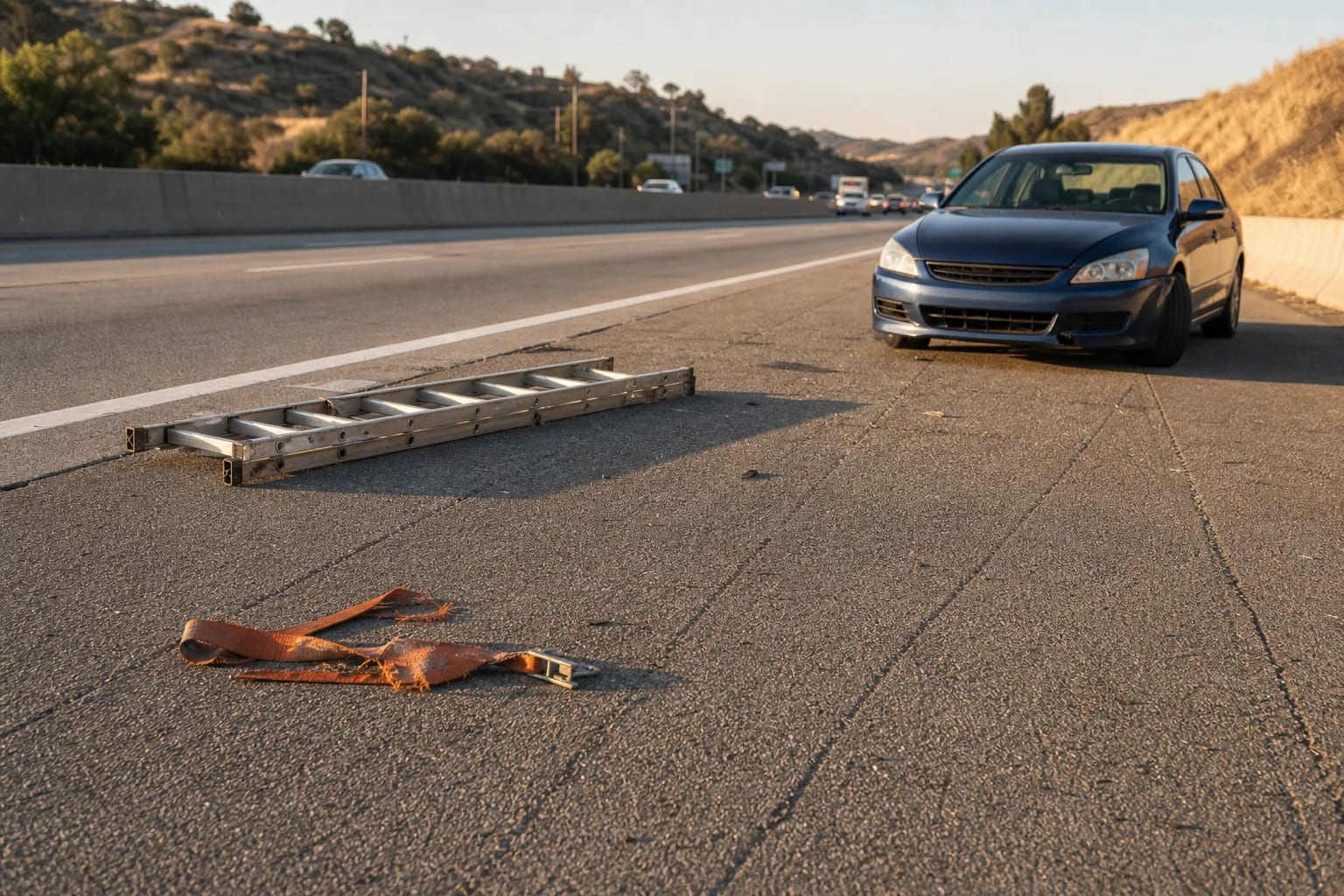
Aluminum ladder and torn cargo strap on a California freeway shoulder near a damaged blue car
Road-debris cases often turn on the object trail, its source, and the records connecting time, place, load, and roadway response.

Quick answer

After a California road-debris crash, protect people first, then preserve the object, lane position, approach path, dashcam original, witnesses, vehicle damage, and source-vehicle clues. The key question is whether cargo just escaped from a vehicle or the object had become a roadway condition, because those paths require different records, parties, and timing analysis.

Key takeaways

  • <strong>Protect people before proof:</strong> never walk into a live lane, stand behind a disabled vehicle, or chase the suspected source vehicle.
  • <strong>Preserve the chain:</strong> keep original video and photos, record who collected any object, and do not alter the source files.
  • <strong>Identify before accusing:</strong> write down observable facts—vehicle type, plate characters, company markings, route, time, and direction—without guessing.
  • <strong>Calendar separate clocks:</strong> evidence loss, insurance notice, a possible public-entity claim, and a civil filing deadline are different issues.
Hurt Advice Editorial Team

Prepared by

Hurt Advice Editorial Team

Editorial Research and Publishing Team

Source-checked editorial publishing

Why trust this article

Prepared by the Hurt Advice Editorial Team from current California statutes, California Highway Patrol and Caltrans procedures, canonical site contracts, and original image review. No attorney reviewed this displayed version.

Recent update: Original publication explaining road-debris source identification, load-securement evidence, roadway records, government-claim timing, and safe preservation steps.

At a glance

What this guide helps you decide

Start with the question that brought you here, identify the records that can verify the facts, and use the related guidance only where it helps. This article addresses car accidents questions in California.

Main question

Decide how this topic may apply to your situation

Use "California Road-Debris Crashes: Evidence and Liability" to sort the facts you know, the questions still open, and whether a car accidents resource or consultation may be useful in California.

Guide map

Start with the sections most relevant to you: What is the short answer?, Who this guide helps—and what it does not decide, Use this two-track decision tool

Move through the article by issue, not by guesswork, so liability, medical proof, insurance pressure, deadlines, and next steps stay connected.

Records to gather

Connect these subjects to your records: road debris crashes, unsecured loads, evidence preservation, dangerous road conditions

Compare the topic with records, photos, medical visits, police reports, insurer letters, and local claim details before relying on a general answer.

Trust check

Use the source trail before acting

This page includes 6 source references plus internal next-step paths so readers can verify where the guidance comes from.

Before you rely on this guide

This article is written for people dealing with injury-law questions in California. It is meant to help you understand the issue, not replace legal advice about your specific case.

What to do after this article

Start with the quick answer, skim the table of contents, and then use the links below to move into the practice area, author archive, or resource page that turns general guidance into a clearer next step for your situation.

What is the short answer?

After a California road-debris crash, get out of danger and obtain medical help before collecting proof. From a safe location, preserve the debris, its lane position, the complete approach path, vehicle damage, dashcam original, witnesses, nearby cameras, and any identifying details from the vehicle that dropped the item. Report a live highway hazard to 911 or the appropriate road authority; do not enter traffic or retrieve debris yourself.

The first legal fork is whether the object just escaped from a vehicle or had become a roadway condition. That distinction changes which records matter. A dropped-load case may focus on the driver, vehicle owner, employer, loader, contractor, or carrier. A roadway-condition theory may require proof about who controlled the road, who created the condition, notice, response time, and government-claim procedure.

  • Protect people before proof: never walk into a live lane, stand behind a disabled vehicle, or chase the suspected source vehicle.
  • Preserve the chain: keep original video and photos, record who collected any object, and do not alter the source files.
  • Identify before accusing: write down observable facts—vehicle type, plate characters, company markings, route, time, and direction—without guessing.
  • Calendar separate clocks: evidence loss, insurance notice, a possible public-entity claim, and a civil filing deadline are different issues.

Who this guide helps—and what it does not decide

This guide is for a driver, passenger, motorcyclist, bicyclist, pedestrian, or family member organizing evidence after a ladder, tire tread, furniture, gravel, construction material, trash, or another object contributed to a California crash. It also helps when the responsible vehicle left before anyone could identify it.

The live road-debris accident service guide explains the broader claim category. This article owns a narrower task: preserving the object trail, identifying its likely source, and separating a recently dropped load from an existing road condition. Use the digital-evidence guide for file integrity and device data, and the truck-record guide when a commercial carrier has been identified.

A debris photograph alone does not prove who dropped the object, when it arrived, or who had time to remove it. A traffic citation can matter without deciding civil responsibility. Insurance coverage, employment, vehicle ownership, comparative fault, causation, and damages all require facts beyond the object itself. This guide therefore uses “may,” “can,” and “could” where the answer depends on evidence.

Use this two-track decision tool

Start with the last reliable observation before impact. If the source is uncertain, preserve both tracks and label every fact as confirmed, reported by a witness, inferred, or unknown. That simple discipline prevents an early assumption from narrowing the investigation.

  • Track A — object escaped from a vehicle: look for video of the drop, a matching vehicle or trailer, plate characters, company or permit markings, load type, straps or tie-down remnants, exit or route, witness descriptions, and matching damage on the source vehicle.
  • Track B — object was already on the roadway: record its exact location, how long witnesses observed it, earlier 911 or service reports if obtainable, road ownership, construction activity, maintenance response, prior complaints, and whether another private party created it.
  • Mixed track: an object may fall from a private vehicle and later remain long enough for road-control facts to matter. Preserve source-vehicle proof and public-response proof without assuming both theories are valid.
  • Unknown source: preserve uninsured-motorist policy documents and give the insurer accurate facts, but do not promise that a particular coverage applies. Policy language and California law control the result.

Seven safe steps to take after the crash

Use these steps in order only when conditions allow. A freeway shoulder can remain dangerous after traffic begins moving again.

  • 1. Move out of danger. Call 911 for injuries, a blocked lane, fire, leaking fluids, or another immediate hazard. Follow responder directions and do not stop in a place that exposes you to traffic.
  • 2. Get appropriate medical care. Tell the clinician what happened and describe symptoms accurately. Do not exaggerate, minimize, or turn this evidence task into a diagnosis.
  • 3. Capture the whole approach. From a protected location, photograph the road curve, grade, lighting, lane markings, shoulder, sight distance, traffic controls, work zone, and where the object and vehicles came to rest.
  • 4. Preserve source clues. Save dashcam video before it loops over. Note plate characters, vehicle body type, trailer, load, color, markings, direction, nearest exit, and exact time. Ask witnesses for their own words and contact details.
  • 5. Document the object without moving it. Photograph scale, material, markings, fractures, dirt, fresh scrape patterns, straps, fasteners, tire impressions, and vehicle transfer marks. Let law enforcement or the road authority handle a dangerous object.
  • 6. Report accurately. Give law enforcement and insurers facts, not conclusions. Ask for an incident or report number and write down which agency responded.
  • 7. Back up originals. Keep unedited files, export full message threads, retain receipts and towing records, and make a second copy. The accident evidence checklist can help organize the broader file.

Build an evidence package that can identify the source

A useful package connects time, place, object, vehicle, and damage. Begin with a one-page event log: exact or estimated time, highway and direction, nearest exit or cross street, lane, weather, traffic, first sight of the object, evasive action, impact, and where each vehicle stopped. Mark estimates as estimates.

Preserve the original dashcam card or full-resolution export, not only a social-media clip or screen recording. Save at least several minutes before and after impact because the source vehicle may appear earlier than the falling object. Record camera clock accuracy and any time-zone or daylight-saving offset. For phone photos, retain the original files and avoid editing the only copy.

Look outward. Nearby businesses, homes, buses, work vehicles, toll or managed-lane facilities, construction projects, and other drivers may have cameras. Ask promptly and politely whether footage exists, but do not claim a private person must release it to you. A lawyer can evaluate a formal preservation request or subpoena when appropriate.

If CHP investigated, a proper party of interest can use the agency’s CHP 190 collision-report process. If another police department investigated, request that agency’s report instead; CHP states it cannot obtain a report investigated by another department.

Request the right records without overclaiming

Once a possible source is identified, the useful record list becomes specific. For a pickup, trailer, contractor, or commercial carrier, consider the dispatch record, route, driver assignment, vehicle ownership, inspection records, load manifest, loading location, photographs, bills or tickets, tie-down inventory, telematics, dashcam, nearby fleet video, incident report, and communications about the missing item. Not every record exists, belongs to the same organization, or has one universal retention period.

For a state-highway condition, identify the correct Caltrans district and describe the location, direction, lane, date, and time. Caltrans District 4, for example, lists maintenance and incident reports among frequently requested records and asks requesters to describe documents specifically. Review the agency’s records-request guidance, then use the channel for the district that controlled the road. A records request is not a preservation order and does not prove notice or liability.

A concise preservation message can say: “Please preserve records reasonably related to the road-debris incident at [exact location and direction] on [date] between [time range], including available video, dispatch, route, vehicle, driver, loading, maintenance, incident, and communication records. This request does not ask you to create records. Please confirm the correct recipient for any formal request.”

Keep proof of delivery and the exact wording. Do not demand privileged material, threaten a witness, pose as law enforcement, or state that evidence destruction occurred without proof.

What California load and roadway law actually says

California Vehicle Code section 23114(a) generally says a vehicle may not be driven or moved on a highway unless it is constructed, covered, or loaded to prevent contents or a load—subject to stated exceptions—from dropping, sifting, leaking, blowing, spilling, or otherwise escaping. The section also contains detailed aggregate-material rules and exceptions. Read the exact current text of section 23114. A statutory violation may be important evidence, but a civil claim still requires the applicable legal elements and proof tying the violation to the harm.

When the theory concerns public property, Government Code section 835 sets a demanding framework. The claimant must establish a dangerous condition at the time of injury, causation, a reasonably foreseeable risk of that kind of injury, and either creation by a public employee acting within the scope of employment or actual or constructive notice to the public entity with enough time to protect against it. Review Government Code section 835. Other statutes, defenses, and immunities may apply.

That means “debris was on a state highway” is not the same as “Caltrans is liable.” Road ownership, creation, notice, timing, response, causation, foreseeable risk, and statutory defenses require evidence. The same caution applies to a city or county road. Identify the entity that controlled the location rather than sending the same notice to every agency.

Timing and process: separate the clocks

Evidence can disappear before a legal deadline arrives. Dashcams overwrite, traffic video rotates, vehicles return to service, debris is discarded, and memories fade. Start preservation promptly, but do not turn “promptly” into a made-up universal number. Ask each known custodian about its actual process and do not assume an informal email stops deletion.

If a California public entity may be involved, Government Code section 911.2(a) generally requires a claim relating to death, personal injury, or personal-property injury to be presented no later than six months after accrual. Read section 911.2. The correct recipient, required contents, accrual, late-claim procedure, exceptions, and later lawsuit timing need separate analysis. Presenting a government claim is not the same as filing a lawsuit.

For a covered California action seeking recovery for injury or death caused by another’s wrongful act or neglect, Code of Civil Procedure section 335.1 states a two-year period. Read section 335.1. Other causes of action, defendants, government procedures, accrual rules, tolling, contractual terms, and facts can change the analysis. Do not wait for the longest period you have heard about.

Insurance notice is another clock. Review the actual policy and report truthfully. The insurance-claim guide explains the basic communication path, while the California injury-proof guide covers medical and loss documentation beyond the debris source.

Use this evidence checklist before the file goes cold

A complete file does not need every possible item. It needs the strongest available proof for identity, mechanism, notice, causation, injury, and loss, with gaps stated honestly.

  • Scene: approach path, lane, shoulder, location marker, road geometry, visibility, lighting, weather, traffic controls, construction activity, debris position, and cleanup.
  • Source identity: plate characters, vehicle and trailer description, markings, load, route, direction, witness accounts, video, and matching source-vehicle damage.
  • Object: material, dimensions, markings, serial or rental label if safely visible, straps or fasteners, fractures, scrape or transfer marks, and who took custody.
  • Response: 911 time, responding agency, report number, tow record, road-authority call, lane closure, cleanup crew, incident number, and photographs taken by responders if obtainable.
  • Vehicle and insurance: damage photographs, repair estimate, diagnostic data if relevant, rental and towing receipts, policy, declarations, claim number, and accurate communications.
  • Health and loss: timely care records, symptoms reported accurately, work restrictions, wage records, expenses, and a simple event timeline rather than a coached narrative.
  • Integrity: originals, backups, metadata, export method, custodian, dates, delivery receipts, and a log of any edits made only to working copies.

Mistakes and red flags to avoid

The most dangerous mistake is risking a second collision to collect evidence. Stay out of traffic and let responders handle a live hazard. Do not follow or confront a suspected source vehicle. Call 911 with location and direction when the object creates an immediate danger.

Do not post an edited clip as the only surviving copy, discard the dashcam card after exporting one segment, wash away transfer marks before documenting them, repair the vehicle before recording damage, or hand the only original object to a private person without a receipt. If an object is lawfully released to you, store it safely and document condition and custody; do not test or alter it yourself.

Treat unsolicited promises carefully. No one can guarantee that a blurry plate will be enhanced, that an agency will accept liability, that uninsured-motorist coverage applies, or that a case has a particular value. Be skeptical of pressure to sign broad releases, give a rushed recorded statement, or settle before the injury picture and responsible parties are understood.

Hurt Advice is a lawyer referral and legal information service, not a law firm. This article is educational, does not create an attorney-client relationship, and does not guarantee routing, representation, free legal services, insurance coverage, case value, timing, or any outcome.

Careful next steps

Create the event log today, back up original files, request the responding agency’s report through the correct channel, identify the road authority, and list every possible private custodian without accusing anyone. Then compare what you have with the seven evidence categories above and mark the missing items that are likely to change or disappear.

If a commercial vehicle may be involved, the truck-accident hub and carrier-record guide can help frame the next questions. For a broader driver-side path, use the car-accident hub. Hurt Advice’s source policy explains how this guide uses primary authority and distinguishes legal information from individual advice.

A California injury lawyer can evaluate the responsible parties, public-entity procedure, policy language, preservation options, and deadlines using the actual facts. Asking for an evaluation does not guarantee acceptance or representation, and you should not delay urgent medical care or a legal deadline while waiting for a response.

Frequently Asked Questions

What should I photograph after a California road-debris crash?
From a safe location, photograph the complete approach path, lane and shoulder, road geometry, lighting, debris position and details, vehicle damage, scrape or transfer marks, nearby cameras, and cleanup. Do not enter traffic or move a dangerous object to get a better picture.
Who may be responsible when cargo falls from a vehicle?
Depending on proof, potentially relevant parties can include the driver, vehicle or trailer owner, employer, carrier, loader, contractor, or another organization that controlled the load. A plate, logo, or citation alone does not establish every element of responsibility.
Is Caltrans automatically liable for debris on a state highway?
No. Government Code section 835 requires proof of a dangerous condition, causation, foreseeable risk, and either public-employee creation or actual or constructive notice with enough time to protect against it. Defenses and immunities may also apply.
How do I get a California Highway Patrol collision report?
If CHP investigated and you are a proper party of interest, use the CHP collision-report process and form CHP 190 or the agency’s available request channel. If another police department investigated, request that agency’s report instead.
What deadline may apply to a California public-entity claim?
Government Code section 911.2 generally requires covered claims for death, personal injury, or personal-property injury to be presented within six months after accrual. Correct recipient, claim content, accrual, late-claim rules, exceptions, and lawsuit timing require separate review.
Does Hurt Advice represent me after a road-debris crash?
No. Hurt Advice is a lawyer referral and legal information service, not a law firm. Reading this article or submitting intake information does not create an attorney-client relationship, guarantee routing or representation, promise free legal services, or predict coverage, value, timing, or an outcome.

Sources and references

Need help after an accident?

Hurt Advice intake team can review your situation, explain your options, and help you move forward with a plan that fits your case.