
Legal ExplainerCar AccidentsInformational

California Roadside-Assistance Crashes: Evidence to Save

After a California roadside-assistance crash, protect yourself first, then preserve the scene, warning setup, service assignment, and complete ownership trail. The legal question is not simply whether a tow truck or service van was present. Vehicle position, warning lights, cones, traffic conditions, who controlled the work, and whether a public entity was involved can change both the evidence plan and the timing analysis.

Published

July 16, 2026

Updated

July 16, 2026

Reading time

10 min read

Jurisdiction

California

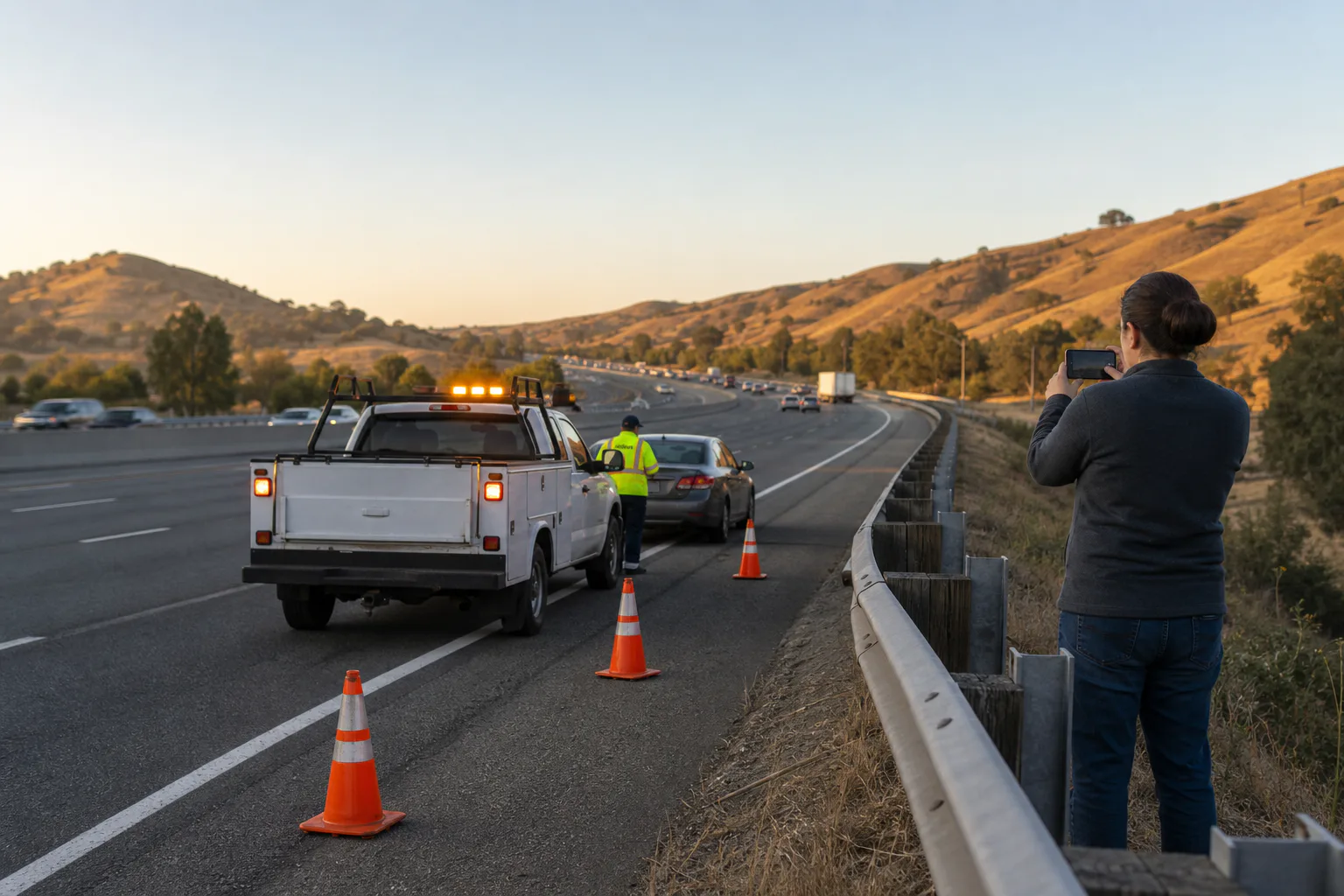
A witness safely photographs an unbranded roadside service vehicle assisting a disabled car on a California freeway shoulder
A roadside-crash file should show the vehicle position, warning setup, traffic approach, service assignment, and who controlled the response.

Quick answer

After a California roadside-assistance crash, protect yourself first, then preserve the vehicle positions, warning lights, cones, sight lines, service ticket, dispatch trail, and witness originals. The move-over rule depends on the vehicle’s position and warnings—not merely its job. Identify every owner, operator, employer, contractor, insurer, and public entity before choosing a deadline.

Key takeaways

  • <strong>Safety first:</strong> do not stand in a live lane or cross traffic to take a photograph.
  • <strong>Preserve the warning setup:</strong> capture lights, hazards, cones, flares, reflective devices, lane closure, guardrail, and the view an approaching driver had.
  • <strong>Trace the work:</strong> save the service ticket, app request, dispatch time, arrival notice, invoice, membership record, and all company communications.
  • <strong>Separate deadlines:</strong> a 10-day DMV report, a possible six-month public-entity claim, and an ordinary civil limitations period are different requirements.
Hurt Advice Editorial Team

Prepared by

Hurt Advice Editorial Team

Editorial Research and Publishing Team

Source-checked editorial publishing

Why trust this article

Prepared by the Hurt Advice Editorial Team from current California statutes, California Highway Patrol procedures, canonical site contracts, and original image review. No attorney reviewed this displayed version.

Recent update: Original publication explaining roadside-warning evidence, the move-over rule, service records, and California reporting and claim timing.

At a glance

What this guide helps you decide

Start with the question that brought you here, identify the records that can verify the facts, and use the related guidance only where it helps. This article addresses car accidents questions in California.

Main question

Decide how this topic may apply to your situation

Use "California Roadside-Assistance Crashes: Evidence to Save" to sort the facts you know, the questions still open, and whether a car accidents resource or consultation may be useful in California.

Guide map

Start with the sections most relevant to you: What is the short answer?, Who this guide helps and why the distinction matters, Use this three-scenario roadside decision tool

Move through the article by issue, not by guesswork, so liability, medical proof, insurance pressure, deadlines, and next steps stay connected.

Records to gather

Connect these subjects to your records: roadside-assistance crashes, tow truck evidence, move-over rule, disabled vehicles

Compare the topic with records, photos, medical visits, police reports, insurer letters, and local claim details before relying on a general answer.

Trust check

Use the source trail before acting

This page includes 7 source references plus internal next-step paths so readers can verify where the guidance comes from.

Before you rely on this guide

This article is written for people dealing with injury-law questions in California. It is meant to help you understand the issue, not replace legal advice about your specific case.

What to do after this article

Start with the quick answer, skim the table of contents, and then use the links below to move into the practice area, author archive, or resource page that turns general guidance into a clearer next step for your situation.

What is the short answer?

After a California roadside-assistance crash, move to safety and obtain medical help before collecting evidence. From a protected location, preserve the approach lane, shoulder, vehicle positions, warning lights, cones or flares, sight distance, damage, and nearby cameras. Identify the disabled vehicle, roadside vehicle, driver, technician, service company, dispatcher, vehicle owner, insurer, and any public agency or contractor.

Do not assume California’s move-over rule applies merely because someone was helping a disabled car. The statutory trigger turns on a stationary vehicle, its position next to the highway, and specified lights or warning devices. A moving service vehicle or a vehicle separated by a protective barrier requires a different analysis.

  • Safety first: do not stand in a live lane or cross traffic to take a photograph.
  • Preserve the warning setup: capture lights, hazards, cones, flares, reflective devices, lane closure, guardrail, and the view an approaching driver had.
  • Trace the work: save the service ticket, app request, dispatch time, arrival notice, invoice, membership record, and all company communications.
  • Separate deadlines: a 10-day DMV report, a possible six-month public-entity claim, and an ordinary civil limitations period are different requirements.

Who this guide helps and why the distinction matters

This guide is for a driver, passenger, technician, pedestrian, bicyclist, or family member organizing records after a collision involving a tow truck, roadside-assistance pickup, mobile mechanic, tire-service vehicle, disabled car, or another warned stationary vehicle. It covers post-crash evidence and timing, not fault predictions, insurance coverage, or case value.

The existing roadside towing service guide helps readers decide whether that service lane fits. This article answers a narrower question: what facts prove where the roadside operation was, which warnings were visible, how traffic approached, and which organizations controlled the response. For a broader business-vehicle frame, compare the commercial-vehicle accident guide.

A label on a vehicle does not settle responsibility. The service company, vehicle owner, driver’s employer, dispatch platform, motor club, public agency, maintenance contractor, and insurer may be different entities. Record what each one did before drawing a conclusion about who may be responsible.

Use this three-scenario roadside decision tool

Start by placing the scene into one of three lanes. If the facts are uncertain, preserve evidence for all plausible lanes and mark each fact as confirmed, reported, or unknown.

  • Lane 1 — stationary tow truck with flashing amber warning lights: record whether it was next to the highway, which lights were on, the adjacent travel lane, whether a safe lane change was practicable, traffic and weather, and whether a barrier separated the truck from traffic.
  • Lane 2 — another stationary vehicle displaying hazards or a warning device: record hazard lights, cones, flares, reflective devices, exact position, time of day, visibility, and whether the warning could be seen along the full approach path.
  • Lane 3 — moving service vehicle or no qualifying warning setup: preserve speed, lane changes, signals, braking, route, video, telematics if they exist, and ordinary collision evidence. Do not force a stationary-vehicle statute onto moving facts.
  • Public-entity overlay: if Caltrans, a city, county, CHP-contracted responder, or another public entity may have controlled a vehicle or roadway operation, identify the exact entity and contract immediately because claim-presentation rules may be separate and shorter.

How California’s move-over rule applies

California Vehicle Code section 21809 applies when a driver on a highway approaches a specified stationary vehicle displaying the required warning. The current text covers a stationary authorized emergency vehicle with emergency lights, a stationary tow truck with flashing amber warning lights, a stationary marked highway-maintenance vehicle with flashing amber lights, and any other stationary vehicle displaying hazard lights or another warning device such as cones, flares, or retroreflective devices. Read the exact current section 21809.

Before passing in an immediately adjacent lane, the driver must approach with due caution and, if practicable and lawful, move into an available nonadjacent lane. If that lane change would be unsafe or impracticable, the statute calls for slowing to a reasonable and prudent speed safe for the existing conditions. Section 21809(c) says the requirement does not apply when the stationary vehicle is not adjacent to the highway or is separated from it by a protective physical barrier.

Vehicle Code section 25253 separately addresses tow-truck amber lamps. Tow trucks used to tow disabled vehicles must be equipped with flashing amber warning lamps; they may display those lamps while providing service to a disabled vehicle. The section limits freeway display to circumstances involving an unusual traffic hazard or extreme hazard. Review section 25253’s complete lamp rules.

These statutes identify duties and triggers; they do not prove which lights were working, what a driver could see, whether a lane change was practicable, causation, comparative responsibility, or damages in a particular crash. That is why the physical scene and warning evidence matter.

What to do at the scene and during the first day

Call 911 for an emergency and follow responder directions. If you can act without entering traffic, use the car-accident checklist to record the exact time, roadway, direction of travel, lane, shoulder width, weather, lighting, visibility, traffic density, vehicle positions, and sequence of events.

Vehicle Code sections 20001 and 20003 require a driver involved in an injury collision to stop and provide specified identity, vehicle-registration, owner, and occupant information, and section 20003 also requires reasonable assistance to an injured person. See section 20001 and section 20003. These criminal collision duties do not decide civil fault.

Photograph wide views before close-ups: the entire approach, travel lanes, shoulder, guardrail, curve or grade, traffic signs, warning devices, final vehicle positions, debris, tire or scrape marks, and camera locations. Then capture all visible sides of the vehicles, damage, unit numbers, license plates, and unbranded or branded identifying features. Avoid photographing injured strangers or private information.

Ask witnesses for names, contact information, where they stood, what direction they faced, and original unedited files. The digital-evidence preservation guide explains how to keep originals, metadata, and backups rather than relying on screenshots or social-media copies.

Build this roadside evidence checklist

Not every operator creates or retains every record. Ask the correct custodian to identify and preserve relevant material without asserting that a file must exist or has a universal retention period. Keep a request log with the recipient, date, delivery proof, response, and follow-up.

  • Scene file: wide and close photographs, measurements, diagrams, collision report, witness originals, 911 audio, traffic or nearby business video, lighting, sight distance, barriers, shoulder condition, lane-control devices, and weather.
  • Warning file: amber lamps, hazards, cones, flares, reflective devices, arrow boards, technician clothing, their placement and spacing, activation records if they exist, maintenance records, and post-crash inspection.
  • Service file: request or app record, membership or policy number, service ticket, dispatch and arrival timestamps, job type, disabled-vehicle complaint, route, invoice, messages, calls, cancellation or completion status, and technician assignment.
  • Vehicle file: registration, ownership, employer, insurer, maintenance, inspection, onboard video, telematics, event data if available, tow equipment, technician credentials relevant to the task, and post-crash repair or disposal location.
  • Organization file: service company, platform or motor club, contractor and subcontractor, public-agency agreement, dispatch/control terms, applicable safety policies, incident report, and each entity’s claims or risk office.
  • Injury and loss file: first care, later treatment, bills, symptoms, work loss, damaged property, towing and storage, transportation costs, and a dated chronology. The symptom-journal guide and damages guide provide practical folder structures.

How to obtain the collision report and test the scene story

Record the investigating agency, report number, officer name, and jurisdiction. The California Highway Patrol says a proper party of interest may request a CHP crash report through its online portal, in person, or by mail using CHP 190. Use CHP’s current crash-report instructions. If another agency investigated, use that agency’s process.

A report is a starting point, not the entire evidence file. Compare its diagram and narrative with original photographs, physical marks, vehicle damage, witness vantage points, service dispatch times, traffic-camera time stamps, and the warning setup. Make a discrepancy list instead of editing originals or asking witnesses to adopt a theory.

Use the California injury-claim proof guide to map each fact to duty, breach, causation, and harm. A warning-light photograph may help show visibility; it does not by itself establish who caused the impact.

Which California timing rules need separate attention?

Vehicle Code section 16000 generally requires the driver of a motor vehicle involved in a street or highway accident with bodily injury, death, or more than $1,000 in property damage to report it to the DMV within 10 days. Subsection (b) contains an exception for a vehicle owned or leased by, or under the direction of, specified public agencies. Read section 16000 and its limits. Do not assume a police report or insurer call completed a separate DMV requirement.

For an ordinary injury action caused by another’s wrongful act or neglect, Code of Civil Procedure section 335.1 states a two-year period. Read section 335.1. Accrual, tolling, defendant identity, and other statutes can change the analysis, so the two-year text is not a universal safe date.

If a covered claim against a public entity or employee is involved, Government Code section 911.2 generally requires presentation of a claim relating to death, personal injury, or injury to personal property not later than six months after accrual. Review section 911.2. Presentation contents, recipient, accrual, exceptions, and late-claim procedures require separate analysis.

A preservation letter, public-records request, collision-report request, insurer notice, repair estimate, or service-company complaint does not automatically perform a government-claim presentation or extend a limitations period. Identify the potential defendants and deadlines early rather than waiting for every record to arrive.

Use this focused preservation request script

Send a short factual request separately to each likely custodian. Adapt this script without accusing anyone or demanding records that may not exist:

“I am preserving records concerning the roadside-assistance collision on [date] at approximately [time] near [location]. Please identify the disabled vehicle, service vehicle, vehicle owner, operator, technician’s employer, dispatching company or platform, service-request number, and any contractor or public agency connected to the response. Please preserve relevant service tickets, dispatch timestamps and communications, available location or telematics data, onboard or nearby video, warning-light or hazard activation data if recorded, photographs, incident reports, vehicle inspection and maintenance records, technician assignment, and applicable roadside safety procedures. Please identify the correct process for requesting releasable copies. This request does not ask anyone to admit fault or waive a lawful privilege or exemption.”

Keep the exact request, attachments, delivery proof, acknowledgments, clarifying questions, denials, and productions. A preservation request asks a custodian not to destroy relevant material; it does not guarantee access, establish that a record exists, or replace formal discovery or a statutory claim.

Mistakes and red flags to avoid

The common mistake is collapsing the roadside operation into one label. A motor-club logo may identify who arranged service but not who owned the truck, employed the technician, or controlled the roadway response. A collision report may identify drivers but omit contracts, dispatch records, and warning-device details.

  • Walking into a live lane or unstable shoulder to recreate a photograph.
  • Assuming “move over” always applies, or never applies, without documenting stationarity, lights or warnings, adjacency, barriers, and traffic conditions.
  • Saving screenshots while losing original video, metadata, app messages, service tickets, or witness contact information.
  • Waiting for an insurer to investigate before sending focused preservation requests to other custodians.
  • Believing a DMV report, police report, records request, or company complaint automatically protects a civil deadline.
  • Signing a release before confirming the parties, claims, injuries, property loss, and scope of the document.
  • Posting accusations, injury details, witness names, or edited clips publicly while the evidence is incomplete.

Careful next steps

Create a one-page chronology from the service request through dispatch, arrival, warning setup, impact, emergency response, report requests, medical care, and follow-up. Create a separate entity map showing the disabled-vehicle owner, service-vehicle owner, driver or technician, employer, dispatcher, platform or motor club, contractors, public agencies, insurers, and record custodians.

List each important question beside the best evidence source: warning visibility beside wide photographs and witness originals; arrival time beside the service ticket and dispatch log; vehicle movement beside video and telematics if they exist; injury progression beside treatment records and a symptom log. Use the California car-accident hub only for the next broader question your file raises.

Hurt Advice is a lawyer referral and legal information service, not a law firm. This guide is general education, not individual legal advice. Reading it or contacting Hurt Advice does not create an attorney-client relationship, guarantee routing or representation, promise free legal services, or predict coverage, value, timing, or an outcome. A participating lawyer must independently accept and evaluate any matter.

Frequently Asked Questions

Does California’s move-over rule apply to every roadside-assistance vehicle?
No. Vehicle Code section 21809 depends on a stationary vehicle, its warning lights or devices, its position next to the highway, and whether a protective barrier separates it from traffic. A moving service vehicle or different warning setup requires a separate analysis.
What should I photograph after a tow-truck or roadside-service crash?
From a safe place, photograph the complete approach, travel lanes, shoulder, guardrail, vehicle positions, amber or hazard lights, cones or flares, sight distance, road grade or curve, damage, debris, signs, and nearby cameras. Preserve original files and metadata.
What company records may matter after a roadside-assistance crash?
The service ticket, dispatch and arrival timestamps, messages, technician assignment, vehicle ownership, employer, route, location or telematics data if available, onboard video, warning-device maintenance, incident report, and contracts may help. Do not assume every record exists or has one universal retention period.
Is a police report the same as the California DMV accident report?
No. Vehicle Code section 16000 generally requires a separate DMV report within 10 days when its injury, death, or property-damage trigger is met, subject to the statute’s exceptions. A police report or insurer notice should not be assumed to satisfy that separate duty.
What if a public agency or contractor was involved?
Identify the exact public entity, employee, contractor, vehicle owner, and agreement promptly. Government Code section 911.2 generally uses a six-month presentation period for covered injury, death, and personal-property claims, but accrual, presentation, exceptions, and late-claim procedures need case-specific review.
Does Hurt Advice represent me after a roadside-assistance crash?
No. Hurt Advice is a lawyer referral and legal information service, not a law firm. Reading this guide or submitting intake information does not create an attorney-client relationship, guarantee routing or representation, promise free legal services, or predict coverage, value, timing, or an outcome.

Sources and references

Need help after an accident?

Hurt Advice intake team can review your situation, explain your options, and help you move forward with a plan that fits your case.