
Legal ExplainerCar AccidentsChecklist / Process

California Crash Tow-Yard Records: What to Get Before Release

A useful tow-yard file begins by identifying the vehicle’s exact custody status and who controls release. Preserve the notice, access request, condition images, itemized charges, authority documents, payment, release, transfer, and insurer communications without treating any one record as proof of fault, coverage, injury causation, or legal outcome.

Published

July 22, 2026

Updated

July 22, 2026

Reading time

11 min read

Jurisdiction

California

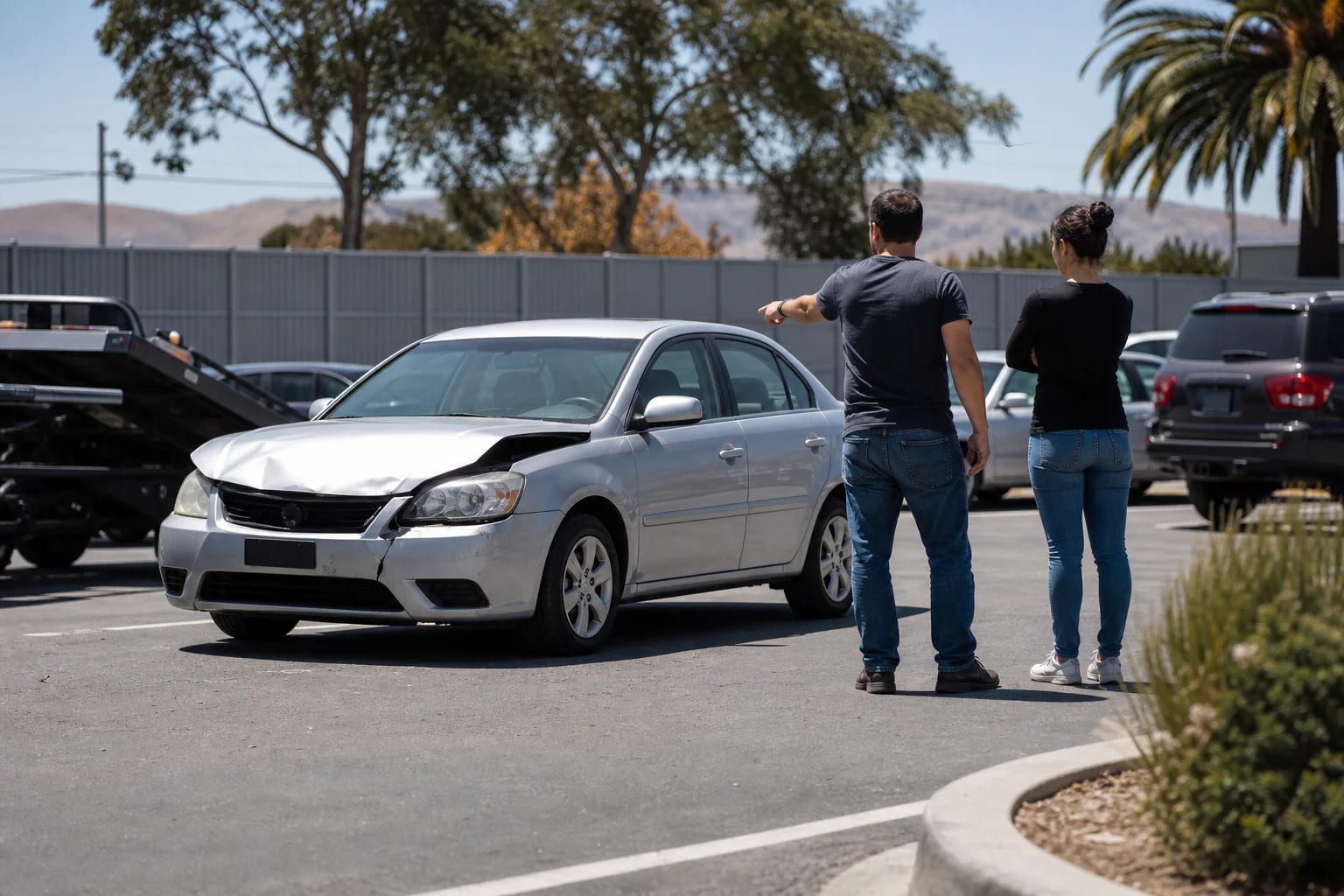
Two people inspect an unbranded damaged silver car from a safe distance in an orderly California tow yard
A reliable tow-and-storage file records custody status, inspection, charges, authority, vehicle condition, release, and every transfer as separate dated events.

Quick answer

When a crash vehicle is towed in California, first identify whether it is stored or impounded, then obtain the agency and yard details, inspect and photograph the vehicle, retrieve personal property, request the statutory fees-and-access notice and itemized invoice, confirm who may authorize release, and preserve every payment, transfer, condition, and insurer communication as a separate dated record.

Key takeaways

  • First identify who ordered the tow and whether the vehicle is stored or impounded; a CHP-stored collision vehicle and a CHP-impounded vehicle follow different release paths.
  • Before payment, request the Towing and Storage Fees and Access Notice, an itemized invoice, inspection access, and a no-charge opportunity to retrieve personal property during the applicable normal business hours.
  • Photograph vehicle condition before release or transfer and keep the tow notice, authorization, invoice, payment, release, transfer, and insurer communications as separate dated records.
  • Do not assume that paying a bill, signing a release form, moving the car, or opening an insurance claim resolves fault, coverage, injury causation, fee legality, or a deadline.
Hurt Advice Editorial Team

Prepared by

Hurt Advice Editorial Team

Editorial Research and Publishing Team

Source-checked editorial publishing

Why trust this article

Prepared by the Hurt Advice Editorial Team from current California towing and storage statutes, California Highway Patrol release guidance, and California Department of Insurance consumer guidance. No attorney reviewed this displayed version.

Recent update: Original publication with a stored-versus-impounded decision map, statutory notice and invoice checklist, inspection and personal-property workflow, fee and hearing timing, private-property tow distinctions, insurer track, release log, and transfer record.

At a glance

What this guide helps you decide

Start with the question that brought you here, identify the records that can verify the facts, and use the related guidance only where it helps. This article addresses car accidents questions in California.

Main question

Decide how this topic may apply to your situation

Use "California Crash Tow-Yard Records: What to Get Before Release" to sort the facts you know, the questions still open, and whether a car accidents resource or consultation may be useful in California.

Guide map

Start with the sections most relevant to you: Quick takeaways, Who this guide is for—and the narrow task it solves, Start with the stored-versus-impounded decision

Move through the article by issue, not by guesswork, so liability, medical proof, insurance pressure, deadlines, and next steps stay connected.

Records to gather

Connect these subjects to your records: California Tow Yard, Vehicle Storage, Vehicle Release, Towing and Storage Fees

Compare the topic with records, photos, medical visits, police reports, insurer letters, and local claim details before relying on a general answer.

Trust check

Use the source trail before acting

This page includes 6 source references plus internal next-step paths so readers can verify where the guidance comes from.

Before you rely on this guide

This article is written for people dealing with injury-law questions in California. It is meant to help you understand the issue, not replace legal advice about your specific case.

What to do after this article

Start with the quick answer, skim the table of contents, and then use the links below to move into the practice area, author archive, or resource page that turns general guidance into a clearer next step for your situation.

Quick takeaways

  • First identify who ordered the tow and whether the vehicle is stored or impounded; a CHP-stored collision vehicle and a CHP-impounded vehicle follow different release paths.
  • Before payment, request the Towing and Storage Fees and Access Notice, an itemized invoice, inspection access, and a no-charge opportunity to retrieve personal property during the applicable normal business hours.
  • Photograph vehicle condition before release or transfer and keep the tow notice, authorization, invoice, payment, release, transfer, and insurer communications as separate dated records.
  • Do not assume that paying a bill, signing a release form, moving the car, or opening an insurance claim resolves fault, coverage, injury causation, fee legality, or a deadline.

Who this guide is for—and the narrow task it solves

This guide is for a California driver, passenger, vehicle owner, family member, or authorized representative dealing with a vehicle that was removed after a collision. It addresses one narrow reader task: identify the custody path, gather the records needed for access or release, document the vehicle and fees, and preserve a source-labeled tow-and-storage file.

The California car-accident guide covers the broader claim area. The post-crash checklist covers immediate scene, care, insurance, and follow-up steps. The repair-estimate records guide owns the later repair and valuation file. This article stops earlier: custody, access, inspection, charges, release authority, transfer, and yard condition.

Address emergency care and immediate safety first. Do not enter a restricted yard, touch an unstable vehicle, remove evidence from an official hold, or drive a vehicle that may be unsafe. Follow the agency’s instructions, the storage facility’s lawful safety rules, and qualified towing or repair guidance.

Start with the stored-versus-impounded decision

Ask the agency and yard the same question: “Is this vehicle stored, impounded, held for investigation, or in another status?” Record the exact answer, speaker, agency, date, time, incident number, yard, and callback number. Do not replace the answer with your own label.

The California Highway Patrol’s current towed-vehicle FAQ says a vehicle stored by CHP—such as a collision vehicle that cannot be driven—may be retrieved directly from the towing company by the registered owner or agent. A CHP-impounded vehicle requires a release from the CHP office that caused the impound, and the tow company will not release it without that direction. Other agencies and legal holds can have different requirements, so confirm the actual custodian and authority rather than assuming the CHP example controls every tow.

If the yard says “we need a release,” ask which agency, office, form, case number, and condition it means. If the agency says no release is needed, ask how the yard can verify that answer and preserve the response.

Use a first-call script that creates a reliable record

Adapt this neutral script for the agency, tow company, or storage facility:

“I am calling about [vehicle and plate or VIN ending], connected to incident [number]. Please tell me the vehicle’s exact status, who ordered the tow, the date and time storage began, the yard location and hours, whether any hold or agency release applies, what identification or ownership authorization is required, the current itemized charges, accepted payment methods, and how I can inspect the vehicle and retrieve personal property. Please send the available notice, invoice, authorization, and release instructions without changing the vehicle’s condition.”

Write down what was said and request the existing documents. The script does not concede that a tow or fee is valid, promise payment, authorize repairs, transfer title, abandon the vehicle, or direct disposal. If the caller is not the registered or legal owner, confirm what written authorization or other proof the facility will accept before traveling.

Build a seven-part tow-and-storage record pack

  1. Origin: collision report or incident number, date, time, location, responding agency, who directed the tow, and the stated authority or reason.
  2. Vehicle identity: year, make, model, color, plate, VIN ending, mileage if recorded, registered owner, legal owner or lienholder, and keys received.
  3. Custody: tow operator, carrier information, dispatch, arrival and completion times, tow method, storage start, yard address, and each transfer between facilities.
  4. Condition: scene images, tow intake images, yard inspection images, visible loose parts, interior condition, personal-property inventory, and any changes seen at release.
  5. Access and authority: status, hold, agency release, owner or agent authorization, identification presented, inspection requests, personal-property pickup, and every response.
  6. Charges and payment: notice, itemized invoice, rate information, daily storage calculation, gate or lien fee, payment method, receipt, dispute communication, and insurer position.
  7. Exit: release date and time, recipient, destination, transporter, odometer, keys, documents signed, payment, final condition images, and repair or salvage transfer instructions.

Preserve original emails, texts, photographs, voicemails, portal downloads, and PDFs. The digital-evidence preservation guide explains why an exported working copy should not replace the original file and its source context.

Request the statutory notice and itemized invoice before payment

California Vehicle Code section 22651.07 applies broadly to people and entities that charge for towing or storage, subject to stated exceptions. It requires the facility to make the Towing and Storage Fees and Access Notice available and, before receiving payment, to provide an itemized invoice of actual towing, recovery, and storage charges to the owner or agent.

The statute lists invoice fields including the charging entity, service date, vehicle description, tow location, dispatch and completion times, rates, separately stated storage days and rates, gate-fee date and time when applicable, tow method, and—when the tow was not owner-requested—the directing person or agency, subject to redaction rules. Request the complete invoice, not only a card receipt or total typed into a message.

Compare each line with the custody log. Mark a fee as listed, explained, paid, insurer accepted, disputed, or unresolved. Do not label a charge illegal or covered solely because it surprises you; preserve the rate source and obtain case-specific review.

Inspect the vehicle and retrieve personal property safely

Section 22651.07 states that, before paying, an owner or agent may inspect the vehicle without a fee, have an insurer inspect at no charge during normal business hours, receive personal property at no charge during those hours, and request the fees-and-access notice. The statute permits facilities to manage insurer inspections in consecutive 45-minute increments when needed to serve other waiting customers. It also describes normal business hours and required callback access outside them.

Make the request in writing when practical. Ask whether the vehicle is subject to an evidence hold, whether staff must escort the inspection, what photography is allowed, and whether a safety condition limits access. If access is restricted, record the precise reason and proposed alternative. Do not force entry or remove a component.

For personal property, use a simple inventory: item, location in vehicle, condition, person receiving it, date, time, and signature or receipt. Photograph the interior before and after removal when permitted. Keep property pickup distinct from vehicle release.

Photograph condition before release, transfer, repair, or salvage

If access is lawful and safe, photograph all four corners, each side, front, rear, roof, wheels, visible underbody areas without entering a hazard, interior, restraints, cargo area, odometer, warning lights, keys, loose parts, and every visible damaged or transferred area. Include wide context and close views. Record who took the images, the date and time, the yard, whether the car was moved, and any limits on access.

Ask for existing scene, tow-intake, inventory, and release photographs rather than assuming your images show the same moment. Preserve each source separately. A new dent seen at release is an observation to document; it is not by itself proof of when or how the condition arose.

Do not authorize destructive inspection merely to improve a record. Before a transfer or tear-down, ask who will receive the vehicle, what will happen to loose parts, whether additional storage starts elsewhere, and who will photograph newly exposed conditions. Then connect the tow file to the repair file without merging their conclusions.

Map current accident-tow and storage charges carefully

California Vehicle Code section 22524.5, as amended effective January 1, 2026, addresses towing and storage charges arising from an accident or stolen-vehicle recovery. It states that those fees must be reasonable and identifies categories that are presumptively unreasonable, with exceptions and context. The current list includes certain administrative, security, dolly, load/unload, pull-out, and gate fees, plus storage charged after a paid release request when a facility fails to release the vehicle. It also addresses a reduced storage amount when a vehicle is recovered within the first four hours.

Do not turn that summary into a universal bill calculation. Law-enforcement agreements, the facts of the service, time of release, policy coverage, who requested the tow, and other statutory provisions matter. Preserve the posted or approved rate, invoice, exact request time, tendered documents and payment, facility response, and actual release time.

If a daily charge is accruing, communicate promptly and keep proof. Prompt action can reduce ongoing storage without waiving the right to question a charge later; whether it does in a particular matter requires specific advice.

Keep public-agency storage hearings in their own lane

California Vehicle Code section 22852 provides a poststorage-hearing opportunity when an authorized public-agency member directs storage under the covered chapter, subject to listed exceptions. The notice is to be mailed or personally delivered to the registered and legal owners within 48 hours, excluding weekends and holidays, and must explain that a hearing request is due within 10 days of the date on the notice. The hearing is to occur within 48 hours of the request, again excluding weekends and holidays.

Those are not universal tow deadlines. The statute excludes specified categories, including certain investigation impounds and private-property removals. A hearing addresses the validity of covered storage; it is not automatically an injury-claim hearing, insurance-coverage decision, or damages award.

Preserve the envelope or delivery record, notice date, actual receipt date, request method, proof of delivery, scheduled hearing, attendance, decision, and any fee or release consequence. If the deadline may be close, seek agency instructions and qualified advice immediately rather than waiting for the broader claim file.

Separate private-property towing from a crash-scene public tow

A later private-property removal can arise if a damaged vehicle is left on a lot, repair property, residence, or other private location. California Vehicle Code section 22658 has its own authorization, notice, rate, release, and storage rules. Among other provisions, it addresses written tow authorization, the grounds for removal, a copy of the authorization before payment when the owner or agent claims the vehicle, and limits tied to release timing.

Do not assume section 22852’s public-agency hearing process applies to a private-property tow; section 22852 expressly excludes vehicles removed under section 22658. Conversely, do not use the private-property rules to describe a CHP collision storage.

Preserve the posted sign when relevant, property name, person who authorized removal, written authorization copy, stated grounds, time first observed, authorization time, removal time, notice, yard, rates, and request-to-release time. The tow may be related to the same damaged car but is a separate custody event.

Create a separate insurer communication track

Notify the appropriate insurer promptly under the actual policy and facts. The California Department of Insurance’s auto-accident consumer guide says that, unless an insurer provided a specific towing company before the facility was used, the insurer must pay reasonable towing expenses. The guide also summarizes general claim communication and response standards. Coverage, fault, deductibles, policy terms, third-party status, reasonableness, and mitigation questions can still affect a specific claim.

Ask the adjuster in writing: what towing and storage is accepted; through what date; whether an inspection is scheduled; whether the vehicle should move; who will arrange transport; what destination is approved; whether a total-loss evaluation has begun; and what notice will precede a change in storage payment. Preserve each answer and any reservation or dispute.

Do not abandon the vehicle or sign title, salvage, repair, power-of-attorney, or release papers merely because someone says storage is accruing. Read what the document does, keep a copy before signing, and obtain specific advice when ownership or evidence may change.

Use a release log instead of relying on memory

Keep one row for every release attempt or transfer. Use these fields:

  • Request: date, time, requester, method, vehicle, incident or claim number, and requested action.
  • Status: stored, impounded, hold, private-property tow, repair custody, salvage transfer, or exact other label supplied.
  • Authority: agency, owner, lienholder, insurer, agent, court, or other source; record the required document.
  • Access: inspection requested, personal property requested, response, appointment, restrictions, and staff contact.
  • Money: invoice version, rates, days, total, disputed line, accepted payment methods, tender, and receipt.
  • Exit proof: release time, recipient, transporter, destination, odometer, keys, condition images, signatures, and unresolved issue.

A precise entry reads: “July 22, 2:14 p.m.; yard confirmed CHP stored status; registered owner and photo ID required; inspection set for 3 p.m.; invoice version 1 emailed at 2:22 p.m.” Avoid entries such as “yard refused everything” unless the record identifies what was requested, by whom, and the actual response.

Common mistakes and red flags

  • Calling every custody status an impound: the label can change who must authorize release.
  • Saving only the payment receipt: preserve the notice, full itemized invoice, rate source, and release record.
  • Waiting to photograph: transfer, weather, access, repair, or salvage can change the observable condition.
  • Removing property without an inventory: record what left the vehicle, when, and who received it.
  • Assuming insurer contact stops storage: obtain a written payment-through date and transfer plan.
  • Signing a broad form unread: release, repair, title, power-of-attorney, salvage, and abandonment language have different effects.
  • Using the wrong legal lane: public storage, investigation holds, private-property towing, owner-requested towing, repair custody, and salvage are not interchangeable.
  • Treating the vehicle file as medical proof: condition, tow method, and cost do not independently diagnose injury or establish medical causation.

Connect the final custody record to the California injury-proof guide, but keep sourced observations separate from legal and medical conclusions. A licensed attorney can assess disputed custody, evidence preservation, fees, fault, insurance, and deadlines.

A seven-step next-action checklist

  1. Address emergency care and vehicle safety; do not enter a restricted or hazardous area.
  2. Identify who directed the tow, the exact custody status, incident number, yard, and whether an agency release or hold applies.
  3. Request the fees-and-access notice, itemized invoice, rate information, access instructions, ownership or agent requirements, and accepted payment methods.
  4. Inspect and photograph the vehicle when lawful and safe; retrieve and inventory personal property separately.
  5. Notify the appropriate insurer, obtain the storage-payment and transfer position in writing, and preserve every response.
  6. Before release or transfer, reconcile authority, payment, recipient, destination, condition, keys, odometer, and documents signed.
  7. Keep the tow file linked to—but distinct from—the roadside-assistance evidence guide, repair file, medical file, and liability analysis.

Hurt Advice is a lawyer-referral and legal-information service, not a law firm. This article provides general educational information, not towing, insurance, medical, engineering, or legal advice. No attorney reviewed this displayed version. A licensed California attorney can evaluate the actual tow, status, documents, policy, vehicle, injuries, evidence, and deadlines. You can use the Hurt Advice contact page to request a referral.

Frequently Asked Questions

What tow-yard documents should I request after a California crash?
Request the Towing and Storage Fees and Access Notice, full itemized invoice, tow or storage notice, directing agency or person, tow authorization when applicable, custody and release instructions, payment receipt, and final release or transfer record. Preserve each version with its source and date.
What is the difference between a stored and impounded vehicle?
CHP says a stored collision vehicle that cannot be driven may generally be retrieved directly from the tow company by the registered owner or agent. A CHP-impounded vehicle requires a release from the CHP office that caused the impound. Confirm the actual agency and status because other holds and agencies can differ.
Can I inspect a towed vehicle before paying the bill?
California Vehicle Code section 22651.07 states that an owner or agent may inspect the stored vehicle without a fee before payment, subject to lawful safety rules and other valid restrictions. Ask in writing, confirm whether an evidence hold applies, and document any limit or alternative offered.
How long do I have to request a California poststorage hearing?
For public-agency storage covered by Vehicle Code section 22852, the notice must explain that the owner or agent should request the hearing within 10 days of the date on the notice. The section has exceptions, including specified investigation impounds and private-property removals, so confirm the correct process immediately.
Does automobile insurance pay towing and storage after a crash?
California law and insurance rules address reasonable towing and storage in covered circumstances, but the result can depend on the policy, claimant status, fault allocation, reasonableness, notice, and transfer opportunities. Ask the adjuster in writing what is accepted, through what date, and what move is requested.
What should I preserve if the vehicle is moved to another yard or repair shop?
Record the release authority, invoice and payment, release time, transporter, destination, odometer, keys, condition photographs, personal-property status, documents signed, and new storage terms. Treat every transfer as a separate custody event and keep the earlier facility’s record intact.

Sources and references

Current fees-and-access notice, itemized invoice, inspection, personal-property, payment, hours, and release-document requirements.

Need help after an accident?

Hurt Advice intake team can review your situation, explain your options, and help you move forward with a plan that fits your case.