
Legal ExplainerPersonal InjuryChecklist / Process

Air Fryer Fire and Burn Evidence in California: What to Preserve

After an air fryer fire, burn, smoke, or electrical incident in California, address safety first, then preserve the unplugged appliance, basket, cord, outlet context, packaging, purchase and repair records, photos, and exact model or date-code evidence. Match identifiers to official recall notices; do not assume a recall, defect, causation, or responsibility from appearance or incident alone.

Published

July 30, 2026

Updated

July 30, 2026

Reading time

11 min read

Jurisdiction

California

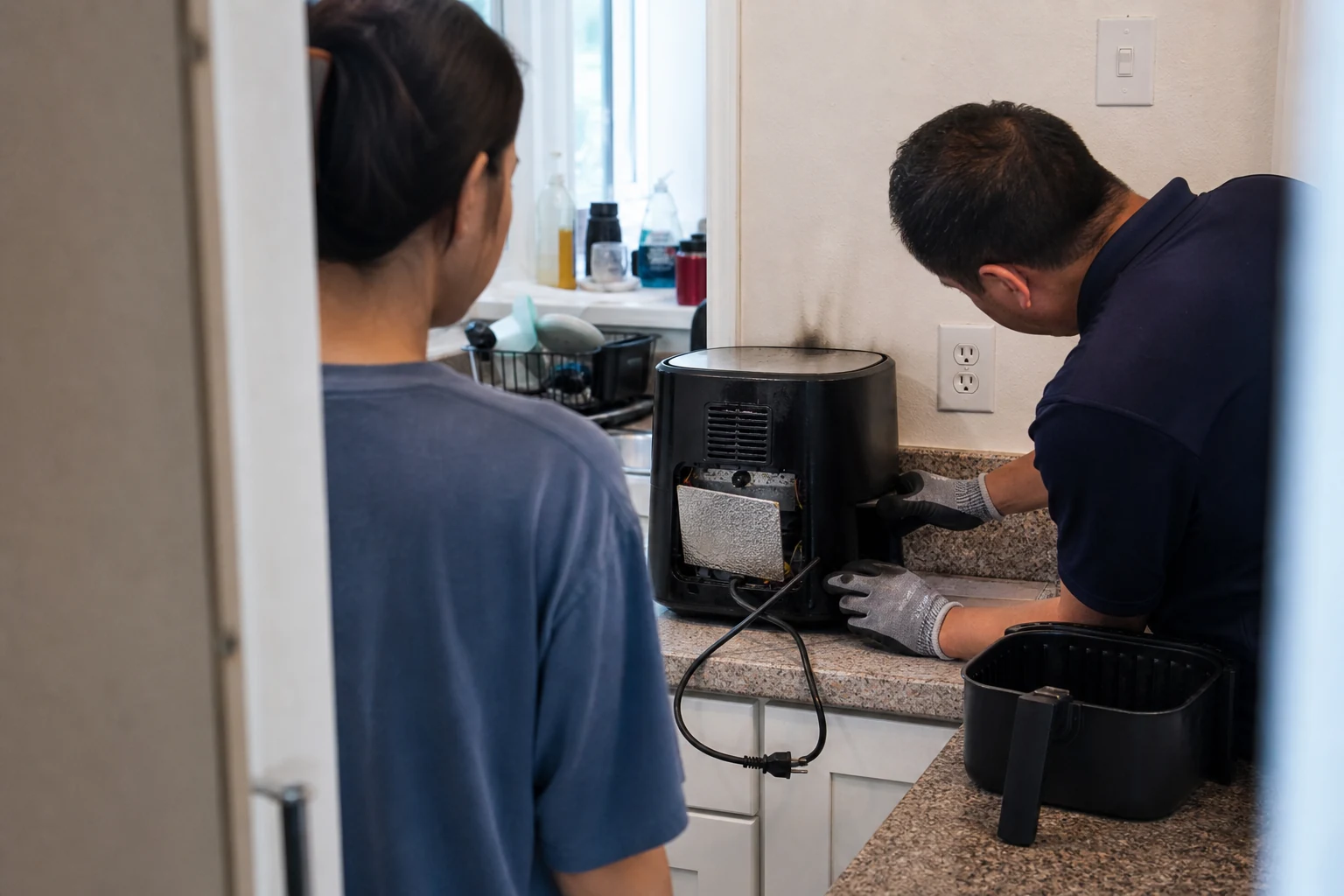
Gloved appliance technician inspects the opened rear of an unplugged heat-damaged air fryer while its owner watches in a home kitchen
Product identity, condition, energy source, and later movement should remain separate evidence fields after an appliance incident.

Quick answer

After an air fryer fire, burn, smoke, or electrical incident in California, address safety first, then preserve the unplugged appliance, basket, cord, outlet context, packaging, purchase and repair records, photos, and exact model or date-code evidence. Match identifiers to official recall notices; do not assume a recall, defect, causation, or responsibility from appearance or incident alone.

Key takeaways

  • Safety and medical needs come first; do not reenergize, dismantle, move, or store a hot or hazardous appliance merely to collect evidence.
  • Photograph identity markings and condition in place when it is safe, then preserve the air fryer, matching basket, cord, plug, packaging, manuals, accessories, and removed parts as a connected set.
  • A recall search is identifier-specific. Product appearance, brand familiarity, a similar incident, or a partial model name is not an exact recall match.
  • Separate what happened before shutdown from what a technician, insurer, fire department, manufacturer, retailer, or investigator recorded later.
Hurt Advice Editorial Team

Prepared by

Hurt Advice Editorial Team

Editorial Research and Publishing Team

Source-checked editorial publishing

Why trust this article

Prepared by the Hurt Advice Editorial Team from current U.S. Consumer Product Safety Commission, California Legislature, and U.S. Fire Administration sources. No attorney reviewed this displayed version.

Recent update: Original publication with an air-fryer identity sheet, recall-match method, energy-and-use timeline, condition-and-custody ledger, custodian map, request scripts, evidence checklist, mistakes, and FAQs.

At a glance

What this guide helps you decide

Start with the question that brought you here, identify the records that can verify the facts, and use the related guidance only where it helps. This article addresses personal injury questions in California.

Main question

Decide how this topic may apply to your situation

Use "Air Fryer Fire and Burn Evidence in California: What to Preserve" to sort the facts you know, the questions still open, and whether a personal injury resource or consultation may be useful in California.

Guide map

Start with the sections most relevant to you: Who this guide is for—and the narrow task it solves, Quick takeaways, Contents and the six evidence lanes

Move through the article by issue, not by guesswork, so liability, medical proof, insurance pressure, deadlines, and next steps stay connected.

Records to gather

Connect these subjects to your records: California Air Fryer Fire Evidence, Air Fryer Burn Evidence, Air Fryer Recall Records, Air Fryer Repair Records

Compare the topic with records, photos, medical visits, police reports, insurer letters, and local claim details before relying on a general answer.

Trust check

Use the source trail before acting

This page includes 6 source references plus internal next-step paths so readers can verify where the guidance comes from.

Before you rely on this guide

This article is written for people dealing with injury-law questions in California. It is meant to help you understand the issue, not replace legal advice about your specific case.

What to do after this article

Start with the quick answer, skim the table of contents, and then use the links below to move into the practice area, author archive, or resource page that turns general guidance into a clearer next step for your situation.

Who this guide is for—and the narrow task it solves

This guide is for a California consumer organizing evidence after an air fryer produced smoke, flame, unusual heat, an electrical event, property damage, or a burn injury. It is also useful when a household member, retailer, repair shop, insurer, fire department, manufacturer, or product-safety investigator may hold a different part of the record.

The task is source control. Identify the exact appliance; preserve its condition without creating a new hazard; separate firsthand observations from later conclusions; match identifiers to official recall material; and keep purchase, repair, return, replacement, reporting, and investigation records in distinct evidence lanes. The broader California product-liability resource explains legal theories. This article focuses on the air fryer, its history, and the records that can later be tested.

Hurt Advice is a lawyer referral and legal information service, not a law firm. This is general information, not legal, fire-safety, engineering, or medical advice. It does not establish a defect, recall match, causation, damages, admissibility, or responsibility. No attorney reviewed this displayed version.

Quick takeaways

  • Safety and medical needs come first; do not reenergize, dismantle, move, or store a hot or hazardous appliance merely to collect evidence.
  • Photograph identity markings and condition in place when it is safe, then preserve the air fryer, matching basket, cord, plug, packaging, manuals, accessories, and removed parts as a connected set.
  • A recall search is identifier-specific. Product appearance, brand familiarity, a similar incident, or a partial model name is not an exact recall match.
  • Separate what happened before shutdown from what a technician, insurer, fire department, manufacturer, retailer, or investigator recorded later.
  • A recall, complaint, repair, refund, or replacement may be relevant, but none automatically proves a defect, cause, injury, or legal responsibility.

Contents and the six evidence lanes

The workflow has six lanes: (1) immediate safety and scene preservation, (2) product identity, (3) pre-event use and energy state, (4) physical condition and custody, (5) purchase, service, retailer, and manufacturer records, and (6) recall, complaint, agency, and insurer records. Do not merge them into one story before recording what each source actually says.

Use one source-and-condition ledger for the appliance and one file manifest for records. The accident evidence checklist provides a general preservation framework. For an air fryer, the differentiating work is connecting exact product identifiers to the observed condition and to a time-ordered use, power, shutdown, movement, and inspection history.

Safety comes before preservation

If there is active fire, smoke, heat, damaged wiring, energized equipment, chemical residue, or another immediate danger, follow emergency instructions and keep people away. Seek appropriate medical attention for burns, smoke exposure, or electrical injury. Do not plug the unit back in, operate it for a video, recreate the food load, reset a breaker, open an energized housing, or ask an unqualified person to test it.

The U.S. Fire Administration’s current electrical and appliance fire-safety guidance addresses outlet, cord, and heat-producing-appliance hazards. It is prevention guidance, not a method for diagnosing a particular incident. If a fire department, utility, landlord, insurer, manufacturer, or qualified investigator controls the scene, document who directed movement or disposal instead of interfering.

When conditions are safe, take wide and close photographs before moving anything: appliance position, counter or surface, surrounding clearance, wall receptacle, plug and cord route, nearby power strip or extension if present, basket and contents, controls, visible residue, scorch or melt patterns, suppression material, and objects moved during the response. Do not touch a hazardous plug or outlet simply to obtain a better image.

Build an exact air-fryer identity sheet

Start with the appliance as found. Record brand, product name, model, serial number, date code, batch or lot code, electrical rating plate, country of manufacture, color, capacity, control type, basket configuration, accessories, and every identifier on packaging, receipt, order history, registration email, warranty record, manual, or recall notice. Photograph the entire label and its location before making a transcription.

The CPSC’s official required report information for subject firms illustrates why identity detail matters: it calls for product description, brand, series or model numbers, date codes, identifying marks, pictures or samples, complaint information, and other technical material. A consumer is not taking on a firm’s federal reporting duty by using those fields as an organization checklist.

Never clean a label, peel it off, trace over faint characters, or guess a missing digit. Record uncertain characters with a question mark and preserve the original photograph. Link each identifier to its source: appliance plate, carton, retailer order, manual, registration, repair ticket, or manufacturer response. If those sources conflict, keep every value and ask the custodian to clarify; do not silently choose the value that produces a recall match.

Search recalls without turning the search into a conclusion

Use the CPSC’s official recall data and public product-safety resources to search by product type, brand, model, date code, recall number, and date range. Save the exact query, search date, result URL or export, recall notice, included identifiers, hazard description, remedy, and manufacturer contact route. Search spelling variants only after preserving the exact label text.

A reliable match joins the notice to the physical unit through the identifiers and inclusion criteria stated in the notice. Similar shape, color, controls, packaging, or reported hazard is not enough. A notice may cover only certain models, manufacturing windows, retailers, or countries. A product can also be involved in an incident without appearing in a recall database. Record “exact match,” “possible match—identifier missing,” “excluded by notice,” or “no result located on this search date” rather than “recalled” or “safe” when the evidence does not support that label.

Keep the recall lane separate from the incident lane. The official notice records what the agency and recalling firm published. The appliance, scene photographs, medical records, fire report, service history, and witness accounts record different facts. The product-liability glossary can help define general terms, but it does not convert a database result into a case conclusion.

Create a pre-event energy-and-use timeline

Write the timeline from the nearest reliable source, not from hindsight. Record who placed the unit, which outlet or power device it used, whether the plug and cord were visible, basket and food load, oil or accessories, selected setting, start time, preheat or cooking phase, sounds, odors, smoke, unusual heat, control behavior, first alarm or observation, shutdown attempt, breaker or ground-fault event, unplugging, suppression, evacuation, and emergency call. Use actual clock sources and time zones when available.

Distinguish firsthand observation from inference. “Owner saw smoke at the rear vent at 6:14 p.m.” is different from “rear component failed.” “Breaker was found off after the event” is different from “breaker tripped before smoke.” “Display went dark” is not the same as loss of power unless another source confirms it. Preserve smart-plug history, breaker-panel photographs, security video, building incident records, and original media metadata when they exist, but do not assume any device clock was synchronized.

California Evidence Code section 250 defines a writing broadly enough to include photographs, sounds, symbols, and electronically stored records. That definition does not guarantee admissibility. Section 1401 states the authentication requirement for a writing and secondary evidence of its content. Preserve originals, source, capture method, and ordinary handling rather than relying only on edited screenshots or forwarded copies.

Use a condition-and-custody ledger

Give every important event its own ledger entry:

  1. Date, time, and location: displayed timestamp, time zone, capture time, and exact place.
  2. Object: air fryer body, basket, tray, cord, plug, packaging, accessory, outlet, countertop fragment, removed component, or sample.
  3. Source or actor: owner, witness, responder, landlord, insurer, repair shop, retailer, manufacturer, shipper, agency, or laboratory.
  4. Condition: intact, wet, sooted, melted, scorched, opened, cleaned, photographed, moved, unplugged, bagged, boxed, shipped, tested, repaired, discarded, or unknown.
  5. Reason and authority: safety direction, emergency response, inspection, insurer request, recall remedy, return, repair, storage, or unknown.
  6. Proof and limit: original photo, video, receipt, tracking, signature, work order, report, secondhand account, missing interval, or disputed time.

Example: “7:02 p.m., kitchen: firefighter unplugged unit after visible heat had subsided; owner photographed cord route before later movement; basket set two feet away by occupant during response; no photo shows the moment the basket was removed. 9:20 a.m. next day: insurer authorized dry storage of the unit and basket together; no destructive testing authorized.” The ledger protects uncertainty instead of filling the gap.

Map the records by custodian

Owner or household: original photos and video, purchase record, delivery confirmation, packaging, manual, registration, warranty, messages, maintenance, cleaning history, accessories, recipe or setting used, and contemporaneous notes. Preserve only relevant private material and keep unrelated household information out of working copies.

Retailer or marketplace: order detail, seller identity, listing version, invoice, fulfillment and delivery, serial or registration information if maintained, return authorization, refund, replacement, safety alert, and communications. A marketplace page may change; preserve the version actually viewed and do not treat current listing text as proof of what appeared at purchase.

Manufacturer or importer: registration, support ticket, complaint, warranty claim, requested photographs, troubleshooting, repair or replacement offer, shipping label, received-product record, recall communication, and remedy status. Preserve the original response and attachments. Do not accept disposal, return, repair, or destructive testing instructions without first understanding how the item and its condition will be documented.

Repair shop, insurer, landlord, or public agency: intake condition, photographs, technician observations, estimate, removed-parts list, cause classification, fire or incident report, evidence transfer, testing scope, storage direction, payment, and subrogation communication. The defective-appliance information page and fire and explosion page describe the broader injury lanes; this guide keeps their sources from being collapsed.

CPSC reports and investigations: what they can and cannot show

The CPSC’s current consumer investigation FAQ explains that product-safety incidents can reach the agency through consumer complaints, SaferProducts.gov, hospitals, public-safety entities, companies, and other sources. It also identifies materials an investigator may request, including purchase receipts, repairs, insurance investigation reports, manuals, the product, and related evidence.

If you make a report, keep the submitted version, confirmation, attachments, consent choices, manufacturer response if provided, correction request, investigator communications, and any transfer or return paperwork. Report only what you can support. Distinguish incident date from report date and a report’s existence from agency findings. An assigned investigator, public report, manufacturer comment, or later recall can add a source; it does not by itself resolve a private legal claim.

If someone claiming to be an investigator, manufacturer representative, insurer, or laboratory requests the appliance, verify identity and authority through an independently located official channel. Record the proposed test, whether it is destructive, who may attend, how the item and removed parts will be photographed, where it will be stored, and what will be returned. Do not obstruct a lawful public-safety process; obtain case-specific advice when preservation and safety directions conflict.

Neutral preservation and records-request scripts

Retailer or manufacturer: “Please preserve and provide the existing records associated with [exact product and order or support identifier] for [focused date range], including the listing or product record, seller or manufacturer identity, fulfillment, delivery, registration, safety notice, support ticket, complaint, troubleshooting, repair, return, refund, replacement, shipping, receipt, and disposition records. Please preserve original timestamps, attachments, versions, and identifier fields and identify the custodian for records you do not maintain. This request does not ask you to create a new cause analysis.”

Repair shop, insurer, or investigator: “Before inspection or transfer, please provide the proposed scope, whether any step may alter or destroy the appliance, the persons and facilities involved, documentation methods, storage location, removed-parts handling, and return or disposition plan. Please preserve the appliance, basket, cord, plug, accessories, packaging, and every removed part as an identified set, subject to safety and lawful agency directions.”

Use verified current contact channels. Share only the minimum information needed. Save the request, delivery proof, acknowledgment, response, attachments, objections, transfer record, tracking, and follow-up. A script is an organization aid, not a command, subpoena, guarantee of retention, or substitute for legal advice.

Timing and process checkpoints

Immediately: protect people, follow emergency directions, obtain care, and do not reenergize the appliance. When safe, preserve wide and close scene views and identify who moved, unplugged, suppressed, opened, or took custody of anything.

First organized pass: build the identity sheet, download the purchase and registration records, preserve original media, search official recall data using exact identifiers, and start the energy-and-use timeline. Keep a copy of the search and notice as they existed that day.

Before transfer, return, repair, or disposal: verify identity, photograph every side and matching component, record condition, clarify whether testing is destructive, create a transfer receipt, and identify storage and removed-parts handling. Do not keep a dangerous item in an unsafe location simply to preserve it.

When records arrive: keep the production unchanged, create a manifest, compare identifiers, preserve corrections and manufacturer comments, and update the ledger without overwriting earlier entries. If a deadline or contested claim may be involved, the California deadline resource is general background only; seek individual legal advice promptly.

Evidence checklist

  • Air fryer body, matching basket and tray, cord, plug, accessories, packaging, manual, and every removed part, handled subject to safety instructions.
  • Full product label in context plus close photographs of brand, model, serial, date code, batch or lot, electrical rating, country of manufacture, and identifying marks.
  • Wide and close scene images showing appliance position, surface, clearance, outlet, cord route, nearby power device, residue, soot, melt or scorch condition, and suppression effects.
  • Original purchase, seller, listing, fulfillment, delivery, registration, warranty, support, repair, return, refund, replacement, shipping, and disposition records.
  • Exact CPSC recall queries, saved notices, inclusion criteria, remedy, search date, and a match-status note that preserves uncertainty.
  • Pre-event setting, food load, basket state, clock source, sound, odor, smoke, heat, flame, control behavior, shutdown, breaker, unplugging, suppression, and emergency-call timeline.
  • Fire, landlord, insurer, repair, laboratory, manufacturer, retailer, and CPSC records kept as separate sources.
  • Condition-and-custody ledger with actor, time, location, object, condition, reason, proof, missing interval, and transfer receipt.
  • Medical and property-damage records kept in their own lanes without embedding unnecessary private information in product files.
  • Untouched originals and working copies, with every crop, annotation, conversion, or redaction identified.

Mistakes and red flags

  • Plugging the air fryer back in, resetting a breaker, recreating the load, or staging video to show the problem.
  • Cleaning soot, separating the basket, discarding packaging, peeling a label, removing a component, or accepting repair before condition and custody are documented.
  • Calling a visually similar product recalled without matching the notice’s exact identifiers and inclusion criteria.
  • Treating no recall result as proof the product was safe, or treating a recall as proof of defect, causation, injury, or liability.
  • Collapsing a witness observation, fire report, technician opinion, insurer classification, manufacturer response, and agency record into one conclusion.
  • Using only screenshots when an original download, message, receipt, media file, or export is available.
  • Shipping the appliance without verified recipient, tracking, condition photographs, basket and parts inventory, testing scope, storage plan, and return or disposition terms.
  • Keeping a hot, energized, contaminated, unstable, or otherwise dangerous item in an occupied place solely for evidence.
  • Posting private or disputed allegations publicly before preserving accurate source records and obtaining appropriate advice.

Careful next steps

Complete the identity sheet, recall-search record, energy-and-use timeline, file manifest, and condition-and-custody ledger. Preserve each custodian’s record in its original form. Keep “observed,” “reported,” “matched,” “excluded,” “unknown,” and “later concluded” as different labels.

If another party requests the appliance, ask about safety, authority, scope, alteration, removed parts, documentation, storage, access, and disposition before transfer when circumstances allow. If emergency personnel or a public agency has already taken control, document the custodian and follow the lawful process. Do not jeopardize safety or obstruct an investigation.

Hurt Advice can connect people with independent California lawyers through the contact page, but it does not promise representation or an outcome. This article was prepared by the Hurt Advice Editorial Team from the official sources listed below. No attorney reviewed this displayed version. See the editorial standards for sourcing, corrections, and autonomous-article disclosure.

Frequently Asked Questions

What should I preserve after an air fryer fire or burn incident?
When it is safe, preserve the unplugged air fryer, matching basket and tray, cord, plug, accessories, packaging, manual, purchase and repair records, original photos and video, and exact product identifiers. Record who moved, opened, cleaned, tested, repaired, shipped, or discarded anything. Do not reenergize a hazardous appliance to create evidence.
How do I know whether my air fryer is included in a recall?
Compare the appliance’s exact brand, model, serial or date code, batch or lot, manufacturing window, and other notice criteria with the official CPSC recall record. Save the query and notice. Similar appearance, color, controls, product name, or incident type is not an exact match, and no search result does not prove the product was safe.
Does an air fryer recall prove that the product caused my injury?
No. A recall notice, consumer report, repair, refund, or replacement can be relevant, but it does not automatically prove that a particular unit was defective, that the alleged condition caused an incident or injury, or that a person or company is legally responsible. Those questions require the exact product, records, and other evidence.
Should I return or repair the air fryer right away?
Safety directions come first, but a return or repair can change the product or its custody. Before a voluntary transfer when circumstances allow, document identity and condition, include the matching basket and parts inventory, verify the recipient, and clarify testing, removed-parts, storage, return, and disposition terms. Do not keep a dangerous item in an unsafe place.
Can I report an air fryer incident to the CPSC?
Consumers can report a product-related injury or risk through the CPSC’s SaferProducts.gov pathway. Keep the submitted version, confirmation, attachments, consent choices, corrections, manufacturer response if any, and investigator communications. A report may or may not lead to contact, publication, investigation, corrective action, or recall.
What belongs in an air fryer condition-and-custody ledger?
Use one row per event with date, time, location, object, source or actor, condition, action, reason, proof, and limitation. Include unplugging, movement, suppression, opening, cleaning, inspection, testing, repair, shipping, storage, return, removed parts, and disposal. Preserve missing intervals and disputed facts instead of filling them in.

Sources and references

U.S. Consumer Product Safety CommissionCPSC Data

Current official recall data, public incident-report resources, and product-safety data tools.

U.S. Consumer Product Safety CommissionRequired Report Information

Official product-identity and incident-information fields used in firm reporting.

Need help after an accident?

Hurt Advice intake team can review your situation, explain your options, and help you move forward with a plan that fits your case.