
Referral intake reviewES
Legal ExplainerTruck AccidentsChecklist / Process

How to Match a Trailer and Rear Guard After a California Underride Crash

A trailer number on a police report, a guard marking in a photograph, and a repair invoice may describe different pieces of equipment. Keeping those identities separate makes the next conversation with a custodian or independent attorney more precise.

Published

August 28, 2026

Updated

August 28, 2026

Reading time

11 min read

Jurisdiction

California

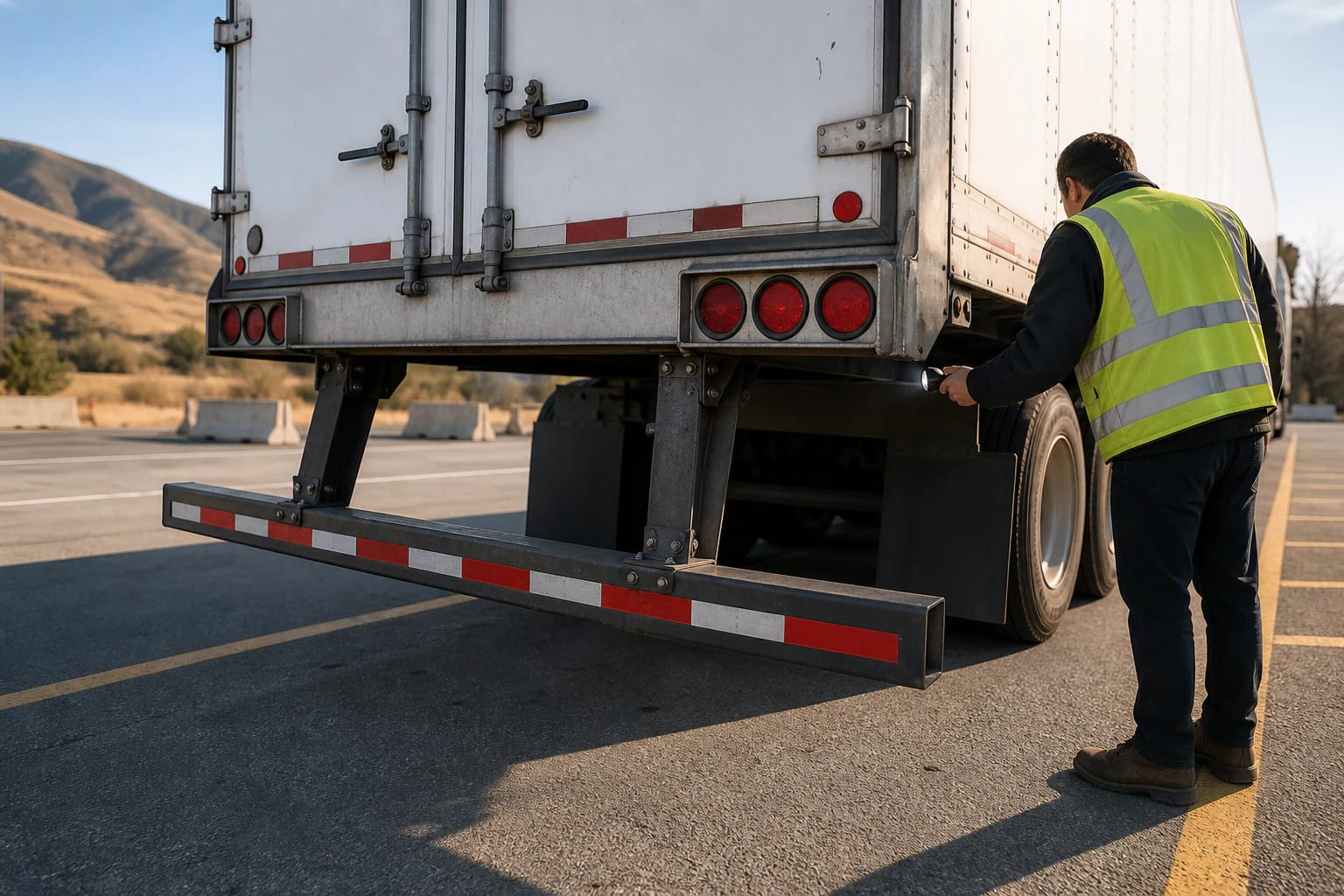
Inspector aiming a flashlight toward a stationary trailer’s rear guard mounting area at an outdoor inspection pullout
AI-generated illustration of a stationary trailer rear-guard inspection; not a photograph of an actual collision or evidence of vehicle compliance.

Quick answer

After a California underride crash, identify the tractor, trailer, and rear guard separately. Preserve existing photographs and records, then compare component markings, installation information, inspection dates, repairs, and later handling. Keep uncertain matches unresolved. A damaged guard, missing label, or passing inspection does not by itself establish compliance, fault, or the cause of an injury.

Key takeaways

  • Keep the tractor, trailer, and rear guard identities separate; a cab number alone may not identify the damaged trailer.
  • Compare manufacturing information, inspection records, repair history, and crash photographs without treating them as interchangeable.
  • Record missing or conflicting information as a question. A damaged guard or unreadable label does not establish fault.
  • Arrange safe, authorized preservation before repairs or disposal; leave measurements, testing, and legal conclusions to qualified professionals.
Hurt Advice Editorial Team

Prepared by

Hurt Advice Editorial Team

Editorial Research and Publishing Team

Source-checked editorial publishing

Why trust this article

Prepared by the Hurt Advice Editorial Team using the linked federal regulations and CHP guidance. No attorney reviewed this article. The practical checklist organizes records; it does not determine compliance, fault, causation, or deadlines for your situation.

Recent update: Original guide to matching trailer and rear-guard identities, separating inspection records, and organizing unresolved evidence questions.

Who does this guide help?

This guide is for an injured person, family member, or authorized representative trying to identify a trailer and its rear impact guard after a California collision. Under FMVSS No. 223, a rear impact guard is the structure below the back of some trailers intended to limit how far a striking vehicle travels underneath. The task here is organizing evidence, not deciding whether a particular guard performed properly.

Use the broader truck-accident guide for the overall claim context. The focused underride information page explains the collision setting. This worksheet is most useful when records describe only a “truck,” a trailer has changed hands, or photographs and repair entries appear to refer to different equipment. You do not need to resolve those uncertainties before asking for help.

Why separate the trailer from its rear guard?

The powered tractor, the towed trailer, and an installed guard can have different identifying marks and different histories. Treating every number as a truck number makes it easy to attach a repair invoice to the wrong unit. Start three separate identity lines, even when one business appears to operate the whole combination.

Federal 49 CFR 393.86 distinguishes rear-protection requirements by vehicle type and manufacture date and includes exceptions. For covered trailers, it refers to manufacturing standards in effect when the vehicle was manufactured. A photograph of a modern guard therefore does not establish what an older or differently configured vehicle was required to have.

Write down what each source actually identifies: tractor, trailer, guard, carrier, or unknown. Preserve the original wording beside your interpretation. If two records disagree, keep both. The discrepancy may concern a fleet number, an abbreviation, a replacement component, or something that requires investigation; it is not a reason to choose whichever version seems more helpful.

Step 1: What can you preserve without approaching the equipment?

Put safety and medical care before collecting material. Do not enter traffic, climb onto a trailer, crawl under it, cross a restricted yard, or touch unstable components. An authorized professional can document inaccessible areas later. If the scene is unsafe, preserve the photographs, messages, and report references already available to you.

Keep original image files separately from copies used for notes. Record who supplied each file and when you received it. If a photograph came through a messaging app, ask whether the sender still has the original. Do not remove private information from the only copy; make a separate redacted copy when sharing is appropriate.

Create a short custody note for any physical item already lawfully in your possession: what it is, where it was found, who handled it, and its present location. Do not take parts from someone else’s vehicle or ask a yard worker to remove them. Use the tow-yard records guide to organize release paperwork and identify the actual custodian.

Step 2: Which identifying details belong together?

For the tractor, transcribe the visible plate, unit number, and carrier markings from existing photographs. For the trailer, make a separate entry for its plate, unit number, manufacturer information, and VIN when available. Note the source for every entry. A number copied from an invoice should remain distinguishable from one read directly in a photograph.

For the guard, retain any safely obtained image of existing manufacturer markings, mounting connections, and the horizontal member. FMVSS No. 223 addresses guard manufacturing requirements, including labeling and installation instructions. Its labeling provision identifies manufacturer information, the manufacture month and year, and manufacturer certification. Do not make a replacement label, scrape paint, or clean damaged surfaces to improve readability.

If lettering cannot be read, describe it as unreadable and keep the image. Ask for a clearer existing photograph or a qualified inspection. Current section 393.86 lists paragraph (a)(6) as reserved; do not use an old quotation of that paragraph to declare a present labeling violation. A missing marking alone does not resolve manufacture, installation, performance, or causation.

Step 3: How can photographs show component location?

Organize photographs from broad context to detail: the whole trailer, its rear face, each visible support, each mounting area, and any separated material. Preserve the sequence in which photographs were taken if known. Record whether the vehicle had already been towed, unloaded, moved, or repaired before each image was captured.

For an ordinary location sketch, draw the rear frame at the top, the horizontal guard below it, and the supports connecting them. Mark the vehicle’s left and right sides explicitly. Give each photograph a simple filename reference beside the area it shows. Mark unknown locations as unknown instead of placing a detached piece where you think it belonged.

The vehicle-level FMVSS No. 224 addresses installation and configuration and defines terms used for the trailer and guard. Keep those requirements separate from your sketch. Camera angle, road slope, loading, and later damage can affect what an image appears to show. A ruler added to a picture is not a reliable reconstruction of the original clearance. Leave dimensional surveys and any destructive testing to qualified people with authorization.

Step 4: Which inspection and repair records should you distinguish?

Ask which records concern the specific trailer and which concern only the tractor. 49 CFR 396.3 establishes systematic inspection, repair, and maintenance duties and identifies vehicle-specific record information, including inspection and repair dates and their nature. An invoice for work on another fleet unit does not answer a question about this trailer.

Federal 49 CFR 396.17 treats each vehicle in a combination separately for periodic inspection. It describes inspection within the preceding 12 months and documentation identifying the inspected vehicle. Keep the report or decal information with its vehicle identity; an inspection sticker is not a substitute for reading the underlying report.

For California context, CHP’s BIT booklet describes terminal oversight and separate periodic vehicle documentation, including inspections at least every 90 days for regulated vehicles. Applicability matters. A terminal rating is not a finding about one collision. Compare the scope of each document before drawing conclusions. The brake-record guide addresses a different component system; brake work does not establish the history of the rear guard.

How do you build a five-track evidence checklist?

Use five headings in a folder or notebook. Under each, keep the original record, your short description, its date, its source, and the unanswered question. This arrangement helps another person follow the evidence without relying on your memory.

  • Tractor identity: plate, unit number, carrier identification, and the record connecting that tractor to the trip.
  • Trailer identity: plate, VIN or manufacturer information when available, fleet number, and any document showing who supplied it.
  • Guard identity: existing markings, overall photographs, support and mounting images, and installation or replacement information if available.
  • Inspection and repair history: vehicle-specific reports, work orders, invoices, removed-part records, and explanations of any corrected entry.
  • Collision and later handling: police report references, witness photographs, tow intake images, storage location, and dates of movement or repair.

How should dates and conflicting numbers be compared?

For each event, record three things separately: when the event reportedly happened, when the record was created, and when you received it. A repair invoice issued after a crash might describe earlier work. An inspection entry uploaded later might reflect an earlier inspection. Ask which date is which.

Consider this illustrative example: the collision report lists one trailer fleet number, while a repair invoice lists a different number. Do not rewrite either record to make them match. Ask whether the invoice identifies the same VIN, whether a fleet number changed, and whether the work concerned the guard or another component. Keep the reply with the originals.

Use a simple decision aid: matching identity and clear date means file the item on the relevant track; matching identity but unclear date means ask for the service date; conflicting identity means hold it in an unresolved folder; no identifying information means ask how the custodian connected it to the vehicle. These categories organize questions, not findings of responsibility.

What can you say to the record custodian?

Once the custodian knows which collision and vehicle you mean, this script can be used as written:

“I am trying to preserve and identify the trailer and rear impact guard involved in the collision we are discussing. Please tell me who holds the vehicle and related inspection, repair, installation, and tow-intake records. Please preserve the existing records, original photographs, and removed components while access is discussed. Please explain how each record identifies the trailer, which dates reflect actual work, and whether any repair, transfer, or disposal is planned. Please confirm the appropriate contact and any authorization you need from me.”

A request is not a court order and does not guarantee access or stop work. Record the response without arguing about fault. If access, preservation, or planned disposal is disputed, ask an independent attorney about appropriate steps. Avoid sending unrelated medical records or sensitive identifiers merely to begin a vehicle-record inquiry.

What timing issues and red flags deserve attention?

Ask promptly about the equipment’s location and any planned work, but do not assume every record has the same retention period. Inspection intervals are not filing deadlines. The truck-record retention guide covers broader retention questions; obtain individual advice about claim deadlines rather than calculating them from an inspection date.

Be cautious if someone asks you to discard an original, alter a date, label an uncertain photograph as definite, or sign a broad release before understanding it. Keep a copy of the request and ask for clarification. An incomplete file or corrected entry can have more than one explanation.

Do not confront a driver, repair worker, or carrier employee about an alleged defect. Do not stage a photograph, reposition damage, or attempt a home strength test. The most useful handoff separates what you personally observed, what a record says, and what remains unverified.

What should you bring to an attorney conversation?

Bring the five-track index, a brief collision description, the equipment’s known location, key photographs, and a list of unresolved identity or timing questions. Ask who would coordinate a qualified inspection, what access is needed, and how removed parts or electronic originals should be preserved. You can explain what is missing without claiming that the missing item proves your case.

For relevant professional background, Astghik Sogoyan’s profile lists truck-accident context and California Bar number 337142. The link does not mean she wrote, reviewed, endorsed, or agreed to handle this matter. Verify current licensing, fit, and availability directly.

Hurt Advice is a lawyer referral and legal information service, not a law firm. Read the editorial standards and service disclaimer before using contact and routing information. Sending information does not create an attorney-client relationship, promise representation, or guarantee a result.

Frequently Asked Questions

Is the tractor’s number enough to identify the trailer?
Not necessarily. Keep separate tractor and trailer entries and identify the source of each number. Ask the custodian to connect a fleet number or invoice to the specific trailer rather than assuming they refer to the same equipment.
Does a missing rear-guard label prove a defect?
No. Preserve what is visible and ask for identification or installation records. A missing or unreadable marking alone does not determine which requirements applied, whether the guard performed properly, or what caused an injury.
Should I measure the guard myself?
Do not enter traffic, a restricted yard, or an unsafe position to take measurements. Preserve existing photographs and arrange authorized professional documentation where needed. A photograph alone may not establish the original geometry.
Does a passing inspection settle the collision question?
No. Read what was inspected, when, and on which vehicle. Inspection documentation is one part of the record; it does not by itself establish the equipment’s condition at the collision or resolve causation.
Does this article mean an attorney has reviewed my situation?
No. This is general information from the Hurt Advice Editorial Team. No attorney reviewed this article or your circumstances through this page, and reading it or submitting a routing request does not create an attorney-client relationship.

Sources and references

Current federal periodic-inspection rule identifying vehicle-specific documentation and the separate inspection status of tractor and semitrailer components.

Need help after an accident?

Hurt Advice intake team can review your situation, explain your options, and help you move forward with a plan that fits your case.