
Legal ExplainerTruck AccidentsChecklist / Process

Commercial-Truck Brake Inspection and Maintenance Records After a California Crash

This practical California guide helps injured people and families identify the exact commercial vehicle and brake-system records that may exist after a crash, request them by custodian, and compare condition changes without making a mechanical or legal conclusion. Safety, lawful access, source labels, and qualified review come first.

Published

August 2, 2026

Updated

August 2, 2026

Reading time

10 min read

Jurisdiction

California

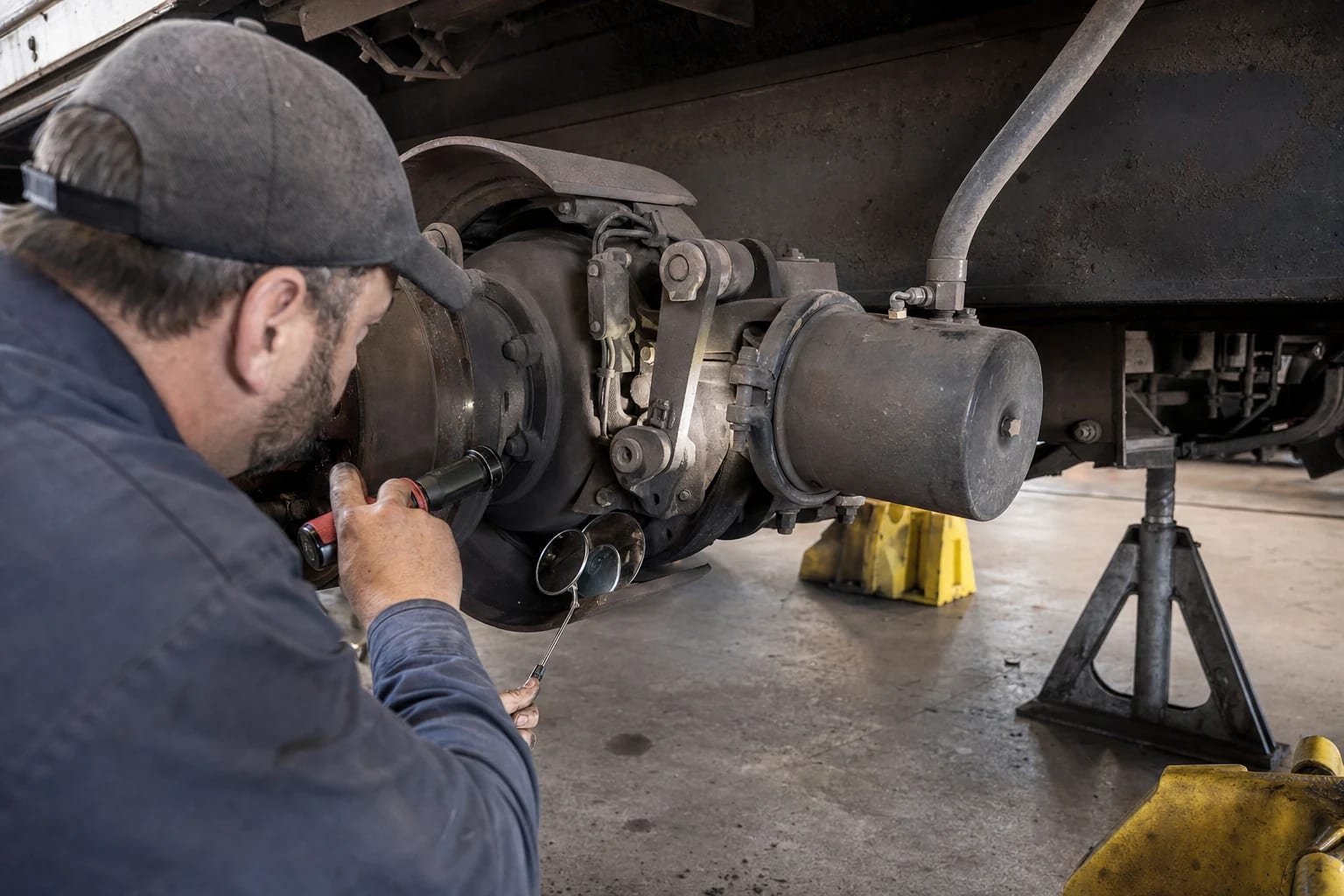
Commercial-vehicle technician inspects an exposed tractor-trailer air-brake chamber, hose, and linkage with a flashlight and mirror
Keep truck and trailer identity, scheduled service, reported defects, as-found condition, inspection, repair, and later changes in separate source-labeled states.

Quick answer

After a California commercial-truck crash, identify the tractor, trailer, axle, and wheel end; preserve safe as-found evidence; request event-date inspection, defect, repair, and out-of-service records from each custodian; and separate scheduled, documented, observed, inspected, and changed conditions without treating one record or later test as proof of brake failure or cause.

Key takeaways

  • Do not inspect, move, test, or disassemble a truck yourself; photograph only from a lawful, safe position.
  • A tractor, trailer, and individual wheel ends can have different identifiers, service histories, and custodians.
  • Inspection, defect, repair, parts, roadside, and post-crash records answer different questions and should not be collapsed into one timeline.
  • A missing, late, or conflicting entry is a question to investigate, not automatic proof of brake failure, causation, or responsibility.
Hurt Advice Editorial Team

Prepared by

Hurt Advice Editorial Team

Editorial Research and Publishing Team

Source-checked editorial publishing

Why trust this article

Prepared by the Hurt Advice Editorial Team from the current official California Legislature, California Highway Patrol, and federal eCFR sources cited on this page. No attorney reviewed this version. Hurt Advice is a lawyer referral and legal information service, not a law firm.

Recent update: Original publication created with a vehicle-and-wheel-end identity map, inspection and repair source map, five-state record ledger, request scripts, and current official citations.

At a glance

What this guide helps you decide

Start with the question that brought you here, identify the records that can verify the facts, and use the related guidance only where it helps. This article addresses truck accidents questions in California.

Main question

Decide how this topic may apply to your situation

Use "Commercial-Truck Brake Inspection and Maintenance Records After a California Crash" to sort the facts you know, the questions still open, and whether a truck accidents resource or consultation may be useful in California.

Guide map

Start with the sections most relevant to you: Who this guide helps and what it does, Start with a truck-and-brake identity sheet, Separate the four inspection and maintenance lanes

Move through the article by issue, not by guesswork, so liability, medical proof, insurance pressure, deadlines, and next steps stay connected.

Records to gather

Connect these subjects to your records: California Truck Brake Records, Commercial Truck Inspection Records, 90-Day Inspection, Brake Maintenance Records

Compare the topic with records, photos, medical visits, police reports, insurer letters, and local claim details before relying on a general answer.

Trust check

Use the source trail before acting

This page includes 6 source references plus internal next-step paths so readers can verify where the guidance comes from.

Before you rely on this guide

This article is written for people dealing with injury-law questions in California. It is meant to help you understand the issue, not replace legal advice about your specific case.

What to do after this article

Start with the quick answer, skim the table of contents, and then use the links below to move into the practice area, author archive, or resource page that turns general guidance into a clearer next step for your situation.

Who this guide helps and what it does

This guide is for someone injured in a California collision involving a tractor-trailer, straight truck, delivery truck, or another regulated commercial vehicle when the condition, inspection, or repair of the brake system may matter. It helps a reader organize source questions; it does not diagnose a mechanical failure, assign fault, or replace a qualified inspection. For a broader claim overview, start with the California truck-accident guide.

The practical task is narrower than asking for “all maintenance records.” First identify the power unit, every trailer or dolly, and the relevant axle or wheel end. Then request records by custodian and date, preserve the as-found condition when lawful and safe, and keep later inspection or repair activity in a separate lane. If you need the larger retention map for logs, accident registers, and other carrier files, use the existing truck-record retention guide.

  • Do not inspect, move, test, or disassemble a truck yourself; photograph only from a lawful, safe position.
  • A tractor, trailer, and individual wheel ends can have different identifiers, service histories, and custodians.
  • Inspection, defect, repair, parts, roadside, and post-crash records answer different questions and should not be collapsed into one timeline.
  • A missing, late, or conflicting entry is a question to investigate, not automatic proof of brake failure, causation, or responsibility.

Start with a truck-and-brake identity sheet

A useful request begins with identity, not conclusions. Record the carrier name and U.S. DOT or California carrier number if known; the tractor unit number, VIN, plate, make, model, and model year; the trailer number, VIN, plate, and owner; and any converter dolly or leased equipment. Note the crash date, location, tow destination, storage location, and whether the combination was later separated. Do not publish private personal identifiers in a public folder or shared chronology.

For the brake system, preserve the terms used in existing records instead of guessing. A document may refer to a power-unit axle, trailer axle, left or right wheel end, service brake, parking brake, emergency system, air reservoir, chamber, hose, valve, drum, rotor, lining, pad, slack adjuster, automatic adjuster, warning device, or antilock system. The federal brake rules recognize multiple system types and components; the current FMCSA’s official Part 393 brake-systems guide brake provisions are the primary reference for the equipment rule, not a substitute for a mechanical examination.

Create one row for each identified unit and wheel end. Fields can include identifier source, component named, date observed, who made the observation, original file location, and whether the condition was before movement, during an official inspection, during a retained expert inspection, or after repair. This prevents a later photograph of one wheel end from being mislabeled as evidence about the entire combination.

Separate the four inspection and maintenance lanes

California and federal requirements overlap, but they are not interchangeable. California Vehicle Code section 34505.5 requires covered motor carriers to conduct a systematic inspection at least every 90 days, or more often when necessary for safe operation. The listed inspection includes brake adjustment and brake-system components and leaks. The statute also says listed defects must be corrected before highway operation other than travel to a repair location, and it identifies what the inspection record must contain. Read the current official California Vehicle Code section 34505.5 for scope and exceptions.

Federal law adds a broader systematic-maintenance lane. 49 C.F.R. section 396.3 requires covered motor carriers and intermodal equipment providers to systematically inspect, repair, and maintain vehicles or equipment under their control and describes vehicle-identification, maintenance-due-date, inspection, repair, and maintenance records. A periodic-inspection report, a driver-reported condition, a repair invoice, and a preventive-maintenance schedule therefore should not be treated as four copies of the same fact.

California Highway Patrol terminal review is another lane. CHP explains that its Basic Inspection of Terminals process can review regulated vehicles, maintenance records, and driver records and publishes carrier inspection information. The current CHP Commercial Vehicle Section also provides the CHP 108 truck maintenance-and-safety inspection form and BIT materials. A BIT result can help identify a regulatory source, but it does not establish the event-date mechanical condition of a particular wheel end by itself.

Brake-record evidence checklist by custodian

Ask who created and who currently holds each record. A motor carrier may have vehicle rosters, preventive-maintenance schedules, 90-day inspection forms, periodic-inspection reports, driver condition reports, defect lists, repair approvals, invoices, parts records, vendor communications, roadside inspection reports, out-of-service documentation, and records showing when a unit entered or left service. An owner-operator, lessor, trailer owner, intermodal provider, repair vendor, or mobile mechanic may hold a different portion of the file.

The driver-held lane can include pre-trip or post-trip observations, messages about warning lights or air pressure, dispatch communications, and photographs. The repair lane can include work orders, technician notes, estimates, parts numbers, labor entries, test results, and sign-off records. The official lane can include CHP or other enforcement inspection results, collision reports, photographs, measurements, and any documented out-of-service action. Request the maintained record and its attachments; do not ask a custodian to create a new conclusion.

Preserve digital context as well as exports. A PDF or screenshot may omit database history, attachments, timestamps, or the link between a defect and a repair order. The digital-evidence preservation guide explains why an original file, export method, filename, and source note can matter. Keep access lawful: do not enter private carrier systems, bypass credentials, or pose as an employee.

  • Vehicle and combination identity: tractor, trailer, dolly, axle, wheel end, plate, VIN, unit number, owner, and controller.
  • Scheduled work: preventive-maintenance interval, due date, inspection type, checklist version, and assigned facility.
  • Reported condition: who noticed what, when, on which unit, by what channel, and whether the truck was operating.
  • Inspection and repair: findings, measurements if actually recorded, technician, work performed, parts, completion, and sign-off.
  • Official and custody records: roadside or terminal inspection, out-of-service status, tow, storage, release, later movement, and later testing.

Use a five-state brake record ledger

A compact ledger makes conflicts visible without pretending to resolve them. Use five state columns: scheduled, last documented, event or as-found, inspected, and repaired or changed. Add one row for each unit or wheel end. In every cell, record the date and time, source, person or system, exact wording, attachment name, and confidence limit. Leave a cell blank when the source does not answer it; do not fill gaps from memory.

Example: the scheduled column may say “90-day inspection due June 12” from a carrier schedule. The last-documented column may cite a signed inspection dated June 8. The as-found column may describe only what a crash-scene photograph actually shows. The inspected column may quote an enforcement or retained-expert observation. The changed column may list towing, wheel removal, air-system discharge, parts replacement, or repair. Those entries can coexist without proving why the collision happened.

Add a separate source-status field: requested, acknowledged, produced, withheld with reason, unavailable, or requires follow-up. For each produced record, note whether it is original, a system export, a scan, a photograph, or a later summary. This tool differs from a generic chronology because it ties each condition statement to a specific unit, state, custodian, and version.

A step-by-step preservation and request process

First, handle medical and scene safety. Second, save lawful photographs, videos, tow information, and the crash-report number without approaching unstable equipment. Third, build the identity sheet from reliable sources. Fourth, list custodians before drafting requests. Fifth, send focused requests or discuss a preservation notice with counsel when appropriate. Sixth, log each response and preserve original files. Seventh, compare records only after sources and versions are labeled.

A neutral carrier or vendor request can say: “Please preserve and provide the maintained inspection, defect, maintenance, repair, parts, roadside-inspection, and out-of-service records for tractor unit [identifier], trailer [identifier], and the identified brake system for [date range]. Please include attachments and identify the system or custodian from which each export was made.” Tailor the scope to the actual combination and event; an overbroad demand can hide the most useful records in noise.

A follow-up can say: “The production references inspection or repair item [identifier], but the cited attachment or completion record was not included. Please provide that item or state whether it is unavailable and who maintains it.” Keep correspondence factual. Do not accuse a driver, carrier, mechanic, or manufacturer of altering evidence based only on a delayed or incomplete response.

Timing, retention, and California deadline boundaries

Regulatory retention periods are minimum recordkeeping rules, not a promise that every useful item will remain available until a claim is filed. Under the current text of 49 C.F.R. section 396.3, the listed vehicle maintenance records generally must be retained where the vehicle is housed or maintained for one year and for six months after the vehicle leaves the carrier’s control. California Vehicle Code section 34505.5 states that covered 90-day inspection records must be retained for two years at designated terminals, subject to the statute’s scope and interstate-vehicle provisions. Different records can have different clocks.

California filing deadlines are a separate lane. Code of Civil Procedure section 335.1 states a two-year limitations period for actions involving injury or death caused by another’s wrongful act or neglect, but exceptions and other causes of action can change the analysis. A claim involving a California public entity can trigger a much shorter administrative presentation rule; Government Code section 911.2 generally sets six months for claims relating to injury or death. The California deadline resource is a starting point, not individualized legal advice.

Do not wait for the end of any quoted period to identify the vehicle, custodian, storage site, or requested record. Trucks can be returned, sold, repaired, dismantled, or placed back into service. Early, specific, lawful preservation is different from deciding what the evidence proves.

Reconcile roadside, shop, and post-crash records carefully

A roadside inspection may document a condition using an enforcement standard and a particular time and location. A shop inspection may use a maintenance checklist, different equipment, and a later condition. A post-crash teardown may alter or expose components that were not visible at the scene. Record each event separately, including who authorized movement or work and what changed before the next observation.

If tire or wheel condition is also disputed, cross-reference the tire-condition and repair records guide, but do not merge tire and brake findings. A wheel removal might expose brake components while changing custody and condition. Likewise, towing and storage records can establish who possessed the truck without proving a mechanical finding.

Conflicting measurements require source review. Ask whether the same unit, axle, wheel end, component, test method, load condition, and timestamp are being compared. Preserve the conflict in the ledger and leave technical interpretation to a qualified person with access to the actual evidence and applicable standards.

Mistakes and red flags to avoid

The most common mistake is beginning with “the brakes failed” and sorting every later record around that conclusion. Another is requesting only invoices, which may show billing but omit the defect report, technician note, inspection checklist, rejected recommendation, parts detail, or completion sign-off. A third is treating the tractor as the entire combination when a trailer or dolly has a separate owner and history.

Red flags for follow-up include an unidentified unit, a missing referenced attachment, a repair entry without the underlying complaint or finding, a later summary that does not name its source, inconsistent wheel-end labels, unexplained date or time changes, or an inspection record that cannot be tied to the crash vehicle. These are reasons to clarify the file, not self-proving wrongdoing.

Avoid unsafe or unlawful conduct: do not crawl under a vehicle, release air, operate controls, remove parts, trespass, impersonate a regulator, or demand another person’s credentials. Do not post VINs, driver medical information, private messages, or other sensitive material publicly. Keep originals read-only and work from labeled copies.

What to do next

Start with the identity sheet and five-state ledger, then list the carrier, equipment owner, repair vendor, tow yard, insurer, and official agency sources that may exist. Save the exact official rule pages used for the request and note the date accessed. If the truck may be moved, repaired, returned, or released soon, consider getting prompt legal advice about a tailored preservation approach.

For immediate crash tasks, use the truck-accident action guide. For the legal-service lane, review the truck brake-failure service page. Hurt Advice is a lawyer referral and legal information service, not a law firm. Its intake team can help route a California injury matter, but it does not guarantee a lawyer match, result, or recovery. You can use the contact page if you want an intake review.

Frequently Asked Questions

What truck brake records should I ask for after a California crash?
Start with records tied to the exact tractor, trailer, axle, or wheel end: maintenance schedules, 90-day and periodic inspections, driver-reported defects, repair orders, technician notes, parts records, roadside inspections, out-of-service documents, and records of post-crash movement or repair. Ask for referenced attachments and identify each custodian.
How long must California 90-day truck inspection records be kept?
California Vehicle Code section 34505.5 states that covered 90-day inspection records must be retained by the motor carrier for two years at its designated terminals, subject to the statute’s scope and interstate-vehicle provisions. Other brake, maintenance, driver, or crash records can have different retention rules.
Do federal truck maintenance records have the same retention period?
No. Under the current text of 49 C.F.R. section 396.3, the listed vehicle maintenance records generally must be retained where the vehicle is housed or maintained for one year and for six months after it leaves the carrier’s control. A different rule may govern another record type.
Does a missing inspection or repair record prove the brakes failed?
No. A missing, delayed, or conflicting record can justify focused follow-up, but it does not by itself prove a mechanical failure, crash cause, negligence, evidence destruction, or responsibility. Confirm the unit, custodian, record type, date range, referenced attachments, and later changes before drawing conclusions.
Can I inspect or photograph the truck myself?
Do not enter private property, operate controls, release air, remove parts, or go under a vehicle. From a lawful and safe position, you may be able to preserve ordinary scene or storage information. A mechanical inspection should be authorized, documented, and performed by a qualified person with appropriate safety controls.
What is the difference between a brake record ledger and a general crash timeline?
A brake record ledger ties each statement to one truck unit, trailer, axle, wheel end, condition state, custodian, date, version, and source. A general crash timeline may combine events. Keeping scheduled, last-documented, as-found, inspected, and changed states separate makes conflicts easier to identify.

Sources and references

Official California text for covered 90-day inspections, listed components, correction, record content, retention, and exceptions.

Need help after an accident?

Hurt Advice intake team can review your situation, explain your options, and help you move forward with a plan that fits your case.