
Legal ExplainerBicycle AccidentsInformational

California Bicycle Dooring Crashes: Evidence to Preserve

Dooring evidence is strongest when it preserves the scene and source history without staging a preferred account. Record the parked vehicle, door side, rider line, fixed landmarks, lighting, witnesses, cameras, report identifiers, and physical condition; keep originals unchanged; and let qualified professionals evaluate fault, causation, preservation duties, and deadlines.

Published

July 21, 2026

Updated

July 21, 2026

Reading time

10 min read

Jurisdiction

California

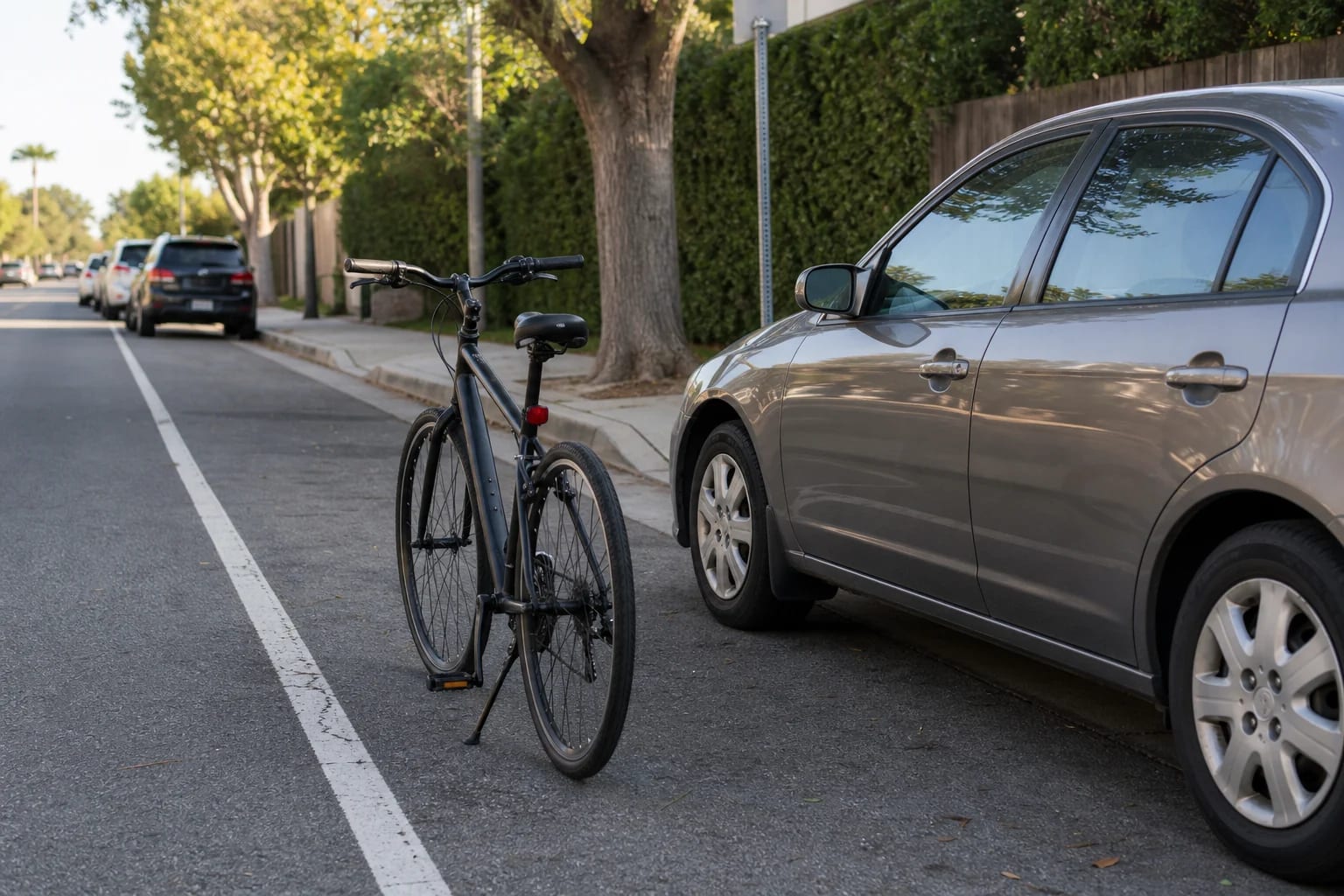
Unbranded commuter bicycle beside a closed parked car on a quiet California street with a marked bicycle lane
A useful dooring-crash file preserves the vehicle, door zone, rider line, fixed landmarks, and source history without staging a reconstruction.

Quick answer

After a California bicycle dooring crash, preserve the door-zone geometry, original bicycle and vehicle condition, short-lived camera sources, witness accounts, and report identifiers without moving objects or recreating the event. Keep firsthand facts separate from measurements and expert conclusions, and address medical care, SR-1 reporting, preservation, insurance, and legal deadlines as distinct tasks.

Key takeaways

  • Photograph the parked vehicle, closed and open door positions if safely available, bicycle, lane line, curb, sight lines, and fixed landmarks without moving objects or recreating the collision.
  • Separate what each person directly saw or heard from measurements, medical opinions, legal conclusions, and later reconstruction work.
  • Preserve original bicycle, clothing, helmet, vehicle, camera, message, and report evidence; work from copies and avoid repairs, cleaning, destructive testing, or staged reenactments.
  • A dooring-evidence file can organize facts, but it does not establish fault, causation, injury severity, admissibility, or compensation by itself.
Hurt Advice Editorial Team

Prepared by

Hurt Advice Editorial Team

Editorial Research and Publishing Team

Source-checked editorial publishing

Why trust this article

Prepared by the Hurt Advice Editorial Team from current California vehicle-door law, DMV bicyclist and SR-1 guidance, CHP crash-report procedures, the Judicial Council’s 2026 civil instructions, and California limitations law. No attorney reviewed this displayed version.

Recent update: Original publication with a door-zone scene map, physical and digital preservation workflow, evidence-source matrix, witness and preservation scripts, report and SR-1 guidance, legal-use cautions, and next-action checklist.

At a glance

What this guide helps you decide

Start with the question that brought you here, identify the records that can verify the facts, and use the related guidance only where it helps. This article addresses bicycle accidents questions in California.

Main question

Decide how this topic may apply to your situation

Use "California Bicycle Dooring Crashes: Evidence to Preserve" to sort the facts you know, the questions still open, and whether a bicycle accidents resource or consultation may be useful in California.

Guide map

Start with the sections most relevant to you: Quick takeaways, Who this guide is for—and what it does, Start with California’s door-opening rule

Move through the article by issue, not by guesswork, so liability, medical proof, insurance pressure, deadlines, and next steps stay connected.

Records to gather

Connect these subjects to your records: Bicycle Dooring Crash, Vehicle Door Evidence, Door Zone, Scene Geometry

Compare the topic with records, photos, medical visits, police reports, insurer letters, and local claim details before relying on a general answer.

Trust check

Use the source trail before acting

This page includes 6 source references plus internal next-step paths so readers can verify where the guidance comes from.

Before you rely on this guide

This article is written for people dealing with injury-law questions in California. It is meant to help you understand the issue, not replace legal advice about your specific case.

What to do after this article

Start with the quick answer, skim the table of contents, and then use the links below to move into the practice area, author archive, or resource page that turns general guidance into a clearer next step for your situation.

Quick takeaways

  • Photograph the parked vehicle, closed and open door positions if safely available, bicycle, lane line, curb, sight lines, and fixed landmarks without moving objects or recreating the collision.
  • Separate what each person directly saw or heard from measurements, medical opinions, legal conclusions, and later reconstruction work.
  • Preserve original bicycle, clothing, helmet, vehicle, camera, message, and report evidence; work from copies and avoid repairs, cleaning, destructive testing, or staged reenactments.
  • A dooring-evidence file can organize facts, but it does not establish fault, causation, injury severity, admissibility, or compensation by itself.

Who this guide is for—and what it does

This guide is for a bicyclist, family member, or representative organizing evidence after a bicycle rider collides with an opening or open vehicle door in California. The task is narrower than a general crash checklist: preserve the door-zone geometry, identify who controlled the door and vehicle, collect short-lived camera and message sources, and keep physical items in their post-event condition.

The California bicycle-accident service guide explains the broader claim area. The defective e-bike guide focuses on product and component evidence. This article addresses a different reader job: documenting a parked or stopped vehicle, an opening door, the rider line, nearby traffic, and the records that may confirm when and how the door entered the path.

Do not use the checklist to stage a recreation, confront another person, enter traffic, trespass, secretly record a private conversation, or postpone care. If the scene is unsafe, prioritize emergency instructions and collect later material through lawful requests. The file should remain honest about gaps and uncertainty.

Start with California’s door-opening rule

California Vehicle Code section 22517 says a person may not open a vehicle door on the side available to moving traffic unless doing so is reasonably safe and does not interfere with that traffic. It also limits leaving such a door open longer than necessary to load or unload passengers. The text applies to a person opening or leaving open the door; it is not a shortcut that decides every collision.

The evidence still needs context: which side of the vehicle faced moving traffic, whether the vehicle was parked or stopped, who opened or controlled the door, where the bicycle was traveling, whether the door was moving or already open, what each person could see, and what happened next. Other conduct, roadway rules, disputed facts, comparative responsibility, causation, and damages can also matter.

The current California Driver’s Handbook sharing-the-road section tells drivers to give bicyclists space so they are not forced into parked vehicles or open doors. It also explains that bicyclists may move left to avoid hazards and that bicyclists share road rights and responsibilities. Use that official guidance for orientation, not as a substitute for the governing statutes, complete facts, or case-specific legal analysis.

The first 30 minutes: safety, identity, and source capture

Call for appropriate emergency help and follow medical instructions. Do not stand in a travel lane to take a photograph. If another safe person can document the scene, ask that person to preserve original files and note who took each image. The medical-care resource can help organize later provider locations and records, but recordkeeping should never delay urgent evaluation.

  1. Identify the event: date, local time, street, direction of travel, nearest address or intersection, side of the street, weather, lighting, and whether the vehicle was parked, stopped, loading, or moving.
  2. Identify people and vehicles: names and contact details when lawfully exchanged, driver and door opener if different, passenger locations, vehicle make or type, plate, insurance information, bicycle description, and responding agency or incident number.
  3. Identify short-lived sources: storefront, residence, parking, bus, vehicle, delivery, helmet, or phone cameras; electronic access logs; rideshare or delivery trip records; messages; calls; and nearby witnesses.
  4. Preserve condition: do not close, reopen, move, repair, wash, discard, or test an item solely to improve a photograph. If safety requires movement, document the reason, who moved it, its earlier position, and its new location.

Record what was unavailable too. “The rider was transported before a wide scene photograph was taken” is a useful limitation. It is better than filling the gap with a later image presented as if it showed the untouched scene.

Build a door-zone scene map without reconstructing fault

Create a source-labeled map from wide views to close views. Begin with the whole block or approach, then the parked vehicle and bicycle path, then relevant details. Keep the original photographs unchanged. A working copy may carry labels, but the original should preserve metadata and the unedited frame.

  • Fixed references: curb, lane or bike-lane line, parking-space marks, driveway, pole, sign, tree, drain, crosswalk, building corner, and address.
  • Vehicle position: front and rear location relative to fixed references, curb distance if later measured safely, wheel direction, vehicle orientation, window condition, mirrors, and door involved.
  • Door condition: closed, partly open, fully open, or moved before documentation; exterior and interior surfaces; edge; hinges; handle; window; trim; and any visible transfer or damage without interpreting its cause.
  • Rider line: direction, bicycle rest point, debris or loose items, lane markings, adjacent traffic space, obstructions, grade, lighting, and sight lines.
  • Scale: use an ordinary known object only when safe, or record later measurements with date, method, person, and fixed endpoints. Never estimate a number and present it as measured.

Do not pose the door at an assumed impact angle or place the bicycle where someone thinks it traveled. A reconstruction professional may use measurements, damage, video, and other data later. Your job is to preserve source facts and label any later measurement as later.

Preserve the bicycle, vehicle, clothing, and digital originals

Keep the bicycle, detached parts, helmet, clothing, shoes, bag, lights, camera, and damaged personal property in the condition received when practical. Photograph each item from multiple sides with a date and custodian. Avoid riding the bicycle, charging or resetting a device, laundering clothing, removing transfers, inflating tires, straightening components, or authorizing repair or disposal before qualified advice about preservation.

The vehicle and door may be repaired quickly. A prompt, specific preservation request can identify the vehicle, door, mirrors, windows, locks, interior trim, onboard camera, event-data systems if any, photos, estimates, inspection records, rental or ownership records, and communications. A request does not guarantee that every item exists, is controlled by the recipient, must be produced, or will be preserved indefinitely.

For digital material, export the original file when possible. Keep its filename, date, time zone, device, sender or custodian, and a read-only copy. Screenshots can be useful for orientation, but they may omit metadata, surrounding messages, or full resolution. The broader California injury-proof guide explains source labeling across an entire claim; this dooring file adds door position, rider line, and traffic-side details.

Use this evidence-source matrix

Organize the file by holder so a missing response is not confused with proof that a record never existed:

  • Rider or family: original photos and video, helmet or bicycle-camera files, device health data if relevant and accurately described, messages, location history, damaged property, receipts, medical instructions, and a same-day account.
  • Vehicle driver, owner, passenger, renter, or employer: identity, insurance, trip purpose, door-control facts, vehicle photos, repair estimates, rental or fleet records, dispatch records, and available onboard video. Different people may control different records.
  • Businesses and properties: exterior cameras, door-access logs, delivery records, parking records, incident reports, and employee witness identities. Retention periods vary, so identify the exact time window and camera location promptly.
  • Government or transit sources: responding-agency report, dispatch or body-worn-camera material where lawfully available, parking or curb records, public camera material, transit video, and road-design records. Access rules, exemptions, fees, and retention can differ.
  • Medical and work sources: ambulance and provider records, imaging and treatment records, work restrictions, job duties, time records, accommodation exchanges, wage records, and out-of-pocket receipts.

Connect each claimed loss to its source instead of using one diary entry for everything. The California damages evidence guide separates medical expenses, earnings, property, and other claimed effects, while the symptom-journal guide explains how to record day-to-day changes without self-diagnosis.

A neutral witness note and preservation request

Ask a witness for their own account, in their own words. Do not suggest the answer or circulate one person’s wording to others:

“Please write only what you personally saw or heard, including where you were, what first drew your attention, the bicycle’s direction, the vehicle and door position, whether you saw the door move, any words you heard, and what happened afterward. If you did not see a point, say that. Please date the note and keep any original photo or video file unchanged.”

A narrow preservation message can identify a source without making unsupported accusations:

“Please preserve any original exterior video showing the curb and traffic lane outside [location] from [time range] on [date], including available metadata and the period immediately before and after the event. The request concerns a bicycle-and-vehicle-door collision near [fixed landmark]. Please let me know promptly whether the system covered that area and whether another person controls the recording.”

Keep delivery proof, replies, and a dated follow-up log. Do not claim a legal hold exists merely because a message was sent. A lawyer can decide whether a formal demand, subpoena, public-records request, inspection protocol, or court process is appropriate.

Obtain the crash report and handle California reporting separately

If CHP investigated, the CHP crash-report page states that a proper party of interest—including a bicyclist—may request a report online or use form CHP 190. The page asks for the crash date and location, driver or owner, party-of-interest status, applicant information, and applicable fee. A city police or sheriff’s report uses that agency’s process instead.

Read the entire report and attachments. Record identifiers, diagrams, witness names, statements, cited provisions, photographs, supplemental reports, and any factual error. A report may organize evidence, but it does not automatically resolve every disputed fact or legal issue. Preserve the unaltered copy and make a separate correction list rather than editing the document.

The California DMV SR-1 page states that a driver, insurance agent, broker, or legal representative must send an SR-1 within 10 days when someone is injured or killed or property damage exceeds $1,000, and that the SR-1 is separate from a police, CHP, or insurance report. Because a dooring event can involve questions about who is a reporting driver and how the form applies, obtain case-specific guidance instead of assuming another report satisfies the requirement.

How the evidence may fit a California injury claim

The Judicial Council’s 2026 CACI resource center publishes the current official civil jury instructions. Those instructions address negligence, causation, comparative fault, and categories of damages, among other subjects. Which instructions or legal standards apply depends on the pleaded claims, parties, evidence, and court rulings.

Keep the proof chain separated. Section 22517 supplies statutory text; scene photographs show what their frames actually capture; a witness describes firsthand perception; a repair estimate addresses proposed vehicle work; medical records address clinical evaluation; and a qualified reconstruction opinion may analyze geometry. No single source necessarily proves duty, breach, causation, injury, recoverable loss, or an amount.

Preserve facts that may cut in different directions: door position, lighting, visibility, rider path, speed evidence if reliable, bicycle equipment, lane availability, adjacent traffic, distraction evidence if lawfully obtained, prior damage, medical history, later improvement, and conflicting statements. A complete file is more useful than a curated set that omits unfavorable or uncertain material.

Timing, deadlines, and process cautions

Camera systems overwrite, vehicles are repaired, witnesses move, and memories fade. Send specific lawful requests promptly, but do not exaggerate what exists or who controls it. Record the request date, exact time window, recipient, delivery method, response, and any stated retention limit. If inspection is arranged, identify the item, custodian, participants, date, method, and whether any testing changes the item.

California Code of Civil Procedure section 335.1 states a two-year period for an action for injury to or death of an individual caused by another’s wrongful act or neglect. That is not a universal deadline calculation. Accrual, tolling, public entities, minors, defendant identity, government claims, contracts, federal law, and other rules may change what must be done and when.

Evidence collection, medical care, insurance communication, vehicle repair, and settlement discussion do not necessarily pause a legal clock. The California limitations guide gives general orientation, but a licensed California attorney should calculate every deadline from the actual facts as early as practical.

Mistakes and red flags to avoid

  • Recreating the event: do not reopen the door, reposition the bicycle, or enter traffic to stage a preferred account.
  • Editing originals: preserve raw files and annotate a separate working copy.
  • Cleaning or repairing: do not remove transfers, wash clothing, ride the bicycle, or authorize destruction before preservation questions are addressed.
  • Leading witnesses: ask for firsthand facts, not agreement with a theory.
  • Overstating a source: a photograph, report, statute, estimate, or log proves only what it reliably supports.
  • Ignoring ownership: the driver, owner, passenger, renter, employer, property, platform, agency, and insurer may hold different records.
  • Assuming a request freezes deletion: track delivery and response, and seek qualified advice about formal preservation tools.
  • Missing reporting or legal deadlines: handle SR-1, agency, insurance, preservation, and lawsuit timing as separate questions.

Be skeptical of anyone who asks you to alter a record, backdate a note, hide a prior condition, discard an item, or promise a result before reviewing the evidence. The Hurt Advice source policy explains why visible authority, precise attribution, and claim limits matter.

A seven-step next-action checklist

  1. Address safety and appropriate medical evaluation before evidence work.
  2. Write the exact date, time, location, direction, door side, people, vehicle, bicycle, and report identifiers.
  3. Preserve wide-to-close original scene files, fixed references, bicycle and vehicle condition, and any limitation in what was captured.
  4. Identify short-lived cameras, messages, trip or parking records, witnesses, and custodians; send narrow lawful requests promptly.
  5. Keep physical items and digital originals unchanged, maintain a custodian log, and work from copies.
  6. Request the appropriate agency report, address any SR-1 question separately, and create a dated gap list.
  7. Ask qualified medical, reconstruction, insurance, and legal professionals to evaluate meaning, causation, admissibility, preservation, and deadlines.

Hurt Advice is a lawyer-referral and legal-information service, not a law firm. This article provides general educational information, not medical or legal advice. No attorney reviewed this displayed version. For case-specific questions, a licensed California attorney can review the parties, evidence, preservation duties, reporting rules, insurance, and deadlines.

Frequently Asked Questions

What should I photograph after a California bicycle dooring crash?
When it is safe, capture wide-to-close views of the block, parked vehicle, relevant door, bicycle path, lane or bike-lane line, curb, fixed landmarks, lighting, sight lines, bicycle, and visible condition. Preserve originals and do not move objects or recreate an assumed impact position.
Does Vehicle Code section 22517 automatically prove fault?
No. Section 22517 supplies a rule about opening or leaving open a door on the side available to moving traffic. A claim can still depend on who controlled the door, vehicle and rider positions, timing, visibility, other conduct, causation, comparative responsibility, admissibility, and damages.
Should I repair my bicycle or wash my clothing?
Preserve their post-event condition until qualified advice addresses inspection and preservation. Photograph each item and its custodian. Avoid riding, repair, cleaning, part replacement, transfer removal, or disposal that could change relevant condition; work from copies of digital records.
How can a bicyclist request a CHP crash report?
CHP says a proper party of interest, including a bicyclist, may use its online Crash Portal or submit form CHP 190. The request identifies the crash date and location, driver or owner, applicant, party-of-interest status, and applicable fee. Other agencies use their own process.
Is a California SR-1 required after a dooring collision?
DMV states that a driver or representative must send an SR-1 within 10 days when someone is injured or killed or property damage exceeds $1,000, separate from police, CHP, or insurance reporting. Because dooring facts may raise who-is-the-driver and application questions, obtain case-specific guidance promptly.
What is the California deadline for a bicycle dooring injury case?
Code of Civil Procedure section 335.1 states a general two-year period for injury caused by another’s wrongful act or neglect, but it is not universal. Accrual, tolling, public entities, minors, defendants, government claims, contracts, and other law can change the result, so obtain a fact-specific calculation early.

Sources and references

Provides California’s rule for opening or leaving open a vehicle door on the side available to moving traffic.

California Highway PatrolRequest a Crash Report

Explains report access for proper parties of interest, including bicyclists, and the CHP 190 request process.

Need help after an accident?

Hurt Advice intake team can review your situation, explain your options, and help you move forward with a plan that fits your case.