
Legal ExplainerPersonal InjuryChecklist / Process

Pharmacy Fill and Payment Records After a California Injury

After a California injury, keep the prescriber order, pharmacy fill profile, health-plan claim or EOB, and actual receipt or payment as separate records. Match them by date and prescription number, preserve corrections and reversals, and do not treat a filled prescription as proof that a medication was taken or caused an outcome.

Published

July 29, 2026

Updated

July 29, 2026

Reading time

11 min read

Jurisdiction

California

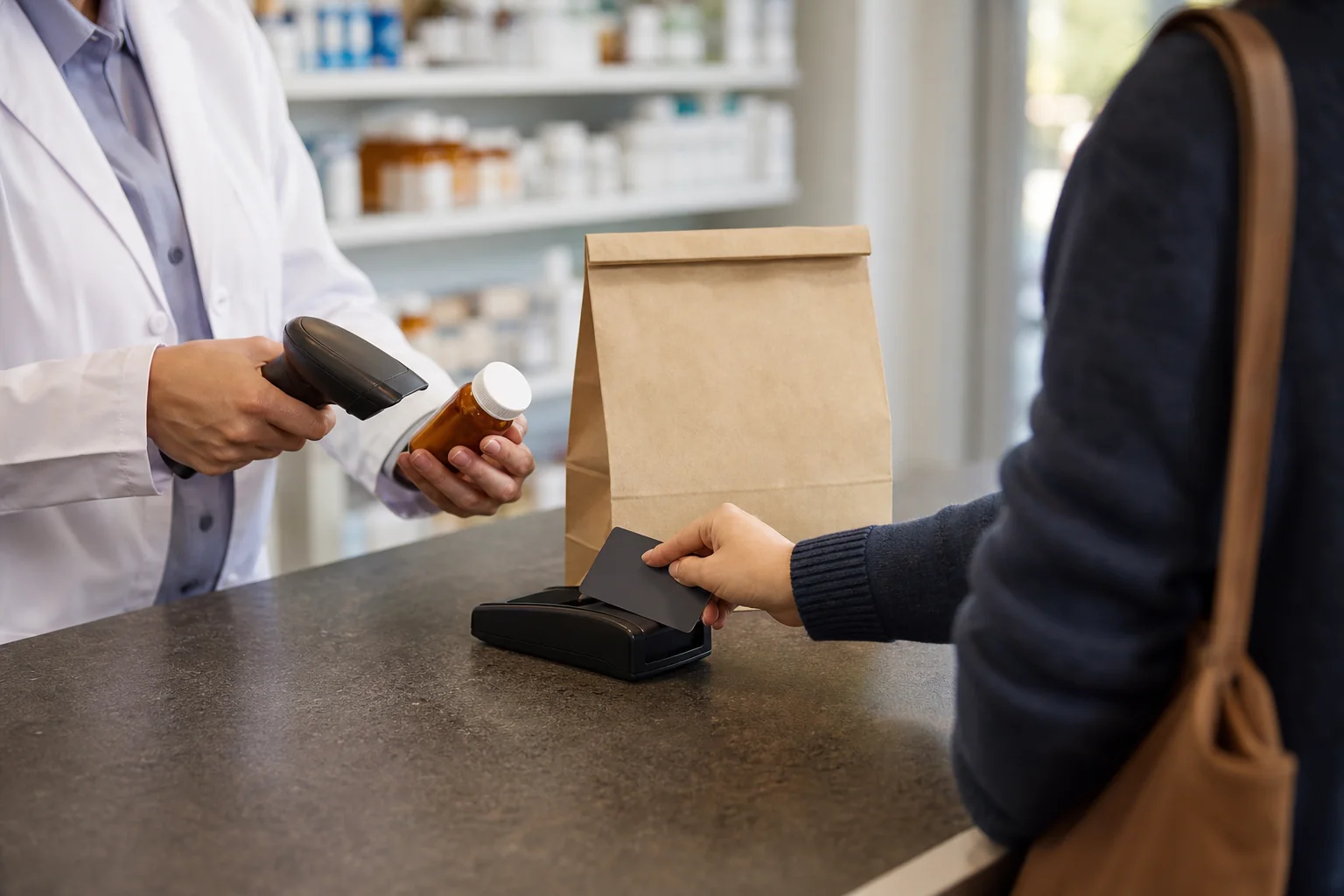
Pharmacist scanning an unbranded amber prescription bottle while a patient taps a plain payment card at a pharmacy counter
A reliable pharmacy file keeps the prescriber order, dispensing record, payer claim, payment, and possession source in separate lanes.

Quick answer

After a California injury, keep the prescriber order, pharmacy fill profile, health-plan claim or EOB, and actual receipt or payment as separate records. Match them by date and prescription number, preserve corrections and reversals, and do not treat a filled prescription as proof that a medication was taken or caused an outcome.

Key takeaways

  • Keep the prescriber order, pharmacy fill profile, health-plan claim or EOB, and actual receipt or payment as separate source types.
  • A dispensing record can show what a pharmacy processed or released; it does not by itself prove when, whether, or how a person used a medication.
  • Request records from each pharmacy and health plan that held them, preserve native portal exports, and label corrections or reversals instead of overwriting them.
  • California CURES can add a separate controlled-substance dispensing source, but it is not a complete history of every prescription or over-the-counter product.
Hurt Advice Editorial Team

Prepared by

Hurt Advice Editorial Team

Editorial Research and Publishing Team

Source-checked editorial publishing

Why trust this article

Prepared by the Hurt Advice Editorial Team from current California State Board of Pharmacy, California Legislature, California DOJ, eCFR, and CMS sources. No attorney reviewed this displayed version.

Recent update: Original publication with a four-lane pharmacy-record map, CURES boundary, fill-and-payment ledger, request scripts, timing workflow, evidence checklist, mistakes, and FAQs.

At a glance

What this guide helps you decide

Start with the question that brought you here, identify the records that can verify the facts, and use the related guidance only where it helps. This article addresses personal injury questions in California.

Main question

Decide how this topic may apply to your situation

Use "Pharmacy Fill and Payment Records After a California Injury" to sort the facts you know, the questions still open, and whether a personal injury resource or consultation may be useful in California.

Guide map

Start with the sections most relevant to you: Quick takeaways, Who this guide is for—and the narrow task it solves, Build four source lanes before you build a timeline

Move through the article by issue, not by guesswork, so liability, medical proof, insurance pressure, deadlines, and next steps stay connected.

Records to gather

Connect these subjects to your records: California Pharmacy Records, Prescription Fill History, Patient Medication Profile, Pharmacy Claims

Compare the topic with records, photos, medical visits, police reports, insurer letters, and local claim details before relying on a general answer.

Trust check

Use the source trail before acting

This page includes 6 source references plus internal next-step paths so readers can verify where the guidance comes from.

Before you rely on this guide

This article is written for people dealing with injury-law questions in California. It is meant to help you understand the issue, not replace legal advice about your specific case.

What to do after this article

Start with the quick answer, skim the table of contents, and then use the links below to move into the practice area, author archive, or resource page that turns general guidance into a clearer next step for your situation.

Quick takeaways

  • Keep the prescriber order, pharmacy fill profile, health-plan claim or EOB, and actual receipt or payment as separate source types.
  • A dispensing record can show what a pharmacy processed or released; it does not by itself prove when, whether, or how a person used a medication.
  • Request records from each pharmacy and health plan that held them, preserve native portal exports, and label corrections or reversals instead of overwriting them.
  • California CURES can add a separate controlled-substance dispensing source, but it is not a complete history of every prescription or over-the-counter product.

Who this guide is for—and the narrow task it solves

This guide is for a California patient organizing medication-related records after an injury, or an authorized personal representative helping with that task. It focuses on source control: matching an order to a dispensing event, insurance claim, patient payment, and later correction without turning any one record into a medical or legal conclusion.

The emergency-department record guide explains chart components such as medication-administration records and discharge instructions. The hospital billing guide separates facility charges, codes, EOBs, and clinical records. This article solves a different reader task: reconstructing what happened after a prescription left the prescriber and moved through a retail, mail-order, specialty, or hospital outpatient pharmacy and a payer.

Hurt Advice is a lawyer referral and legal information service, not a law firm. This is general information, not legal, medical, pharmacy, insurance, privacy, tax, or benefits advice. It does not determine causation, treatment appropriateness, adherence, coverage, damages, admissibility, or whether a particular entity must create a record it does not maintain.

Build four source lanes before you build a timeline

Lane one: the order. Preserve the prescription or medication order available from the prescriber, patient portal, discharge packet, or pharmacy. Record the drug name, strength, dosage form, directions, quantity, prescriber, order date, and any documented discontinuation or replacement. Do not treat a medication list as proof that a particular order reached a pharmacy.

Lane two: the pharmacy fill. Request the patient medication profile or prescription history maintained by each pharmacy. Useful fields can include the pharmacy, prescription number, drug and strength, quantity, directions, prescriber, date dispensed or refilled, refill number, and status. A transfer, partial fill, reversal, return-to-stock event, or corrected claim may require a separate entry.

Lane three: the payer claim. Preserve the health plan or pharmacy-benefit claim, EOB, denial, prior-authorization notice, formulary message, and appeal result. A payer record answers payment and coverage questions; it may not prove physical pickup or use.

Lane four: actual payment and possession. Keep the pharmacy receipt, card or account record, delivery confirmation, mail-order tracking, pickup message, and any refund. These sources can help reconcile what the patient paid or received. They should remain separate from clinical notes about use, effect, or side effects.

What California pharmacy records can contain

The California State Board of Pharmacy’s current 2026 Pharmacy Lawbook includes title 16, section 1707.1, the duty to maintain patient medication profiles. The regulation describes a profile that is readily retrievable during normal pharmacy hours and includes patient identifiers and, for each prescription dispensed, information such as the drug, strength, dosage form, quantity, directions, prescriber, dispensing or refill date, and prescription number. It states that the patient medication record must be maintained for at least one year from the last prescription filled.

That one-year profile rule is not a promise that every pharmacy record disappears after one year. California Business and Professions Code section 4105 includes a general three-year retention period for records required by the pharmacy-law chapter and requires specified electronic records to remain producible during business hours. Different prescriptions, controlled-substance rules, payer contracts, litigation holds, and business systems may create other retention duties or longer actual retention.

Ask the pharmacy what it maintains for the date range and request the existing fields you need. Avoid demanding a newly created analysis. If a chain, independent pharmacy, mail-order pharmacy, hospital outpatient pharmacy, and specialty pharmacy were involved, identify each location or entity rather than assuming one portal is the complete source.

Use the patient access route without overclaiming it

Current 45 C.F.R. part 164, subpart E defines a designated record set to include a covered provider’s medical and billing records, a health plan’s enrollment, payment, claims-adjudication, and case-management systems, and records used to make decisions about individuals. Section 164.524 generally gives an individual a right to inspect and obtain a copy of protected health information about that individual in a designated record set, subject to the rule’s exceptions.

A covered entity may require a written request. The regulation states that the requested form and format should be provided when readily producible, with an agreed readable alternative when it is not. The access right generally reaches existing protected health information in a designated record set; it does not require the pharmacy or plan to create an explanation, legal analysis, or reconciliation that does not already exist.

Keep the request narrow: name the patient, date range, pharmacy or plan, and fields sought. Ask for a machine-readable export if one is readily producible, plus any legend needed to understand transaction status. If access is denied or limited, preserve the response and the stated basis. Do not bypass another person’s account, use a family member’s login without authority, or send sensitive records over an unsafe channel.

CURES is a separate controlled-substance source—not the whole medication history

The California Department of Justice CURES FAQ states that CURES stores Schedule II, III, IV, and V controlled-substance prescriptions reported as dispensed in California. A Patient Activity Report can include the prescriber, pharmacy, fill date, prescription number, drug, strength, quantity, refill information, days’ supply, payment method, and other specified fields. The FAQ also explains how a patient can request a copy of the patient’s own CURES prescription history report from DOJ.

Use that report as its own lane. It does not cover every prescription medication, over-the-counter product, supplement, medication administered in a facility, prescription never dispensed, or transaction outside its reporting scope. A pharmacy profile may contain noncontrolled medications that CURES does not. A prescriber chart may show an order later canceled or never filled. A payer claim can be reversed. The comparison is useful precisely because the sources answer different questions.

If a CURES entry appears inaccurate, follow the DOJ process and contact the reporting pharmacy or prescriber as appropriate. Preserve the original report, correction request, response, and later report as separate versions. Do not edit the first report or accuse a provider of wrongdoing based only on an unexplained mismatch.

Read an EOB as a payer record, not a receipt

CMS explains that an explanation of benefits is not a bill. It can list a claim reference, service or supply description, provider, date, provider charge, allowed amount, insurer payment, and patient balance. CMS also cautions that the patient may already have paid part of the displayed balance.

For a pharmacy claim, preserve the EOB or claim detail together with the pharmacy receipt and account transaction. Record whether the claim was paid, denied, reversed, resubmitted, or adjusted. A “patient responsibility” field is not automatically the amount paid at pickup. A card charge may combine several prescriptions or nonprescription purchases. A coupon or manufacturer assistance program may create another payment source.

When amounts differ, write the exact comparison: “EOB shows allowed amount of [amount]; pharmacy receipt shows patient paid [amount]; card record shows combined transaction of [amount].” Keep the original documents private and redact account numbers in working copies. The damages evidence guide explains broader loss categories; it does not make every pharmacy charge recoverable or prove that a medication was injury-related.

A practical fill-and-payment reconciliation ledger

Create one responsive entry for each order or dispensing event. Avoid a wide spreadsheet that becomes unreadable on mobile. Use these nine fields:

  1. Medication identity: generic or brand name as shown, strength, dosage form, and quantity.
  2. Order source: prescriber or facility, order date, order identifier, and documented status.
  3. Pharmacy source: entity and location, prescription number, fill or refill date, and transaction status.
  4. Payer source: health plan or PBM, claim reference, submitted date, paid, denied, reversed, or adjusted status.
  5. Patient amount: amount shown as owed, amount actually paid, payment date, and source.
  6. Possession source: pickup, delivery, mail tracking, return-to-stock, refund, or unknown.
  7. Clinical source: separate chart note, medication list, or patient observation—never inferred from the fill alone.
  8. Version and provenance: producer, export date, file name, native format, page or row, and hash when practical.
  9. Open question: mismatch, missing field, correction request, or source still needed.

Example: “Prescriber portal shows order entered May 3; pharmacy profile shows filled May 4; payer claim shows paid then reversed May 5; pharmacy confirms return to stock; no possession source.” That ledger does not say the patient took the medication. It identifies a sequence requiring explanation.

Two neutral request scripts

Pharmacy request: “Please provide the existing patient medication profile and prescription-dispensing records your pharmacy maintains for me from [start date] through [end date], including prescription number, drug, strength, dosage form, quantity, directions, prescriber, fill or refill date, refill number, and available transaction status. Please identify the identity-verification process, readily producible electronic format, fees, expected response date, and any category maintained by a different entity.”

Health-plan or PBM request: “Please provide my existing pharmacy claims, EOBs, prior-authorization notices, denial or appeal records, and transaction history for [date range], including claim reference, pharmacy, drug or product identifier as maintained, date, submitted amount, allowed amount, plan payment, patient responsibility, and paid, denied, reversed, or adjusted status. Please include a field legend if one already exists.”

Use only verified identifiers and the minimum necessary date range. Adapt the request to the entity’s form and current rules. Do not claim that the script compels every listed field, demand another person’s records, or ask an employee to alter a transaction history.

Timing and process checkpoints

At the first safe opportunity: address medical needs first. Save the prescription instructions, pharmacy messages, pickup or delivery confirmation, receipt, payer notice, and portal export already available to you. Photograph a container only if safe, and do not post a label containing personal information.

Before a portal changes: download the native file or full export when available. Record the export date, covered period, pharmacy or plan, and visible status legend. Keep screenshots as secondary context, not a substitute for the underlying export when it can be obtained.

When requesting records: send separate focused requests to the pharmacy, prescriber, and health plan or PBM. Track identity verification, delivery proof, response date, fees, denials, redactions, and missing date ranges. Request a patient’s CURES report only through the DOJ process that applies to that patient.

Before writing a chronology: reconcile the order, fill, payer, payment, possession, and clinical sources. Use “not located,” “reversed,” “disputed,” or “unknown” instead of filling a gap with an assumption. A symptom journal records personal observations; it is not a pharmacy record and should remain in a separate lane.

Before relying on a deadline or disclosure right: confirm the current rule and obtain case-specific advice when necessary. A minor’s record, personal representative, substance-use record, workers’ compensation claim, litigation hold, subpoena, plan appeal, or state-law exception may require a different process.

Evidence checklist

  • Prescriber order, medication list, discharge instruction, cancellation, substitution, and documented correction kept as separate versions.
  • Medication profile or prescription history from every retail, mail-order, specialty, and hospital outpatient pharmacy involved.
  • Prescription number, drug, strength, dosage form, quantity, directions, prescriber, fill date, refill number, and transaction status when maintained.
  • Health-plan or PBM claim, EOB, prior authorization, denial, appeal, reversal, resubmission, and adjustment record.
  • Pharmacy receipt, card or account record, coupon or assistance record, refund, pickup notice, delivery confirmation, and mail tracking.
  • Patient CURES report when relevant to a California Schedule II–V controlled-substance history, kept separate from the broader medication file.
  • Requests, identity-verification steps, delivery proof, fees, responses, denials, redactions, and correction correspondence.
  • A fill-and-payment ledger with source, status, version, provenance, and unresolved question for every event.
  • Privacy-safe working copies and a protected original folder; redact labels, addresses, account numbers, and other identifiers before sharing.

Mistakes and red flags

  • Treating a prescriber medication list, pharmacy fill record, payer claim, receipt, and clinical note as interchangeable.
  • Calling a paid or filled claim proof that the patient picked up, used, benefited from, or was harmed by a medication.
  • Treating CURES as a complete list of every medication or interpreting the absence of an entry without checking its reporting scope.
  • Overwriting a reversed claim, corrected profile, refund, substitution, or transferred prescription instead of preserving each version.
  • Requesting another person’s prescription history, using an account without authority, or sharing unredacted labels and portal exports.
  • Assuming one pharmacy chain portal includes independent, mail-order, specialty, hospital, or prior pharmacy records.
  • Calling a denial, prior authorization, quantity limit, price change, or mismatch proof of bad faith, negligence, causation, or damages.
  • Changing file names without a source log, cropping away context, recreating a missing receipt, or converting an estimate into an original record.

Why provenance matters—and careful next steps

California Evidence Code section 1271 identifies conditions for the business-record hearsay exception, including regular-course creation, timing, custodian or qualified-witness testimony, and trustworthiness. Saving a pharmacy or payer export does not automatically establish admissibility. The practical lesson is to preserve who produced it, when, how, and in what original form.

Finish the reconciliation ledger, make focused requests for missing source lanes, and list unresolved differences without guessing. Keep medication use and effects in the clinical and personal-observation lanes. The medical care resources can help identify care information, while this article remains limited to record organization.

If an access dispute, privacy issue, disputed medication history, benefits appeal, preservation concern, or injury claim needs individual review, obtain current professional advice. Hurt Advice can connect people with independent California lawyers through the contact page, but it does not promise representation or an outcome.

This article was prepared by the Hurt Advice Editorial Team from the official sources listed above. No attorney reviewed this displayed version. Review the editorial standards for the site’s sourcing and correction process.

Frequently Asked Questions

Which pharmacy records should I request after a California injury?
Request the existing patient medication profile or prescription history from each pharmacy involved, plus the prescriber order, health-plan or PBM claim and EOB, pharmacy receipt, payment record, and pickup or delivery confirmation. Keep each source separate because they answer different questions.
Does a pharmacy fill record prove that I took the medication?
No. A fill record can show that a pharmacy processed or dispensed a prescription. It does not by itself prove pickup, delivery, ingestion, timing of use, adherence, effect, side effect, medical causation, or damages. Use possession, clinical, and personal-observation sources for those separate questions.
How long does a California pharmacy keep a patient medication profile?
Title 16, section 1707.1 in the California Pharmacy Lawbook states that the patient medication record must be maintained for at least one year from the last prescription filled. Other pharmacy records can have different retention rules, including Business and Professions Code section 4105.
Can I get prescription and payment records under HIPAA?
45 C.F.R. §§ 164.501 and 164.524 define designated record sets to include specified provider billing and health-plan payment and claims systems and generally give individuals access to their protected health information in those sets. A written request may be required, and exceptions can apply.
Is a California CURES report my complete medication history?
No. The California DOJ says CURES stores Schedule II, III, IV, and V controlled-substance prescriptions reported as dispensed in California. It does not cover every prescription, over-the-counter product, facility-administered medication, canceled order, or transaction outside its reporting scope.
Is an explanation of benefits the same as a pharmacy receipt?
No. CMS explains that an EOB is not a bill. It reports how a payer processed a claim and may show charges, allowed amounts, plan payment, and patient responsibility. A pharmacy receipt or account transaction is a separate source for what was actually charged or paid.

Sources and references

Electronic Code of Federal Regulations45 C.F.R. part 164, subpart E

Current federal definition of designated record set and section 164.524 access, format, timing, fee, and exception rules.

California Department of JusticeCURES Frequently Asked Questions

Official scope, fields, patient-report request process, and correction information for California controlled-substance dispensing reports.

Need help after an accident?

Hurt Advice intake team can review your situation, explain your options, and help you move forward with a plan that fits your case.