Referral intake reviewES
News UpdatePublic Transit AccidentsNews / Timely Update

California School Bus Danger Zone Is Now 12 Feet

This California update is for parents, caregivers, witnesses, school transportation teams, and anyone organizing records after a school-bus loading or unloading incident. It explains the new 12-foot training guidance, shows how to map the area without guessing, separates likely record custodians, and states the limits of what the change can establish.

Published

August 26, 2026

Updated

August 26, 2026

Reading time

12 min read

Jurisdiction

California

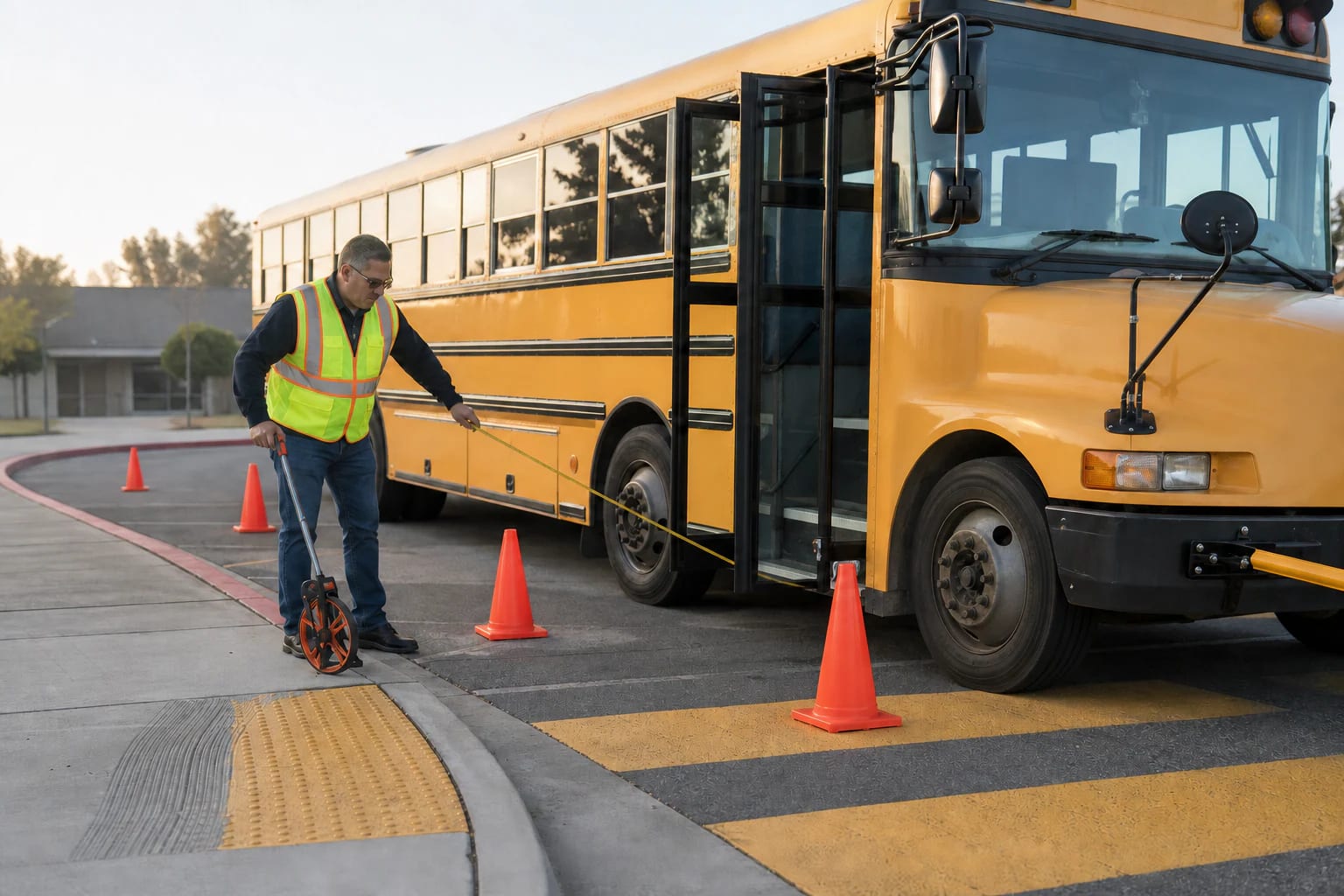
School transportation safety instructor measuring a cone-marked perimeter beside a yellow school bus in a loading zone
Editorial illustration: a transportation safety instructor measures a school-bus loading-zone perimeter; no child, crash, injury, or identifiable victim is shown.

Quick answer

California’s school-bus driver curriculum now defines the danger zone as 12 feet from the bus on the sides, front, and rear, replacing 10 feet. The August 25, 2026 CDE bulletin changes training guidance; it does not by itself prove fault in an incident. Document bus position, walking path, vehicle signals, witnesses, and existing records promptly.

Key takeaways

  • The training danger zone now extends 12 feet from the sides, front, and rear of the bus.
  • The bulletin changes curriculum; it does not establish who was legally responsible.
  • Measure or estimate only from a safe place, and label estimates as estimates.
  • Separate bus, carrier, school-site, roadway, emergency-response, and witness records by custodian.
Hurt Advice Editorial Team

Prepared by

Hurt Advice Editorial Team

Editorial Research and Publishing Team

Source-checked editorial publishing

Why trust this article

Prepared by the Hurt Advice Editorial Team from current California Department of Education, California Highway Patrol, California Legislative Information, and NHTSA sources. The August 25, 2026 training change and its limits are stated directly. No attorney reviewed the displayed version.

Recent update: Original publication added the August 25, 2026 California 12-foot school-bus danger-zone update, a four-side mapping tool, custodian-specific record guidance, a preservation script, and clear limits on incident-level conclusions.

At a glance

What this guide helps you decide

Start with the question that brought you here, identify the records that can verify the facts, and use the related guidance only where it helps. This article addresses public transit accidents questions in California.

Main question

Decide how this topic may apply to your situation

Use "California School Bus Danger Zone Is Now 12 Feet" to sort the facts you know, the questions still open, and whether a public transit accidents resource or consultation may be useful in California.

Guide map

Start with the sections most relevant to you: How to use this California school-bus update, What changed on August 25, 2026, A four-side 12-foot mapping tool

Move through the article by issue, not by guesswork, so liability, medical proof, insurance pressure, deadlines, and next steps stay connected.

Records to gather

Connect these subjects to your records: California school bus danger zone, school bus loading zones, pupil transportation safety, school bus incident records

Compare the topic with records, photos, medical visits, police reports, insurer letters, and local claim details before relying on a general answer.

Trust check

Use the source trail before acting

This page includes 6 source references plus internal next-step paths so readers can verify where the guidance comes from.

Before you rely on this guide

This article is written for people dealing with injury-law questions in California. It is meant to help you understand the issue, not replace legal advice about your specific case.

What to do after this article

Start with the quick answer, skim the table of contents, and then use the links below to move into the practice area, author archive, or resource page that turns general guidance into a clearer next step for your situation.

How to use this California school-bus update

On August 25, 2026, the California Department of Education changed the danger-zone distance taught to original and renewal school-bus drivers. This is a timely training update, not a verdict about an individual event. Use it to understand the area that now receives focused safety instruction, then build a separate factual record of what was observed at a particular bus, stop, route, or school site.

The sections below follow a practical order: what changed, how to map the four sides of the bus, what to document, which custodian may hold each record, how warning equipment fits into the picture, and how to send a narrow preservation request. For broader context, see the school bus accident information page and the California public-transit hub.

  • The training danger zone now extends 12 feet from the sides, front, and rear of the bus.
  • The bulletin changes curriculum; it does not establish who was legally responsible.
  • Measure or estimate only from a safe place, and label estimates as estimates.
  • Separate bus, carrier, school-site, roadway, emergency-response, and witness records by custodian.

What changed on August 25, 2026

The official California Department of Education Danger Zone 08-25 bulletin says the danger zone previously extended 10 feet from the sides, front, and rear of a school bus. Effective immediately, CDE increased that distance to 12 feet. CDE says original and renewal driver instruction should reflect the change and that new editions of the state training documents will incorporate it.

Read the scope carefully. The bulletin describes a curriculum change adopted by CDE in response to pupil-transportation safety recommendations. It does not say every person within 12 feet is injured, that every incident inside the area was preventable, or that the distance decides fault. It also does not replace the need to identify the exact vehicle, driver, route, location, time, road condition, warning-equipment use, walking path, and available records.

The four-side wording matters. The area is not limited to the passenger door or the travel lane beside the bus. It includes the front, rear, and both sides. A child, adult, cyclist, or nearby driver may move through different parts of that perimeter. Document the path actually observed instead of drawing a straight line afterward.

The update is distinct from school-site design standards. CDE’s School Site Design Diagrams illustrate separate questions about buses passing through parking areas, backing movements near loading zones, separation of parent drop-off, and conflicts with student walking paths. A 12-foot perimeter and a site-traffic plan describe different layers of safety.

A four-side 12-foot mapping tool

Start with a simple overhead sketch. Draw a rectangle for the bus and mark the front, rear, driver side, and passenger-door side. Add a dashed perimeter 12 feet away on each side. If you did not measure the distance, label the drawing “not to scale.” Never step into a roadway, active loading area, or restricted space to obtain a measurement.

Add fixed reference points: curb edge, loading lane, crosswalk, driveway, parking aisle, sidewalk, fence, school entrance, traffic lane, sign pole, and camera locations. Record the direction the bus faced. A photograph from a safe lawful position can help, but preserve the original file and metadata before making an annotated copy.

Plot movement as separate observations. One line can show where the bus was reported to stop. Another can show the observed walking path. A third can show another vehicle’s reported path. Use labels, not conclusions. If witnesses disagree, record each account and vantage point rather than blending them into one route.

  • Front: crossing path, crossing-control arm, sight line, bus overhang, and adjacent lane.
  • Passenger-door side: curb, stepwell, door, loading queue, attendant position, and sidewalk.
  • Rear: backing area, rear wheels, visibility limits, and nearby traffic.
  • Driver side: passing traffic, mirrors, lane edge, parked vehicles, and opposing movement.

Evidence checklist for the specific event

Write down the bus number or another lawful vehicle identifier, route or school if known, date, approximate time range, direction of travel, stop location, weather, lighting, and whether pupils were boarding, exiting, waiting, or already away from the bus. Do not post a child’s name, medical information, school schedule, or image publicly. Preserve sensitive material privately and share only what is necessary.

Photograph or describe the physical setting from a safe position: curb color, signs, lane markings, crosswalk, driveway openings, parked vehicles, vegetation, construction, glare, shadows, and temporary obstructions. Note whether a parent pickup area, parking aisle, delivery route, or school-bus path intersects the walking route. Observation comes before interpretation.

Identify potential video without claiming it exists. Possible sources may include bus cameras, a school entrance, a nearby building, a parking system, a dashcam, or a witness phone. Record the camera location, likely direction, owner or custodian, and a narrow time range. A visible camera does not guarantee that it recorded, retained, or can release footage. The 911 and dispatch records guide explains how to compare emergency-system timestamps without changing a source.

  • Original photos, video, messages, and file metadata
  • Bus identifier, route, stop, direction, door position, and observed warning lights
  • Witness names and contact information kept privately
  • Collision report number, diagram, photographs, and school-bus supplement if created
  • Carrier, school, site, roadway, dispatch, and identified video records

Which custodian may hold which record

The carrier may hold vehicle inspection, maintenance, repair, driver, route, dispatch, and collision material. The current CHP School Bus Inspection Manual, Chapter 5 says a carrier must maintain a report of each collision on public or private property involving a school bus with a pupil aboard. It says the report contains pertinent details and is retained for 12 months under 13 CCR 1234(h). That stated carrier period does not promise that every requested item is releasable.

Law enforcement may hold a traffic collision report, diagram, photographs, witness information, or school-bus supplement. The CHP 555E School Bus Crash Supplemental Report instructions show fields for driver certification, vehicle inspection approval, passenger count, and seating positions. A qualifying supplement answers different questions from a maintenance file or route record.

A district, county office, charter school, private school, or contractor may hold route assignments, stop approvals, transportation policies, parent communications, training documents, incident correspondence, or site plans. Ownership and access vary. Confirm the actual operator and contracting arrangement before sending a request; a yellow bus at a school does not identify the legal custodian.

A city, county, Caltrans, property owner, or school facilities office may hold curb, traffic-control, driveway, crosswalk, lighting, construction, or site-design material. Ask for the record family tied to a defined location and period. If an office is not the custodian, ask whether it can identify the responsible office.

Keep a five-column index: item requested, likely custodian, date sent, response or limitation, and storage location. Preserve portal receipts, cover letters, redactions, and denials with produced files. “Not located,” “withheld,” “not recorded,” and “not yet requested” are different statuses.

Warning lights, stop arms, and crossing paths

California’s official Vehicle Code lighting provisions require school buses used to transport schoolchildren to have a flashing red light signal system. They also address amber warning lights and stop signal arms for covered buses. Equipment requirements identify what may need inspection, but the existence of equipment does not establish how it operated during a particular incident.

Record what a witness actually saw or heard: whether the bus was moving or stopped, whether the passenger door was open, which lamps appeared illuminated, whether an arm appeared extended, where other vehicles were, and where the person crossed. Avoid replacing an uncertain observation with a legal label. A short video may miss when a light sequence began, and a still image cannot show the full order of events.

If the bus has a crossing-control arm, photograph it only when safe and lawful, and note whether the image was taken during the event or later. Do not assume every bus has identical equipment, camera coverage, GPS, or telematics. Model year, configuration, maintenance, and operating context can differ.

Preservation timing and a copy-ready script

Preserve material already in your control first. Keep original photos, videos, messages, route notices, report numbers, and medical papers. Do not crop, filter, overwrite, or repeatedly export the only copy. Make a working duplicate for annotations and keep the original file name, creation information, and source note with the untouched file. The digital evidence preservation guide gives a broader workflow.

When a potentially temporary record has been identified, send a narrow message: “Please preserve any existing records relating to the school-bus loading or unloading event at [location] on [date] between approximately [time range], including responsive onboard or exterior video, dispatch or route records, and incident material. Please tell me the correct process and custodian for requesting releasable copies. This message does not request unrelated student information.” Keep proof of delivery.

For a collision report, use identifiers rather than conclusions: “I am seeking the releasable collision report and school-bus supplement for the event involving bus [identifier, if known] at [location] on [date] near [time]. If your office is not the custodian, please identify the appropriate agency or carrier if known.” An agency may require its own form, portal, identification, or fee.

A preservation request does not guarantee production, create representation, or extend a legal deadline. The carrier collision-report period described by CHP is not a universal retention period for every camera, route system, school record, or private source. If a deadline or right may be affected, obtain case-specific advice rather than waiting for every response.

Worked example: questions, not conclusions

Assume a witness says a child stepped from the passenger-door side toward the front of a stopped bus while another vehicle approached in the adjacent lane. A later photograph shows the curb and crosswalk, but it was taken after pickup ended. The CDE update says current California driver training treats the first 12 feet around every side of the bus as the danger zone. It does not supply the exact path, timing, visibility, warning-light sequence, or responsibility.

The map should mark the bus, curb, front, door, crosswalk, and adjacent lane. The witness path should be labeled as that witness’s account. The later photograph should be dated as a later site image. Unknown distances should remain unknown or be labeled as estimates. If another witness reports a different position, preserve that account separately.

The record index might list carrier collision material, a CHP or local report and supplement, route or dispatch information, site-traffic records, and identified video. Each request should use the same location and time range. If a camera clock differs from dispatch time, keep both original values and investigate the offset rather than editing one to match.

National context and California limits

The National Highway Traffic Safety Administration school-bus safety page says less than 1% of traffic fatalities involve children on school transportation vehicles and emphasizes risk while children approach or leave a bus. Those are national measures, not California incident rates or evidence about one event. Use California sources for the curriculum change and specific records for individual facts.

Mistakes and red flags to avoid

Do not say the 12-foot change created an automatic liability rule, proves negligence, or establishes that an event happened inside the zone. Do not claim a bus had video, GPS, a stop-arm camera, a passenger roster, or telematics unless a specific record confirms it. Do not treat a missing file as proof that an event did not happen.

Avoid diagrams without orientation, measurements without a method, later photos presented as event photos, screenshots without surrounding frames, and witness accounts rewritten as established fact. Do not trespass, enter traffic, approach an active bus operation, or ask a child to reenact a path.

Do not publish student names, schedules, faces, medical records, home addresses, or identifying route details. Keep sensitive material private and use the minimum necessary information in a request. If a record concerns other pupils, the custodian may need to review or redact it.

Careful next steps

Create a one-page event sheet with the bus identifier, date, time range, location, direction, four-side map, three confirmed observations, three open questions, and the next custodian to contact. Attach a private record index rather than an unsorted folder.

For related operations that may not be a school bus, the bus and shuttle service page explains the broader category. The public-transit injury article discusses evidence and public-entity process questions, but not every school-bus operator is a public entity. Confirm the operator instead of assuming.

Read the Hurt Advice editorial standards and source policy for the sourcing and correction method behind this update. It was prepared by the Hurt Advice Editorial Team from official sources and has not been reviewed by a named attorney.

Hurt Advice is a lawyer-referral and legal-information service, not a law firm. This page provides general information and does not create an attorney-client relationship. To ask whether Hurt Advice can help connect you with a participating independent lawyer, use the contact page. An intake response does not promise representation or an outcome.

Frequently Asked Questions

What is California’s new school bus danger-zone distance?
California Department of Education driver-training guidance now defines the danger zone as 12 feet from the sides, front, and rear of the school bus. The change from 10 feet was announced as effective immediately on August 25, 2026.
Does the 12-foot danger zone automatically prove fault?
No. It is a school-bus driver-training safety concept. A specific event still requires facts about the bus position, walking and vehicle paths, warning equipment, visibility, witnesses, site conditions, records, and the parties involved.
Which school-bus records should be identified after an incident?
Possible records include a carrier collision report, maintenance and inspection files, a law-enforcement report and school-bus supplement, route or dispatch material, site or loading-zone records, and identified video. Confirm the actual custodian and whether each record exists.
How long must a carrier keep a school-bus collision report?
The current CHP School Bus Inspection Manual says carriers retain for 12 months a report of each collision on public or private property involving a school bus with a pupil aboard under 13 CCR 1234(h). Other record types may follow different periods.
Should I measure 12 feet around a bus after an incident?
Only from a safe and lawful position. Never enter traffic, an active loading area, or restricted property. If you cannot measure safely, use fixed reference points and label every distance as an estimate rather than presenting it as exact.
Does Hurt Advice provide legal representation?
Hurt Advice is a lawyer-referral and legal-information service, not a law firm. This page is general information and does not create an attorney-client relationship. A participating independent lawyer must separately accept representation under a written agreement.

Sources and references

California Department of Education bulletin announcing the immediate change from a 10-foot to a 12-foot school-bus danger zone in original and renewal driver training.

California Department of Education illustrations for bus-loading separation, parking, backing movements, parent drop-off, and student walking paths under Title 5 design standards.

Current national school-transportation safety context, used with explicit national scope and not as California incident-level evidence.

Need help after an accident?

Hurt Advice intake team can review your situation, explain your options, and help you move forward with a plan that fits your case.