Legal ExplainerTrain AccidentsChecklist / Process

Railroad Crossing Signal and Inspection Records After a California Crash

Start with the U.S. DOT crossing number, then preserve the FRA inventory and collision history, CPUC authorization and design records, railroad inspection, test, maintenance, trouble, and failure records, road-agency signal or camera data, train-operation records, and witness observations. Reconcile them by source and time; no single record proves how the crossing operated.

Published

July 30, 2026

Updated

July 30, 2026

Reading time

11 min read

Jurisdiction

California

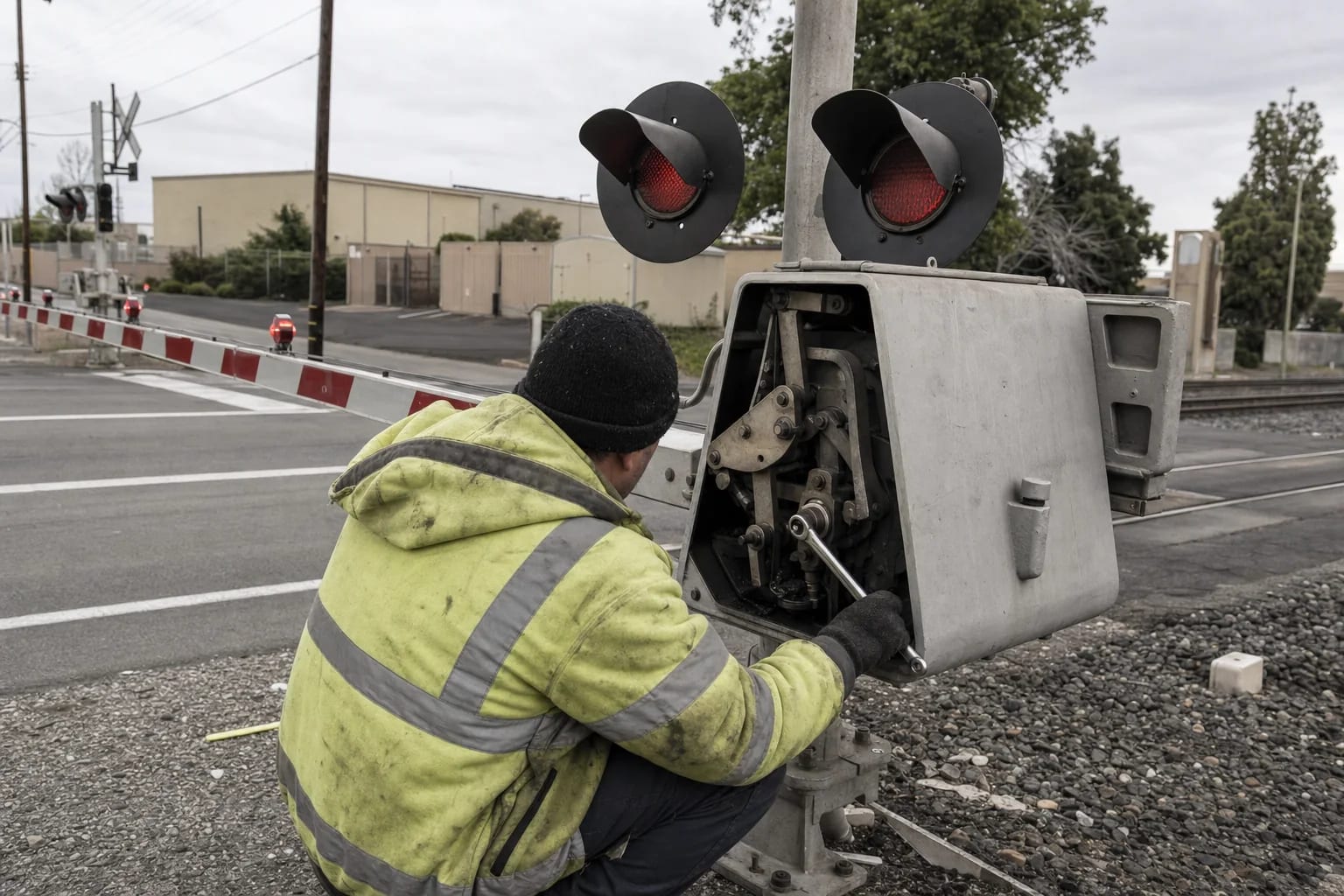
Rail signal maintainer inspects an open grade-crossing gate-drive mechanism with a torque wrench beside lowered gates and tracks
A reliable crossing file separates inventory, design, inspection, test, maintenance, failure, traffic-signal, train, and first-hand sources.

Quick answer

Start with the U.S. DOT crossing number, then preserve the FRA inventory and collision history, CPUC authorization and design records, railroad inspection, test, maintenance, trouble, and failure records, road-agency signal or camera data, train-operation records, and witness observations. Reconcile them by source and time; no single record proves how the crossing operated.

Key takeaways

  • Lock the U.S. DOT crossing number before requesting records; a street name or map pin can identify the wrong crossing, approach, or warning device.
  • Treat inventory, design, inspection, test, maintenance, trouble, failure, train, traffic-signal, camera, and witness sources as separate evidence lanes.
  • Record each clock source and time zone; a controller, locomotive, dispatch center, camera, phone, and 911 system may not share one synchronized time.
  • Preserve original and corrected versions, code definitions, configuration history, and post-event work so later changes are not mistaken for event-time conditions.
Hurt Advice Editorial Team

Prepared by

Hurt Advice Editorial Team

Editorial Research and Publishing Team

Source-checked editorial publishing

Why trust this article

Prepared by the Hurt Advice Editorial Team from current GovInfo, Federal Railroad Administration, California Public Utilities Commission, and California Legislature sources. No attorney reviewed this displayed version.

Recent update: Original publication with a crossing-identity sheet, four-custodian source map, warning-system and preemption record guide, event ledger, preservation scripts, timing workflow, evidence checklist, mistakes, and FAQs.

At a glance

What this guide helps you decide

Start with the question that brought you here, identify the records that can verify the facts, and use the related guidance only where it helps. This article addresses train accidents questions in California.

Main question

Decide how this topic may apply to your situation

Use "Railroad Crossing Signal and Inspection Records After a California Crash" to sort the facts you know, the questions still open, and whether a train accidents resource or consultation may be useful in California.

Guide map

Start with the sections most relevant to you: Who this guide is for—and what it can establish, Quick takeaways, Build a crossing-identity sheet first

Move through the article by issue, not by guesswork, so liability, medical proof, insurance pressure, deadlines, and next steps stay connected.

Records to gather

Connect these subjects to your records: California Railroad Crossing Records, Grade Crossing Warning Systems, Signal Inspection Records, Crossing Inventory

Compare the topic with records, photos, medical visits, police reports, insurer letters, and local claim details before relying on a general answer.

Trust check

Use the source trail before acting

This page includes 6 source references plus internal next-step paths so readers can verify where the guidance comes from.

Before you rely on this guide

This article is written for people dealing with injury-law questions in California. It is meant to help you understand the issue, not replace legal advice about your specific case.

What to do after this article

Start with the quick answer, skim the table of contents, and then use the links below to move into the practice area, author archive, or resource page that turns general guidance into a clearer next step for your situation.

Who this guide is for—and what it can establish

This guide is for a person organizing records after a vehicle, bicycle, pedestrian, or other injury event at a California highway-rail grade crossing. It is also useful when a crossing warning system, nearby traffic signal, queue, road work, sight line, train movement, or post-event equipment change may matter. It does not decide fault, causation, compliance, damages, admissibility, or whether a warning device malfunctioned.

The narrow reader task is source reconstruction. Identify the exact crossing; separate the public inventory, California authorization and design file, railroad warning-system file, roadway-agency file, train-operation file, and first-hand evidence; then compare events without forcing them into one story. The train-accident service page describes the broader legal lane. This article focuses only on records and provenance.

Hurt Advice is a lawyer referral and legal information service, not a law firm. This is general information, not legal, engineering, railroad-operating, traffic-signal, medical, or preservation advice. It does not promise access to any record, representation, or an outcome.

Quick takeaways

  • Lock the U.S. DOT crossing number before requesting records; a street name or map pin can identify the wrong crossing, approach, or warning device.
  • Treat inventory, design, inspection, test, maintenance, trouble, failure, train, traffic-signal, camera, and witness sources as separate evidence lanes.
  • Record each clock source and time zone; a controller, locomotive, dispatch center, camera, phone, and 911 system may not share one synchronized time.
  • Preserve original and corrected versions, code definitions, configuration history, and post-event work so later changes are not mistaken for event-time conditions.
  • Use neutral source labels such as reported, observed, configured, tested, unavailable, or disputed; do not convert one timestamp or code into a legal conclusion.

Build a crossing-identity sheet first

The Federal Railroad Administration says railroads must submit information about crossings through which they operate and makes the information available through the U.S. DOT National Highway-Rail Crossing Inventory. The inventory includes at-grade and grade-separated crossings and can be updated by railroads and states. Use it to identify the location and reported characteristics, not as proof of the exact physical condition on the crash date.

The FRA’s Rail Crossing Locator can search by U.S. DOT crossing number, address, or location and provides access to inventory records and collision-report histories. Save the result and access date. Then confirm the number against the crossing itself, an emergency notification sign, official records, or another reliable source when possible.

Your identity sheet should list the crossing number, road, nearest intersection, city or county, railroad, public or private status, at-grade or grade-separated configuration, track count, roadway lanes, each approach, gates, flashing lights, bells, passive signs, pedestrian devices, nearby traffic signal, emergency notification number, and jurisdiction. Add photos of the approaches without trespassing or standing in a hazardous area. Never rely on readable license plates or a bystander’s identity.

Map the custodians before sending requests

Railroad or signal maintainer: warning-system plans, circuit and configuration records, inspection and test results, maintenance, repairs, trouble calls, activation failures, false activations, work orders, diagnostic or event logs when maintained, communications, and post-event testing or changes.

CPUC or other regulator: crossing applications, decisions, General Order 88-B alteration authority when applicable, correspondence, plans, inspection or complaint material, and crossing-specific regulatory history. The CPUC’s rail-crossing rules page identifies General Order 75-D for at-grade warning devices, General Order 88-B for alterations, other crossing orders, Public Utilities Code sections, and the California MUTCD.

Road owner or traffic agency: roadway signal plans, preemption settings, controller or detector data when retained, cameras, traffic counts, pavement markings, signs, sight-distance or queue studies, construction or lane-closure records, complaints, maintenance, and post-event changes. The road-construction traffic-control plan guide covers temporary-work records separately.

Train, emergency, and first-hand sources: train consist and movement data, crew reports, dispatch communications, locomotive event or image records when they exist, police or collision reports, 911 and dispatch records, nearby business or vehicle video, photos, phone metadata, and witness observations. The 911 and dispatch guide explains why call, CAD, audio, and agency clocks should remain distinct.

Separate the warning-system record families

The official GovInfo text of the FRA’s grade-crossing final rule republishes 49 CFR 234.1 and describes Part 234 as prescribing minimum maintenance, inspection, and testing standards for highway-rail grade-crossing warning systems, standards for reporting failures and railroad actions when systems malfunction, and crossing-inventory requirements. Part 234 contains multiple requirements and definitions; cite the exact current section that a custodian says governs a test, record, or response instead of labeling every problem a regulatory violation.

Request the crossing-specific warning-system layout and equipment list; installation and modification dates; current and superseded configurations; periodic inspection and test records; maintenance and repair work; trouble tickets; activation-failure and false-activation reports; temporary protection or flagging records; power, battery, communication, track-circuit, gate, light, bell, predictor, and event-log records when maintained; and post-event downloads, tests, repairs, or replacements. Ask who created each record, which system clock it used, whether daylight-saving or time-zone conversion was applied, and whether entries were edited or regenerated.

A test result says what the recorded procedure tested at a stated time. A trouble ticket records a reported issue. A controller event may show an input or output state. A witness describes what that person perceived. None automatically proves the other sources wrong. Use the injury-claim proof guide to label each proposition, limitation, conflict, and missing source.

Collect traffic-signal preemption and roadway records

At a crossing near a signalized intersection, a traffic queue can extend onto the track. The CPUC explains that roadway signals are often interconnected with the train-activated warning system so vehicles can move away from the track and movements toward the track can be restricted. Its traffic-signal preemption page identifies site-specific documentation such as a timing worksheet, measurement exhibit, traffic-signal plan, phase sequence, interface wiring diagram, preemption request form, and design-vehicle turning template.

For a relevant site, request the approved and event-time signal plan; preemption sequence and programmed values; controller make, model, firmware, clock configuration, and event data when retained; detector layout; cabinet maintenance; conflict-monitor events; coordination settings; timing changes; interconnect tests; complaints; and post-event modifications. Ask the road agency and railroad separately, because each may maintain only part of the interface.

Record what was planned, approved, programmed, tested, observed, and later changed as separate fields. Do not infer that a plan was implemented exactly, that a controller log captures every field condition, or that a queued vehicle had a legal or physical opportunity to clear without reviewing the full site and event evidence. The crosswalk signal-timing guide offers a related planned-versus-observed-versus-logged method without substituting pedestrian timing rules for rail preemption.

Use a source-and-clock event ledger

A responsive field ledger works better than a wide table on a phone. Create one row for each source event:

  1. Source: railroad controller, gate mechanism, roadway controller, locomotive, dispatch, camera, 911, phone, or witness.
  2. Custodian and record: who produced it, file name, version, export method, and date obtained.
  3. Clock: displayed time, time zone, synchronization source, drift information, and any conversion.
  4. Event: train approach, warning activation, traffic-signal phase, gate movement, bell or light state, vehicle movement, impact, call, response, test, or repair.
  5. Status: planned, configured, commanded, sensed, displayed, observed, reported, corrected, unavailable, or disputed.
  6. Limits: missing interval, obstructed view, unknown code, unsynchronized clock, overwritten data, inferred location, or post-event change.

Example: “Roadway controller export, agency copy 1, local time not yet confirmed: preemption input shown 14:08:11; rail event report uses UTC and lists warning activation 21:08:07; business camera shows gate arm entering frame at displayed 14:08:15; camera drift unknown; witness recalls lights before gate movement; sources not yet normalized.” The ledger preserves the conflict without pretending one clock or perception controls.

Send focused preservation and record requests

Railroad or maintainer script: “Please preserve and identify the crossing-specific warning-system configuration, inspection, test, maintenance, repair, trouble, activation-failure, temporary-protection, event or diagnostic, communication, and post-event records maintained for U.S. DOT Crossing [number] for [focused date range]. Please preserve original and corrected versions, native files and available metadata, clock and time-zone information, code definitions, and records of post-event testing or changes. This request does not assume a malfunction.”

Road-agency or CPUC script: “Please provide the crossing authorization, alteration, warning-device, roadway-signal, preemption, timing, interface, measurement, inspection, complaint, maintenance, change, and post-event records maintained for U.S. DOT Crossing [number] and the adjacent intersection for [focused date range]. Please identify the custodian for categories your office does not maintain.”

Use the custodian’s current process. A public-records request, party discovery, subpoena, preservation notice, insurance request, and voluntary production are different tools with different scopes. Do not promise that every requested category exists or is disclosable. Preserve your outgoing request, attachments, delivery proof, response, objections, redactions, file list, and follow-up. Minimize medical, address, driver, vehicle, and bystander information.

Timing and process checkpoints

Immediately: address safety and medical needs, report emergencies through the proper channel, identify the crossing from a safe location, preserve photos and video already available, save 911 or agency reference numbers, and avoid entering railroad property. Digital video and system logs may be overwritten under ordinary schedules, but retention varies; obtain case-specific advice about preservation rather than inventing a universal deadline.

Within the first organized pass: save the FRA inventory and collision-history views, map custodians, send focused preservation requests, and record every clock source. Preserve roadway condition, debris, temporary signs, construction, vegetation, visibility, lighting, and weather sources when relevant. The road-debris evidence guide explains how to separate condition observations from maintenance and notice records.

When records arrive: keep the native production unchanged; create a working copy; list missing date ranges and attachments; ask for code definitions, configuration history, and export details; and compare inventory, design, inspection, test, failure, controller, train, camera, and witness sources. Record later repairs or upgrades without assuming they prove the earlier condition.

Before sharing: redact private identifiers from working copies, preserve originals, and get advice about protective orders, privilege, authentication, admissibility, experts, and applicable deadlines when the matter is contested.

Evidence checklist

  • U.S. DOT crossing number, road, nearest intersection, railroad, jurisdiction, track count, approaches, warning devices, nearby traffic signal, and access date.
  • FRA Crossing Inventory record, locator result, collision-history view, prior versions when available, and any identified reporting or update date.
  • CPUC application, decision, General Order 88-B authorization when applicable, warning-device plan, correspondence, complaint, inspection, and change history.
  • Railroad warning-system equipment list, configuration, inspections, tests, maintenance, repairs, trouble calls, failures, temporary protection, event data, and post-event work.
  • Roadway signal and preemption plan, timing worksheet, measurements, phase sequence, interface wiring, settings, tests, controller data, cameras, and post-event changes.
  • Train identity, consist, movement, crew or dispatch material, locomotive event or image records when maintained, and railroad incident reports.
  • Police, collision, 911, CAD, audio, responder, tow, roadway-condition, construction, weather, lighting, and nearby-camera sources.
  • Original photos, video, phone metadata, vehicle data, first-hand observations, witness contact routing, and privacy-protected working copies.
  • Source-and-clock ledger naming custodian, file, version, time zone, synchronization, event, status, limitation, conflict, and open question.
  • Requests, delivery proof, responses, objections, redactions, file manifests, code definitions, correction history, and chain-of-custody notes.

Mistakes and red flags

  • Using a road name, GPS pin, or photo alone when several crossings, approaches, gates, or railroad lines are nearby.
  • Treating the FRA inventory as proof of event-time physical condition or treating collision history as proof that a particular crash happened the same way.
  • Combining railroad-warning, roadway-signal, locomotive, camera, phone, CAD, and witness times before confirming time zone, synchronization, drift, and source.
  • Calling a gate, light, bell, controller, queue, sight-line, or train event a failure before reading the applicable codes and obtaining the underlying record.
  • Requesting only post-event tests while omitting prior inspections, configuration, trouble history, temporary protection, repair, and later changes.
  • Assuming CPUC, railroad, road owner, police, and FRA each maintain the entire crossing file or that one request reaches every custodian.
  • Editing, renaming, transcoding, or posting originals in a way that removes metadata or exposes victims, witnesses, addresses, plates, or private identifiers.
  • Trespassing, entering the track area, opening equipment, touching debris, or recreating traffic movements to collect evidence.

Why provenance matters—and careful next steps

California Evidence Code section 1271 addresses conditions for the business-record hearsay exception, including regular-course creation, timing, custodian or qualified-witness testimony, and trustworthiness. A database export, inspection sheet, controller log, work order, video, or screenshot is not automatically authenticated, complete, admissible, or conclusive merely because it looks official.

Finish the crossing-identity sheet, custodian map, preservation log, and source-and-clock ledger. Ask for the native files, code definitions, prior configuration, correction history, and post-event changes. Keep technical observations separate from medical facts and legal conclusions. If a disputed warning system, public-entity issue, railroad claim, evidence-loss concern, injury, or deadline requires individual advice, consult the appropriate qualified professional promptly.

Hurt Advice can connect people with independent California lawyers through the contact page, but it does not promise representation or an outcome. This article was prepared by the Hurt Advice Editorial Team from the official sources listed above. No attorney reviewed this displayed version. Review the site’s editorial standards for sourcing, corrections, and autonomous-article disclosure.

Frequently Asked Questions

What railroad crossing records should I preserve after a California crash?
Preserve the U.S. DOT crossing inventory and collision history, CPUC authorization and alteration records, warning-device plans, railroad inspection, test, maintenance, trouble, activation-failure and correction records, traffic-signal preemption plans and logs when applicable, train-operation records, dispatch or 911 material, photos, video, and first-hand observations. Keep original versions and identify each custodian.
How do I identify the exact railroad crossing?
Use the U.S. DOT crossing number when it can be confirmed. Also record the road name, nearest intersecting street, city or county, railroad, track count, crossing type, nearby traffic signal, direction of travel, and which gate or signal faces each approach. Do not rely only on a map pin, nickname, or street address.
Does the FRA Crossing Inventory show whether the signal worked during the crash?
No. The inventory describes crossing characteristics and equipment reported to the federal system, and the FRA locator can provide inventory and collision-history access. Those sources help identify the crossing and frame requests, but they do not by themselves prove the crossing’s exact configuration, condition, timing, or operation at the event time.
Which records can show whether crossing gates, lights, or bells were inspected or tested?
Potential sources include railroad inspection and test records, maintenance and repair work, trouble calls, activation-failure reports, event or diagnostic logs, post-event tests, and device-change histories. The applicable record depends on the equipment and custodian. Ask for definitions, time zone, clock source, original and corrected versions, and the section of 49 CFR Part 234 relied on.
What is traffic-signal preemption at a railroad crossing?
At some crossings near a signalized intersection, the roadway traffic signal is interconnected with the train-activated warning system so traffic can move away from the track and movements toward the track can be restricted. Relevant records may include the timing worksheet, measurement exhibit, signal plan, phase sequence, interface wiring, authorization, settings, tests, and change history.
Does a railroad or agency record automatically prove fault or become admissible evidence?
No. A record may establish only what its system captured or what a custodian reported. California Evidence Code section 1271 addresses conditions for the business-record hearsay exception, including regular-course creation, timing, custodian or qualified-witness testimony, and trustworthiness. Authenticity, completeness, other objections, and the legal effect remain separate questions.

Sources and references

Federal Railroad AdministrationCrossing Inventory

Official explanation of the U.S. DOT National Highway-Rail Crossing Inventory and how railroads and states update it.

Federal Railroad AdministrationRail Crossing Locator App

Official locator resource for crossing identity, inventory records, and collision-report histories.

California Public Utilities CommissionRail Crossing Rules and Regulations

Current California rail-crossing rules page linking warning-device, crossing-alteration, maintenance, Public Utilities Code, and California MUTCD authorities.

Need help after an accident?

Hurt Advice intake team can review your situation, explain your options, and help you move forward with a plan that fits your case.