
Legal ExplainerMotorcycle AccidentsChecklist / Process

Motorcycle Helmet Damage After a California Crash: What to Preserve

Helmet evidence is most useful when the object, labels, components, loose pieces, and custody history remain honest and unchanged. Photograph before handling, preserve product and purchase records, log every transfer, and let qualified professionals evaluate certification, recall status, impact, injury causation, product issues, fault, and deadlines.

Published

July 22, 2026

Updated

July 22, 2026

Reading time

10 min read

Jurisdiction

California

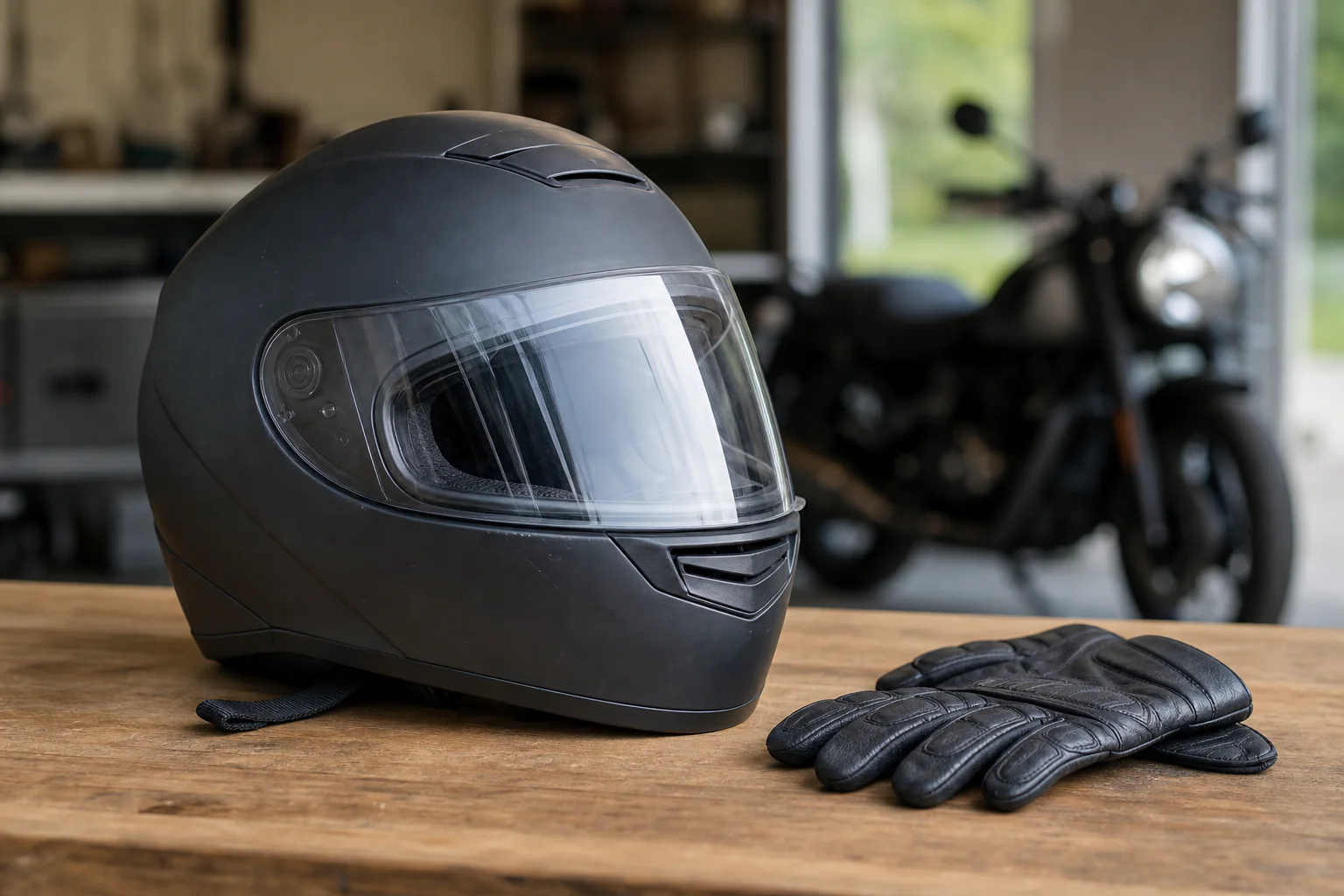
Unbranded matte motorcycle helmet and black riding gloves preserved on a clean garage workbench
A useful helmet-evidence file preserves visible condition, product identity, labels, components, and custody without cleaning, disassembly, or home testing.

Quick answer

After a California motorcycle crash, preserve the helmet exactly as received. Photograph the shell, visor, liner, straps, labels, and loose pieces; record custody and product identity; save purchase and recall records; and keep certification, impact, medical causation, fault, and damages as separate questions for qualified review.

Key takeaways

  • Preserve the helmet exactly as received: do not clean, repair, disassemble, relabel, discard, or stage new damage for photographs.
  • Photograph the shell, visor, vents, lower edge, interior padding, retention system, and every existing label before placing the helmet in clean, dry, secure storage.
  • Keep certification, fit, recall status, crash contact, medical causation, product defect, and legal responsibility as separate questions supported by separate sources.
  • A scuff, crack, missing label, or DOT mark is a fact to document; it does not by itself prove impact sequence, compliance, defect, injury, fault, or damages.
Hurt Advice Editorial Team

Prepared by

Hurt Advice Editorial Team

Editorial Research and Publishing Team

Source-checked editorial publishing

Why trust this article

Prepared by the Hurt Advice Editorial Team from current California helmet law, NHTSA helmet and recall guidance, the federal motorcycle-helmet standard, the Judicial Council’s 2026 civil instructions, and California limitations law. No attorney reviewed this displayed version.

Recent update: Original publication with a helmet component map, product-identity and recall workflow, custody log, neutral preservation request, evidence boundaries, timing cautions, and next-action checklist.

At a glance

What this guide helps you decide

Start with the question that brought you here, identify the records that can verify the facts, and use the related guidance only where it helps. This article addresses motorcycle accidents questions in California.

Main question

Decide how this topic may apply to your situation

Use "Motorcycle Helmet Damage After a California Crash: What to Preserve" to sort the facts you know, the questions still open, and whether a motorcycle accidents resource or consultation may be useful in California.

Guide map

Start with the sections most relevant to you: Quick takeaways, Who this guide is for—and the narrow task it solves, Start with California’s helmet rules—but do not overread them

Move through the article by issue, not by guesswork, so liability, medical proof, insurance pressure, deadlines, and next steps stay connected.

Records to gather

Connect these subjects to your records: Motorcycle Helmet Damage, Helmet Evidence, Helmet Preservation, Chain of Custody

Compare the topic with records, photos, medical visits, police reports, insurer letters, and local claim details before relying on a general answer.

Trust check

Use the source trail before acting

This page includes 6 source references plus internal next-step paths so readers can verify where the guidance comes from.

Before you rely on this guide

This article is written for people dealing with injury-law questions in California. It is meant to help you understand the issue, not replace legal advice about your specific case.

What to do after this article

Start with the quick answer, skim the table of contents, and then use the links below to move into the practice area, author archive, or resource page that turns general guidance into a clearer next step for your situation.

Quick takeaways

  • Preserve the helmet exactly as received: do not clean, repair, disassemble, relabel, discard, or stage new damage for photographs.
  • Photograph the shell, visor, vents, lower edge, interior padding, retention system, and every existing label before placing the helmet in clean, dry, secure storage.
  • Keep certification, fit, recall status, crash contact, medical causation, product defect, and legal responsibility as separate questions supported by separate sources.
  • A scuff, crack, missing label, or DOT mark is a fact to document; it does not by itself prove impact sequence, compliance, defect, injury, fault, or damages.

Who this guide is for—and the narrow task it solves

This guide is for a California motorcycle rider, passenger, family member, or representative who has possession of a helmet after a collision. Its task is narrower than a general crash checklist: identify the helmet, preserve its post-event condition, document each component without destructive testing, connect it to purchase and recall sources, and maintain a clear custody record.

The California motorcycle-accident service guide explains the broader claim area. The lane-splitting evidence guide addresses roadway position, surrounding traffic, video, and witnesses. This article addresses a different object and reader job: the helmet itself, its labels and retention system, its condition when recovered, who handled it, and what records can identify it.

Do not use this guide to decide that a helmet is safe to ride in, to diagnose a head injury, to recreate an impact, or to accuse a seller or manufacturer. Follow emergency and medical instructions first. Obtain qualified product, medical, and legal guidance before reuse, inspection, testing, repair, surrender, or disposal.

Start with California’s helmet rules—but do not overread them

California Vehicle Code sections 27802 and 27803 connect California helmet use to requirements that include Federal Motor Vehicle Safety Standard No. 218. Section 27803 requires a driver and passenger on covered vehicles operated on highways to wear a qualifying safety helmet. It defines wearing to include fastening the straps and a size that fits securely without excessive lateral or vertical movement.

Those provisions make fit, fastening, and the helmet’s identity important facts. They do not make a photograph of a strap or label a complete liability analysis. A DOT mark concerns manufacturer certification to a performance standard; it is not a government approval of a particular helmet and does not answer whether a specific helmet was altered, recalled, damaged, correctly worn, involved in a particular contact, or connected to an injury.

Preserve facts on both sides of any dispute: helmet position after the event, strap and fastener condition, fit history, prior drops or modifications if known, maintenance, accessories, purchase source, packaging, instructions, and conflicting accounts. Do not hide an unfavorable fact or improve the appearance before documentation.

The first safe preservation steps

Address the rider’s safety and appropriate medical evaluation before working with equipment. The medical-care resource can help organize provider and record information later; it should not delay urgent care. If emergency personnel, police, a tow operator, family member, or insurer has the helmet, record that fact rather than guessing what happened to it.

  1. Identify the event: date, local time, location, rider or passenger, motorcycle, responding agency, report number, and the person who recovered the helmet.
  2. Record receipt: when and where the current custodian received it, from whom, in what container, and whether the condition appeared changed.
  3. Make an untouched overview: photograph all sides before wiping dust, closing a visor, operating a buckle, removing padding, or arranging loose pieces.
  4. Stabilize without altering: place the helmet and any separately recovered pieces in clean, dry, secure storage where they are not compressed, exposed to chemicals, or repeatedly handled.
  5. Log every transfer: date, time, from, to, purpose, container or seal condition, and return.

If safety personnel changed or removed equipment, preserve their identity and account if available. A truthful gap is better than a reconstructed chain presented as certain.

Use a component-by-component helmet map

Work from wide views to details and keep original files unchanged. Photograph the helmet where it was found if that can be done safely and lawfully, then document it on a neutral surface. Use the same orientation sequence each time—front, right, rear, left, top, bottom, and interior opening—so later viewers can locate a mark.

  • Outer shell: shape, finish, scuffs, gouges, cracks, deformation, transferred material, stickers, mounts, vents, and any area that looks different. Describe appearance, not cause.
  • Face shield and hardware: visor position on receipt, scratches, cracks, pivots, fasteners, seals, and any loose piece. Do not cycle the visor merely to create views.
  • Lower edge and chin area: rim, chin bar, trim, abrasion, separation, and accessories.
  • Retention system: straps, stitching, anchors, buckle or rings, adjuster, keeper, cuts, stretching, contamination, and position as received. Do not conduct a pull test.
  • Interior: visible energy-absorbing liner, comfort padding, tears, compression, loose material, stains, and labels that can be seen without removing permanent parts.
  • Loose pieces: photograph in place first, then separately only if they were already detached; assign each piece an item number and container.

A component map preserves observable condition. It is not an impact reconstruction, engineering test, or medical opinion.

Build the product-identity file

The current NHTSA helmet guide explains that the DOT symbol is the manufacturer’s certification to FMVSS No. 218, not an NHTSA approval. It says the current exterior certification label for compliant helmets includes the manufacturer or brand, model designation, DOT, FMVSS No. 218, and “CERTIFIED”; older certified helmets may carry a simpler DOT mark.

Photograph every exterior and visible interior label exactly as found. Also preserve the box, manual, receipt, order confirmation, product listing, seller messages, warranty registration, replacement parts, and photographs from before the crash. Record brand, model, size, color, graphics, serial or production code if present, manufacture date if shown, seller, purchase date, and who selected the size. Do not create a missing value from memory; label it unknown.

49 C.F.R. §571.218 is the federal performance and labeling standard. Its laboratory requirements should not be imitated at home. Preserve the helmet for a qualified inspection rather than pressing the liner, cutting material, removing padding, or applying improvised loads.

Check recalls and complaints without changing the evidence

Search by the most specific product identity available, not merely by color or “DOT helmet.” The NHTSA investigations and recalls resource directs consumers to search recalls for vehicles or equipment and to use “Report a Safety Problem” for a possible equipment issue. NHTSA may request receipts or photographs; not every complainant is contacted.

  1. Save the exact search date, brand, model, size, product or serial code, manufacture information, and search result.
  2. Open any candidate recall document and compare the described population carefully. A similar brand or model name does not establish coverage.
  3. Preserve the recall notice, manufacturer communication, remedy instructions, and contact log as separate records.
  4. Before mailing, surrendering, repairing, replacing, or destroying a helmet under a remedy, obtain case-specific advice about documenting condition, notice, inspection, and custody.
  5. If a complaint is submitted, keep the exact description and attachments. State observed facts and uncertainty; do not convert a suspicion into a confirmed defect.

A recall can establish that an identified population was subject to a remedy. It does not automatically establish that this helmet is included, that the condition caused a crash or injury, or that another party is legally responsible.

Use this custody and inspection log

Create one row for every receipt, viewing, transfer, or return. A simple working tool can use these fields:

  • Item ID: helmet H-1; loose visor piece H-1A; packaging H-2.
  • Date and time: include time zone when it matters.
  • From / to: full names, roles, organizations, and contact information.
  • Purpose: storage, photography, insurer viewing, expert inspection, recall inquiry, or another accurately described reason.
  • Condition: container, seal, visible change, detached pieces, moisture, odor, or contamination noted without interpretation.
  • Actions: photographs taken, no testing, measurements made, parts moved, visor operated, padding removed, or other handling.
  • Files: photo range, video filename, receipt, shipping record, inspection protocol, and return acknowledgment.

Use signatures or contemporaneous acknowledgments when practical, but do not backdate or ask someone to certify facts they did not observe. If an earlier transfer is reconstructed from messages or shipping data, identify the source and mark the entry reconstructed.

Connect helmet evidence to the rest of the crash file

The helmet is one evidence source. Connect it to the roadway, motorcycle, clothing, cameras, reports, and medical timeline without claiming they say the same thing:

  • Scene and video: helmet position, separation from the rider, visible contacts, motorcycle movement, roadway marks, and camera limitations.
  • Witnesses and responders: who first saw, removed, recovered, bagged, transported, or returned the helmet and what each person directly perceived.
  • Motorcycle and clothing: independent condition photographs, transfers, accessories, repair records, and custody.
  • Medical sources: symptoms reported, examination, diagnoses, imaging, treatment, restrictions, and provider opinions—without asking the helmet to prove a diagnosis.
  • Loss records: receipts, property valuation, work records, and other claimed effects. The California damages-evidence guide separates categories of claimed loss.

The broader injury-claim proof guide explains source labeling across an entire file. Keep the helmet log linked to, but distinct from, the symptom journal. Equipment condition and daily symptoms answer different questions.

Keep compliance, impact, injury, and fault separate

The Judicial Council’s 2026 CACI resource center publishes California’s current official civil jury instructions, including negligence, products liability, causation, comparative fault, evidence, and damages topics. Which instructions apply depends on the claims, parties, evidence, and court rulings.

A careful file avoids four common leaps. First, a certification mark is not proof that the helmet remained unaltered or performed a certain way in this event. Second, visible damage is not a complete impact analysis; absence of dramatic damage is not proof that no harmful force occurred. Third, an injury diagnosis and causation opinion come from qualified medical analysis, not a shell photograph. Fourth, even a product noncompliance or defect issue does not alone resolve roadway negligence, comparative responsibility, causation, admissibility, or damages.

Let each source do its own work: the statute states a rule; the label identifies what it says; a photograph captures its frame; the custody log records handling; a recall defines its covered population; medical records address clinical care; and qualified experts may analyze engineering or causation. Preserve material that may support or weaken a theory.

A neutral preservation request

A narrow request can identify the property and proposed handling without asserting a conclusion:

“Please preserve the motorcycle helmet identified as [brand/model/size or item ID], together with any detached pieces, packaging, labels, photographs, receipt, order record, inspection notes, and communications. Please do not clean, repair, disassemble, test, relabel, discard, or surrender it without first providing the current custodian, storage location, proposed action, and reasonable notice. This request concerns preservation of existing condition and records; it does not state a conclusion about defect, compliance, causation, or responsibility.”

Customize the request truthfully for the actual holder—family member, tow yard, police property unit, insurer, retailer, manufacturer, or another custodian. Keep delivery proof and replies. Do not claim that a legal hold, inspection right, or duty exists merely because a message was sent. A licensed attorney can decide whether a formal notice, agreement, protective order, subpoena, or inspection protocol is available and appropriate.

Timing, process, and deadline cautions

Product pages change, camera files overwrite, vehicles are repaired, and equipment can be returned or discarded. Identify short-lived sources promptly, but do not rush into destructive testing or surrender. A sensible sequence is: stabilize and photograph; identify custody and product details; preserve related records; check recall and complaint sources; obtain medical and legal guidance; agree on any inspection protocol; and document every transfer.

California Code of Civil Procedure section 335.1 states a two-year period for an action for injury to or death of an individual caused by another’s wrongful act or neglect. That is not a universal deadline calculation. Accrual, tolling, government claims, public entities, minors, defendant identity, product theories, contracts, federal law, and other rules may change what must be done and when.

Evidence work, a recall inquiry, medical treatment, an insurance claim, or negotiation does not necessarily pause a legal clock. The California limitations guide offers general orientation; ask a licensed California attorney to calculate every deadline from the actual facts early.

Mistakes and red flags to avoid

  • Cleaning for photographs: wiping away dust, paint, fluid, hair, fibers, or transferred material may alter condition.
  • Home testing: do not press, flex, cut, drill, pull, drop, or load the helmet to see whether it “passes.”
  • Removing parts: do not take out padding, labels, mounts, visor hardware, or straps merely to expose another view.
  • Staging damage: never place pieces, buckle straps, or pose the helmet as if that were the recovered state.
  • Overreading a DOT mark: document the mark and product identity; do not call it NHTSA approval or event-specific proof.
  • Assuming recall coverage: compare model, size, production information, and defined population.
  • Mixing source roles: a helmet photograph does not diagnose injury, and a medical note does not test FMVSS performance.
  • Losing custody: obtain receipts before any insurer, seller, shipper, lab, or other person takes possession.
  • Hiding prior history: preserve known drops, modifications, age, storage, accessories, and prior use.

Be skeptical of anyone who asks you to alter, backdate, discard, secretly test, or promise a result from the helmet alone. The Hurt Advice source policy explains why source limits and precise attribution matter.

A seven-step next-action checklist

  1. Address immediate safety and medical evaluation before equipment documentation.
  2. Record event, recovery, current custodian, and every gap in the helmet’s known history.
  3. Make untouched wide-to-detail photographs of every side, component, label, loose piece, and container.
  4. Preserve the helmet, packaging, purchase records, instructions, pre-crash images, messages, and recall-search results.
  5. Create item IDs and a transfer log; require a receipt for every inspection, shipment, surrender, or return.
  6. Keep certification, recall, damage, impact, medical causation, fault, and loss questions separate.
  7. Obtain qualified product, medical, and California legal guidance before reuse, testing, repair, disposal, or a deadline expires.

Hurt Advice is a lawyer-referral and legal-information service, not a law firm. This article provides general educational information, not medical, engineering, or legal advice. No attorney reviewed this displayed version. For case-specific help, a licensed California attorney can assess preservation, parties, evidence, product issues, insurance, and deadlines. The Hurt Advice contact page is available if you want to request a referral.

Frequently Asked Questions

What should I do with a motorcycle helmet after a California crash?
Preserve it in the condition received. Photograph every side, visible component, label, loose piece, and container before cleaning or operating anything. Record who recovered it and each transfer, store it securely, and obtain qualified advice before reuse, testing, repair, surrender, or disposal.
Does a DOT label mean NHTSA approved the helmet?
No. NHTSA explains that the DOT symbol represents the manufacturer’s certification that the helmet conforms to FMVSS No. 218; NHTSA does not approve individual helmets. Preserve the exact label and product identity, and keep certification separate from recall, crash damage, causation, and fault questions.
Should I remove the helmet liner to photograph damage?
Do not disassemble the helmet merely to expose another view. Photograph the visible shell, visor, retention system, padding, liner, labels, and any pieces already detached. Removing padding or applying pressure can change condition. A qualified inspection can use an agreed protocol and document every action.
How do I check whether a motorcycle helmet was recalled?
Use the most specific brand, model, size, production or serial information available in the NHTSA recalls search and manufacturer records. Save the search terms, date, result, and full notice. Similar names do not prove coverage; compare the recall’s defined population before drawing a conclusion.
Does helmet damage prove what caused a rider’s injury?
Not by itself. A photograph preserves visible condition but does not independently establish impact sequence, force, product performance, medical diagnosis, or causation. Those questions may require scene evidence, custody history, medical records, and qualified engineering, reconstruction, or medical analysis.
What is the deadline for a California motorcycle injury claim?
Code of Civil Procedure section 335.1 states a general two-year period for injury caused by another’s wrongful act or neglect, but it is not universal. Accrual, tolling, government claims, public entities, minors, defendants, product theories, and other law can change the result, so obtain a fact-specific calculation early.

Sources and references

Need help after an accident?

Hurt Advice intake team can review your situation, explain your options, and help you move forward with a plan that fits your case.